
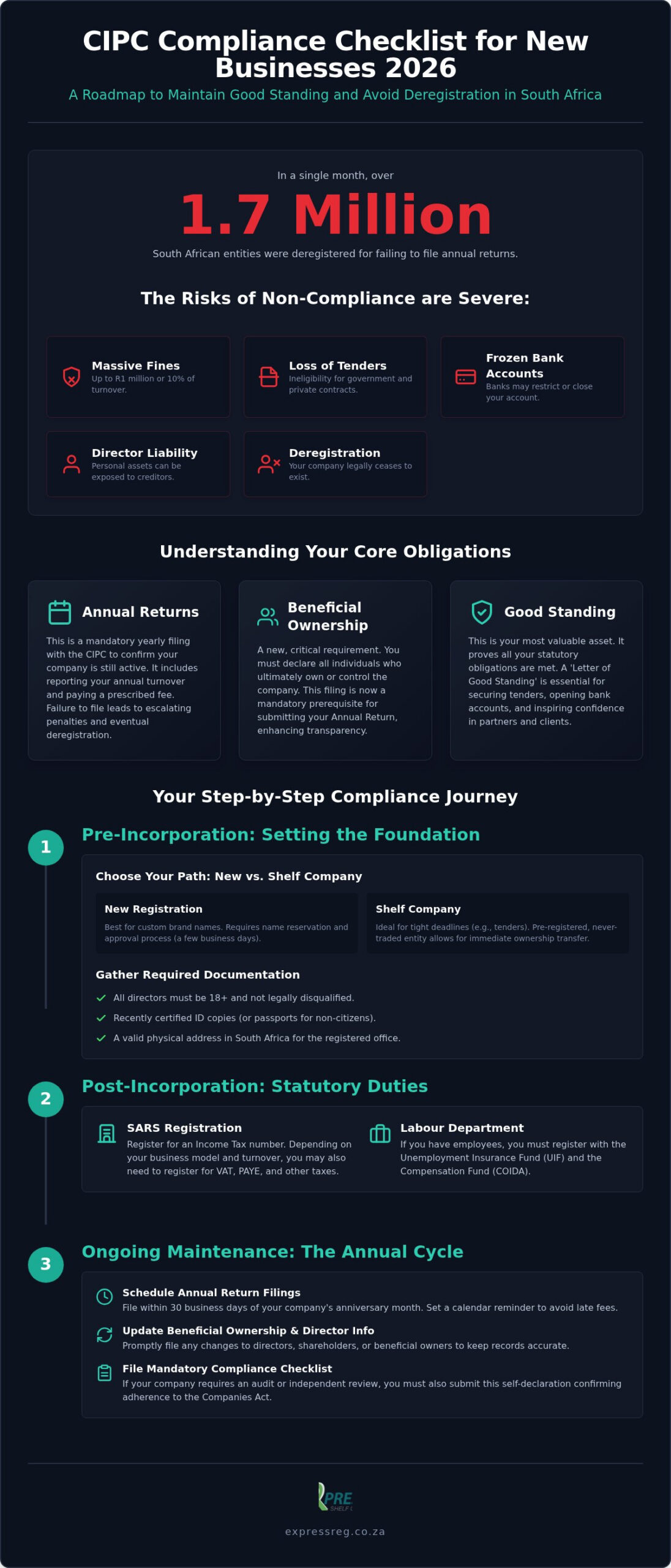
Did you know that in a single month, more than 1.7 million South African entities were deregistered simply for failing to comply with annual return requirements? It is a staggering figure that highlights how easily a legitimate business can legally cease to exist due to a simple administrative oversight. When you are focused on scaling your operations, the constant pressure of regulatory filings can feel like an unnecessary distraction from your core goals.
It’s completely understandable if you feel overwhelmed by the latest Beneficial Ownership rules or the fear of a rejected application stalling your progress. This guide provides a definitive CIPC compliance checklist for new businesses 2026, designed to help you master every statutory requirement with organised efficiency and complete peace of mind. By following this structured framework, you’ll learn how to maintain a status of Good Standing for tenders, avoid costly late filing fees, and protect your company from the risk of deregistration. We will break down the essential filings, from annual returns to director changes, into a clear roadmap for your first year and beyond.
Key Takeaways
- Master the new Beneficial Ownership requirements which are now a mandatory prerequisite for completing your annual returns.
- Follow our CIPC compliance checklist for new businesses 2026 to protect your entity from deregistration and maintain eligibility for government tenders.
- Clarify your statutory obligations regarding SARS and Labour Department registrations, including VAT and COIDA requirements.
- Establish a structured schedule for filing annual returns and the mandatory compliance checklist to avoid escalating late fees.
- Recognise when to transition from DIY administration to a professional intermediary to ensure procedural accuracy and save valuable time.
Navigating the CIPC Compliance Landscape in 2026
The Companies and Intellectual Property Commission (CIPC) serves as the primary regulator for all corporate entities in South Africa. For any entrepreneur, adhering to the CIPC compliance checklist for new businesses 2026 is not just a suggestion; it is a statutory obligation mandated by the Companies Act 71 of 2008. This year marks a significant shift in how the commission operates, with an intensified focus on transparency and the enforcement of Beneficial Ownership rules. It’s no longer enough to simply register a name and hope for the best. You must actively manage your company’s legal standing to survive an environment where over 1.7 million entities have previously faced deregistration for non-compliance.
Ignoring these requirements carries heavy risks. If your company falls out of compliance, you could face administrative fines of up to R1,000,000 or 10% of your turnover, whichever is greater. Beyond the financial impact, non-compliance leads to the loss of tender eligibility and may even result in personal liability for directors. You must distinguish between your Annual Return, which is a yearly fee and turnover report, and the Mandatory Compliance Checklist. The latter is a specific self-declaration (Section 135) required for companies that are audited or independently reviewed, ensuring they adhere to the fundamental principles of the Act.
The Role of the Companies Act 71 of 2008
Every director has a fiduciary duty to ensure that company records remain accurate and up to date. Your Memorandum of Incorporation (MoI) acts as the foundational document that governs the relationship between shareholders and directors. It’s the “rule book” for your business. Under the Act, your company is a juristic person, meaning it’s a separate legal entity from its owners. Maintaining this separation is vital. If you fail to follow the CIPC compliance checklist for new businesses 2026, you risk “piercing the corporate veil,” which could expose your personal assets to business creditors.
Why “Good Standing” is Your Most Valuable Asset
A status of Good Standing indicates that your company has met all its filing obligations with the CIPC and, where applicable, the Department of Labour. This status is often proven through a Letter of Good Standing, which is essential for securing government contracts and private sector tenders. Most South African banks will also restrict or close your business bank account if your CIPC status moves to “Deregistration Process.” Statutory Compliance is the ongoing maintenance of a company’s legal existence. It ensures that your business remains a valid, active participant in the economy, ready to seize growth opportunities as they arise.
The Pre-Incorporation Checklist: Setting the Foundation
Setting up a company requires more than just a good idea; it demands meticulous attention to administrative detail. The first decision on your CIPC compliance checklist for new businesses 2026 is determining how you want to enter the market. You can either register a brand-new entity or purchase a shelf company. Each path has distinct advantages depending on your timeline and commercial needs. Every item on the CIPC compliance checklist for new businesses 2026 serves to protect your legal standing from day one.
New Registration vs. Shelf Company
If you have a specific brand name in mind, the most common route is to register pty ltd south africa. This process involves reserving a name and waiting for CIPC approval, which typically takes a few business days. However, if you’re facing a tight deadline for a tender application, a shelf company south africa is often the superior choice. These are pre-registered entities that have never traded, allowing you to take ownership almost immediately. The transfer process involves changing the directors and shares to your name, which we can facilitate with organised efficiency to ensure you don’t miss business opportunities.
Director Requirements and Documentation
Before you begin, you must verify that all proposed directors are legally eligible. According to the guidelines on CIPC’s official website, individuals must be at least 18 years old and not disqualified by a court order or an undischarged sequestration. You’ll need to gather valid, recently certified ID copies or passport documents for every director. You also need to provide a valid South African physical address for the registered office, as this is where official legal documents will be served. A clear “main object” or business activity description is also required to categorise your company correctly within the commission’s database.
You’ll also need to decide on your financial year-end during this phase. While many South African businesses choose February to align with the tax year, you can select any month that suits your operational cycle. If you’re in a hurry, you can opt for a “number-named” company, which uses your registration number as the name, bypassing the name reservation stage entirely. If you’d prefer to focus on your business strategy while we handle the heavy lifting of paperwork, consider using an intermediary to streamline your registration and ensure procedural accuracy from the start.
Post-Incorporation: SARS, Labour, and Statutory Duties
Once your entity is registered, the next phase of the CIPC compliance checklist for new businesses 2026 involves activating your fiscal and social responsibilities. Whilst CIPC registration automatically generates a SARS Income Tax number, this is merely the start of your relationship with the revenue service. You must manually activate specific tax types and register with the Department of Labour to ensure your business is fully operational and legally protected from the outset. Handling these steps with organised efficiency prevents the administrative bottlenecks that often plague new enterprises.
Tax Compliance and VAT Registration
In 2026, the thresholds for tax compliance have been updated to reflect the current economic climate. Mandatory registration is required if your taxable supplies exceed R2.3 million in any 12-month period. However, many startups choose voluntary VAT registration south africa once they hit the R120,000 mark to claim back input VAT on business expenses. Maintaining a valid Tax Compliance Status (TCS) is critical for your business continuity, as a non-compliant PIN can block access to tenders within 24 hours of a missed return. The SARS Tax Number Registration serves as the gateway to fiscal compliance, enabling you to trade legally and demonstrate financial transparency to your partners.
Labour and COIDA Obligations
Protecting your workforce and your business from liability requires immediate registration for UIF and COIDA. Securing the requirements for letter of good standing south africa from the Compensation Fund is a non-negotiable step for any business seeking government or private sector contracts. This document proves you’re up to date with your workplace insurance assessments and that your employees are covered in the event of an on-site injury. Labour compliance is often a prerequisite for CIPC-related tender certifications, making it a cornerstone of your administrative foundation. You’ll also need to register for PAYE (Pay As You Earn) if you employ staff who earn above the tax threshold, ensuring monthly EMP201 returns are filed by the 7th of every month.
Beyond tax and labour, you must establish a statutory register to track director changes and share allocations. This internal record is a legal requirement under the Companies Act and is often the first thing requested by banks or potential investors during a due diligence process. Keeping these records accurate from day one ensures that your business remains in a state of constant readiness for growth opportunities. By ticking these items off your CIPC compliance checklist for new businesses 2026, you move from a state of administrative complexity to full legal standing with minimal stress.
Ongoing Maintenance: Annual Returns and Beneficial Ownership
Maintaining your company’s legal existence requires moving beyond the initial setup into a rhythm of continuous transparency. The CIPC compliance checklist for new businesses 2026 emphasises that statutory duties are now real-time obligations rather than annual chores. If you fail to keep these records current, you risk “Final Deregistration.” This is a state where your business effectively ceases to exist, making it impossible to trade or access frozen bank accounts. You must treat these deadlines with the same discipline as your financial reporting to ensure your business remains a going concern.
The Annual Return Filing Window
You must complete your CIPC annual returns submission within 30 business days following the anniversary of your company’s incorporation. It’s a common misconception that these filings are tax returns. They are actually fee-based statutory declarations that update the commission on your annual turnover. In 2026, the CIPC has intensified its focus on these submissions. Late filing fees increase significantly based on your turnover; for example, the fee for a company with a turnover up to R10 million rises from R450 to R600 if the deadline is missed. Missing two or more successive years triggers the deregistration process automatically.
The Beneficial Ownership (BO) Register
A critical component of the CIPC compliance checklist for new businesses 2026 is the Beneficial Ownership register. The commission now enforces a “hard stop” policy. This means you’re unable to file your annual return until your BO records are submitted and current. A beneficial owner is defined as any individual holding 5% or more interest or control in the entity. To satisfy this requirement, you must provide certified ID copies and a detailed share register that tracks the ultimate natural persons who benefit from the company. New companies must file this information within 10 business days of incorporation to remain compliant from the start.
In addition to ownership records, you must complete the Mandatory Compliance Checklist (Section 135). This is a self-declaration regarding your company’s adherence to the Companies Act, specifically focusing on solvency and liquidity. Any director change CIPC must also be notified within a strict 10-day window using Form CoR39. Keeping these administrative details accurate ensures your business remains in Good Standing for future tenders and funding. If you’d prefer to focus on growth whilst we handle the paperwork, you can appoint us to manage your statutory filings with organised efficiency.
Professional Compliance Management vs. DIY Filing
Whilst the CIPC self-service portal appears straightforward, it often masks the procedural complexity that leads to high rejection rates for new applicants. Attempting to manage the CIPC compliance checklist for new businesses 2026 independently can quickly become a significant time-cost for entrepreneurs. You might spend hours navigating government portals only to have a filing rejected due to a minor clerical error. This administrative friction distracts you from your primary goal of scaling your business and generating revenue. By using a professional intermediary, you trade a small, fixed fee for the certainty that your statutory standing is handled with organised efficiency.
Professional compliance management ensures that every filing, from your initial Pty Ltd registration to your annual returns, is processed without delay. At Express Shelf Company, we specialise in navigating the complex machinery of government administration so you don’t have to. Our fixed-fee structure provides budget certainty for new startups, removing the stress of hidden costs or escalating hourly rates. We act as a knowledgeable guide, standing between your business and the bureaucratic hurdles of CIPC and SARS.
Common DIY Pitfalls to Avoid
One of the most frequent errors in DIY filings is the incorrect selection of a Memorandum of Incorporation (MoI). Choosing a standard MoI when your shareholders require custom protections can lead to legal complications later. Mismatched director data, such as addresses that don’t align with SARS records, is another common cause for application rejections. Furthermore, the “Solvency and Liquidity” questions within the Mandatory Compliance Checklist require a precise understanding of Section 4 of the Companies Act. Providing incorrect answers here isn’t just a clerical mistake; it’s a criminal offence that can lead to personal liability for directors. Professional agents mitigate these risks by verifying your data before submission.
Streamlining Your 2026 Compliance Strategy
Adopting a “set and forget” approach to your statutory duties allows you to focus entirely on growth. When you outsource your CIPC compliance checklist for new businesses 2026, you ensure that deadlines for Beneficial Ownership filings and annual returns are met automatically. This proactive management prevents the risk of your entity falling into the “Deregistration Process,” which we’ve seen affect more than 1.7 million companies in a single month. You’re invited to explore our modular compliance solutions, which are tailored to the specific size and needs of your business. Whether you require a simple director change or a comprehensive COIDA registration, we handle the heavy lifting of paperwork to protect your peace of mind and your status of Good Standing.
Securing Your Company’s Statutory Future
Statutory compliance in 2026 requires a proactive approach to transparency, specifically regarding the new Beneficial Ownership mandates and mandatory solvency declarations. By following this CIPC compliance checklist for new businesses 2026, you protect your entity from the risk of sudden deregistration and ensure your business remains eligible for lucrative government tenders. Your status of Good Standing is a dynamic asset that requires consistent maintenance rather than once-a-year attention.
Navigating the administrative complexities of CIPC and SARS doesn’t have to be a source of stress for your leadership team. As a reliable intermediary, we provide fixed-fee statutory filing and expert Beneficial Ownership management to ensure your records are always accurate and up to date. You can secure your business compliance with our expert CIPC filing services and redirect your energy toward sustainable growth. We are here to handle the heavy lifting of paperwork so you can build your business with confidence.
Frequently Asked Questions
What is the CIPC mandatory compliance checklist?
The CIPC mandatory compliance checklist is a self-declaration required for companies whose annual financial statements are audited or independently reviewed. This questionnaire ensures that your entity adheres to the fundamental principles of the Companies Act 71 of 2008. It focuses specifically on solvency and liquidity requirements mentioned in Section 4. Knowingly providing false information on this checklist is a criminal offence; you must ensure your internal records are accurate before submission.
How often must a new business file annual returns with the CIPC?
You must file annual returns once every year within 30 business days following the anniversary of your company’s incorporation date. This is a fee-based statutory filing that confirms your entity is still trading. It’s separate from your SARS tax returns and is a vital part of the CIPC compliance checklist for new businesses 2026. Failing to file for two or more successive years will trigger the automatic deregistration of your company.
Can a company be deregistered for missing a Beneficial Ownership filing?
Yes, a company can face deregistration if it fails to submit Beneficial Ownership (BO) information. The CIPC has implemented a “hard stop” policy; you cannot complete your annual return until your BO records are current. Since missing annual returns leads to deregistration, the BO filing is now a critical prerequisite for maintaining your legal status. New companies must submit this data within 10 business days of incorporation to remain compliant from the start.
What is the difference between CIPC compliance and SARS tax compliance?
CIPC compliance focuses on your company’s legal existence and statutory duties under the Companies Act, such as filing annual returns and maintaining director records. SARS tax compliance relates to your fiscal obligations, including VAT, PAYE, and Income Tax submissions. Whilst CIPC registration automatically generates a tax number, you must manually activate specific tax types on SARS eFiling. Both are required to maintain a status of Good Standing for tenders and bank accounts.
How long does it take to register a new Pty Ltd company in 2026?
Registering a new Pty Ltd company typically takes a few business days, provided your name reservation is approved without queries. If you require an immediate legal entity for an urgent tender, purchasing a shelf company is a faster alternative as the registration number already exists. Once you have your registration, you must complete the remaining items on the CIPC compliance checklist for new businesses 2026, including SARS activation and Beneficial Ownership filing.
Is a shelf company already compliant when I buy it?
A shelf company is usually in a state of Good Standing at the point of purchase, meaning its annual returns are up to date. However, it only remains compliant if you immediately update the CIPC records with your new director details and Beneficial Ownership information. You’ll also need to activate the company for specific tax types with SARS. We facilitate these transfers with organised efficiency to ensure your new acquisition meets all statutory requirements.
Do I need a professional agent to file my CIPC documents?
You aren’t legally required to use a professional agent, but it’s highly recommended to avoid common clerical errors. The CIPC portals can be complex; minor mistakes in director data or Memorandum of Incorporation (MoI) selections often lead to rejected applications. Using an expert intermediary ensures procedural accuracy and saves you valuable time. This allows you to focus on growing your business whilst we handle the heavy lifting of statutory paperwork and filings.
What happens if my company status changes to “Deregistration Process”?
If your status moves to “Deregistration Process,” your company is at risk of legally ceasing to exist. Banks will typically freeze your business accounts within 24 hours of a status change, and you’ll be disqualified from participating in tenders. You must act quickly to file any outstanding annual returns and Beneficial Ownership records to restore your status to “In Business.” Ignoring this notice eventually leads to “Final Deregistration,” which is far more complex to reverse.