For the first time in over fifteen years, the rules for VAT registration in South Africa have undergone a massive shift, moving the goalposts for every entrepreneur in the country. You probably feel the pressure of these new regulations, especially since the compulsory threshold jumped from R1 million to R2.3 million in April 2026. It’s common to feel overwhelmed by the documentation required for eFiling or to worry about the strict 21-day deadline for registration once you hit that limit. We understand that tax compliance can feel like a barrier to growth when it should be a foundation for your success.
This comprehensive guide from Express Shelf Company ensures you master the complexities of VAT registration South Africa by providing a clear, action-oriented roadmap for the current tax year. We’ll break down the difference between the new R120,000 voluntary limit and the R2.3 million mandatory requirement, whilst providing a complete checklist of documents to prevent SARS rejections. You’ll gain the clarity needed to use your tax status as a competitive edge in the corporate market and secure your business’s financial standing with confidence. By following this methodical approach, you can transition from administrative confusion to full regulatory standing without the typical stress of handled paperwork.
Key Takeaways
- Identify the updated 2026 thresholds, including the R2.3 million compulsory limit and the R120,000 voluntary entry point, to ensure your business remains compliant.
- Collate essential CIPC records and original stamped bank statements to prevent administrative delays or common SARS documentation rejections.
- Navigate the methodical eFiling process to secure your VAT registration south africa and improve your standing for corporate tenders and contracts.
- Evaluate the strategic benefits of becoming a VAT vendor, such as the ability to claim input tax on significant capital expenditures and business expenses.
- Maintain strict adherence to the 21-day registration deadline once your taxable supplies exceed the mandatory threshold to avoid unnecessary SARS penalties.
What is VAT Registration in South Africa?
Value-Added Tax (VAT) is an indirect tax on the consumption of goods and services within the South African economy. Managed by the South African Revenue Service (SARS), it serves as a primary revenue stream for the government, funding essential public infrastructure and social services. Unlike direct taxes like corporate income tax, VAT is collected at each stage of the production and distribution chain, ultimately paid by the final consumer. For a business, the process of VAT registration South Africa transforms your company from a simple commercial entity into an authorised agent of the state.
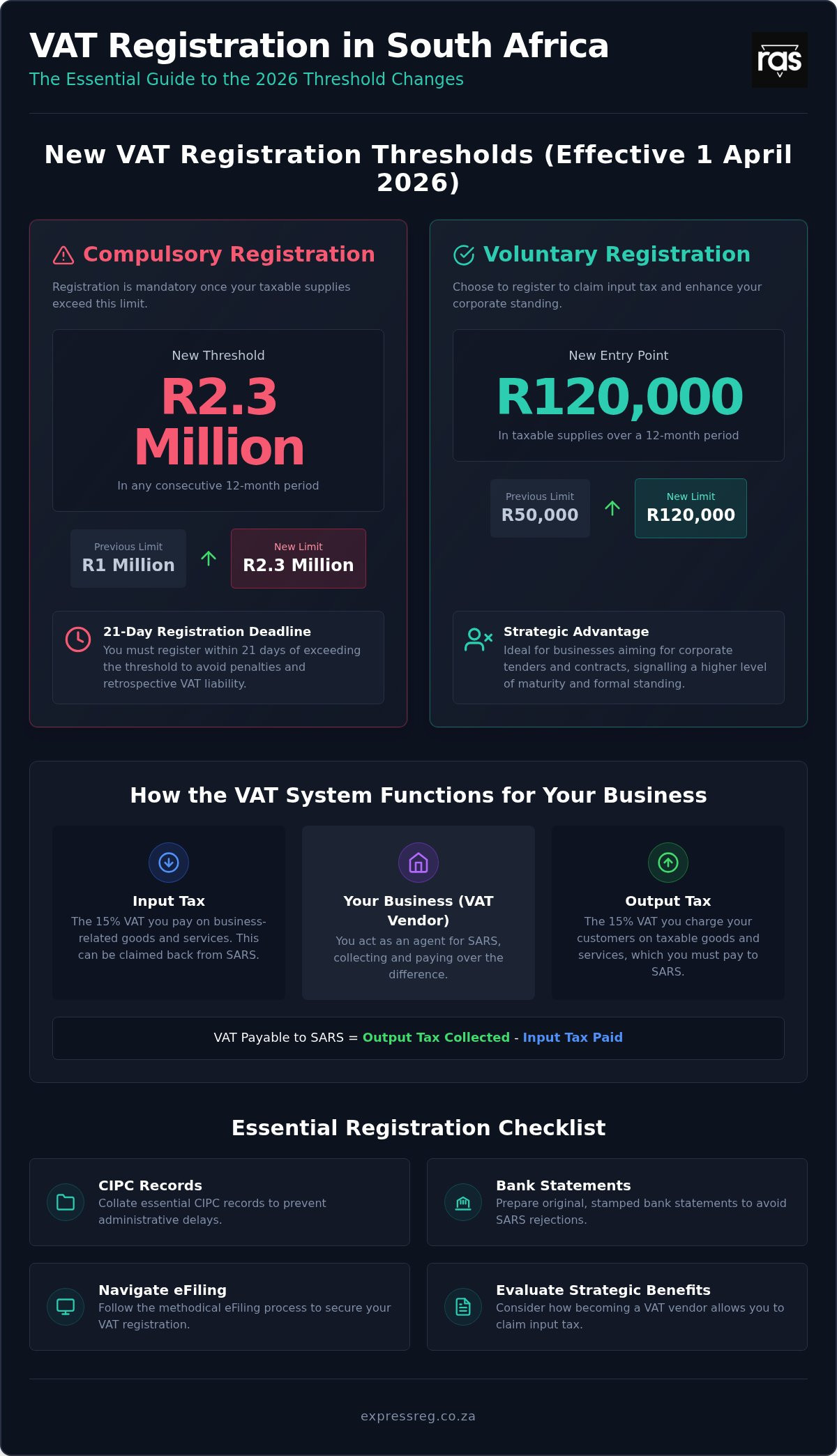
The VAT Act defines an “enterprise” as any activity carried on continuously or regularly by any person in the Republic, or partly in the Republic, where goods or services are supplied for a consideration. This broad definition ensures that almost every regular commercial activity falls under the tax net. Once you register, you must distinguish between output tax and input tax. Output tax is the 15% you charge your customers on taxable supplies. Input tax is the VAT you pay to your own suppliers. Your primary obligation is to pay SARS the difference between the output tax you’ve collected and the input tax you’ve paid on business-related expenses.
How the VAT System Functions for Businesses
Registered vendors collect VAT on behalf of SARS, acting as a bridge between the consumer and the revenue service. This requires strict adherence to tax invoice requirements. Every invoice you issue must clearly state your VAT number, the standard 15% rate, and the total amount due. Whilst most supplies are taxed at the standard rate, some are zero-rated, such as basic foodstuffs or exported goods. Correctly categorising these supplies is vital to ensure your returns are accurate and to avoid the risk of SARS audits or rejections.
The Role of the VAT Vendor
Completing your VAT registration South Africa means accepting the responsibilities of a VAT vendor. You’re effectively an agent for the South African Revenue Service, tasked with the administrative burden of calculating and paying over tax at regular intervals. These intervals, known as tax periods, are typically categorised as Category A (odd-numbered months) or Category B (even-numbered months). Maintain disciplined record-keeping to ensure you meet these deadlines. This organised approach reduces the stress of statutory filings and positions your business as a transparent, compliant partner in the corporate landscape.
Compulsory vs Voluntary VAT Registration: Thresholds for 2026
The 2026 National Budget introduced significant updates to the VAT registration south africa framework to provide relief for smaller enterprises. As of April 1, 2026, the compulsory registration threshold has increased to R2.3 million in taxable supplies over any consecutive twelve-month period. This is a substantial jump from the previous R1 million limit, designed to reduce the administrative load on growing businesses. Conversely, the entry point for voluntary registration has also shifted. You can now choose to enter the VAT system once your turnover exceeds R120,000, up from the old R50,000 mark.
Deciding when to register requires a balance between administrative capacity and growth goals. If your clients are primarily individuals who cannot claim VAT back, staying unregistered as long as possible keeps your prices 15% lower than registered competitors. However, if you’re positioning yourself for tender readiness or dealing with corporate clients, the R120,000 voluntary window is your best point of entry. It signals that your business has reached a level of maturity and formal standing that large organisations expect from their service providers.
When Compulsory Registration is Non-Negotiable
You must register for VAT if your total value of taxable supplies has exceeded R2.3 million in the preceding 12 months, or if you expect it to exceed this amount in the next 30 days due to a written contractual obligation. Once you cross this line, the law requires you to apply for the SARS VAT registration process within 21 days. Failure to meet this deadline triggers immediate penalties and potential interest charges. SARS can hold your firm retrospectively liable for the VAT you should’ve collected from the date you were legally required to register. This means you might have to pay 15% of your past turnover out of your own pocket if you didn’t charge it to your clients at the time.
The Strategic Case for Voluntary Registration
Whilst staying below the R2.3 million mark avoids some paperwork, registering voluntarily at the R120,000 level offers distinct commercial advantages. Many corporate clients and government entities prefer dealing with VAT-registered vendors because it allows them to claim back the input tax on your invoices. Having a VAT number adds an immediate layer of credibility, signalling that your business is a formal, established entity. It’s often the final hurdle for tender readiness. Additionally, voluntary registration is highly beneficial if you’ve incurred heavy startup costs on equipment or stock. You can claim back the 15% VAT paid on these purchases, which significantly improves your initial cash flow. If you want to skip the paperwork stress and focus on scaling your operations, securing your registration early is a powerful growth tactic.
Essential Requirements and Documentation for SARS
Successful VAT registration south africa depends on the precision of your documentation. SARS maintains strict standards to prevent fraudulent applications, meaning any minor error in your paperwork can lead to an immediate rejection. You must ensure that every document is current, legible, and correctly formatted before uploading them to the eFiling system. This methodical preparation is the best way to skip the paperwork stress and move your business toward full legal standing without unnecessary delays.
- CIPC Records: Provide your latest Notice of Incorporation (COR14.3) to prove the company is legally registered and active.
- Identity Documents: Include certified copies of ID for all directors and the appointed Public Officer.
- Banking Proof: SARS requires an original bank statement, not older than three months, which must bear the bank’s official stamp.
- Proof of Address: Submit a utility bill or lease agreement that confirms the physical location of the business enterprise.
Proving Your Business is Trading
Since the history of VAT in South Africa began in 1991, the requirements for proving commercial activity have become increasingly rigorous. For voluntary applicants, you must provide “Proof of Enterprise” to show you’re actively trading. Valid proof includes signed contracts for services, purchase orders from established clients, or a series of issued tax invoices that demonstrate you’ve met the R120,000 threshold. SARS won’t accept simple quotes or estimates as proof of trade. You must demonstrate a committed commercial relationship or actual turnover to satisfy the requirements and secure your status as a vendor.
The Public Officer and SARS eFiling Setup
Every registered company must appoint a Public Officer to act as the primary contact for all tax communications. Before you begin the VAT application, ensure this individual is correctly registered on your SARS eFiling profile. Mismatched data between your CIPC records and your eFiling account is a common cause for rejection. Verify that your registered business address matches across all platforms. A prerequisite for this entire process is completing your SARS tax number registration correctly, as mismatched data between your Income Tax number and your VAT application is one of the most frequent causes of delays. SARS often conducts site visits for new vendors, so having a fixed, verifiable physical address is non-negotiable. Don’t risk a rejection by submitting outdated or inconsistent information during this critical phase of your business growth. It is equally important to ensure your company’s leadership records are current, as any discrepancy in director details can trigger further scrutiny; understanding the director change CIPC process ensures your statutory records accurately reflect your board before you submit your VAT application.
The Benefits and Challenges of Being a VAT Vendor
Transitioning to a VAT-registered entity changes how you view every transaction. Whilst it introduces new administrative duties, VAT registration south africa offers a clear competitive advantage when dealing with larger corporations. Most corporate entities prefer vendors who can provide valid tax invoices, as this allows them to reclaim the 15% VAT on their own returns. If you remain unregistered, you effectively become 15% more expensive to these clients compared to a registered competitor who offers the same base price.
You must also consider the impact on your pricing strategy and profit margins. Once registered, you’re required to add 15% to your sales price. If your market is price-sensitive, you may need to absorb some of this cost to remain competitive, which directly affects your bottom line. Balancing this against the benefits of claiming back tax on your business inputs is a critical strategic decision for any growing enterprise.
Input Tax: Turning Expenses into Savings
Claimable expenses like rent for your business premises, office equipment, and fuel for commercial delivery vehicles all carry VAT that you can now claim back. This mechanism effectively reduces your operational costs by 15% on all taxable inputs. It’s a powerful tool for improving cash flow, especially during phases of heavy capital expenditure or when purchasing stock in bulk.
The Tax Invoice rule remains absolute in 2026. You cannot claim any input tax without a valid tax invoice that meets all SARS requirements, including your company’s VAT number and the correct 15% calculation. Missing or incorrect invoices are the most common reason for denied claims during a SARS review.
For businesses dealing in pre-owned inventory, the rules for claiming VAT on second-hand goods provide a unique advantage. You can often claim “notional” input tax on goods purchased from non-vendors, provided you maintain a full record of the transaction, including the seller’s details and proof of payment. This ensures you aren’t double-taxed on items that have already entered the economy.
Managing the Compliance Burden
The primary challenge for new vendors is the administrative cost of filing returns every two months. You must maintain meticulous records of every cent spent and earned to ensure your filings are accurate. SARS frequently conducts audits on VAT vendors, specifically targeting high input tax claims or unusual refund requests. Being prepared with organised digital records is the only way to navigate these checks without stress.
To stay compliant and avoid penalties, ensure your digital filing system is updated weekly rather than waiting for the end of the tax period. Many entrepreneurs find that the time spent on these filings detracts from their core business growth. You can apply for VAT registration through an expert facilitator to ensure your initial setup is correct and your first few filings are handled with professional accuracy.
How to Register for VAT: The 2026 Process
The path to a successful VAT registration south africa follows a strict sequence of administrative milestones. Before you interact with SARS, your company must be fully active on the CIPC database with an assigned Income Tax number. Collate all verified documents into high-resolution digital formats, as blurred scans are a primary reason for automated rejections. Once your files are ready, submit the application through the RAV01 form on the SARS eFiling platform. If you prefer to avoid the technical hurdles of the online portal, a registered tax practitioner can handle the submission on your behalf.
Following your submission, SARS may request a verification interview or a physical site visit to your business premises. This is a standard procedure in 2026 to confirm the legitimacy of your enterprise. Ensure your Public Officer is available and that your physical address matches your utility bills exactly. Once SARS is satisfied with the verification, you’ll receive a VAT201 notice of registration. This document contains your unique 10-digit VAT number and confirms your first filing category, marking your official transition into a registered vendor. As your business grows and you take on staff, you’ll also need to consider PAYE registration services South Africa to ensure your employer obligations are met within the mandatory 21-day SARS window.
Integrating VAT with Your Company Setup
Maintaining your corporate standing is a prerequisite for tax compliance. Registering a Pty Ltd is the foundational step that generates the tax number required for your VAT application. If you need to hit the ground running, the advantage of using a Shelf Company is that it provides an immediate platform for VAT entry, often saving weeks in the startup phase. Remember that your tax status is tied to your corporate health. Submitting your CIPC Annual Returns on time is vital to keep your company active. If the CIPC deregisters your entity for non-compliance, SARS will likely suspend your VAT number, halting your ability to claim input tax or issue valid invoices. Businesses that participate in government tenders should also be aware that meeting the requirements for letter of good standing South Africa is equally critical, as an expired COIDA certificate can disqualify an otherwise compliant bid.
Working with an Administrative Partner
Navigating government portals can be frustrating and time-consuming for busy entrepreneurs. Using a fixed-fee service for your application ensures that experts review your documentation before it reaches SARS, significantly reducing the risk of a “Suspended” status. Professional facilitators understand the current 2026 requirements and can guide you through the site visit process with ease. You can get your VAT registration started today to skip the paperwork stress and focus on securing your next big contract.
Securing Your Status as a VAT Vendor
Completing your VAT registration south africa is a transformative milestone that signals your readiness for corporate expansion and large-scale tenders. By mastering the new 2026 thresholds and organising your CIPC documentation with precision, you protect your business from retrospective liabilities whilst unlocking significant cash flow benefits through input tax claims. Compliance isn’t just a legal requirement; it’s a strategic asset that builds trust with large suppliers and government bodies alike.
Managing the intricate details of SARS eFiling and statutory documentation doesn’t have to be a source of stress for your team. Our specialists provide national South African coverage and expertise in CIPC and SARS administrative filings to ensure your application is handled correctly the first time. Secure your SARS VAT registration with our expert administrative support through our fixed-fee compliance services. Take this final step toward full regulatory standing and watch your enterprise grow with confidence.
Frequently Asked Questions
Is VAT registration compulsory for small businesses in South Africa?
Registration is mandatory only if your taxable supplies exceed R2.3 million over any consecutive 12-month period. You must apply for VAT registration south africa within 21 days of reaching this limit. Smaller businesses below this threshold remain exempt unless they choose to register voluntarily once they cross the R120,000 mark. Failing to register when required leads to retrospective tax liabilities and interest charges from SARS.
How long does it take to get a VAT number from SARS in 2026?
Most applications are processed within 5 to 15 working days if your documentation is perfect. However, if SARS selects your business for a verification interview or a physical site visit, the timeline can extend to 21 working days or more. Providing original stamped bank statements and clear CIPC records during the initial submission is the best way to prevent administrative delays in the current system.
Can I register for VAT if my turnover is less than R50,000?
No, you cannot register if your turnover is below the new 2026 voluntary threshold of R120,000. SARS increased this limit from the previous R50,000 to reduce the administrative burden on micro-enterprises. You must demonstrate that your business has already exceeded R120,000 in sales or has written contractual obligations that will soon push your turnover past this specific entry point to qualify for a voluntary application.
What happens if I charge VAT but I am not registered with SARS?
Charging VAT without being a registered vendor is a serious criminal offence under the VAT Act. You’re effectively collecting state revenue without authorisation, which leads to severe penalties, interest, and potential prosecution. If you’ve accidentally charged tax before your VAT registration south africa was finalised, you must notify SARS immediately and seek professional advice to rectify the error and pay over the funds to the revenue service.
Do I need a separate bank account for my VAT-registered company?
Yes, you must have a dedicated business bank account opened in the registered name of your company. SARS won’t process a VAT application if you provide personal banking details or an account belonging to a different entity. Your bank statement must be an original document, not older than three months, and it must bear an official bank stamp to verify the account’s legitimacy and ownership.
What is the current VAT rate in South Africa for 2026?
The standard VAT rate remains at 15% for the 2026 tax year. This rate applies to most goods and services consumed in South Africa, excluding zero-rated items like basic foodstuffs or exempt services like residential rent. The 2026 National Budget confirmed this rate would stay stable to support economic growth whilst ensuring the government maintains its primary revenue stream from consumption tax across the country.
Can I backdate my VAT registration to claim previous expenses?
You generally cannot backdate a registration to claim historical operating expenses. Input tax claims usually begin from the effective date of registration stated on your VAT201 notice. Whilst you might be able to claim tax on certain capital assets or stock held on the day of registration, you’ll need precise records and original tax invoices to satisfy a SARS auditor during a subsequent review or audit.
How do I check if a company’s VAT number is valid?
You can verify a vendor’s status by using the VAT Vendor Search tool available on the SARS eFiling website. Simply enter the company’s 10-digit VAT number to confirm it’s active and belongs to the correct entity. Performing this check before paying a new supplier protects your business from fraud and ensures you’re legally entitled to claim back the input tax on the invoices they issue to you. Before conducting this search, confirm that your own SARS tax number registration is fully up to date so that your business appears correctly in the system for clients verifying your details.