
The lowest-cost way to register a company isn’t automatically the easiest. If you’re weighing DIY company registration vs using an agent in South Africa, the real choice is how much time and administration you’re prepared to manage yourself. A DIY filing can suit a founder who’s comfortable following CIPC’s process, while agent assistance can help organise the paperwork and related filings.
It’s reasonable to want to keep costs down and avoid errors that could lead to corrections or extra follow-up. But an agent’s fee is only one part of the comparison. Your available time, confidence with forms and need for administrative support matter too.
This article compares the two approaches, including the steps involved, who handles each responsibility and what support an agent can provide. It also covers post-registration tasks such as beneficial ownership filing, annual returns and relevant tax registrations. Use the comparison to choose the route that fits your business, then keep track of the work that remains after registration.
Key Takeaways
- Compare DIY company registration vs using an agent by looking beyond fees. Consider your time, confidence with forms and need for administrative support.
- Decide which registration tasks you can manage yourself and where help organising paperwork and follow-up would be useful.
- Check that company, director and ownership information is accurate. Administrative assistance cannot guarantee an authority’s decision.
- Plan for post-registration responsibilities as well as the initial filing, including relevant tax and compliance tasks.
- Choose an approach that suits your available time and comfort with follow-up, then identify any registration or administrative support you need.
DIY company registration vs using an agent: what are you comparing?
The choice is about who manages the administrative work, not who makes the important decisions about the company. With DIY company registration, the founder prepares and submits the relevant information to the Companies and Intellectual Property Commission (CIPC), then manages any follow-up. With agent-assisted registration, a paid service helps prepare and handle registration documentation using details and instructions supplied by the founder.
In short, DIY exchanges service fees for the founder’s time and attention. An agent can organise the filing work, but the founder still needs to provide accurate information and make decisions about the company. Using an agent does not remove the director’s responsibility for the information submitted.
What does DIY registration involve in South Africa?
For a DIY application, the founder works directly with the relevant CIPC process, prepares the company and director information, and submits it through the available channel. The Companies and Intellectual Property Commission (CIPC) is the South African body responsible for company registration. The founder must keep information accurate, follow the process requirements and respond if further action is needed.
This approach can work well if you’re comfortable handling forms and tracking follow-up. It also means checking that names, details and supporting information are consistent before submission. For a step-by-step explanation, use a dedicated Pty Ltd registration guide rather than treating this comparison as a registration walkthrough.
What does a company registration agent do?
An agent provides administrative support, such as preparing registration paperwork, organising details supplied by the founder and handling relevant filing tasks. The founder remains responsible for company decisions and for providing complete, accurate information. This is filing assistance, not legal representation or independent auditing.
Express Shelf Company assists with new Pty Ltd registrations and related CIPC documentation. Its services also include initial tax registration and administrative filings such as annual returns, director changes and beneficial ownership disclosures. The purpose is to organise the paperwork, not to promise that an authority will approve an application or decide it within a particular timeframe.
Before choosing, separate tasks that require your judgement from tasks that require careful administration. You decide what company details to provide; the person managing the filing must enter and submit those details correctly. An agent can help keep the paperwork moving, but you’ll still need to review the information and respond to requests for clarification or additional details.
- DIY: You manage preparation, submission and follow-up directly, and control each step.
- Agent-assisted: You supply the information and make the decisions, while an agent assists with registration documentation and filing administration.
The best fit depends on your experience with forms and your capacity to stay on top of the process. If you have time and feel confident managing administrative details, DIY may suit you. If you’d rather delegate paperwork while remaining involved in decisions, agent assistance offers a practical middle ground.
DIY or agent-assisted registration: compare the real workload and trade-offs
The practical difference is how much administration you want to manage yourself. DIY may avoid an agent’s professional fee, but it still takes time to prepare information, complete forms and track follow-up. With an agent, you pay for administrative support while retaining control of the company decisions and information you provide.
Use this comparison to assess the workload, not just the submission method. The South African Government’s guide to company registration provides official context for the process. Your own effort will also depend on how familiar you are with forms and how promptly you can respond to requests.
| Consideration | DIY registration | Agent-assisted registration |
|---|---|---|
| Founder time | You set aside time to prepare, submit and monitor the application. | You supply information and decisions, while the agent assists with administrative preparation and filing. |
| Process control | You manage the steps directly and decide when to prepare and submit information. | You remain responsible for your decisions, but delegate some filing administration. |
| Administrative support | You organise records, check entries and handle follow-up yourself. | You receive help organising registration documents, which can reduce avoidable omissions. |
| Fees | You avoid an agent’s professional fee, but applicable CIPC charges may still apply. | You pay an agent’s professional fee as well as any applicable CIPC charges. These are separate costs. |
The workload varies from one founder to another. Someone familiar with online forms and comfortable tracking correspondence may manage a DIY application with little outside help. A first-time founder balancing customer work, finances and other setup tasks may spend more time gathering details and checking what needs attention. The right option depends on your capacity, not simply the filing method.
When can DIY registration be a sensible choice?
DIY can suit you if you’re confident preparing company information, keeping records organised and following up on administrative requests. Handling the process directly gives you control over how information is prepared and submitted. Set aside focused time to review each entry rather than rushing through it. Saving an agent fee still means investing your own attention, and an omission may require further checking or action.
When can using an agent make the process easier?
Agent assistance may suit you if you have limited time, feel unsure about managing forms, or would rather have help organising documents. Express Shelf Company provides fixed-fee administrative services for new Pty Ltd registrations and related filings, without taking over your company decisions. You can review Express Shelf Company’s registration assistance as part of your comparison.
What registration mistakes and follow-up tasks should you plan for?
An agent can help organise documents and handle filing administration, but cannot guarantee an authority’s decision. The same applies to a DIY application: careful preparation can help avoid preventable errors, but it does not control how an application is assessed. Treat support as help with the process, not a promise of approval.
When comparing DIY company registration vs using an agent, plan for both the initial submission and the work that follows. Incorporation establishes the entity, but it does not automatically take care of every tax registration or later CIPC filing your business may need. Check current CIPC and SARS guidance, as requirements and processes can change.
Which filing details need careful attention?
Review company, director and ownership information before submission. Names, contact details and other particulars should be consistent across the information you provide. A typo or mismatch between records can prompt questions, corrections or further follow-up, adding administration whether you file directly or use an agent.
Before submitting, compare the information entered with your source records, confirm that each relevant person’s details are current and keep a copy of what you submitted. Do not rely on a saved form or old company record without checking it first. Follow the current CIPC instructions for the application rather than assuming the same supporting information applies in every case.
What may need attention after incorporation?
Once the company is incorporated, identify the next administrative tasks instead of assuming registration covers them all. Depending on your business and current requirements, these may include tax matters with SARS, such as VAT registration where applicable, and ongoing CIPC compliance filings. The relevant tasks depend on your circumstances, so check the authority guidance rather than treating every item as universal.
Keep a record of filing dates, correspondence and any information you may need to update. CIPC annual returns are separate from the original incorporation, while VAT registration is a separate SARS process for businesses that need it. Use dedicated guides to understand CIPC annual returns and SARS VAT registration, and verify the current rules before acting.
- At submission: Check that company, director and ownership details are complete and consistent.
- After incorporation: List the tax and CIPC tasks relevant to your business, then note who will manage each one.
- When circumstances change: Review whether company information or filing details need updating.
A short compliance calendar can help prevent follow-up from being forgotten once your attention shifts to running the business. An agent may assist with selected administrative filings, but you remain responsible for company decisions and for providing accurate information. Build that oversight into your plan from the start.
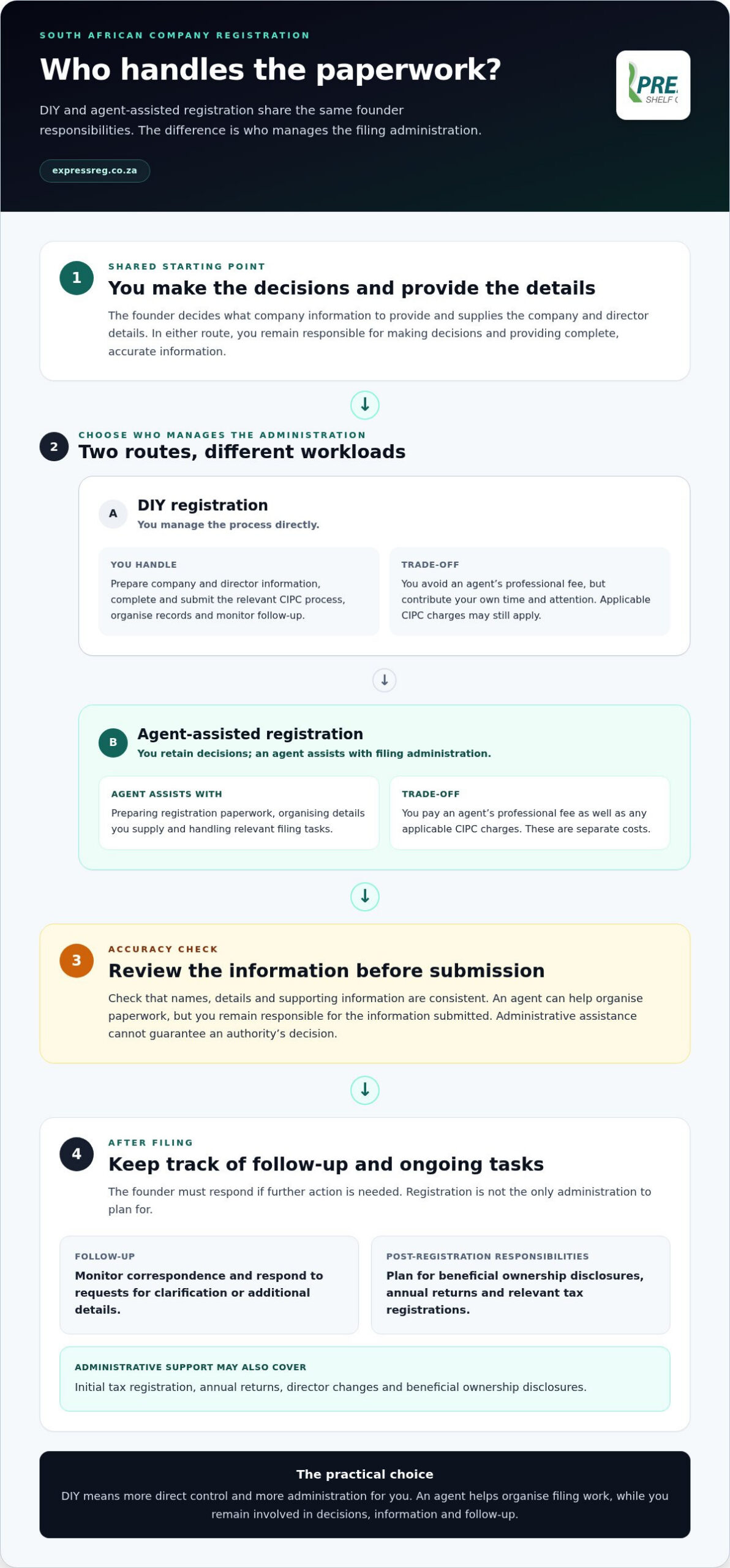
How to decide between DIY company registration and an agent
Make the choice by looking at the work you can realistically take on, not just the initial submission. The DIY company registration vs using an agent decision should account for your confidence with company information, the time you can set aside and who will monitor follow-up. Include the administrative tasks you’ll need to manage after incorporation.
Work through this short sequence:
- Assess your confidence. Can you prepare accurate company details and complete the application without help organising the information?
- Check your availability. Can you monitor progress, respond to requests and deal with any corrections while managing your other responsibilities?
- Plan beyond incorporation. Are you comfortable keeping track of relevant CIPC and SARS administration as your business develops?
If you can confidently manage each step and have time for follow-up, DIY may suit you. If you’re unsure about handling the paperwork or cannot reliably monitor the process, administrative assistance may be a better fit. Neither option removes your responsibility to provide accurate details or make decisions about your company.
Use these questions to assess your readiness
Answer each question honestly. “Yes” to all three suggests you may be ready to manage the administration yourself. If you answer “no” to one or more, identify the difficult task: preparing information, following up or tracking later obligations. Pinpointing the need can guide your choice more clearly than a general concern about company registration.
- Can you prepare and check the company and director information yourself?
- Do you have time to monitor the application and respond to administrative requests?
- Can you keep track of relevant post-registration responsibilities?
Compare support by scope, not by promises
Before choosing paid assistance, compare the administrative work covered with what you’ll still manage. Consider whether support includes preparing registration documentation, handling relevant filings or assisting with selected follow-up tasks. Separate the agent’s professional fee from any applicable authority charges, and assess the fee against the specific work included. A clear description of the service is more useful than claims about approval or outcomes.
Registration assistance is administrative support. It is not legal representation, independent auditing or business funding, and it does not transfer your responsibility for the information submitted. Express Shelf Company assists with new Pty Ltd registrations, CIPC filings and selected SARS applications. Keep your own decisions and information accurate, even when you delegate paperwork.
Use this final check: choose DIY if you have the confidence and time to prepare, submit and follow up; consider an agent if organising the filing work is the main obstacle; and either way, plan for later administration. If administrative support fits your needs, explore company registration assistance from Express Shelf Company.
Using Express Shelf Company for registration and related administration
Choosing support does not mean handing over control of your business. Express Shelf Company assists with new Pty Ltd registration by helping organise CIPC registration documentation and related administrative filings. You provide the company information and make the decisions; the support focuses on preparing and managing paperwork, not deciding how the business should operate.
This can be useful if you understand the decisions you need to make but would prefer help keeping registration administration in order. The DIY company registration vs using an agent choice still comes down to your time, confidence and support needs. An agent can help with filings, but cannot guarantee an authority’s decision.
What administrative support can cover
Registration documentation brings together details about the proposed company and its directors. Administrative support can help organise those details and prepare the relevant paperwork for filing. You remain responsible for checking that the information is accurate, complete and reflects your decisions before submission.
Support can also extend to initial tax registration and selected compliance filings. Which follow-on tasks are relevant depends on the company and current requirements, so incorporation should not be treated as automatic completion of every tax or compliance obligation. Keep a clear record of what has been handled and what remains for you to manage.
- New Pty Ltd registration: Assistance with organising registration information and documentation.
- Related administration: Support with initial tax registration and selected CIPC or compliance filings, as relevant.
- Your role: Make business decisions, supply accurate information and review the details used for filing.
Move forward with a clear registration plan
Before you begin, decide which tasks you’ll handle yourself and which filing work you’d prefer to delegate. If you’re comfortable preparing information, submitting it and managing follow-up, self-management may suit you. If paperwork is likely to compete with other priorities, administrative support can help organise that part of the process while you retain responsibility for the company’s details and decisions.
Express Shelf Company charges fixed professional fees for its administrative services. These are separate from any applicable authority charges. Focus on the work you need help with, such as a new registration or selected follow-on filings, and make a plan for any tasks that will remain yours.
Registration support is practical assistance, not a substitute for the founder’s oversight. Check the information carefully, keep copies of relevant records and note any later responsibilities that apply to your business. This gives you a clear view of what has been submitted and what still needs attention.
If administrative support fits your plan, explore company registration support and decide which next steps you’d like help organising.
Choose the support that lets you move forward
Make your next step practical: decide which registration tasks you can manage confidently, then identify where administrative support would free up time or help you stay organised. The choice of DIY company registration vs using an agent is not a test of how capable a founder is. It is a decision about how to use your time while keeping oversight of your company’s information and plans.
Express Shelf Company supports businesses across South Africa with fixed-fee administrative services for company registration and selected compliance filings. Consider how that support fits the tasks you’re ready to delegate.
Explore company registration support and take the next step with a plan that suits your business. You’re in control of the decision, and you can build your company’s administrative foundation one task at a time.
Frequently Asked Questions
Is it cheaper to register a company yourself in South Africa?
Usually, yes, because DIY registration avoids an agent’s professional fee. As of October 2026, CIPC’s standard private company registration fee is R125 without a name reservation, or R175 with an electronic name reservation. These are CIPC charges, not an agent’s fees. Compare the amount saved with the time you’ll spend preparing the application and managing follow-up, and check CIPC’s current fee schedule before submitting.
Do I have to use an agent to register a company with CIPC?
No, you can submit a company registration application directly through CIPC’s online services. An agent is optional administrative support, not a required step. If you register yourself, keep access to the account and records used for the application, and save submission confirmations and correspondence. These records can help you track progress and respond accurately if CIPC requests clarification or further action.
Can a company registration agent help with SARS tax registration too?
Yes, an agent may assist with initial tax registration and selected SARS applications. The relevant tax tasks depend on how the company is registered and what the business needs. For example, companies registered through CIPC’s BizPortal are automatically registered with SARS for an income tax number, while VAT registration is a separate matter. Check current SARS guidance to establish which registrations apply to your circumstances.
How long does company registration take in South Africa?
A realistic DIY timeframe is about 5 to 10 business days from start to finish, assuming there are no errors or rejections. The name reservation stage and company registration processing each take time, so allow for both when planning. This is an estimate, not a guaranteed completion date. An agent can help organise the paperwork, but the authority’s processing time remains outside the agent’s control.
Can I use an agent after I have started a DIY registration?
Often, an agent can assist with remaining administrative steps after you’ve begun, but the options depend on your application’s status and the current CIPC process. Gather your application reference, submitted information and any messages you’ve received before transferring tasks. This gives the agent context and helps avoid confusion over what has already been filed. Do not assume a new application is needed without first reviewing the existing one.
Does using a company registration agent guarantee CIPC approval?
No. An agent can help prepare and manage registration paperwork, but cannot guarantee CIPC’s decision. Approval depends on the authority’s assessment and the information submitted. Reduce avoidable problems by checking that company and director details are correct, responding to requests and keeping copies of the application. Treat an agent’s role as administrative assistance, not a promise of a particular outcome or decision.