
If you’re asking, “why is my CIPC application delayed”, you may be tempted to submit everything again. First, check where the filing is in the process. A “pending” status means it is awaiting a further step, but it does not explain whether you need to take action.
This guide explains how to check your filing record, interpret a CIPC request and choose a practical next step. Name-reservation issues, incomplete documents, payment problems, profile verification and processing backlogs can all affect progress. Start by confirming the application stage and the details on record rather than assuming what has caused the wait.
You’ll also learn when to follow up and how organised paperwork can help prevent avoidable applicant-side hold-ups. Express Shelf Company supports South African businesses with CIPC administrative filings. CIPC makes its own processing decisions, so no filing service can guarantee approval or a faster outcome.
Key Takeaways
- To understand why your CIPC application is delayed, identify its filing stage first. Pending, returned for correction and rejected call for different responses.
- Separate possible CIPC backlogs or service disruptions from issues with your documents, information or payment.
- Use your submission evidence, status record and CIPC messages to establish what has happened. Compare dates with current guidance for that filing type.
- Follow CIPC’s instructions in order. Avoid submitting a duplicate application unless current guidance tells you to.
- Administrative filing support can help prepare and review CIPC paperwork, while CIPC retains control of processing and decisions.
Why is my CIPC application delayed, and what does “pending” mean?
A CIPC application is delayed when a decision or processing step takes longer than you expected. That does not necessarily mean you made a mistake. CIPC manages its own processing queue, and application volumes or service interruptions may affect progress independently of your documents. A delay can also arise when information, supporting documents or payment needs attention. Check the filing record before deciding what has happened.
A processing delay means you’re waiting for a step to be completed; a rejection means CIPC has declined the application. Read the status alongside any message attached to it. A status label on its own may not explain the reason for the wait.
Which CIPC applications can be delayed?
Company registration and name reservation are related but separate applications. A name reservation may need to be resolved before you proceed with a chosen company name, while a registration application concerns the company filing itself. If you’re preparing to form a private company, the guide to registering a Pty Ltd in South Africa explains the registration process.
Maintenance filings follow their own processes too. A director change, for example, updates company information. Check the turnaround guidance for the specific application you submitted instead of assuming every CIPC service has the same timeframe.
Does a pending status mean CIPC has rejected the application?
No. Pending alone does not establish rejection, incompleteness or approval. It generally indicates that a submission is awaiting a further processing step, but the precise meaning depends on the service and the wording in the relevant portal. Status labels and instructions can change, so read the current notice attached to your filing rather than inferring an outcome from the label alone.
Look for a request for information or correction, a decision notice, or a change in status. “Returned for correction” and “rejected” describe different situations: the former signals that a correction may be required, while the latter communicates an unfavourable decision. Follow the instructions for your application type and verify the exact terminology in the current CIPC channel.
To assess whether the wait is outside the expected timeframe, note the submission date and filing type, then compare them with CIPC’s current official service turnaround guidance. Don’t apply a general registration estimate to a name reservation or director change. The Companies and Intellectual Property Commission (CIPC) overview provides general background on the Commission, but it cannot identify the status or cause of delay for an individual filing.
Start with the information in your filing record. If it remains pending, check the record and applicable guidance. A pending status is not proof that the application has failed.
What causes a CIPC application delay at each filing stage?
If you’re asking “why is my CIPC application delayed”, separate possible processing issues from details in your submission that may need attention. A delay can occur before review, during checks, or while CIPC is waiting for a response or payment confirmation. These are possibilities to investigate, not proof of what has happened in your case. CIPC controls its processing queue, so a complete submission may still take time.
Possible causes generally fall into three groups: processing, information and payment. Identifying which group may fit helps you decide what to check without assuming that a delay means there is an error.
Can missing documents or mismatched details hold up an application?
They can. An incomplete or inconsistent submission may need correction or further review. Compare the details in your application with the identity and company records you supplied, including director names and contact information. Check any CIPC message for the specific item requested. Don’t guess which document is missing or send extra paperwork unless the instructions call for it.
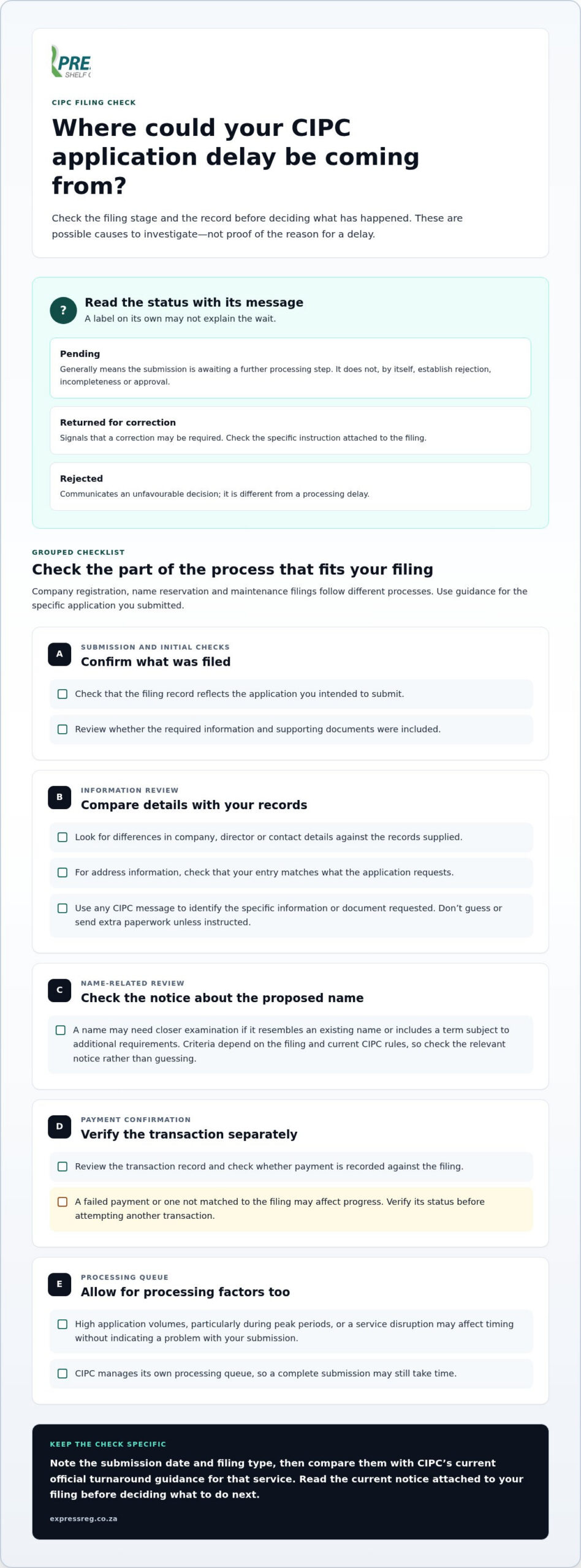
Use the filing stage to focus your checks:
- Submission and initial checks: Confirm that the application record reflects the filing you intended to make, and check that you included the required information and documents.
- Information review: Look for differences in company, director or contact details. For address information, check that what you entered matches the information requested for that application.
- Name-related review: A proposed name may need closer examination if it resembles an existing name or includes a term subject to additional requirements. Criteria depend on the filing and current CIPC rules, so check the relevant notice instead of guessing why a name is under review.
- Payment confirmation: Review the transaction record separately from the application details. A failed payment or one that has not been matched to the filing may affect progress. Verify the payment status before attempting another transaction.
- Processing queue: High application volumes, particularly during peak periods, or a service disruption may affect timing without indicating a problem with your submission.
Can name checks, payment issues or high demand affect timing?
Yes, but these are separate checks, not interchangeable explanations. A name reservation involves review of the proposed name; payment confirmation concerns whether the relevant transaction is recorded. Neither is necessarily the cause of a delay. Look for evidence in the filing record or a CIPC message. Peak-period backlogs are another possibility reported in available guidance, but they do not establish what has happened in an individual case.
Check current service notices and name-reservation updates on the official CIPC website, then compare them with your application’s filing type and date. If your paperwork needs a careful review, Express Shelf Company’s CIPC filing support can help organise and prepare documents. CIPC retains control of processing and decisions.
How can I check where my CIPC application is stuck?
Before following up, bring together a clear record of what you submitted and what CIPC has recorded since. If you’re wondering “why is my CIPC application delayed”, these checks can help distinguish a filing that is awaiting review from one that needs a response or has a payment query.
- Locate your submission evidence. Find the confirmation, receipt or other record issued when you submitted the application. Note the reference number, submission date and filing type. A receipt confirms that a submission was made; it does not confirm approval or promise a completion date.
- Open the relevant status channel. Use the CIPC service through which you made the filing, following its current instructions. CIPC eServices provides online application tracking. For compliance-related filings, check the applicable BizPortal or eServices record. Sign in to the correct customer profile if prompted.
- Review the record and messages. Check the status history, notifications and any request for correction or further information. Review payment confirmation too, where available. A status without its accompanying message may not show what action, if any, is required.
- Compare the dates with current guidance. Check CIPC’s current turnaround guidance and service notices for your filing type. Use the submission date, not the date you first noticed the delay. If a notice affects the service, take it into account before deciding whether to enquire.
What should I check in the CIPC application record?
Match the reference number and application type in the portal to your submission confirmation. Then compare the company and applicant details shown, where available, with the original filing. Check for a status change, correction request or decision notice, and confirm that payment is recorded if the service provides that information. If the record and receipt do not appear to match, keep both for your follow-up.
What information should I prepare before following up?
Gather the reference number, submission date and filing type. Write a short summary of the issue, including the status shown and the date it was last updated. Keep the receipt, relevant payment confirmation and CIPC correspondence together. Use the enquiry route and format currently specified for that filing type, and include only the details requested through that channel.
If the filing is an annual return, use the relevant CIPC annual returns guidance to identify the filing context before enquiring. For another application, follow the instructions for that service. An organised record makes it easier to explain the issue and respond if CIPC asks for more information.
What should I do next if my CIPC application is still delayed?
Choose your next step based on what the filing record shows. A correction request calls for a different response from an application that appears complete but is still in CIPC’s processing queue. If you’re asking “why is my CIPC application delayed”, check the existing filing before starting another one. A duplicate may create confusion or make the original application harder to track.
- Read the latest CIPC message. Check for a request, decision or instruction linked to your application. Note exactly what CIPC says needs attention.
- Make only the requested correction. Compare the request with your submitted records, update the relevant information or provide the specified document, then follow the resubmission instructions for that filing type.
- If no correction is requested, check current guidance. Compare your submission date with CIPC’s published turnaround information and service notices. This can help distinguish a possible processing delay from an applicant-side issue.
- Enquire through the applicable official channel. Follow the current instructions for your filing type and include your reference number, submission date, status and a concise description of the issue. Keep a copy of your enquiry and any response.
Should I amend, resubmit or wait for a CIPC update?
Amend or resubmit only when CIPC has requested a correction or the current instructions for your filing say to do so. If the application is still live and no action is requested, check the relevant turnaround guidance before deciding to wait or enquire. Don’t create a second application simply because the first has taken longer than expected. Confirm the correct procedure in CIPC’s current guidance first.
For enquiries, use the channel currently designated for the service. CIPC is transitioning to its Customer Enquiry Management System (CEMS) for logging enquiries, so check the latest instructions rather than relying on an old email address. Current guidance says an unanswered query can be escalated if there is no response within 10 business days. Escalation is a follow-up route, not a guarantee of a particular decision or processing time.
When can filing support help resolve avoidable hold-ups?
Administrative filing support can help if you’re unsure how to organise your submission record, review the details or prepare documents requested by CIPC. It can help manage paperwork and reduce avoidable applicant-side errors. CIPC remains responsible for its queue, processing decisions and outcomes, so support cannot promise faster processing or approval.
If you’d like help preparing or managing CIPC paperwork, use Express Shelf Company’s CIPC filing support. Keep your correspondence and submission details together so the next step is clear, whether you manage the follow-up yourself or arrange administrative assistance.
How can professional CIPC filing support help with the next application step?
If you’ve checked the application record and still aren’t sure what to do, compare the task ahead with the time and paperwork you can manage yourself. Managing the follow-up means locating the filing evidence, interpreting CIPC’s instructions and preparing any requested information. Administrative support can help organise those records and prepare relevant CIPC documents, while official enquiries and decisions remain with CIPC.
What can an administrative filing service take care of?
For company registration and maintenance filings, an administrative specialist can help prepare and manage relevant CIPC documentation. Maintenance work may include annual returns, director changes and beneficial ownership filings. The practical benefit is a clearer handover: you can bring together the filing type, company details, supporting records and any CIPC request to identify the next paperwork step.
This can be useful if you’re unsure whether a document matches the information already submitted, or if several records need organising before you prepare a correction. For a delayed filing involving director details, the CIPC director-change guidance can help you understand the filing context. Keep the official notice with your records and base any response on the actual request.
What remains outside a filing service’s control?
A filing service can assist with paperwork, but CIPC controls its review, processing queue and decision. Administrative support cannot promise approval, priority handling or a fixed turnaround time. Keep your submission confirmation, reference number and CIPC correspondence, even when someone helps prepare or manage the documents. These records remain important for tracking the filing and responding to official instructions.
Choose the approach that fits your situation:
- Manage it yourself if you can locate the full filing record, understand the instruction and confidently prepare the requested response.
- Use administrative support if you want help gathering company and director information, organising supporting records or preparing CIPC paperwork for a relevant filing.
- Follow CIPC’s direction for status enquiries, corrections and resubmissions, regardless of who helped prepare the paperwork.
If the issue is unclear, write down the filing type, reference number, latest status and precise question you need answered. This gives you a practical starting point and keeps any support request focused on the task, rather than on assumptions about the cause of the delay. If the filing concerns company registration or another CIPC administrative matter, Express Shelf Company can help prepare and organise relevant paperwork. CIPC still makes the processing decision.
For help managing the paperwork for your next CIPC filing step, explore CIPC filing support.
Turn the delay into a clear next step
Not knowing “why is my CIPC application delayed” can make it difficult to plan what comes next. Focus on the steps you can control: keep the filing record organised, respond to any clear CIPC request, and decide who will manage the paperwork. That gives you a practical way forward while CIPC’s review remains outside your control.
If you’d rather not manage every document and filing detail alone, Express Shelf Company supports company registration and CIPC administrative filings, including preparation of relevant documentation. This support can help keep the paperwork in order, but CIPC makes its own decisions and controls processing. Get organised CIPC filing support from Express Shelf Company and take the next step with greater confidence.
Frequently Asked Questions
Why is my CIPC application still pending?
A pending status means a decision may not yet have been recorded, but it does not explain why the application has not progressed. If you’re asking “why is my CIPC application delayed”, check that the reference on your receipt matches the filing you’re viewing. Then look for a newer message or request in the portal and the contact inbox used for the application. If there is no explanation, use CIPC’s current enquiry process.
How long does CIPC take to process an application?
There is no single reliable timeframe for every CIPC filing. Processing can vary by application type, submission completeness and CIPC’s workload, so treat published turnaround information as guidance rather than a guaranteed deadline. Check the current service information for the specific filing, including any notice that may affect it. If the published timeframe has passed, gather your receipt and reference details before asking CIPC for an update.
Can I submit another CIPC application while the first one is pending?
Usually, don’t submit another application just to prompt movement on the first. A second registration or name-related filing, for example, could have its own reference and status, making it harder to tell which record needs attention. Check whether the original is still active and read any instructions attached to it. If CIPC’s guidance does not make the next step clear, enquire about the existing reference before starting another submission.
What happens if CIPC asks me to correct my application?
Use the request to identify precisely what needs changing instead of revising unrelated parts of the filing. Check the notice for the response route, any stated deadline and the required format. For example, if a director’s details need correction, compare the requested change with the information in the source records before responding. Save the notice and a copy of your reply, then monitor the filing record for further instructions.
Can a CIPC name-reservation delay hold up company registration?
It can affect the registration step if your chosen route depends on a name decision, but the effect depends on the filing and current CIPC process. Check the reservation record separately from the company registration record, as they may have distinct references or updates. If CIPC’s process allows alternative names, keep options ready, but don’t interpret a delay as a rejection unless an official decision says so.
Can a filing agent make CIPC process my application faster?
No filing agent controls CIPC’s queue or can guarantee a faster decision. Administrative assistance can still help if you need support organising information, preparing supporting documents or managing filing steps. For example, a well-organised response can make it easier to address a specific correction request. CIPC remains responsible for reviewing the application, so continue checking its official updates and keep your own records.
What should I do if I have received no CIPC update?
Check that you’re viewing the right application record and that the contact details used for the submission are current. Search your inbox, including filtered or junk folders, for a confirmation or request linked to the filing. If nothing explains the silence, compare the elapsed time with CIPC’s current guidance and send a concise enquiry through the applicable channel. Include the filing type and reference so the query can be matched to the record.