
Over 500,000 South African companies and close corporations faced deregistration in the last cycle simply because they neglected a single administrative task. You’ve worked hard to build your brand, so the thought of losing your legal status or having your bank accounts frozen is understandably stressful. It’s common to feel overwhelmed by the differences between CIPC filings and SARS tax returns, but ignoring these deadlines puts your entire operation at risk. If you’re wondering what happens if I don’t file CIPC annual returns, the reality involves far more than just a late penalty; it can lead to the administrative death of your business.
We understand that staying compliant whilst managing daily operations is a challenge. This 2026 guide clarifies the severe legal and financial consequences of neglecting your filings and provides the exact steps needed to protect your assets. You’ll discover the specific deregistration timeline, how the new Beneficial Ownership requirements affect your submission, and a straightforward recovery plan to ensure your business remains active and protected. By the end of this article, you’ll have a clear roadmap to navigate these regulatory hurdles with confidence and speed.
Key Takeaways
- Understand how late filing penalties are calculated based on your company’s annual turnover and how missed deadlines trigger immediate status changes.
- Discover what happens if I don’t file CIPC annual returns, including the high risk of frozen bank accounts and disqualification from government tender opportunities.
- Learn the specific timeline of the deregistration process and the danger of your business assets vesting in the State through Bona Vacantia.
- Identify the critical difference between performing simple catch-up filings and the complex, costly route of formal company restoration.
- Master a proactive compliance strategy by organising a statutory calendar and utilising professional filing services to ensure procedural accuracy.
Immediate Penalties and CIPC Status Changes
CIPC annual returns are statutory documents that confirm your company is still trading and that its registered information is current. The Companies and Intellectual Property Commission (CIPC) uses these filings to maintain an accurate national database of active businesses. If you’re wondering what happens if I don’t file CIPC annual returns, the first consequence is the loss of your ‘Good Standing’ status. This status is essentially your business’s legal clean bill of health. Without it, you can’t obtain a Tax Clearance Certificate or successfully apply for government tenders.
Understanding the Mandatory Filing Window
Every South African company has a strict 30-business-day window to file their returns, starting from the day after the anniversary of its incorporation. It’s vital to understand that annual returns are not the same as your tax returns submitted to SARS. Whilst SARS focuses on your financial profits, the CIPC focuses on your legal existence and corporate transparency. You must file your CIPC return within 30 business days of your anniversary date to avoid immediate late fees and administrative red flags.
The Escalating Penalty Structure
The financial sting of non-compliance starts immediately after your filing window closes. The CIPC applies a tiered penalty system where the cost of the late fee is determined by your company’s annual turnover. Smaller businesses face lower initial penalties, but for larger corporations, the costs can escalate into thousands of rand very quickly. Ignoring these initial notices is a mistake that leads to higher professional fees and more complex paperwork later.
Moving from ‘Active’ to ‘Deregistration Process’ is a critical turning point. At this stage, your company is still legally alive, but it’s on life support. You’ll find it nearly impossible to perform other statutory duties whilst this status is active. A ‘Good Standing’ status is required for:
- Applying for business bank accounts or credit facilities.
- Submitting VAT Registration or COIDA Registration applications.
- Updating Director Changes or Beneficial Ownership Filing records.
- Participating in any formal procurement or tender processes.
Once you miss two consecutive years of filings, the system automatically shifts your status. It’s the point where the CIPC begins the formal process of removing your entity from the national register, making immediate action essential to prevent total dissolution.
Operational Paralysis: How Non-Compliance Affects Your Business
South African banks monitor CIPC records with increasing frequency to ensure FICA compliance. When your company status moves away from ‘Active’, financial institutions often freeze business accounts to mitigate their own regulatory risks. This sudden lack of access to working capital is a primary consequence of what happens if I don’t file CIPC annual returns. Without access to funds, you cannot pay suppliers or staff, effectively halting your operations overnight. It’s a high price to pay for what is essentially an administrative oversight.
The ripple effect extends to your relationship with the South African Revenue Service (SARS). You cannot obtain a Tax Compliance Status (TCS) pin if your CIPC records are not up to date. This creates a compliance deadlock where you might be tax-compliant in terms of payments, yet blocked from doing business because of a missing statutory filing. This administrative friction costs you time and damages your professional reputation with stakeholders.
Losing Your Competitive Edge in Tenders
Procurement officers in both the public and private sectors perform automated checks on CIPC records before awarding any contract. If your business is in the deregistration process, you are viewed as a high-risk entity. This status directly impacts your ability to meet the requirements for letter of good standing south africa. A Letter of Good Standing is non-negotiable for most tenders, and it remains inaccessible until every outstanding annual return is filed and processed. Missing out on a lucrative contract due to a late filing is an avoidable disaster for any growing business.
The Director’s Dilemma: Personal Risk
Operating a business whilst knowing it is non-compliant carries heavy legal weight. Under the Companies Act, continuing to trade whilst in a state of administrative deregistration can be classified as ‘reckless trading’. This is dangerous because it threatens the ‘corporate veil’ that usually protects your personal assets from business creditors. If the company is sued or liquidated whilst non-compliant, directors may be held personally liable for the company’s debts. This risk alone makes keeping your filings current a top priority.
Administrative updates also become impossible during this period. Any required director change CIPC filings or beneficial ownership updates are blocked by the system until the annual returns are brought up to date. To avoid these operational roadblocks, it is often best to organise your statutory filings through a professional intermediary who can clear the backlog quickly. This proactive approach ensures your business remains a separate legal entity and protects your personal financial standing whilst you focus on growth.
The Deregistration Death Spiral: From ‘Active’ to ‘Final’
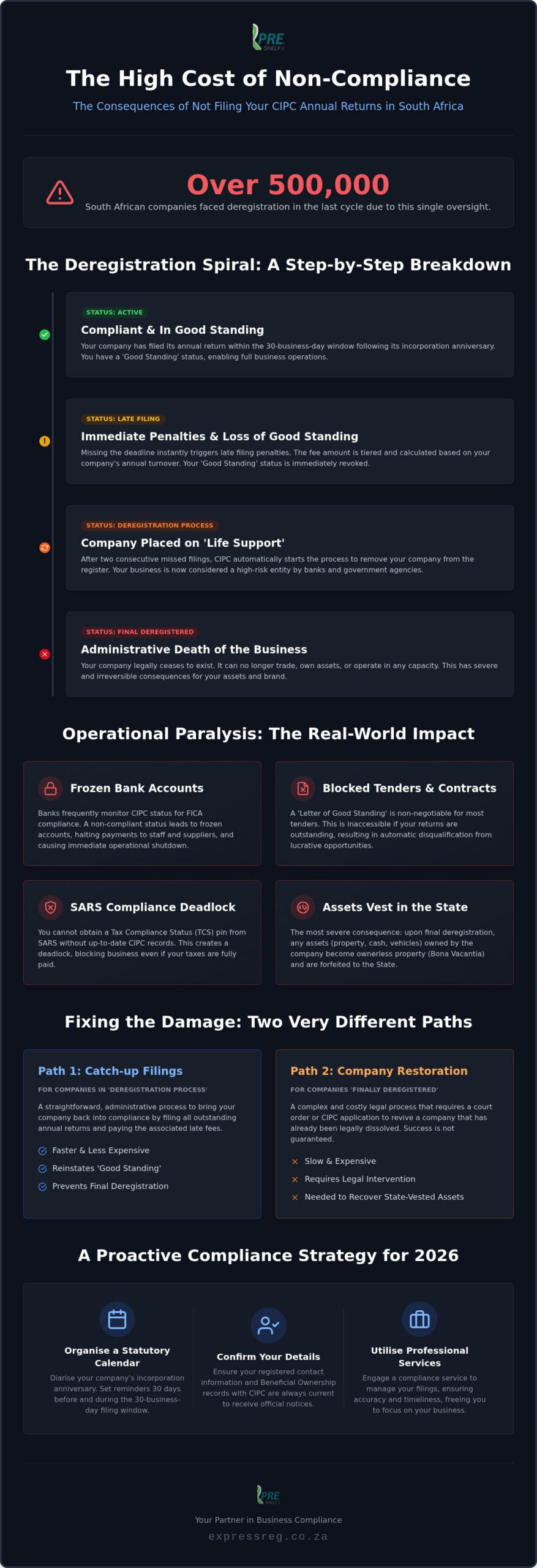
The transition from an active company to one that is finally deregistered is a methodical but destructive process. After two consecutive years of non-compliance, the CIPC initiates the deregistration process. This isn’t just a change in your status on a website; it’s the start of a legal dissolution that ends in the complete loss of your business’s legal personality. Understanding what happens if I don’t file CIPC annual returns requires looking at the final stage where the entity is struck off the register entirely.
This terminal phase has a devastating impact on existing lease agreements and property ownership. If your business premises are leased in the name of a deregistered company, the lease effectively becomes void. Landlords may have the right to reclaim the property or renegotiate terms that are far less favourable. Similarly, any property registered at the Deeds Office in the company’s name becomes locked in a legal limbo that is incredibly expensive and time-consuming to resolve.
The Bona Vacantia Principle Explained
When a company reaches ‘Final Deregistered’ status, it ceases to exist as a legal person. Under South African law, any assets remaining in the entity at that moment become ‘Bona Vacantia’, or ownerless goods. This means your business’s land, vehicles, and equipment technically vest in the State, specifically the National Treasury. The State doesn’t necessarily come to seize your office furniture immediately, but you lose the legal right to sell, transfer, or even use those assets. Final Deregistration means you no longer legally own your business assets.
The legal process the State follows to claim ownerless property is rigid. Once assets vest in the State, they are no longer yours to manage. Retrieving these assets requires a formal restoration of the company, which is a complex administrative hurdle that involves proving the company was still active and paying all outstanding fees and penalties from the period of non-compliance.
Protecting Your Intellectual Property
Your brand name is often your most valuable asset, yet it is completely unprotected once a company is finally deregistered. The CIPC releases the name back into the public pool, allowing any other entrepreneur to register pty ltd south africa using your exact business name. This name hijacking is perfectly legal because your original entity no longer exists to claim the rights to it.
The cost of re-branding after such an event is substantial. You’ll need new signage, stationery, and marketing materials, not to mention the loss of goodwill amongst your existing clients who may be confused by the sudden change. Prevention through regular filing is significantly cheaper than fighting a name restoration case or starting your brand identity from scratch. It’s far more efficient to handle the heavy lifting of paperwork now than to deal with the permanent loss of your business identity later.
Fixing the Damage: Catch-up Filings vs Company Restoration
Rectifying your business’s legal standing depends entirely on where you currently sit in the deregistration timeline. Understanding what happens if I don’t file CIPC annual returns is the first step toward choosing the correct recovery path. If you act quickly, you can avoid the most severe consequences, but delay often leads to a much more expensive and complex administrative process. There are two primary ways to fix the damage: simple catch-up filings or the more intensive formal company restoration.
When to Choose Catch-up Filings
Catch-up filings are the ideal solution if your company is still listed as ‘Active’ or has recently moved into the ‘Deregistration Process’ status. At this stage, the CIPC hasn’t yet finalised the dissolution of your entity. The process is straightforward; you must submit all outstanding annual returns and pay the associated backdated fees and penalties. This action immediately signals to the CIPC system that the company is still trading, which restores your status to ‘In Business’ almost instantly. In many cases, a professional filing agent can complete this entire process within 24 hours, providing the fastest route back to full compliance.
The Gruelling Path of Company Restoration
Once your company reaches ‘Final Deregistered’ status, catch-up filings are no longer an option. You must instead follow the gruelling path of formal restoration. This process is significantly more expensive and can take up to six months to complete. It requires you to place advertisements in the Government Gazette to notify the public of your intent and obtain formal ‘no objection’ letters from SARS and other relevant government departments. Because this involves complex affidavits and specific legal requirements, professional help is non-negotiable to ensure the application isn’t rejected, which would further delay your access to business assets.
Many entrepreneurs fall into the ‘New Company’ trap, thinking they can simply register a new Pty Ltd to bypass the mess. Whilst a new registration is fast, it does not solve the problem of frozen assets. A new legal entity has no claim over the bank accounts, property, or contracts held by your old, deregistered company. To unlock those assets, you must restore the original entity. To avoid these long timelines and the high costs of restoration, you should manage your CIPC annual returns proactively before the status becomes final. Acting whilst you are still in the catch-up window saves your business from months of operational paralysis and unnecessary legal fees.
How to Organise Your Compliance Strategy for 2026
Building a resilient business requires moving beyond the fear of penalties and toward a structured administrative routine. Whilst the risks of what happens if I don’t file CIPC annual returns are severe, they are entirely avoidable with a proactive strategy. A “tender-ready” business is one that anticipates these deadlines rather than reacting to a frozen bank account. In 2026, compliance is no longer a standalone task; it is a continuous process that integrates your legal status, tax standing, and labour registrations into a single professional identity.
The Benefit of Professional Filing Agents
Navigating government portals often involves technical errors and session timeouts that drain your valuable time. Using a professional CIPC annual returns submission service is a strategic investment that eliminates this administrative friction. Expert agents ensure that every statutory detail is correct before submission, which prevents future queries or status blocks. Express Shelf Company acts as your dedicated intermediary, handling the heavy lifting of paperwork and ensuring your records align perfectly with the Commission’s requirements. This allows you to focus on growth whilst we manage the procedural accuracy of your filings.
Future-Proofing Your Business
A successful compliance calendar starts with your company’s anniversary date. Set recurring reminders at least 30 days before your deadline to gather the necessary turnover figures and director details. It is also vital to keep your contact information updated with the CIPC; many companies fall into the deregistration trap simply because they never received the electronic notices. In the 2026 landscape, you must also account for Beneficial Ownership filings. The CIPC now implements a “hard stop” on annual returns if your beneficial ownership disclosures are not up to date, making this a non-negotiable step in your filing programme.
Total compliance provides a level of peace of mind that is essential for any entrepreneur. By integrating your CIPC filings with your SARS tax obligations and COIDA requirements, you create a business that is always ready for new opportunities. You won’t have to scramble for a Letter of Good Standing or worry about what happens if I don’t file CIPC annual returns because your foundation is already secure. This organised approach ensures that when a major contract or tender arises, your administrative standing is an asset rather than a hurdle. Start your 2026 compliance journey by delegating these complex tasks to a partner who values your time and your business’s legal integrity.
Secure Your Business’s Legal Future
Neglecting your statutory duties creates a chain reaction that can end in the permanent loss of your business assets and brand name. Understanding exactly what happens if I don’t file CIPC annual returns allows you to move from a state of anxiety to one of organised efficiency. By prioritising your annual filings and beneficial ownership disclosures, you protect your legal standing and ensure your company remains tender-ready for any upcoming opportunity.
Don’t let administrative hurdles stall your growth or lead to the administrative dissolution of your legal entity. As an expert facilitator for CIPC and SARS paperwork, Express Shelf Company provides fixed-fee administrative filing for peace of mind. We offer national support for entrepreneurs across South Africa, handling the heavy lifting so you can focus on building your brand. Let Expressreg handle your CIPC annual returns and keep your business compliant today. Your business’s longevity is built on a foundation of consistent compliance, and we’re here to ensure that foundation remains solid.
Frequently Asked Questions
Can I still trade if my company is in the deregistration process?
You can technically continue trading whilst in the deregistration process, but your business faces significant operational risks. Your status will trigger red flags for banks and procurement officers, making it impossible to secure new contracts or keep your business accounts open. It is a state of legal vulnerability that often precedes the final dissolution of your entity. You should resolve any outstanding filings immediately to restore your company to a ‘Good Standing’ status.
How much are the CIPC annual return penalties in 2026?
The CIPC applies penalties for late filing that increase the longer the return remains outstanding. These costs are determined by your company’s annual turnover, with different fee tiers for small, medium, and large entities. It is always more cost-effective to file within your 30-day window than to face these escalating charges. Avoiding these penalties requires a proactive approach to your statutory calendar to ensure every deadline is met with procedural accuracy.
What is the difference between an annual return and a tax return?
An annual return is a statutory document filed with the CIPC to confirm your company is still active, whilst a tax return is a financial declaration submitted to SARS. The CIPC return focuses on your corporate data, such as director changes and registered addresses. SARS returns focus on your profit and tax liability. You must complete both to remain fully compliant and avoid operational roadblocks in South Africa.
How do I check my company’s current CIPC status?
You can check your status by performing a free enterprise search on the CIPC eServices portal or by using a professional filing agent. Your status will be listed as ‘In Business’, ‘Deregistration Process’, or ‘Final Deregistered’. Knowing your status is the first step in understanding what happens if I don’t file CIPC annual returns. If your status is anything other than ‘In Business’, you must take immediate action to protect your legal standing.
Can I just register a new company if my old one is deregistered?
You can register a new Pty Ltd, but this does not solve the problem of frozen assets held by your old entity. Any bank accounts, property, or contracts belong to the original legal person and do not automatically transfer to a new registration. Because a deregistered company’s assets vest in the State as Bona Vacantia, you must restore the original company to reclaim them. Starting a new business is often a temporary fix for a deeper compliance issue.
What happens to my business bank account if I don’t file returns?
South African banks regularly audit CIPC records and will freeze your business account if your company enters the deregistration process. This is a common consequence of what happens if I don’t file CIPC annual returns. Once frozen, you cannot pay staff, settle supplier invoices, or withdraw funds. You must provide the bank with a CIPC disclosure certificate showing an ‘In Business’ status before they will restore your access to your capital.
How long does it take to restore a deregistered company?
Restoring a company that has reached ‘Final Deregistered’ status typically takes between four to six months to complete. This lengthy timeline is due to the requirement for advertisements in the Government Gazette and obtaining formal ‘no objection’ letters from SARS. If your company is merely in the ‘Deregistration Process’, catch-up filings can be processed much faster, often within 24 hours. Acting before the status becomes final saves your business from months of administrative delays.
Is beneficial ownership filing mandatory with my annual return?
Yes, filing a Beneficial Ownership declaration is now a mandatory requirement that must be completed before submitting your annual return. The CIPC implemented a ‘hard stop’ policy in 2024 that prevents any annual return submissions until this disclosure is verified. You must identify all individuals who ultimately own or control the company to comply with South African anti-money laundering regulations. This ensures transparency and prevents your filing from being blocked by the CIPC system.