Imagine discovering a high-value tender opportunity with a deadline only days away, only to realise your business lacks the formal registration required to submit a bid. You’ve likely felt the frustration of navigating bureaucratic delays at the CIPC whilst trying to scale your operations. It’s a common hurdle for entrepreneurs who need to move faster than the standard administrative pace allows. You want to focus on growth, yet you’re stuck waiting for a registration number or tax clearance.
Choosing a shelf company south africa might be the strategic pivot you need to bypass these obstacles and secure immediate trading ability. This guide helps you decide whether a pre-registered entity or a new Pty Ltd registration aligns best with your specific business goals and tender readiness. We’ll examine the critical differences in statutory compliance, the realities of SARS tax registration requirements, and the steps needed to ensure your new venture is fully prepared for contracts. Follow this methodical breakdown to move from administrative complexity to a state of full legal standing with confidence and ease.
Key Takeaways
- Understand the time-to-market advantage of acquiring a shelf company south africa, allowing for immediate trading whilst avoiding lengthy CIPC registration delays.
- Learn why aged company registrations provide a strategic advantage for tender applications and enhance perceived financial stability amongst potential contractors.
- Identify the essential statutory updates required after purchase, including CIPC director changes and mandatory beneficial ownership filings to maintain compliance.
- Compare the initial investment of a ready-made entity against a new Pty Ltd registration to determine which path suits your specific business timeline and budget.
- Discover how to navigate the transfer process with professional support to ensure full alignment with SARS and CIPC regulations from the moment you take control.
Understanding the Shelf Company in the South African Context
A shelf company is a private company (Pty) Ltd that has been fully incorporated with the Companies and Intellectual Property Commission (CIPC) but has never conducted business. Think of it as a dormant legal vehicle, waiting for an owner to activate its potential. These entities are kept “on the shelf” to provide entrepreneurs with a valid registration number the moment they need it. Whilst a new registration starts from zero, a shelf company south africa offers a head start by existing as a legal person before your specific business plan even begins.
The CIPC maintains the official registry for all such entities, ensuring they are legally recognised from the date of their incorporation. When you acquire one, you are not creating a new company; you are taking over an existing, compliant registration. This distinction is vital for businesses facing tight deadlines for contracts or tenders where a registration number is a prerequisite for submission. It allows you to skip the initial name reservation and incorporation wait times, which can vary depending on CIPC system availability.
The Legal Framework of Pre-Registered Entities
Every shelf company must operate within the strictures of the South African Companies Act. To remain compliant, these entities are registered with a standard Memorandum of Incorporation (MOI) and are kept in a strictly dormant state. This means they have no trading history, no employees, and no financial liabilities. In 2026, CIPC regulations place a high priority on transparency amongst corporate structures. You must ensure that Beneficial Ownership filings are updated immediately upon transfer to reflect the new control structure. This step is non-negotiable for maintaining statutory standing and ensures that the transition from the facilitator to the new director is recorded accurately within the national registry.
Shelf Companies vs. Shell Companies: Avoiding Confusion
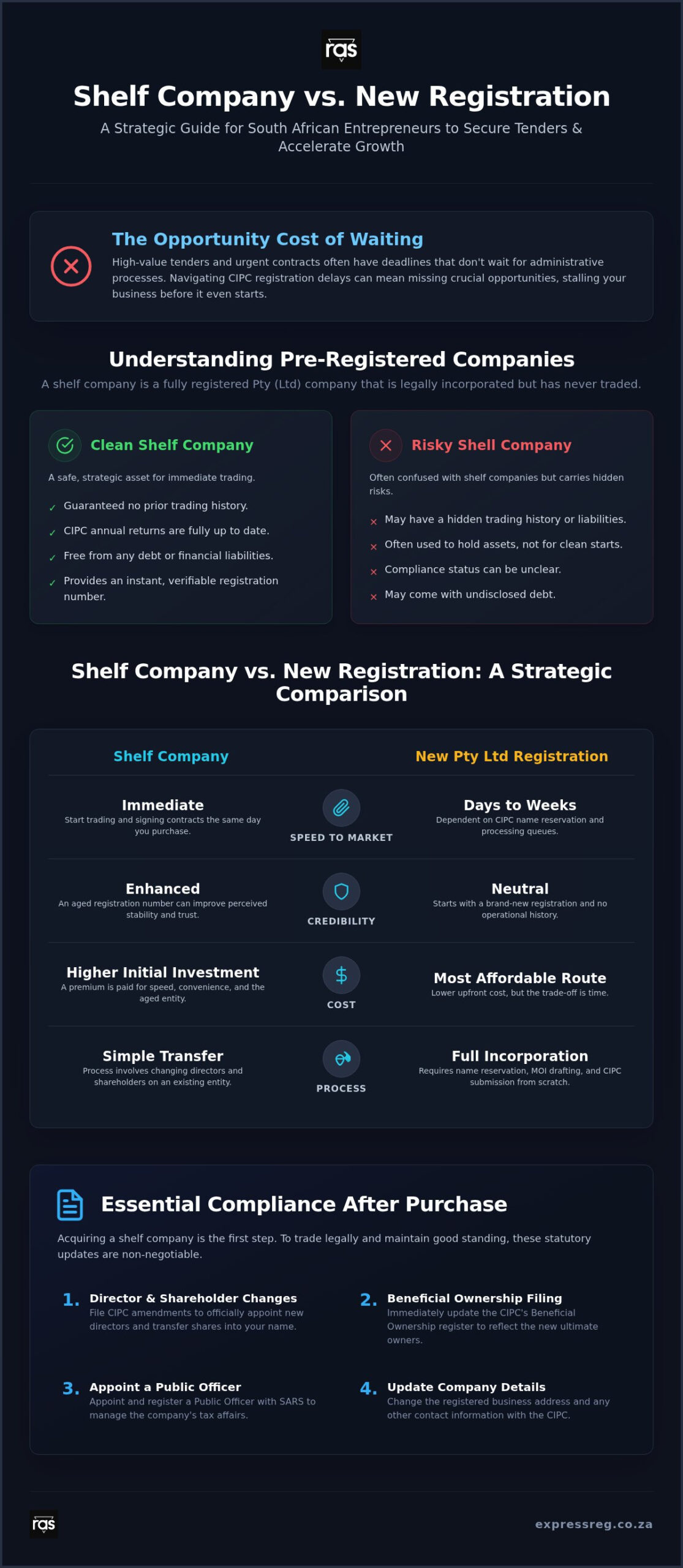
Distinguish clearly between a clean shelf company and a shell company. A shell company often refers to an entity that may have had prior operations or exists solely to hold assets or other companies. In contrast, a shelf company south africa is a “virgin” entity with a guaranteed clean slate. When selecting a provider, look for these specific indicators of a legitimate, safe registration:
- Written confirmation of no prior trading or bank account activity.
- Verification that CIPC annual returns are up to date to avoid deregistration.
- A clear, verifiable registration number that matches official CIPC records.
Avoid any entity that comes with pre-existing debt or undisclosed history. A reputable facilitator will provide a guarantee that the company is free from any prior obligations, ensuring your new business starts on a firm, transparent foundation. This organised approach reduces the stress of administrative hurdles and allows you to focus on your core commercial goals immediately.
Shelf Company vs. New Registration: A Strategic Comparison
Deciding between these two paths depends on your immediate commercial requirements. If you have a contract waiting for a signature, the delay of a new registration is a significant risk. A shelf company south africa provides a registration number instantly. New registrations, though more streamlined in 2026, still involve waiting for name approvals and CIPC processing queues. You’re choosing between waiting for the system or stepping into a vehicle that is already road-ready. For a comprehensive breakdown of both options, reviewing a detailed shelf company vs new registration comparison can help clarify which path suits your specific circumstances.
Consider the cost-benefit breakdown. A new registration is generally the most affordable route but requires patience. Buying a shelf company south africa involves a higher initial investment. This premium pays for the administrative speed and the maturity of the entity. For an established firm, the cost of missing a high-value tender far outweighs the price of a shelf company. For a small startup with no immediate contracts, the savings of a new registration might be more attractive if time is not a critical factor.
Speed of Acquisition and Trading
The core mechanism of a shelf company is the ability to trade immediately. You can legally enter into agreements using the existing registration number whilst the director change is being processed. This is invaluable for securing premises or signing supply contracts that cannot wait. Whilst new registrations are efficient, they cannot compete with the same-day availability of a pre-incorporated entity. It’s the difference between starting a process and finishing a transaction. Entrepreneurs facing imminent deadlines often find that acquiring a ready made shelf company is the most practical solution for bypassing CIPC processing queues and securing immediate trading capability.
Administrative Complexity and Transfer Steps
Administrative steps in 2026 are rigorous. You must update the director details, the registered office address, and the beneficial ownership register. These steps ensure the company’s history remains clean and the new ownership is transparent to authorities. Whilst a new registration allows you to pick a name from the start, a shelf company requires a name change if the original one doesn’t suit your brand. This involves a name reservation and a subsequent amendment, which ensures no compliance gaps occur during the transition.
Managing the share register and ensuring all statutory documents are in order is where precision matters most. If the thought of CIPC queues and paperwork feels overwhelming, you can view our ready-to-transfer options to simplify your launch. We handle the heavy lifting of the transfer, ensuring your transition to full legal standing is seamless and correct. This allows you to focus on your business goals whilst we secure your compliance foundation.
Strategic Advantages for Tenders and Financial Credibility
Acquiring a shelf company south africa provides more than just a fast-tracked registration number; it offers a layer of established credibility. In the competitive procurement environment of 2026, the chronological age of your entity can be a deciding factor in bid evaluations. Whilst a new registration is a valid choice, it carries the “startup” label that some risk-averse institutions and procurement officers view with caution. Position your business as a more stable contender by leveraging the historical registration date of a pre-incorporated entity.
Building trust amongst financial institutions and suppliers is a critical step for any new venture. An older registration number suggests a level of continuity and permanence that a brand-new entity lacks. This perception of stability is particularly useful when negotiating supply terms or seeking to establish a presence in industries where longevity is equated with reliability. It allows you to move past the initial trust hurdles that often slow down the growth of new businesses.
Meeting Tender Requirements with Aged Companies
Many government and private sector tenders include specific criteria regarding the age of a business entity. It’s common to see procurement documents that mandate a company has been registered for at least 24 or 36 months to qualify for certain contract tiers. An “aged” shelf company, incorporated in 2023 or earlier, meets these criteria instantly. This is not about fabricating trading experience, but rather possessing the necessary legal standing required by procurement scoring systems. If your specific goals don’t require this historical advantage, you might prefer to Register a Pty Ltd in South Africa: 2026 Guide and build your own timeline from the ground up.
Opening Business Bank Accounts and Credit Facilities
Financial institutions often view aged entities as lower-risk prospects during the credit vetting process. When you apply for corporate credit or open a complex business account, a company registered several years ago suggests a more established corporate structure. Suppliers also use registration dates as a quick metric for determining credit limits. A three-year-old registration number often facilitates higher initial credit limits than a company registered only days prior. This administrative seniority helps streamline applications for corporate financing and asset-backed lending, giving your business the financial flexibility it needs to scale quickly.
Essential Compliance: From Purchase to Active Trading
Transitioning from the acquisition of a shelf company south africa to active commercial trading requires a methodical approach to statutory updates. Whilst the entity is already incorporated, it exists in a dormant state that must be activated by aligning its records with your specific business details. Ensure you complete these updates promptly to avoid compliance gaps that could jeopardise contract awards or bank account applications. This process moves your business from a state of administrative potential to full legal standing.
CIPC and Statutory Updates
The primary administrative task involves updating the CIPC registry through specific form filings. Submit a COR39 application to remove the facilitator’s directors and officially appoint the new management team. If the pre-registered name doesn’t align with your brand, file a COR15.2 to reserve and implement a new company name. In 2026, you must prioritise the Beneficial Ownership filing. This mandatory disclosure ensures the CIPC has a transparent record of the individuals who ultimately own or control the entity. Failing to update this register can lead to administrative penalties or the suspension of your company’s Good Standing status.
Beyond the public registry, you must manage your internal statutory records. Update the share register to reflect the transfer of shares from the facilitator to the new shareholders. Issue share certificates and record the inaugural minutes of the first meeting of directors. These documents form the legal foundation of your corporate governance and are often requested during due diligence processes for high-value contracts or during the opening of corporate credit facilities. Keeping these records organised from day one prevents future administrative hurdles. To protect your entity’s Good Standing status on an ongoing basis, understanding the full CIPC annual returns submission process is essential for every business owner in 2026.
SARS Tax and VAT Registration
Every shelf company arrives with an existing income tax number, but you must transfer the SARS eFiling profile to your control. This process involves updating the Public Officer details with SARS to match the new director. Once updated, you can apply for a Tax Clearance Status (TCS) PIN. This PIN is a non-negotiable requirement for South African tenders, as it proves your business is in good standing with national tax authorities. Without a valid TCS, your bids will likely be disqualified at the first stage of evaluation.
Consider your VAT requirements early in the transition. If your projected turnover exceeds R1 million per annum, compulsory VAT registration is required. You may also opt for voluntary registration if your turnover has already exceeded R50,000. Understanding the precise thresholds and documentation requirements for VAT registration South Africa is essential, as the rules have undergone significant changes in 2026 that affect every entrepreneur’s compliance obligations. To ensure full operational compliance, register your entity with the Department of Labour for UIF and COIDA. A valid Letter of Good Standing from the Compensation Commissioner is often as important as your tax clearance when bidding for industrial or construction projects. For professional assistance with these filings, buy a shelf company with full compliance support and let us handle the administrative burden whilst you focus on your launch.
How Express Shelf Company Facilitates Your Business Launch
Express Shelf Company acts as a reliable facilitator between the complex machinery of government administration and your commercial objectives. We provide a curated list of ready-made entities that are guaranteed to have no prior trading history, bank accounts, or financial liabilities. This transparency ensures your business begins on a clean foundation, free from the risks associated with undisclosed history. Our national service coverage allows us to support firms across South Africa, ensuring that geographical distance never hinders your ability to secure a compliant registration.
Trust is built through simplicity and correctness. We utilise a fixed-fee structure for all our services to ensure you understand the total investment required from the outset. This grounded approach eliminates the frustration of hidden costs and allows for precise financial planning. By positioning ourselves as a private ally rather than a bureaucratic entity, we handle the heavy lifting of paperwork so you can dedicate your energy to operational growth and tender submissions.
Our Streamlined Transfer Process
Speed and accuracy are the hallmarks of our transfer process. Our filing agents meticulously organise the necessary COR39 and COR15.2 documents to ensure same-day progress on your application once all requirements are met. This methodical flow suggests a well-oiled process where every step is handled with care. We provide the peace of mind that comes from knowing your director changes and name reservations are being managed by experts who prioritising regulatory compliance above all else. This organised efficiency reduces the stress typically associated with CIPC transitions.
Beyond the Registration: Long-term Compliance Support
Our commitment to your business extends far beyond the initial purchase. We offer ongoing assistance with CIPC annual returns submission to ensure your company avoids deregistration and maintains its Good Standing status. Whilst your leadership team evolves, we manage director changes and beneficial ownership filings to keep your statutory records accurate and up to date. This foundational support is essential for businesses that value long-term stability and procedural discipline.
We also facilitate more complex administrative tasks as your business matures. This includes handling specialised applications for VAT registration and COIDA certifications, which are often required for high-stakes contracts. Whether you need a Letter of Good Standing or a change in registered office address, our team remains your approachable guide through every regulatory hurdle whilst you focus on scaling your operations. Contact us today to secure your shelf company south africa and take the first step towards a fully compliant business launch.
Secure Your Competitive Edge in the South African Market
Choosing the right vehicle for your business depends on your specific timeline and commercial goals. A shelf company south africa offers a distinct advantage when you need immediate market entry or a mature registration number to meet specific tender criteria. Whilst a new registration is a cost-effective path for those without urgent deadlines, the administrative speed of a pre-incorporated entity is often the deciding factor for high-growth ventures. Success hinges on ensuring your new entity is fully compliant with CIPC and SARS regulations from the moment you take control.
We stand ready to handle the heavy lifting of your statutory paperwork with fixed-fee transparency and expert precision. As compliance specialists with national service coverage, we ensure your transition from director changes to VAT registration is seamless and correct. Don’t let bureaucratic delays hold back your entrepreneurial vision. Secure your ready-made shelf company and start trading today to build your business on a foundation of professional excellence. Your next contract is waiting, and we’re here to help you reach it.
Frequently Asked Questions
What is a shelf company and how does it work in South Africa?
A shelf company is a pre-registered (Pty) Ltd entity that is kept dormant until a buyer requires it. It works by allowing a new owner to take over the existing registration number through a CIPC director change process. This provides immediate legal personality for the business without waiting for the initial incorporation steps. It is a tool for rapid market entry.
Is it better to buy a shelf company or register a new one?
The choice depends on your specific timeline and tender requirements. Buying a shelf company south africa is better if you need a registration number instantly for a contract or if you require an aged entity for procurement points. Registering a new company is more cost-effective if you have the time to wait for CIPC processing and don’t need historical registration dates. Understanding the full implications of a shelf company vs new registration decision will help you choose the most efficient path for your 2026 business goals.
How long does it take to transfer a shelf company into my name?
The initial transfer of ownership can be processed within 24 to 48 hours once all documentation is submitted. Whilst the director change on the CIPC system may take several business days to reflect officially, you can often begin signing contracts using the registration number immediately. We manage the filing process to ensure the transition is as fast as current system turnaround times allow.
Can I change the name of a shelf company after I buy it?
Yes, you can change the name of a shelf company at any time after purchase. This involves a name reservation followed by a COR15.2 filing with the CIPC. Many entrepreneurs choose to trade under the original name initially to save time and then apply for a name change whilst the business is already operational. This ensures your brand identity matches your legal entity eventually.
Do shelf companies come with existing tax numbers or VAT registration?
Every shelf company south africa comes with a pre-assigned income tax number from SARS. VAT registration is typically not included because it requires proof of trading or a minimum turnover of R50,000. Once you take ownership, you can apply for VAT or COIDA registration as part of your active compliance setup. We facilitate these additional registrations to ensure your business is tender-ready.
Are there any hidden debts or liabilities in a shelf company?
Legitimate shelf companies are guaranteed to be dormant and free from any prior trading history or debt. We provide a clean-slate guarantee for every entity we facilitate, ensuring there are no undisclosed bank accounts or financial obligations. Always verify that your provider offers this indemnity to protect your new venture from historical liabilities. This transparency is vital for your peace of mind.
What documents do I need to provide to buy a shelf company in 2026?
You must provide certified copies of the identity documents or passports for all incoming directors and shareholders. Additionally, you will need a proof of residential address and a signed mandate to allow the facilitator to lodge changes with the CIPC. In 2026, you must also provide details for the mandatory Beneficial Ownership register. These requirements ensure full compliance with national transparency regulations.
Can a shelf company be used for government tenders immediately?
You can use the registration number for tender submissions immediately, provided you have updated the director details and obtained a Tax Clearance Status from SARS. If the tender requires an aged company, a shelf company registered in previous years is often the only way to qualify. Ensure all statutory filings, including beneficial ownership, are current before submitting your bid to avoid disqualification.