
Registering a consulting business in South Africa starts with a decision, not a form: should you operate as a sole proprietor or set up a company? Choosing a Pty Ltd by default can mean taking on administration that may not suit your plans, while skipping registrations that apply to your circumstances can create problems as your work grows. The right structure depends on how you’ll consult, earn income and manage responsibilities.
CIPC company registration, SARS tax administration and employer obligations are separate processes, with different requirements. This guide to registering a consulting business in South Africa explains how to choose a suitable structure, identify the next steps and avoid treating every registration as automatic.
You’ll learn what to consider before registering, which tax registrations may apply to your services, and what to track if you hire employees. We’ll also cover ongoing filing duties and practical ways to organise your records, so you can build a clear compliance checklist and focus on setting up your consultancy.
Key Takeaways
- Choose between operating as a sole proprietor and registering a private company based on your consulting plans and administrative capacity.
- Approach registering a consulting business in South Africa in sequence: settle your structure, prepare the required details, complete applicable filings and organise your records.
- Keep income tax, VAT and PAYE separate, then identify which obligations apply to your business circumstances.
- Compare self-managed filings with administrative support. Assistance can help organise paperwork, but it does not change official requirements or guarantee an outcome.
- Use a practical setup checklist to track filings, tax records, client documents and compliance dates. Set out project terms clearly in consulting agreements.
Before registering a consulting business in South Africa, choose how it will operate
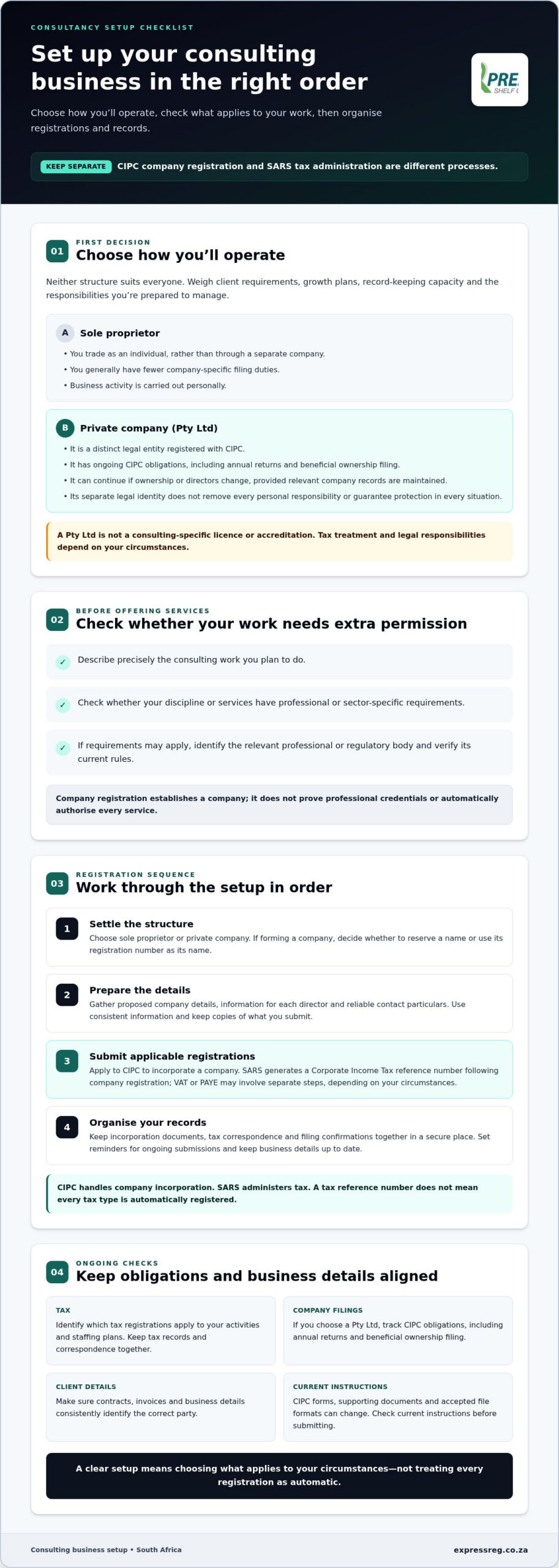
Before registering a consulting business in South Africa, decide how you’ll trade and manage its administration. A consultant working alone may operate personally, while another may prefer a company with its own legal identity. Neither option suits everyone. Consider your client requirements, plans for growth, record-keeping capacity and the responsibilities you’re prepared to manage.
Sole proprietor or Pty Ltd: what changes for a consultant?
As a sole proprietor, you trade as an individual rather than through a separate company. A private company, often called a Pty Ltd, is a distinct legal entity registered with the Companies and Intellectual Property Commission (CIPC). It can continue as an entity even if its ownership or directors change, although the relevant company records must be maintained.
- Administration: A sole proprietor generally has fewer company-specific filing duties. A Pty Ltd has ongoing CIPC obligations, including annual returns and beneficial ownership filing.
- Responsibility: With a sole proprietorship, business activity is carried out personally. A company’s separate legal identity distinguishes the company from its owners, but it doesn’t remove every personal responsibility or guarantee protection in every situation.
- Continuity and clients: A company can provide a continuing structure beyond one consultant. Some clients may have onboarding requirements, so make sure your contracts, invoices and business details consistently identify the correct party.
A Pty Ltd is a company structure, not a consulting-specific licence or accreditation. Tax treatment and legal responsibilities depend on your circumstances, so get appropriate advice before choosing if those factors affect your decision.
When might a consulting practice need extra permissions?
Registering a business and being authorised to provide a particular professional service are separate matters. CIPC company registration establishes the company; it doesn’t prove that you hold a professional credential or meet sector-specific rules. Requirements can depend on your discipline and the work you perform, so identify the relevant professional or regulatory body and verify its current requirements before offering regulated services.
For a general management or business consultancy, don’t assume that forming a company is the only step, or that company registration automatically authorises every service. Describe your work precisely, check whether your field has professional requirements, then choose the business structure that fits your operating plans. This gives you a clearer starting point for the registration and tax steps that follow.
How to register a consulting business in South Africa step by step
Once you’ve chosen how to operate, work through the setup in a clear order. Registering a consulting business in South Africa involves more than submitting a company form: CIPC handles company incorporation, while SARS administers tax. Keep those roles distinct as you prepare, file and organise your records.
- 1. Settle the structure. Decide whether you’ll trade as a sole proprietor or establish a private company. If you choose a company, decide whether to reserve a name or use the company’s registration number as its name.
- 2. Prepare the details. Gather the proposed company details, director information and contact particulars. Use consistent information across forms and keep copies of what you submit.
- 3. Submit applicable registrations. Apply to CIPC to incorporate a company. Company incorporation and tax administration are distinct: SARS generates a Corporate Income Tax reference number following company registration, while other tax registrations, such as VAT or PAYE, may require separate steps depending on your circumstances. Check current procedures through the South African Revenue Service (SARS) tax compliance guidance for small businesses.
- 4. Organise your records. Store incorporation documents, tax correspondence and filing confirmations in one secure place. Set reminders for ongoing submissions and keep your business details up to date.
What information should you prepare before company registration?
Prepare the company name or naming preference, details for each proposed director, and reliable contact particulars. CIPC’s forms, required supporting documents and accepted file formats can change, so review the current instructions before submitting. Accurate details matter: mismatches between company and tax records can make administration harder to manage.
For a closer look at the company-specific process, read this Pty Ltd registration guide. Express Shelf Company can help prepare and process company registration documentation through its administrative support for Pty Ltd registration.
What happens after a company is registered?
Incorporation is one step, not the end of setup. Review which SARS registrations apply to your activities and staffing plans, then complete any relevant applications using current SARS guidance. A tax reference number does not mean every tax type is automatically registered. Keep company records, tax records and filing confirmations together so you can track what’s been completed.
Company registration also doesn’t grant professional accreditation or replace any sector-specific authorisation your consulting discipline may require. Prepare client-facing documents separately, including clear agreements that identify the parties and set out the work to be delivered.
Consulting business tax and compliance: identify what applies to you
Tax and filing duties depend on how your consultancy is structured, what it supplies, its turnover and whether it employs people. Registering a consulting business in South Africa doesn’t mean every tax registration applies automatically. Build a compliance list around your actual circumstances, then check current SARS and CIPC requirements and deadlines as your business changes.
Which SARS registrations might a consulting business need?
A sole proprietor generally accounts for business income through their individual tax affairs. A registered company has its own corporate income tax administration; the standard corporate income tax rate is 27%, although specific tax treatment can depend on eligibility and circumstances. Keep business income and expense records organised, and confirm how your structure affects your tax position.
VAT is a separate consideration. From 1 April 2026, compulsory registration applies when taxable supplies exceed R2.3 million over any consecutive 12-month period; voluntary registration may be available from R120,000, subject to SARS requirements. Turnover alone isn’t the only practical consideration, so review your taxable supplies and circumstances. See the South African VAT registration guide for eligibility and application details.
PAYE is relevant when your business has employees or other remuneration obligations that require it. If you employ staff, also check whether UIF and Compensation Fund (COIDA) duties apply. For example, current guidance requires UIF registration for employers with qualifying employees working more than 24 hours a month, and COIDA registration for employers with one or more employees. Confirm the rules that apply to your working arrangements.
What company compliance continues after registration?
Incorporation doesn’t complete a company’s CIPC obligations. Companies must submit annual returns and maintain the required beneficial ownership information. These are separate compliance items, so note their applicable filing dates and keep supporting company records together. Requirements and processes can change; check current CIPC guidance rather than relying on a deadline from an earlier year.
Use the CIPC annual returns guide for filing detail, and include beneficial ownership submissions in your company compliance calendar. A clear record of completed filings helps you identify what remains outstanding.
Keep tax and company records in an orderly system, and review your obligations when turnover, services or staffing changes. Express Shelf Company provides support with CIPC annual returns, beneficial ownership filing, VAT and PAYE registration, helping you manage the relevant paperwork.
DIY registration or administrative support: compare the practical trade-offs
Choosing between self-managed filings and administrative assistance comes down to the time you can set aside, your comfort with official processes and how much paperwork your setup involves. Neither option changes CIPC or SARS requirements, and an intermediary can’t guarantee an official decision. The aim is to complete the applicable steps accurately and keep a clear record of them.
When might a consultant manage filings independently?
Managing filings yourself may suit a consultant with straightforward requirements, time to follow the relevant CIPC or SARS process, and confidence working with forms and online systems. Before submitting, read the current official instructions and check that details match across applications. Keep copies of source documents, completed forms, submission confirmations and follow-up correspondence. This record makes it easier to track progress and respond if information is requested.
What can administrative registration support help with?
Administrative assistance can be useful if you’d rather have help preparing documentation, coordinating steps or tracking submissions. Express Shelf Company assists with new Pty Ltd registration documentation, CIPC filings and relevant initial tax registration, including VAT or PAYE applications where applicable. Its fixed-fee administrative services help organise the paperwork, but official requirements still apply and CIPC or SARS retains responsibility for its own decisions.
Compare the practical effort, not just the form itself. A company setup may involve incorporation details, tax administration and ongoing records. If you have limited time or aren’t familiar with the filing process, support can reduce the administrative workload; if your requirements are simple and you’re comfortable following official guidance, self-management may be workable. In either case, save confirmations and note ongoing filing dates.
Keep the scope of assistance clear. Registration support concerns administrative preparation and processing; it isn’t a substitute for professional advice on legal structure, tax treatment or audit matters. If your decision depends on those issues, seek advice from an appropriately qualified professional. This distinction helps you use administrative support for paperwork while reserving specialist questions for the right expertise.
If you want help organising company registration documentation and related administration, explore Pty Ltd registration support. Choose the approach that fits your available time and familiarity with the process, then maintain your own records of filings and official responses. This keeps registering a consulting business in South Africa manageable without losing sight of your responsibilities.
Set up your consulting business for clients and ongoing administration
Once your structure and applicable registrations are in place, prepare the practical tools that help you work clearly with clients and stay on top of administration. A simple checklist can help you move from scattered documents to a clear record of what is complete and what still needs attention.
What should be ready before taking on a consulting client?
Use a written consulting agreement or scope of work to set expectations before work begins. Describe the services, deliverables, responsibilities, fees and payment terms. Include a process for handling changes, such as extra work or revised deadlines, so both parties know how scope adjustments will be agreed. A template can help organise these points, but it isn’t legal advice or a guaranteed fit for every engagement.
Keep client agreements, proposals, invoices and project records organised alongside your business records. Separate personal and business records in a way that reflects your chosen structure, and retain copies of important correspondence and payment records.
How can you keep registration and compliance tasks organised?
Create a calendar for relevant filing dates and tax tasks. Save proof of submissions, official acknowledgements and copies of the information filed. Review your records when your consulting activities, turnover or staffing circumstances change, as these changes may affect which registrations and obligations apply. Check current official guidance when reviewing requirements.
Before taking on work, use this checklist to confirm your setup:
- Structure: Record whether you’re operating as a sole proprietor or through a company.
- Filings: Keep copies of completed CIPC and other applicable registration submissions, along with acknowledgements.
- Tax records: Organise tax registration details, correspondence and supporting financial records.
- Client documents: Prepare your agreement, scope of work, proposal and invoicing records.
- Compliance dates: Add relevant filing and tax dates to a calendar, then review it as your business changes.
Keep the checklist current rather than treating it as a one-off task. Good records make it easier to see what’s done, follow up on outstanding items and prepare for future filings. They also help keep client administration separate from compliance responsibilities.
Express Shelf Company can help with company registration paperwork and compliance filings. Get help with company registration and compliance filings. An organised start gives you a practical foundation for serving clients while keeping your business administration on track.
Build a well-organised foundation for your consultancy
Registering a consulting business in South Africa is easier to manage when you choose a structure that fits your plans, complete the registrations that apply and keep up with ongoing filings. Separate tax obligations according to your business circumstances, and maintain accurate company and financial records as your services or staffing change.
Before taking on clients, put your scope, deliverables, fees and payment terms in writing. Keep compliance dates and submission confirmations together so you can see what’s complete and what needs attention. These habits give your consultancy a clearer foundation for working with clients and managing administration.
If you’d like support with the paperwork, Express Shelf Company provides fixed-fee company registration and transfer services, including assistance preparing CIPC documentation and initial tax registration. The company serves businesses across South Africa. Get help with your company registration and compliance filings.
Take the setup one step at a time, keep your records organised and build your consulting practice with confidence.
Frequently Asked Questions
Do I need to register a company to work as a consultant in South Africa?
No. You can work as a consultant as a sole proprietor without incorporating a company with CIPC. You’ll still need to manage the tax and other obligations that apply to your circumstances. If you choose a Pty Ltd, company incorporation adds CIPC filings and record-keeping duties. Regulated consulting disciplines may also have professional requirements, so check the rules for the services you plan to provide.
How do I register a consulting business with CIPC?
If you’re setting up a private company, apply to CIPC to incorporate it. Prepare the proposed company details, director information and contact particulars, then follow CIPC’s current submission instructions. CIPC handles company registration; SARS administers tax separately. A company’s Corporate Income Tax reference number is generated following registration, but other tax registrations may involve separate steps. Keep your submitted documents and confirmations together for your records.
Should I register my consulting business as a sole proprietor or a Pty Ltd?
Choose the structure that fits your work, client requirements and appetite for administration. A sole proprietor trades personally and generally has fewer company-specific filing duties. A Pty Ltd is a separate legal entity, with ongoing CIPC responsibilities and its own company records. Neither option is best for every consultant, and a company structure doesn’t guarantee a particular tax result or remove every personal responsibility. Verify advice for your situation.
Do consultants in South Africa need to register for VAT?
Not every consultant needs to register for VAT. As of 1 April 2026, compulsory registration applies when taxable supplies exceed R2.3 million over any consecutive 12-month period. Voluntary registration may be available from R120,000, subject to SARS requirements. Consider the nature and value of your taxable supplies, and check current SARS guidance before applying. VAT registration is separate from company incorporation and income tax administration.
Can I register a consulting business without employees?
Yes. You can operate as a sole proprietor or register a Pty Ltd without employing staff. Hiring employees can add separate responsibilities, so review your obligations if your staffing changes. For example, current guidance requires UIF registration when an employer has someone working more than 24 hours per month, and COIDA registration for employers with one or more employees. Check current requirements for your specific employment arrangements.
What happens if I do not submit my company’s CIPC annual returns?
Companies are required to submit CIPC annual returns, so missing a filing leaves an outstanding compliance obligation. Failure to file may lead to CIPC compliance action and can put the company’s status at risk, including possible deregistration. The applicable return process and fees depend on current CIPC rules and company information. Check your filing position with CIPC, address overdue returns promptly and keep confirmation of each submission.
Do I need a business licence to offer consulting services in South Africa?
There isn’t one general consulting licence that applies to every service. Requirements can depend on your consulting discipline and the work you perform, particularly in regulated fields. Registering a company with CIPC establishes a company structure, but it doesn’t establish professional accreditation or authorise every service. Identify the rules relevant to your field and verify them with the appropriate professional or regulatory body before offering regulated services.
Can an administrative service help me register a consulting business?
Yes. An administrative service can help prepare and process company registration documentation, CIPC filings and relevant initial tax registration applications. Express Shelf Company assists with these administrative steps, including VAT or PAYE applications where applicable. Using support doesn’t change official requirements or guarantee an outcome: CIPC and SARS make their own decisions. Administrative assistance can help organise paperwork, while legal or tax advice may require an appropriately qualified professional.