
Missing the mandatory 21-day registration window doesn’t just result in a minor administrative hurdle; it triggers a retrospective tax liability that can instantly erase your profit margins. Understanding the consequences of late VAT registration in South Africa is essential for any business owner who has recently crossed the new R2.3 million threshold. It’s a high-stakes situation where silence from the authorities usually precedes a significant financial shock.
It’s understandable to feel overwhelmed by the 2026 threshold changes or anxious about how backdated interest might affect your operational cash flow. You’re likely concerned that a single administrative oversight will disqualify your firm from lucrative tenders or invite an aggressive SARS audit into your books. These fears are common amongst entrepreneurs who prioritise business growth over complex paperwork and statutory filings.
You can navigate this challenge by learning exactly how SARS calculates backdated debt and implementing a structured plan to restore your compliance status. We promise to provide the clarity you need to move from a state of uncertainty to full legal standing without the stress of going it alone.
This guide details the 10% late payment penalties, explains the 15/115 tax fraction rule for past sales, and outlines how professional intermediary support helps you secure your VAT number whilst minimising financial exposure. We’ll also explore how the Voluntary Disclosure Programme can protect your firm’s future assets.
Key Takeaways
- Identify the specific 2026 turnover thresholds and the “month-plus-one” rule to determine exactly when your mandatory registration period begins.
- Understand the financial consequences of late VAT registration in South Africa, including the immediate 10% penalty and the impact of the 15/115 tax fraction rule on your historical revenue.
- Discover how the SARS Voluntary Disclosure Programme (VDP) serves as a strategic tool to mitigate risks and potentially waive substantial administrative penalties.
- Learn why maintaining a status of good standing through VAT compliance is a non-negotiable requirement for securing government tenders and high-value corporate contracts.
- Explore how using a professional intermediary simplifies the complex SARS application process, ensuring your business moves from administrative backlog to full legal standing efficiently.
The Mandatory VAT Threshold: When Does Late Registration Begin?
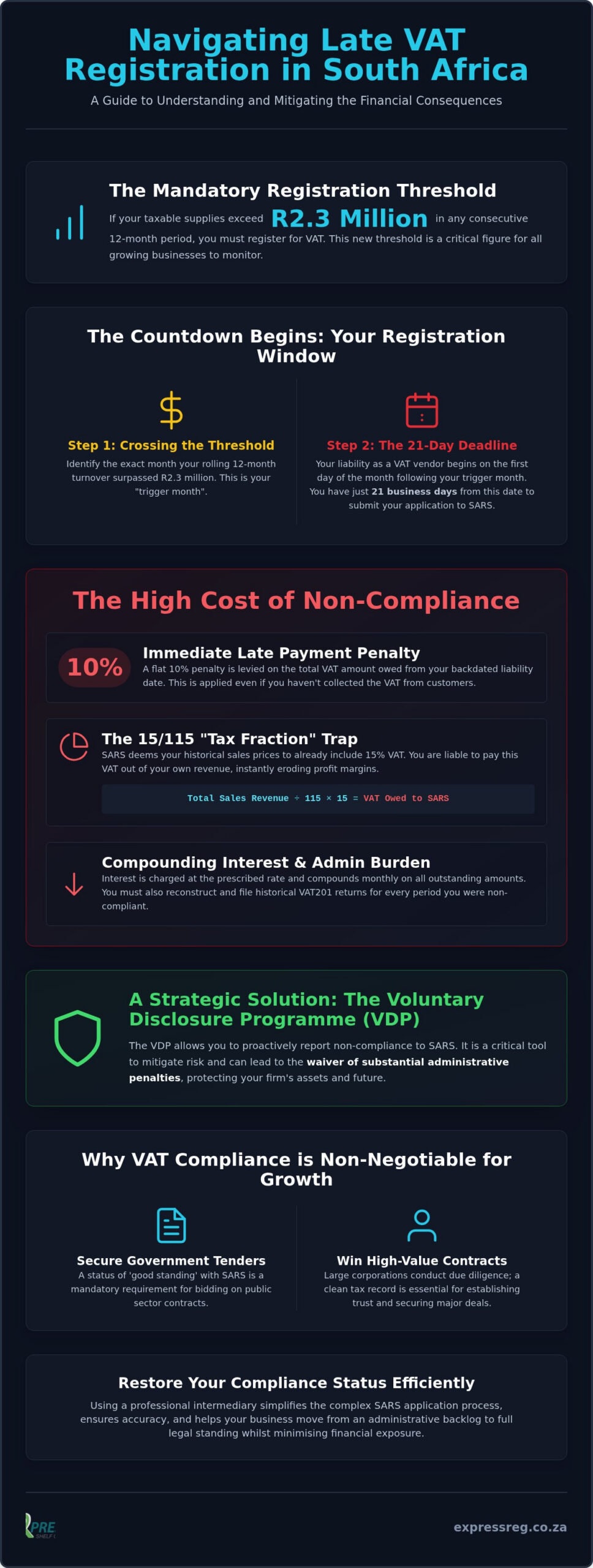
The South African revenue landscape shifted significantly on 1 April 2026. For nearly two decades, the mandatory registration threshold remained at R1 million, but it’s now set at R2.3 million. This update is part of a broader evolution in Taxation in South Africa, designed to reduce administrative pressures on small enterprises. You must register for VAT if your taxable supplies exceed R2.3 million in any consecutive 12-month period. If you miss this window, you face the severe consequences of late VAT registration in South Africa.
The “month-plus-one” rule determines exactly when your liability begins. If your turnover crosses the threshold in July, you’re legally a VAT vendor from the first day of August. You don’t wait for your financial year-end to check these figures; you must monitor your rolling 12-month revenue constantly. Whilst the voluntary threshold also increased from R50,000 to R120,000, the compulsory limit is where the highest risks reside. Rapidly growing businesses often miss these dates because they focus on operations rather than statutory compliance.
Defining Your Effective Date of Liability
Identifying the exact month your turnover exceeded the R2.3 million mark is the first step in managing your risk. Once you hit this target, you have exactly 21 business days to submit your application to SARS. This date isn’t just a suggestion. It’s the anchor for every calculation SARS will perform during an audit. The liability date determines the start of your backdated tax debt and the point from which penalties begin to accrue. If you’re unsure of your crossing point, review your monthly management accounts immediately to pin down the specific trigger month.
The Risk of Being Deemed a “VAT Vendor”
Under Section 1(1) of the VAT Act, SARS treats you as a vendor from the moment you meet the requirements, regardless of whether you’ve received a VAT number. This creates a dangerous financial vacuum. Your Pty Ltd is expected to collect and pay VAT from the liability date onwards. If you haven’t registered, you’re still liable for that money, even though you haven’t charged your customers the extra 15%. This is one of the most punishing consequences of late VAT registration in South Africa. You’re essentially paying the tax out of your own pocket for every sale made whilst unregistered. SARS views this as a debt to the state that exists independently of your current registration status.
Financial Penalties and Interest: The Cost of Non-Compliance
Once you establish your liability date, the financial reality of your delay becomes clear. SARS doesn’t view late registration as a simple oversight; it’s treated as a failure to remit state funds. The primary consequences of late VAT registration in South Africa involve a multi-layered penalty structure that can quickly compound into a significant debt for an unprepared business. It’s vital to calculate these costs early to understand the full extent of your historical liability.
The 10% Late Payment Penalty Explained
This penalty is applied immediately to the total amount of VAT owed from your backdated liability date. If your business should have registered months ago, SARS will calculate the output tax you were supposed to collect during that period. A flat 10% penalty is then levied against that entire amount. This charge applies even if you haven’t yet recovered the VAT from your clients. The late payment penalty is a non-negotiable SARS standard unless relief is sought through formal disclosure channels.
Compounding Interest and Backdated Returns
Beyond the initial penalty, SARS applies interest at the prescribed rate on all outstanding balances. This interest isn’t a one-off charge; it compounds monthly until the debt is fully settled. SARS backdates your registration to the first day of the month following the point you hit the threshold, meaning you’re liable for every transaction thereafter. You’ll face the administrative burden of filing multiple historical VAT201 returns simultaneously. This requires recreating historical records and ensuring every past transaction is correctly accounted for to avoid further discrepancies. Handling this volume of paperwork whilst managing daily operations is often where entrepreneurs feel the most strain. You can simplify this process by using a VAT registration service to ensure your historical filings are accurate and submitted correctly.
Understatement Penalties and Negligence
In cases where SARS determines that the failure to register constitutes gross negligence or intentional tax evasion, they may apply Understatement Penalties. These sanctions can range from 25% to as high as 200% of the tax shortfall, depending on the severity of the behaviour. Whilst most late registrations are treated as administrative delays, a prolonged period of non-compliance increases the risk of these heavier sanctions being applied. Addressing these consequences of late VAT registration in South Africa requires a proactive approach to prevent SARS from initiating an audit before you’ve had a chance to disclose the error voluntarily.
The 15/115 Rule: The Hidden Danger of Retrospective VAT
Most business owners assume that if they haven’t registered for VAT, they simply don’t owe it. However, the South African Revenue Service (SARS) takes a different view once you’ve crossed the mandatory threshold. They treat every Rand you earned from your liability date as being inclusive of VAT. Since you cannot legally issue a tax invoice to past customers to recover this amount, the debt becomes an out-of-pocket expense that directly reduces your net profit. This is arguably one of the most financially crippling consequences of late VAT registration in South Africa.
Calculating Your Out-of-Pocket Liability
SARS uses a specific tax fraction to determine your debt: 15/115. This calculation equates to approximately 13.04% of your total gross turnover. For example, if your business generated R1.2 million in sales during the period of non-compliance, your deemed output VAT liability would be R156,521.74. Because you didn’t charge this to your clients at the time, you must pay this entire amount from your current cash reserves. Your past “all-inclusive” prices are treated as including VAT by default, even if your quotes never mentioned it.
- Step 1: Identify your total gross revenue for the period of non-compliance.
- Step 2: Multiply that gross revenue by 15.
- Step 3: Divide the result by 115 to find your deemed output tax.
Accurate record-keeping is vital during this process. You need to distinguish between exempt, zero-rated, and standard-rated supplies to ensure you aren’t overpaying. Without precise ledgers, SARS may default to the highest possible liability during an audit, further compounding the consequences of late VAT registration in South Africa. You’re effectively paying a massive portion of your historical revenue back to the state.
Input Tax Deductions: A Small Silver Lining?
Whilst the output tax debt is daunting, you aren’t necessarily liable for the full gross amount. You have the right to claim input tax on business-related expenses incurred during the same period. This includes VAT paid on rent, office equipment, and trading stock. However, you must possess valid tax invoices from your suppliers that meet all statutory requirements. If your records are incomplete or your suppliers weren’t VAT vendors themselves, you lose the ability to offset your debt.
Maximising these claims requires a meticulous review of your past accounts. Professional VAT registration South Africa services help you identify every eligible deduction to reduce your final settlement. By organising your historical data professionally, you can mitigate the damage caused by retrospective liability and protect your firm’s operational cash flow. This structured approach ensures you only pay what is legally required whilst restoring your status of good standing.
Mitigating Damage via the Voluntary Disclosure Programme (VDP)
While the financial burden of retrospective VAT is heavy, the South African Revenue Service offers a mechanism to reduce these costs. The Voluntary Disclosure Programme (VDP) allows businesses to “come clean” before an audit begins. By proactively disclosing your failure to register, you move from a state of non-compliance to transparency. This is the most effective way to avoid the harshest consequences of late VAT registration in South Africa.
The primary advantage of a successful VDP application is the potential waiver of the 10% late payment penalty. This can save your business a significant amount of money depending on your historical turnover. Additionally, it protects you from Understatement Penalties, which can reach up to 200% if SARS discovers the error during a field audit. To qualify, your disclosure must be voluntary, full, and complete. Unlike the “discovery” outcome, where SARS finds the error first and applies maximum penalties, the VDP outcome focuses on rehabilitation and settlement. Any omission of past revenue can lead to the rejection of your application and the immediate imposition of all backdated charges.
Eligibility and the 21-Day Rule
Speed is essential when seeking relief from SARS. You must act within 21 days of receiving your VAT number to apply for specific relief related to your historical debt. This window allows you to synchronise your new registration with a formal disclosure of past liabilities. VDP is only available if SARS has not yet notified you of an audit. If you wait until an official letter arrives, you lose the ability to negotiate penalty waivers, and the full weight of the law applies to your historical records.
The Process of Correcting Historical Non-Compliance
Liaising with tax professionals ensures your submission is accurate and defensible, helping you navigate the consequences of late VAT registration in South Africa with expert guidance. SARS requires a detailed breakdown of all missed periods and the corresponding output and input tax. High levels of administrative accuracy are essential for acceptance, as any discrepancies can trigger the very audit you are trying to avoid. Maintaining a clean VAT record also simplifies other statutory obligations, such as your CIPC annual returns submission. This creates a foundation of compliance that supports long-term business growth and tender eligibility. If you are ready to resolve your status, register your business for VAT today to start the disclosure process.
Restoring Your Compliance Status for Business Growth
Resolving the consequences of late VAT registration in South Africa is more than a debt-clearing exercise; it’s a strategic move to unlock your firm’s commercial potential. The most immediate benefit of resolving your VAT status is the activation of a “compliant” Tax Compliance Status (TCS) PIN. This digital certificate is the universal language of trust between your business and the South African Revenue Service. Without a green status on eFiling, your company is effectively invisible to large-scale corporate clients and government procurement officers. Compliance transforms your business from a risky unregistered entity into a verified participant in the national economy.
Securing a VAT number allows you to stop worrying about the looming threat of an audit and start focusing on high-value contracts. Most government departments and private sector supply chains require a valid VAT number before they’ll even consider a proposal. By addressing your historical liabilities now, you ensure that your next major growth opportunity isn’t stalled by a “non-compliant” tax status. Peace of mind comes from knowing your legal standing is secure and your administrative foundation is robust.
Securing Tenders and the Letter of Good Standing
The ripple effect of tax debt extends far beyond your bank balance. If your VAT registration is delayed or your historical returns are outstanding, SARS will block the issuance of your TCS PIN. This blockage has a direct impact on your ability to meet the requirements for letter of good standing South Africa. Many statutory certifications are interlinked; a failure in tax compliance often results in the Department of Employment and Labour refusing to issue letters of good standing for COIDA. Proactive registration ensures that all your statutory pillars, including UIF and PAYE, remain upright and functional. This interconnectedness makes VAT compliance a non-negotiable prerequisite for any business aiming to be a reliable partner in the public or private sectors.
Next Steps: Professional VAT Registration Support
Navigating the consequences of late VAT registration in South Africa alone can lead to further delays and technical errors on the eFiling portal. Using an expert consultant is significantly faster than trying to interpret complex tax legislation yourself. A professional intermediary handles the heavy lifting of documentation, ensuring that your application is correct the first time. This support also extends to ensuring your company directors and beneficial ownership filings are up to date, which is essential for maintaining your CIPC standing. Don’t let administrative complexity hold your business back from its next milestone. Register for VAT with Express Shelf Company today to restore your compliance status and secure your firm’s future growth.
Take Control of Your Statutory Compliance Today
Managing your tax obligations shouldn’t be a source of constant anxiety. By identifying your exact liability date and understanding the 15/115 tax fraction, you can quantify your historical debt and plan for a structured settlement. Proactively applying for the Voluntary Disclosure Programme remains the most effective way to neutralise the harshest consequences of late VAT registration in South Africa. This step protects your firm’s cash flow whilst ensuring you don’t lose out on lucrative government tenders or corporate contracts.
Transitioning to full legal standing is significantly simpler with a reliable intermediary handling the heavy lifting of paperwork. Express Shelf Company provides specialised SARS VAT application support and fixed-fee administrative filing services for Pty Ltd firms and shelf companies nationwide. We offer expert guidance on VDP applications to help you secure a compliant TCS PIN without the stress of navigating eFiling alone. Contact Express Shelf Company for professional VAT registration services today. Your path to sustainable business growth starts with a clean compliance record and a partner you can trust.
Frequently Asked Questions
Can SARS backdate my VAT registration?
Yes, SARS has the authority to backdate your registration to the exact month your turnover crossed the R2.3 million threshold. This retrospective liability is one of the most severe consequences of late VAT registration in South Africa. You’ll be required to file returns for every missed period since that date. This creates an immediate debt for output tax that you likely never collected from your historical customers whilst you were operating as an unregistered entity.
What is the penalty for late VAT registration in South Africa?
SARS imposes a flat 10% late payment penalty on the total VAT amount owed since your liability date. Interest also accrues at the prescribed rate until the full balance is settled. In cases of gross negligence, Understatement Penalties can range from 25% to 200%. These charges are applied automatically unless you seek relief through the Voluntary Disclosure Programme before an audit is initiated by the revenue service or a field inspector.
How do I calculate VAT if I didn’t charge it to my customers?
You must apply the “tax fraction” calculation of 15/115 to your total gross revenue earned during the period of non-compliance. SARS treats your past selling prices as including VAT by default. Because you cannot legally invoice past customers for this tax retrospectively, the resulting 13.04% liability becomes a direct out-of-pocket expense. This often places a significant strain on a firm’s operational cash flow and historical profit margins during the restoration process.
Can I claim input tax for periods before I was registered for VAT?
You are generally permitted to claim input tax on business expenses incurred during the backdated period of your liability. This includes VAT paid on trading stock, equipment, and rent. However, you must possess valid tax invoices from your suppliers that clearly state your company details where required. These claims are vital for offsetting the output tax you owe, but they require meticulous record-keeping to be accepted by SARS during a formal verification process.
What is the SARS Voluntary Disclosure Programme (VDP)?
The Voluntary Disclosure Programme (VDP) is a mechanism that allows you to report tax defaults to SARS before they discover them. By “coming clean” voluntarily, you can avoid criminal prosecution and potentially secure a waiver of the 10% late payment penalty. It’s a critical tool for mitigating the consequences of late VAT registration in South Africa whilst ensuring your business returns to a status of full legal standing and is eligible for future tenders.
Will late VAT registration affect my Tax Clearance Certificate?
Your Tax Compliance Status (TCS) PIN will reflect as “non-compliant” as soon as SARS identifies a failure to register or outstanding returns. This prevents you from obtaining a Tax Clearance Certificate, which is essential for government tenders and corporate contracts. Your status will only be restored once all historical VAT201 returns are submitted and any resulting debt, including penalties and interest, is fully paid or a formal payment arrangement is approved by SARS.
How long does the VAT registration process take with SARS?
The standard timeframe for SARS to process a VAT registration is 21 business days. However, this period can be extended if SARS issues verification queries or requires a site visit to your business premises. Ensuring your application is complete and includes all necessary supporting documents is the best way to avoid delays. Professional intermediaries often streamline this process by managing the eFiling submission and resolving any administrative queries on your behalf to ensure correctness.
Can I register for VAT voluntarily if my turnover is below R2.3 million?
Yes, you can apply for voluntary registration if your taxable supplies exceeded R120,000 in the previous 12-month period. This threshold was increased from R50,000 on 1 April 2026. Voluntary registration is a strategic choice for smaller firms that want to claim input tax on their expenses or need a VAT number to qualify for specific tenders. It demonstrates a commitment to compliance and allows you to participate in formal corporate supply chains and tender processes.