You download your company’s latest CIPC disclosure certificate and spot a director’s name or registered address that doesn’t match your records. Before submitting another form, compare the entry with the original filing and establish whether the difference came from a CIPC data-capture error, incorrect information submitted by the company, or a later change. This is the first step in working out how to fix incorrect information on CIPC records.
An inaccurate entry can complicate company administration and compliance, but the right correction depends on what happened and which record is affected. Using a process intended for a different type of issue can create extra work without resolving the mismatch.
This guide explains how to compare CIPC records with company documents, pinpoint an error and identify the appropriate correction or amendment route. You’ll also learn how to organise supporting information, follow up on a submission and check that the record has been updated accurately. Express Shelf Company provides administrative support with CIPC filings to help keep the paperwork clear and organised.
Key Takeaways
- Compare the affected CIPC record with reliable company documents to identify the exact discrepancy.
- To work out how to fix incorrect information on CIPC records, establish whether it is a processing error, an incorrect company filing or a genuine later change.
- Gather company identification details and relevant evidence, such as the original filing, CIPC correspondence and approved company documents.
- Follow the current CIPC process for the specific record, then review the updated company information to confirm the result.
- Keep approved company records organised and compare them with CIPC details after relevant filings to help prevent future mismatches.
How to identify incorrect information on CIPC records
Start by identifying the specific CIPC record and comparing it with reliable company documents. A mismatch could involve the company name or registration details, a director’s information, a registered address, beneficial ownership information or another filed record. Note the exact field and what it currently shows before deciding what to do.
Accurate records support routine administration, compliance checks and dealings with organisations that rely on a company’s registered details. An inconsistency may prompt questions when you submit a filing or provide company information to a bank or another relevant body. The Companies and Intellectual Property Commission (CIPC) maintains South Africa’s company and intellectual property registers, so identify which record you’re reviewing and what information it contains.
Definition: An incorrect CIPC record is information displayed on a company record that differs from reliable, approved company information. A visible discrepancy is a reason to investigate, but it doesn’t by itself prove that CIPC made a processing error. Comparing the original filing with later records can help establish where the difference arose.
Which company details should you compare?
Review the latest disclosure certificate alongside the company’s incorporation documents, including its registration certificate (CoR14.3) and, where relevant, its Memorandum of Incorporation (MOI). Check the company name and registration number first. Even a small spelling difference or an incorrect digit can make it harder to match the record to the right company.
For director details, compare the CIPC entry with approved company records and the documents supporting the appointment, resignation or other change. Check names and identifying information carefully. If the discrepancy concerns an address or beneficial ownership entry, compare the displayed details with the company’s approved records and the relevant filing documents.
Next, establish what kind of record you’re looking at:
- An existing record: Was the information already present before you noticed the issue?
- A filed update: Does the CIPC entry match the information in the submitted document?
- A recent change: Did the company’s details change after the record was last updated?
This distinction matters. Information that was correct when filed but has since changed may need to be updated through the relevant company process. If the current entry differs from the original submission, compare the documents before concluding that the filing itself was wrong.
How can you document the discrepancy?
Before making a correction request or amendment, write down the exact field, what the CIPC record shows, what the company documents show and the date you checked the record. Avoid a general description such as “director details are wrong”. State which detail differs and what the supporting records show instead.
Gather documents that help explain the entry’s history, such as the relevant CIPC notice or certificate, the filed document and any company resolution or other approved record. Keep correspondence and filing references with your notes. This gives you a clear basis for deciding how to fix incorrect information on CIPC records and makes follow-up easier.
How to choose the right way to correct CIPC information
First establish whether the CIPC record differs from what the company filed, whether the company submitted incorrect information, or whether the information was accurate but has since changed. These situations can require different processes. Choosing a route based only on what looks wrong may result in a filing that does not address the cause.
When deciding how to fix incorrect information on CIPC records, use the original filing as a reference point. Compare it with the current record and the company’s approved documents, then follow the current CIPC instructions for the specific record and issue. The scenarios below can help you identify what to investigate. Forms, channels and evidence requirements vary by process, so use the instructions that apply to your case.
| Issue | Likely route to investigate | Evidence to prepare |
|---|---|---|
| The current record differs from the information in the original submission. | Investigate whether the discrepancy may be a CIPC processing or data-capture error. | Original filed document, current CIPC record and any related CIPC correspondence. |
| The company submitted information that was incorrect at the time. | Identify the applicable correction or amendment process for that record. | Filed document, accurate company-approved information and relevant supporting records. |
| The information was correct, but the company’s circumstances later changed. | Look into the process for recording a subsequent company change. | Approved company documentation and evidence relevant to the change. |
When might the record need correction rather than a new change?
A correction may be appropriate to investigate when the original submission doesn’t match the resulting CIPC entry. For example, if the filed document shows one version of a company detail but the current record shows another, compare both before deciding what to request. Identify the precise field and difference rather than describing the entire record as incorrect. This comparison can help show whether the issue may be a processing error or have another cause.
When is an amendment or later filing more appropriate?
A genuine change after registration isn’t automatically an administrative error. If a director leaves the company or a new director is appointed, the issue may be how to record that subsequent change, rather than how to correct the earlier entry. The applicable form, terminology and submission requirements depend on current CIPC instructions. For this type of update, the CIPC director changes guide explains the relevant process in more detail.
If the distinction is unclear, avoid submitting a new change simply to make the displayed information look right. Express Shelf Company provides administrative support with CIPC filings, helping you prepare and manage company documentation in line with the issue being addressed.
What evidence and information should you prepare for a CIPC correction?
A well-organised correction file helps show which company record is affected, what information you believe is accurate and how the mismatch may have arisen. Requirements depend on the record and the CIPC process, so use this as a preparation checklist rather than a universal list of documents to submit.
A useful evidence checklist covers company identification, the exact field in question, proof of the correct information, documents showing the original filing and any CIPC correspondence or company approval relevant to the discrepancy. These categories help you build a clear account without assuming that every item is required for every correction.
- Company identification: Note the registered company name and registration number so the record can be identified accurately.
- The affected field: Describe what the CIPC record currently shows and what the company’s approved information shows.
- Evidence of the correct detail: Gather the relevant approved company record or supporting document that substantiates the accurate information.
- Filing history: Locate the original submission, filing reference or notice connected to the entry.
- Related correspondence: Include relevant CIPC messages and company-approved documents, such as a resolution, where they help explain the issue.
How to assemble a clear correction file
Separate documents that support the correct details from those that explain how the discrepancy arose. An approved company record may support the accurate information, while the original filing and a CIPC notice may help show where the mismatch appeared. Label each file with its purpose and date, check that copies are legible and link every item to the field it supports.
Keep a complete copy of what you submit, along with any acknowledgement or reference provided. A simple file structure can make follow-up clearer:
- 01 Company identification: documents or details identifying the entity.
- 02 Correct information: evidence supporting the accurate entry.
- 03 Filing history: original documents and relevant references.
- 04 Correspondence: CIPC messages and submission acknowledgements.
Organising the file also helps you explain the issue consistently if you need to follow up. Before submitting, read the current CIPC instructions for the route you’ve identified. The evidence required may differ by record type and process.
How to protect consistency across company filings
Compare the proposed correction with the company’s approved records before submission. Then check whether the same detail appears in other filings. A director’s name or company address, for instance, may be repeated across records. Correcting one entry without checking related information could leave other mismatches unresolved.
If the discrepancy affects annual-return information, compare the relevant details with the records used for that filing. The CIPC annual returns compliance guide covers the annual-return process and can help you assess that context. A consistent evidence file gives you a clearer basis for deciding how to fix incorrect information on CIPC records and checking the outcome against approved company information.
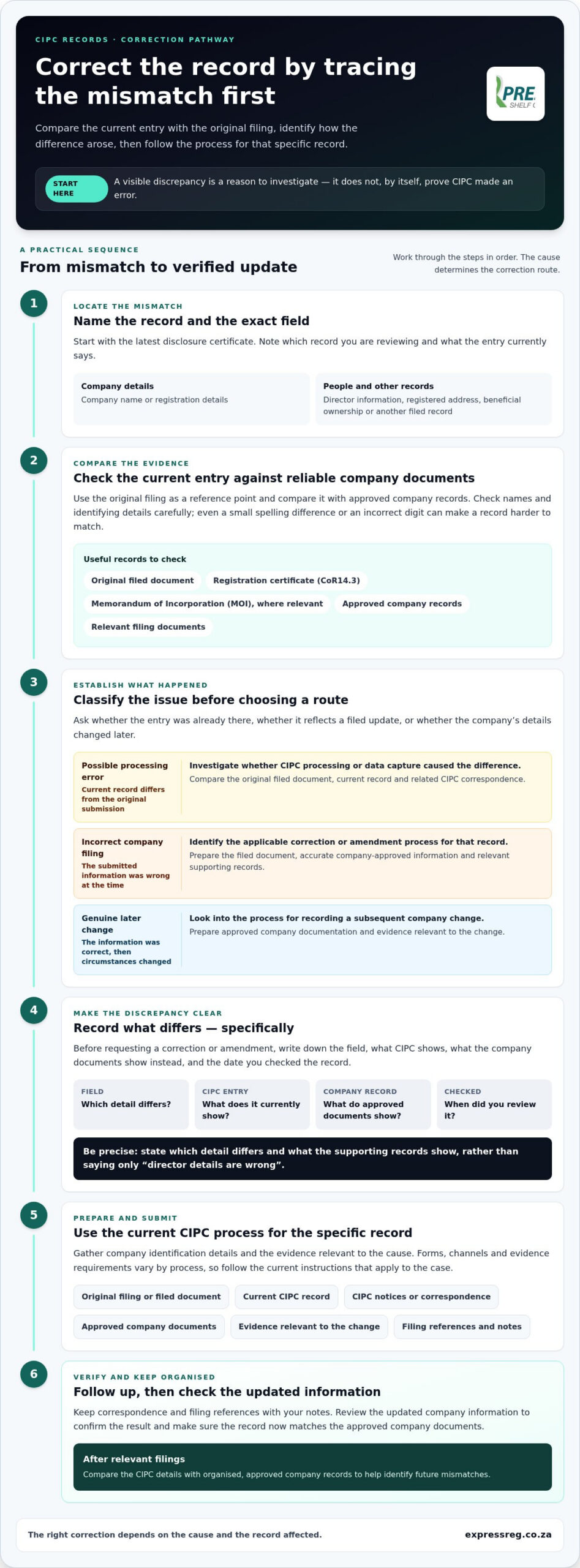
How to submit and follow up a CIPC records correction
Once you’ve identified the discrepancy and gathered evidence, follow a clear process: confirm the appropriate route, submit the relevant documents and check the updated record. CIPC channels and requirements can differ by issue, so follow the current official instructions for your specific correction or filing. A correction request and a company amendment may not use the same process.
What to do before submitting a request
Prepare a concise explanation that identifies the company, the record or field in question, what it currently shows and what the supporting documents indicate. Keep the request focused. A direct comparison makes clear what you want reviewed and how the evidence supports it.
- Confirm the company details. Check the registered name and registration number against your company documents, then identify the exact CIPC record and field that need attention.
- Check the current CIPC instructions. Find the official channel and process for the specific issue. For example, CIPC lists corrections@cipc.co.za for requests concerning data-capture errors and duplications. Confirm that this channel and its requirements apply to your case before using it.
- Prepare the explanation and evidence. Describe the discrepancy in plain language and attach relevant supporting documents in the format required by the current instructions. Make sure the evidence relates directly to the field you’re asking CIPC to review.
- Submit through the specified channel. Follow the stated steps, include the required information and keep a complete copy of the request and attachments.
How to track the outcome and check the record
Submission isn’t the final check. Keep the acknowledgement, reference number and CIPC correspondence together so you can trace the request and respond accurately if further information is requested.
- Save the submission record. Note the date sent, the channel used and any tracking or reference details provided.
- Follow the stated follow-up process. Check progress using the method in CIPC’s instructions or acknowledgement. If CIPC asks for more information, respond to the specific request, attach relevant evidence and keep a copy of your reply.
- Review the outcome. After receiving an outcome, retrieve or review the affected company record. Compare the field with the approved company information rather than relying only on a notification that the request was processed.
- Keep proof of the result. Save the updated record or disclosure certificate with the correspondence and submission reference in the company’s records.
This approach makes how to fix incorrect information on CIPC records easier to manage and gives you a clear trail if follow-up is needed. For practical help preparing and managing company documentation, explore CIPC filing support.
How to keep CIPC records accurate after a correction
Once a correction has been processed, make it part of your company’s recordkeeping routine. A corrected CIPC entry is only one version of the information the business uses. If internal documents or later filings continue to rely on an outdated detail, the mismatch can appear again.
Keep one controlled source for current company information, such as a secure register or company folder, and make clear who updates it. Store approved details and supporting documents together, including resolutions and filing records. This gives the person preparing the next submission a consistent reference instead of requiring them to piece together information from old emails and documents.
What checks help prevent repeat discrepancies?
Use a short review before and after each relevant filing. Before submission, compare the information with the company’s approved records. Afterwards, check the CIPC acknowledgement or updated record against the details filed. Assign someone to own these checks and record any follow-up required, so confirmations are reviewed rather than simply saved and forgotten.
- Maintain one current source: Update the company’s controlled record when a detail is approved or officially changed, and retain previous versions for reference.
- Review before filing: Compare names, registration details and other relevant fields with approved company information and supporting documents.
- Save the final submission: Keep a copy of the completed filing and its supporting evidence, not only the draft.
- Check the result: Review the relevant CIPC record after a filing and note any difference that needs follow-up.
Keep recurring compliance obligations separate from correcting a specific record. A correction addresses a discrepancy in existing information; an annual return is a recurring filing with its own requirements. One doesn’t replace the other. If an annual-return filing uses company details that have changed or been corrected, compare the information before submission and make sure the records align.
When can administrative filing support help?
Company paperwork is easier to manage when records, evidence and filing details are organised around the specific CIPC process. Administrative filing support can help businesses prepare and manage documentation for filings such as director changes, annual returns and beneficial ownership submissions. The filing required depends on the record and the nature of the issue.
For practical assistance organising company documents for a CIPC filing, get help with CIPC filings from Express Shelf Company. Keeping approved company information, submission records and updated CIPC details aligned can make future administration clearer and reduce avoidable discrepancies.
Make accurate CIPC records part of your routine
A corrected record is a useful opportunity to reset your company’s filing routine. Set a clear process for approving company information, keeping supporting documents together and reviewing CIPC updates after submissions. Future filings can then start from a reliable source rather than a trail of old versions.
If you’re still deciding how to fix incorrect information on CIPC records, focus on the next practical step: organise the documents connected to the discrepancy and identify the filing that needs attention. Express Shelf Company supports businesses across South Africa with CIPC filings, including annual returns, director changes and beneficial ownership filings.
Get organised support with CIPC filings from Express Shelf Company and take the next step with a clear, well-managed set of company documents.
Frequently Asked Questions
Can I correct incorrect information on CIPC records online?
An online route may be available, depending on the record and whether the issue is a processing discrepancy or information supplied by the company. To decide how to fix incorrect information on CIPC records, follow the current CIPC instructions for that specific correction or filing rather than assuming one form covers every case. Prepare the requested evidence, submit through the stated channel and save the acknowledgement for follow-up.
How do I know whether CIPC or my company made the mistake?
Compare the document your company submitted with the current CIPC entry, then review any notice or email about that filing. If the submitted document contains the correct detail but the record differs, that may point to a processing discrepancy. If the company submitted incorrect information, a different filing route may apply. Note what each document shows and its date, then follow the process that applies to the issue.
What documents do I need to correct a CIPC company record?
There isn’t one document list for every correction. Requirements depend on the information involved and the current process. Useful categories include the company’s name and registration number, the original filing connected to the entry, evidence supporting the correct detail and relevant CIPC correspondence. A resolution may help explain an approved company decision. Follow the current CIPC requirements for your issue, and retain copies of the complete submission and attachments.
How long does it take CIPC to correct incorrect company information?
CIPC processing time isn’t fixed across all corrections. It may depend on the type of request, whether the supporting evidence is complete, current processing and whether CIPC asks for more information. Keep the submission reference and monitor correspondence so you can respond through the stated channel. After an outcome, check the company record itself. If CIPC publishes a turnaround estimate for your process, use its current official guidance.
Can I change a director’s details by correcting a CIPC record?
If the director information changed after the existing record was accurate, you may need to report a genuine director change rather than correct an old entry. If the submitted details and resulting record don’t match, investigate a possible processing discrepancy instead. The appropriate route depends on what happened and current CIPC instructions. For a genuine update, see the CIPC director changes guide for detailed filing guidance.
What should I do if the incorrect information remains after I submit a correction?
Check whether CIPC acknowledged your submission and whether the reference matches the request you sent. Read later correspondence carefully, including requests for additional evidence, and respond through the stated official follow-up channel. Keep a dated log of checks, messages and replies. If the record remains unchanged, the request may still be pending or need clarification. Follow the applicable process rather than sending a duplicate without checking its status.