
Could a single administrative oversight on your company board disqualify your business from a major tender or a critical banking facility? It’s a risk many South African entrepreneurs face when their statutory records fall out of sync with their actual leadership. We know the frustration of battling the director change CIPC process, from the temperamental OTP system to the constant fear of accidental deregistration. You need your records to be accurate and compliant, but the administrative hurdles often feel designed to consume your time and energy.
This guide simplifies the transition by providing a professional breakdown of the 2026 CIPC requirements. You’ll learn how to master the amendment process whilst ensuring your company remains in full legal standing. We’ll examine the essential COR39 forms, clarify the digital filing steps, and show you exactly how to secure an updated disclosure certificate with confidence. By following this structured approach, you can move from administrative confusion to a state of organised efficiency and peace of mind.
Key Takeaways
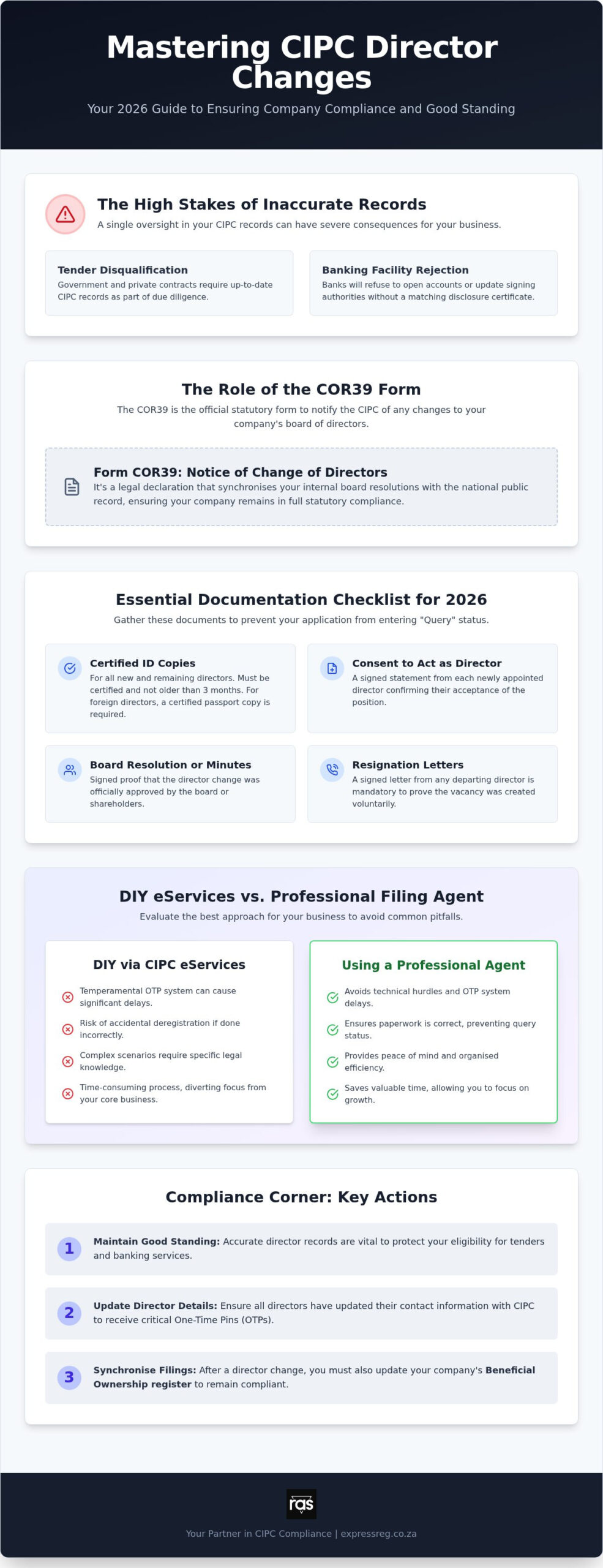
- Recognise that a director change is a mandatory statutory update that synchronises your company board with the public COR39 record.
- Gather all required documentation, such as certified ID copies and board resolutions, to prevent your application from falling into “Query” status.
- Master the 2026 director change CIPC workflow by ensuring all directors have updated their contact details to receive critical OTPs.
- Evaluate the benefits of using a professional filing agent to avoid the delays and technical hurdles associated with the standard eServices portal.
- Maintain your company’s “Good Standing” to protect your eligibility for national tenders and essential banking services.
What is a Director Change at CIPC?
A director amendment is the formal process of updating the national registry to ensure your company’s public records accurately reflect its internal leadership. The Companies and Intellectual Property Commission (CIPC) maintains this database to provide transparency for creditors, investors, and state organs. When you perform a director change CIPC filing, you’re essentially synchronising your internal resolutions with the state’s master file.
This synchronisation is a legal necessity. Accuracy is vital for business continuity. Without a matching disclosure certificate, most commercial banks will refuse to open new accounts or update signing authorities. Similarly, government tenders and private contracts often require a current CIPC record as part of the due diligence process. Failing to keep these records updated can lead to administrative delays that stall your company’s growth.
When is a Director Amendment Required?
Business needs often dictate changes to the board. You’ll need to file an amendment during company expansion when new talent is appointed to guide specific departments. Restructuring or mergers also trigger this requirement. Conversely, directors might leave due to retirement or to pursue other career shifts. In more complex scenarios, a board might initiate the removal of a director under Section 71 of the Companies Act. This process involves specific legal steps and notifications that must be meticulously documented before the CIPC will accept the change.
The Role of the COR39 Form
The COR39 is the official statutory instrument used to update and maintain the accuracy of a company’s director records within the national registry. It serves as the official notice of change, informing the regulator of any leadership shifts within a private or public company. This document reflects the current board composition by listing who has been appointed and who has ceased to hold office.
It’s not merely a piece of paperwork; it’s a legal declaration. Once processed, the information on this form updates your company’s disclosure certificate, providing the peace of mind that your business remains in full statutory compliance. Whether you’re handling a director change CIPC submission for a single appointment or a total board overhaul, the COR39 is the foundation of the entire process.
Essential Requirements for a CIPC Director Change
Success with a director change CIPC filing depends entirely on the quality of your supporting documents. The regulator has become increasingly strict regarding the validity of certifications and the specific wording of board resolutions. If your paperwork is incomplete or outdated, the application will likely be queried, causing unnecessary delays that could stall your banking updates or tender applications. Preparation is the most effective way to ensure a smooth transition.
It is also vital to recognise that any leadership update now triggers a secondary compliance requirement. You must update your records on the Beneficial Ownership register whenever a change in board composition occurs. This ensures your company remains fully compliant with 2026 anti-money laundering regulations and maintains its status in good standing. Failing to synchronise these two filings can lead to administrative red flags during your next annual return submission. For a comprehensive breakdown of exactly what this process entails, consult our beneficial ownership filing CIPC reference guide to ensure your disclosures meet the latest 2026 requirements.
Documentation Checklist for 2026
The CIPC requires a specific set of documents to verify any amendment to your board. Ensure you have gathered the following before starting your application:
- Certified ID Copies: All new and remaining directors must provide clear copies of their South African ID books or cards. These certifications must not be older than three months.
- Consent to Act: Every newly appointed director must sign a formal statement confirming their acceptance of the position and its legal responsibilities.
- Board Resolution or Minutes: You must provide a signed resolution or the minutes of the meeting where the director change CIPC was officially approved by the board or shareholders.
- Resignation Letters: For any director leaving the company, a signed letter of resignation is mandatory to prove the vacancy was created voluntarily.
Handling Complex Scenarios
Not every board change is straightforward. If a director is deceased, you must provide a certified copy of the death certificate to remove them from the registry. For foreign directors who do not possess a South African ID, a certified copy of their valid passport is required instead. It is also important to distinguish between “Alternate Directors” and “Executive Directors” during the filing, as their roles and the necessary supporting evidence may differ. If your records are currently a mess, you might want to arrange a professional review to clear any existing data mismatches before submitting new changes.
Finally, remember that the CIPC uses a One-Time Pin (OTP) system for verification. Every director involved in the change must have an updated cell phone number and email address on the CIPC system. If these contact details are obsolete, the OTPs will not arrive, and the entire amendment process will grind to a halt. Verify these details with your board members before you initiate the filing to avoid technical frustrations.
DIY eServices vs. Professional Filing Agents
Entrepreneurs often choose the DIY route to save on immediate costs, assuming the eServices portal is a simple plug-and-play solution. However, the time-cost of administrative delays frequently outweighs these initial savings. A director change CIPC filing requires absolute precision in every field. Filing agents provide a rigorous professional review that prevents the dreaded “Query” status, which occurs when submitted documents don’t align perfectly with the regulator’s existing database. This proactive checking is the best way to avoid the high rejection rates that plague many self-service applications.
Managing the OTP (One-Time Pin) process is another major hurdle that often surprises business owners. When a board has multiple members, coordinating the simultaneous arrival and submission of pins can be a logistical nightmare. Professional consultants use established workflows to manage these communications efficiently, ensuring that no application expires due to a missed text message or email. This structured approach is a core part of maintaining overall statutory compliance for your business, allowing you to focus on operations whilst we handle the bureaucracy.
The Risks of Incorrect Filing
Errors in the amendment process have far-reaching consequences that go beyond a simple rejected form. If your CIPC records don’t match your internal share registers or board minutes, your business effectively loses its legal consistency. This discrepancy can block critical secondary processes, such as VAT registration or the renewal of tax clearance certificates. The frustration of dealing with expiring OTPs and repeated manual submissions often leads to administrative burnout, leaving the company board in a state of non-compliance for months. It’s not just about the form; it’s about the integrity of your corporate identity.
Why Managed Services Offer Better Value
Choosing a managed service provides budget certainty through fixed-fee structures. You won’t face hidden administrative surprises or mounting costs from resubmitting failed applications. Expert oversight offers peace of mind, knowing that a seasoned facilitator is handling the heavy lifting of paperwork and regulatory liaison. Because filing agents use dedicated administrative channels and possess deep procedural knowledge, they often achieve faster turnaround times for a director change CIPC than a business owner navigating the portal for the first time. It’s a strategic choice between struggling with a complex government interface and partnering with a guide who values your time and procedural accuracy above all else. Businesses that want to eliminate this ongoing burden entirely can benefit from professional statutory compliance services in South Africa that manage all regulatory obligations under a single, structured arrangement.
How to Organise a Director Change Successfully
Organising a leadership transition requires a methodical approach to satisfy both internal governance and state requirements. The director change CIPC workflow is strictly sequential. Skipping a step or mismanaging the timing often leads to the entire application being voided by the regulator. Start by auditing your current board’s contact information to ensure the digital verification phase proceeds without interruption.
Follow these five steps to ensure a successful amendment:
- Step 1: Update Contact Details. Verify that every director has a current mobile number and email address recorded on the CIPC system. This is the only way to ensure One-Time Pins (OTPs) reach the correct recipients.
- Step 2: Formalise Resolutions. Convene a board meeting to approve the change. Draft a clear resolution that specifies the effective date of the appointment or resignation whilst ensuring all signatures are present.
- Step 3: Portal Capture. Log into the CIPC portal to capture the amendment details. Upload your certified IDs, resignation letters, and signed resolutions as a single, legible PDF package.
- Step 4: Manage Approvals. Once the case is logged, the system triggers approval links via SMS and email. You must coordinate with all affected directors to ensure they respond to these prompts immediately.
- Step 5: Final Verification. After processing, download your updated disclosure certificate (COR39 or CoR14.3). This document confirms the registry matches your internal records and serves as proof of compliance.
Navigating the OTP and Approval Process
The CIPC operates on a strict 24-hour window for digital approvals. If any director fails to click their link or enter their OTP within this timeframe, the case may be automatically cancelled. Speed is essential once the case is logged. Common failures occur when SMS gateways delay messages or email filters divert links to spam folders. Use your unique Customer Code to track the application status in real-time. If you find the technical interface overwhelming, you can outsource your director change filing to our expert consultants for a guaranteed result.
Post-Amendment Compliance Actions
Your work isn’t finished once you receive the updated certificate. You must immediately notify your bank and other financial institutions to update signing powers and FICA records. This leadership change also impacts your tax standing; align the new board details with your SARS tax profile to avoid administrative mismatches. Finally, check that your Letter of Good Standing remains valid. A change in directors can sometimes trigger a review of your COIDA status. Maintaining this synchronisation ensures your business remains competitive for national tenders and corporate contracts. To stay ahead of all your regulatory obligations beyond this single amendment, explore how dedicated statutory compliance services in South Africa can protect your business standing across every filing requirement throughout 2026.
Streamline Your CIPC Compliance with Express Shelf Company
Managing a director change CIPC filing doesn’t have to be a source of administrative dread or technical frustration. As a professional filing agent, Express Shelf Company acts as your reliable intermediary, standing between your business and the complex machinery of government administration. We handle the heavy lifting of paperwork and portal navigation, allowing you to focus on your core operations whilst we ensure your board records remain accurate and compliant. Our team understands the nuances of the South African regulatory landscape, providing a grounded, matter-of-fact approach that builds trust through transparency.
We operate on a fixed-fee model to provide you with total budget certainty. You won’t encounter hidden administrative surprises or mounting costs from resubmitting queried applications. This transparency is part of our commitment to simplicity and organised efficiency. Whether you are looking to acquire one of our shelf companies to jumpstart a project or need to update an existing board, our services are designed to facilitate a smooth transition to full legal standing.
Our Professional Administrative Process
Every application we handle undergoes a rigorous internal review before it ever reaches the regulator. We examine your certified IDs, resolutions, and letters of resignation to identify potential errors that often lead to rejections in the DIY portal. This proactive oversight allows us to maintain a high success rate and prevents your business from falling into a state of non-compliance. We manage the communication with the CIPC on your behalf, resolving technical glitches and tracking the case through our dedicated administrative channels. We provide comprehensive administrative support to firms across all nine provinces, ensuring national service coverage for every South African business.
Get Started with Your Director Change Today
Our onboarding process is designed for speed and correctness. Once you provide the basic board details, our consultants take over the administrative workflow, guiding you through the documentation requirements with clear, actionable instructions. This methodical approach ensures that your director change CIPC is captured correctly the first time, securing your updated disclosure certificate without the typical delays. Beyond board amendments, you can access our full suite of statutory and tax services, including VAT registration, COIDA submissions, and annual returns, to maintain a foundation of total compliance.
Don’t let administrative hurdles stall your company’s progress or disqualify you from essential business opportunities. Take the first step toward a compliant and organised board by partnering with a facilitator that values your time and peace of mind. Enquire about our professional director change services today and experience a more efficient way to manage your statutory obligations.
Secure Your Company Board’s Statutory Future
Maintaining an accurate registry is no longer just a matter of filing a form; it’s a strategic requirement for any business aiming to thrive in 2026. Ensuring your COR39 records match your internal resolutions and beneficial ownership filing CIPC disclosures is critical for banking access and tender eligibility. Whilst the technical hurdles of the OTP system can be taxing, the path to compliance is manageable with the right preparation and documentation. You don’t have to face these bureaucratic challenges alone.
As a CIPC Registered Filing Agent, Express Shelf Company offers national South African coverage with a fixed-fee professional service. We handle the heavy lifting of the director change CIPC process, providing you with a seamless transition and total peace of mind regarding your legal standing. Let our experts handle your CIPC director changes today to ensure your business remains in good standing without the administrative stress. We’re ready to help you organise your corporate records with efficiency and precision.
Frequently Asked Questions
How long does a director change take to reflect at CIPC?
A standard director change CIPC filing typically reflects within one to five working days once all parties have approved the digital links. This timeline assumes that every director responds to their OTP within the 24-hour window and that the uploaded documents meet all certification requirements. If the regulator queries the application due to mismatched data, the process can extend significantly whilst you resolve the discrepancies and resubmit the corrected paperwork.
Can I change a director if the company annual returns are outstanding?
You cannot successfully process a director amendment if your company’s annual returns are outstanding. The CIPC system often blocks administrative changes for companies that are not in “In Business” status or those flagged for deregistration. You must first settle all overdue return fees and ensure your company is in good standing before the portal will allow you to capture new board appointments or resignations. Clearing these debts is a prerequisite for any statutory update.
What happens if a director refuses to resign or sign the COR39?
If a director refuses to resign, the board must follow the formal removal process outlined in Section 71 of the Companies Act. This involves serving the director with a notice of the proposed resolution and allowing them to make a presentation before the shareholders vote. Once the shareholders pass the resolution for removal, you can file the director change CIPC amendment using the minutes of that meeting as your supporting evidence for the transition.
Is it mandatory to update beneficial ownership when changing directors?
It is mandatory to update your Beneficial Ownership register whenever there is a shift in your company’s board composition. The 2026 regulations require that your ownership records and director records remain perfectly synchronised to prevent administrative penalties. Failing to update this register during a leadership change can lead to complications when you attempt to file your next annual return or apply for government tenders, as the regulator cross-references these specific data sets.
Do I need to notify SARS when a director is changed at CIPC?
You must notify SARS of any leadership changes to ensure your tax profile remains accurate and compliant. Whilst the CIPC and SARS systems share some data, it’s your responsibility to update the “Registered Particulars” on eFiling to match your new CIPC disclosure certificate. This alignment is vital for maintaining your Tax Compliance Status, as mismatched records can trigger unnecessary audits or prevent the issuance of a Tax Clearance Pin during contract negotiations.
Can a company have only one director in South Africa?
A private company (Pty) Ltd in South Africa is legally permitted to have only one director. This individual can also serve as the sole shareholder of the entity. However, if your business is registered as a Non-Profit Company (NPC), you are required by law to maintain a minimum of three directors on your board at all times. Always check your Memorandum of Incorporation to ensure your board size complies with your company’s specific internal governance rules.
What is the cost of a CIPC director change in 2026?
The CIPC charges a prescribed statutory filing fee for processing a director amendment, which is deducted from the customer credit account used for the submission. Professional filing agents charge additional service fees for managing the documentation, verification, and OTP logistics on your behalf. Since professional costs vary based on the complexity of the board change, it’s best to request a fixed-fee quote to ensure you have budget certainty before you initiate the amendment process.
How do I update a director’s contact details if they no longer have access to their old phone number?
If a director loses access to their registered phone number, they must update their contact details through the CIPC’s dedicated verification function. This often requires a manual verification step where the director provides their ID number and answers specific security questions to prove their identity to the regulator. Once the new mobile number or email address is authenticated, the system will be able to send the necessary OTPs for any future board amendments or statutory filings.