
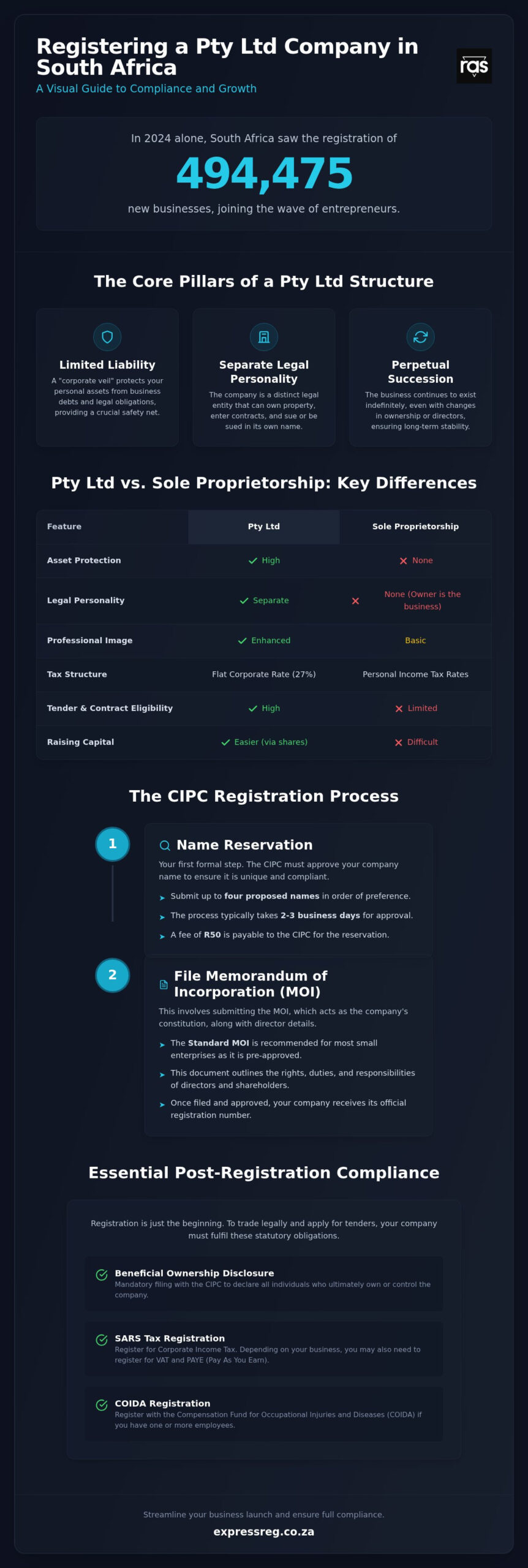
Did you know that 494,475 new businesses were registered in South Africa in 2024 alone? If you intend to register pty ltd south africa this year, you are joining a massive wave of entrepreneurs seeking limited liability protection and professional credibility. It is natural to feel overwhelmed by confusing government portals, lengthy name reservation wait times, and the complex web of tax and labour law requirements that follow the initial filing.
We agree that the administrative burden of starting a company should not distract you from your commercial goals. This guide promises to simplify the entire process, providing a structured path to move from a business concept to a fully compliant entity ready for trading. You will gain the clarity needed to handle statutory obligations without getting stuck in bureaucratic red tape.
We provide a step-by-step preview of CIPC filings, mandatory Beneficial Ownership disclosures, and SARS registration requirements. We also explore how to organise your COIDA and VAT compliance so you can confidently apply for government tenders and build a sustainable foundation for your enterprise.
Key Takeaways
- Understand how the Proprietary Limited structure provides essential limited liability protection and separate legal personality for your business.
- Learn the precise steps required to register pty ltd south africa, ensuring your name reservation and Memorandum of Incorporation meet CIPC standards.
- Compare the speed of acquiring a shelf company against a new registration to determine the most efficient route for immediate trading and tendering.
- Identify critical 2026 compliance obligations, including mandatory Beneficial Ownership disclosures and essential SARS tax registrations.
- Discover how professional administrative support can eliminate common filing errors and streamline your transition to full statutory compliance.
Understanding the Pty Ltd Structure in South Africa
A Proprietary Limited (Pty) Ltd company is a profit-making entity governed by the Companies Act 71 of 2008. It remains the most popular choice for entrepreneurs who decide to register pty ltd south africa because it balances operational flexibility with robust legal protection. Unlike a public company, a private company restricts the transferability of its shares and prohibits any offer of shares to the public. To get started, you only need a minimum of one director and one shareholder. These roles can be held by the same person, making it ideal for solo founders who want full control over their enterprise.
The Legal Capacity of a Private Company
One of the most significant advantages of this structure is its separate legal personality. In the eyes of the law, the company is a distinct entity, separate from its owners or directors. This means the company acts as a natural person. It can own property in its own name, enter into legally binding contracts, and sue or be sued in a court of law. This legal separation ensures that the company’s business activities don’t become entangled with the personal affairs of its founders.
This separation creates a “corporate veil” that provides limited liability. Directors and shareholders aren’t personally responsible for the company’s debts or legal obligations unless they’ve acted with gross negligence or fraud. Additionally, the company enjoys perpetual succession. It continues to exist even if shareholders change or a director passes away, ensuring long-term stability for your business operations and contracts.
Why Choose a Pty Ltd Over a Sole Proprietorship?
While a sole proprietorship is simpler to start, it offers no protection for your personal assets. If the business fails, your personal belongings are at risk. Choosing to register pty ltd south africa instead provides a necessary safety net. It also enhances your professional standing. Most corporate suppliers and financial institutions prefer dealing with registered companies because it suggests a higher level of permanence and regulatory oversight.
Consider these practical benefits of the Pty Ltd structure:
- Tax Efficiency: Companies are taxed at a flat rate of 27% on profits. This is often more favourable than the sliding personal income tax scales for high-earning individuals.
- Tender Eligibility: Most South African government tenders and large private contracts require a formal company registration number and a valid tax clearance certificate.
- Capital Raising: It’s significantly easier to sell shares or attract investors with a Pty Ltd structure than with an informal business setup.
Transitioning from an informal setup to a registered company is a foundational step in scaling your business. It allows you to build a brand that exists independently of your personal identity. This structure makes the business a tradable asset that you can sell, expand, or pass on to future generations with minimal administrative friction.
The Step-by-Step Process to Register Your Company
Launching a business requires precision. To register pty ltd south africa, you must follow a sequence of filings with the Companies and Intellectual Property Commission (CIPC). This ensures your business is recognised as a formal entity capable of trading, entering contracts, and opening a corporate bank account. The process is entirely digital, but it demands strict adherence to statutory requirements to avoid unnecessary rejections.
Navigating CIPC Name Reservations
Your company name is its first point of contact with the market. You’ll need to submit up to four proposed names in order of preference. The CIPC checks these against existing trademarks and company names to prevent consumer confusion. In 2026, the fee for this reservation is R50, and approvals are typically finalised within two to three business days. If all four names are rejected, you’ll have to start the process again. Ensure your choices don’t include prohibited words or suggest government affiliation without specific authorisation.
Understanding the Memorandum of Incorporation (MOI)
The MOI acts as the foundational rulebook for your business. It sets out the rights, duties, and responsibilities of shareholders and directors. For most small enterprises, a “Standard MOI” is the most practical choice. It provides a pre-approved legal framework that complies with the Companies Act. If your business requires unique voting rights or specific profit-sharing arrangements, you’ll need a customised version. Adopting the correct MOI during the initial filing is vital. It’s much harder to change these governance rules once the company is active.
Final Documentation and Submission
Once your name is reserved, you must gather the following documents for all directors:
- Certified copies of South African IDs or passports for foreign nationals.
- Proof of residential address not older than three months.
- A signed power of attorney if an agent is filing on your behalf.
After submitting these via the CIPC portal, the total registration fee including name reservation is R175. Before you proceed, it is worth reviewing the full pty ltd registration cost in South Africa to budget accurately for all associated fees beyond the headline government charge. If you’d rather avoid the technical hurdles of the government portal, you can use a professional New (Pty) Ltd Registration service to manage the entire workflow. Upon successful processing, you’ll receive your Registration Certificate (CoCOR). SARS will also automatically generate a 10-digit income tax number for the entity. This marks the moment your business is officially ready to register pty ltd south africa and begin its commercial journey.
New Registration vs Shelf Company: Which is Right for You?
Deciding how to register pty ltd south africa often comes down to a choice between immediate availability and complete customisation. While the previous section detailed the step-by-step process of a fresh filing, many entrepreneurs opt for a shelf company to bypass the initial waiting period. A shelf company is a legally registered entity that has no prior trading history, no assets, and no liabilities. It sits “on the shelf” until a new owner takes over. This route is particularly popular for those who need a registration number within hours rather than days.
The Strategic Advantage of Shelf Companies
Speed is the primary driver for purchasing a shelf company. The transfer of ownership through a director change can often be initiated and completed much faster than a brand-new application. According to data reflected in the World Bank Doing Business report, the administrative steps for starting a business in South Africa have become more streamlined, yet a shelf company remains the fastest entry point. These entities already possess a registration number and an active income tax number, allowing you to open a business bank account and apply for VAT almost immediately.
Beyond speed, aged shelf companies provide a distinct advantage for certain government tenders. Some contracts require the bidding entity to have been registered for a specific duration, such as 12 or 24 months. Purchasing an older shelf company allows you to meet these criteria instantly. Whilst you’ll eventually need to change the company name to match your brand, the underlying registration number remains the same, providing the continuity required for formal applications. For a comprehensive breakdown of when a pre-registered entity outperforms a fresh filing, the shelf company South Africa strategic guide examines the critical differences in statutory compliance and tender readiness in detail.
Custom New Registrations: Building from the Ground Up
If your timeline allows for a few extra days, a new registration is often the most cost-effective path. You avoid the premium price associated with shelf companies whilst ensuring your chosen business name is attached to the entity from the very beginning. This creates a sense of brand alignment that a renamed shelf company sometimes lacks. You also have the flexibility to define the share structure and appoint the initial board of directors without the need for subsequent statutory changes.
Building a new entity ensures a clean slate, although it requires patience during the CIPC name reservation phase. For startups with a limited budget, the R175 government fee for a new register pty ltd south africa application is significantly lower than the acquisition cost of a pre-registered company. Ultimately, your choice should align with your immediate commercial needs: pick a shelf company for urgent tenders or a new registration for a tailored, cost-efficient start. For a deeper understanding of every stage involved, the company formation process in South Africa extends well beyond the initial CIPC filing and includes critical tax and labour obligations that must be addressed before you can legally trade.
Essential Post-Registration Compliance and Statutory Filings
Once you successfully register pty ltd south africa, your new entity enters a rigorous cycle of statutory obligations. The CIPC certificate proves the company exists, but SARS and the Department of Labour determine its right to trade legally. Neglecting these post-registration steps is a common pitfall that leads to frozen bank accounts or administrative penalties. You must view compliance as a continuous process rather than a once-off event to maintain your company’s standing.
SARS VAT and Tax Number Activation
Every company is automatically assigned an Income Tax number upon registration, but your profile requires manual activation through the SARS eFiling system. If your annual turnover exceeds R1 million, VAT registration becomes mandatory. You may also choose to register voluntarily if your turnover is lower, which is often a requirement for specific supply chain contracts. Using a registered tax practitioner ensures your corporate income tax returns are filed correctly, helping you navigate the 27% corporate tax rate without attracting audits.
COIDA and the Letter of Good Standing
If you employ even one person, you must register for the Compensation for Occupational Injuries and Diseases Act (COIDA). This acts as workplace injury insurance, protecting your business from being sued by employees for accidents that occur on duty. Once your assessments are paid, you can apply for a Letter of Good Standing. This document is a non-negotiable requirement for anyone wanting to apply for government tenders or work on large-scale private contracts. It proves your business is in good standing with the Department of Labour.
Since July 2024, the CIPC has also enforced mandatory Beneficial Ownership (BO) filings for all entities. You cannot submit your Annual Returns without first declaring who truly owns or controls the company. These returns must be paid on the anniversary of your registration to prevent the CIPC from placing your company into a state of “deregistration.” This status effectively strips away your limited liability protection and halts your ability to trade. Understanding the full scope of your CIPC annual returns submission obligations — including the sliding scale of fees based on your turnover and the critical deadlines that apply — is essential for keeping your entity active and compliant. Manage your Beneficial Ownership Filing and annual returns through a dedicated specialist to ensure your entity remains active and compliant.
Simplifying Your Business Launch with Professional Support
While the technical steps to register pty ltd south africa are documented, the practical execution often involves technical hurdles that can delay your launch. Government portals frequently undergo maintenance or return cryptic errors during the name reservation and filing stages. Engaging a professional consultancy allows you to bypass these frustrations. By delegating the administrative “heavy lifting,” you ensure that your company is formed correctly the first time, avoiding the cost and time of corrective filings later.
Managed services do more than just submit documents. They act as a buffer between your business and the complex machinery of state administration. This support is particularly valuable when your business grows and requires statutory updates. Whether you need to process director changes, update your registered office address, or file annual returns, having a dedicated intermediary ensures these tasks are handled with procedural accuracy. This organised approach protects your company’s “In Business” status and maintains your eligibility for corporate contracts.
Why Outsource Your Company Secretarial Tasks?
Time is the most valuable asset for any entrepreneur. Spending hours navigating CIPC system glitches or waiting for call centre responses is a poor use of your energy. Professional agents use established channels and specialised software to submit filings, which often results in faster turnaround times than manual submissions. You gain the peace of mind that comes with knowing every deadline, from Beneficial Ownership disclosures to tax submissions, is monitored by experts.
Outsourcing these tasks also provides a layer of quality control. A seasoned consultant reviews your documentation before submission, identifying potential red flags that might trigger a SARS audit or a CIPC rejection. This proactive management allows you to focus entirely on your market strategy and customer acquisition whilst the regulatory red tape is handled in the background.
Getting Started with Express Shelf Company
Express Shelf Company provides a streamlined pathway for entrepreneurs ready to formalise their ventures. We prioritise transparency through a fixed-fee model, ensuring you understand the costs involved before the process begins. Whether you require a brand-new registration tailored to your specific brand or a ready-made shelf company for immediate tendering, our process is designed for speed and correctness. Our team handles the integration between CIPC filings and SARS requirements, providing a cohesive solution for your business launch.
To begin, simply submit an enquiry through our portal. We will guide you through the document collection phase and manage the submission workflow on your behalf. Take the first step toward a compliant and professional business foundation today. Organise your Pty Ltd registration with Express Shelf Company today and secure your entity’s legal standing with confidence.
Securing Your Business Foundation for 2026
You now understand that the Proprietary Limited structure provides the essential limited liability and professional credibility required to compete for significant contracts. Whether you opt for a new registration for brand alignment or a shelf company for immediate trading, maintaining ongoing compliance with SARS and CIPC is vital for your success. When you decide to register pty ltd south africa, remember that the initial filing is only the start of your regulatory journey. Mandatory Beneficial Ownership disclosures and annual returns require consistent attention to keep your entity in good standing.
We provide expert CIPC and SARS administrative support with fixed-fee transparency and national service coverage across South Africa. Don’t let administrative hurdles or portal errors delay your launch. Register your Pty Ltd or buy a shelf company today to ensure your business is built on a compliant foundation. Your focus belongs on your customers and your strategy. Let us handle the technical complexities of the registration process so you can start trading with peace of mind.
Frequently Asked Questions
How long does it take to register a Pty Ltd in South Africa in 2026?
The total turnaround time is typically seven to ten business days for a new application. This includes two to three days for name reservation and a further three to five days for the CIPC to process the final registration. If you need a registration number immediately, a shelf company transfer can often be initiated within 24 hours, making it the fastest route to market.
What is the difference between a shelf company and a new registration?
A shelf company is a pre-registered entity with no trading history, whereas a new registration is a custom filing using your specific business name. Shelf companies are ideal for urgent tender applications because the registration number already exists. New registrations take slightly longer but allow you to register pty ltd south africa with your preferred branding from day one at a lower initial cost.
Can a foreigner register a company in South Africa?
Yes, foreign nationals can register a company using a valid passport as a form of identification. There’s no requirement for directors to be South African citizens or residents. However, the company must have a physical registered office address located within South Africa where official documents can be served. You’ll also need to follow specific SARS protocols to activate the company’s tax profile.
Do I need a lawyer or accountant to register my company?
You aren’t legally required to use a lawyer or accountant, but engaging a professional filing agent is highly recommended. The CIPC portal can be technically difficult to navigate, and errors in the Memorandum of Incorporation or director details can lead to rejections. A specialist ensures every step of your register pty ltd south africa journey complies with the Companies Act, saving you time and administrative frustration.
What are the annual costs of maintaining a Pty Ltd company?
Annual maintenance involves CIPC return fees, which start at R100 for businesses with a turnover under R1 million, and the costs for mandatory Beneficial Ownership filings. You should also budget for professional tax practitioner fees to manage your corporate income tax and VAT submissions. These costs are essential for keeping your company in good standing and avoiding the risk of administrative deregistration.
Is a BEE certificate included in the company registration process?
A BEE certificate is a separate requirement and isn’t part of the CIPC registration. Most new companies with an annual turnover of less than R10 million are classified as Exempted Micro Enterprises (EMEs). These businesses don’t need a formal certificate; instead, they require a BEE sworn affidavit. This document is sufficient for most government tenders and private sector procurement processes.
What happens if I do not file my CIPC annual returns?
Failing to file annual returns triggers a deregistration process by the CIPC, which effectively ends the company’s legal existence. This status results in the freezing of business bank accounts and the loss of limited liability protection for directors. To restore the company, you’ll have to pay penalty fees and submit all outstanding returns, which is a costly and lengthy administrative process.
How do I get a tax clearance certificate for my new company?
You must request a Tax Compliance Status (TCS) PIN through the SARS eFiling system once your company is registered. SARS will only issue this PIN if all your tax returns are up to date and there’s no outstanding debt on your account. This PIN is what you’ll provide to clients or government departments to prove your company is fully compliant with South African tax laws.