
What if your company ceased to exist tomorrow simply because of a single missed administrative tick-box? It sounds extreme, but failing to manage your CIPC annual returns submission is the quickest way to find your business in the deregistration process or even completely shut down. We understand that as an entrepreneur, your focus is on growth and operations. You shouldn’t have to struggle with technical glitches on government portals or feel confused about how these filings differ from your SARS tax returns.
You’ve worked hard to build your brand, and you deserve the peace of mind that comes with a secure legal standing. This complete 2026 guide provides the clarity you need to master the yearly compliance cycle and protect your business. We’ll outline the specific sliding scale of fees based on your turnover, explain the critical deadlines for both companies and close corporations, and show you exactly how to keep your status “In Business” to ensure you remain eligible for tenders and banking facilities. By the end of this article, you’ll have a straightforward roadmap to navigate these statutory requirements with total confidence.
Key Takeaways
- Understand the vital role of a CIPC annual returns submission in maintaining your company’s legal existence and preventing accidental deregistration from the national register.
- Clear the confusion between CIPC statutory filings and SARS tax returns by learning the distinct purposes and payment destinations for each administrative requirement.
- Pinpoint your exact filing deadline using the “Anniversary Rule” to ensure you submit within the 30-day window and avoid escalating late penalties.
- Prepare correctly for the submission process by determining your annual turnover and identifying whether you need to provide a Financial Accountability Supplement or full Annual Financial Statements.
- Explore the benefits of using a professional intermediary to manage your filings, helping you bypass technical errors and maintain a clean compliance record for banking and tenders.
Understanding CIPC Annual Returns: Your Company’s Yearly “Life Certificate”
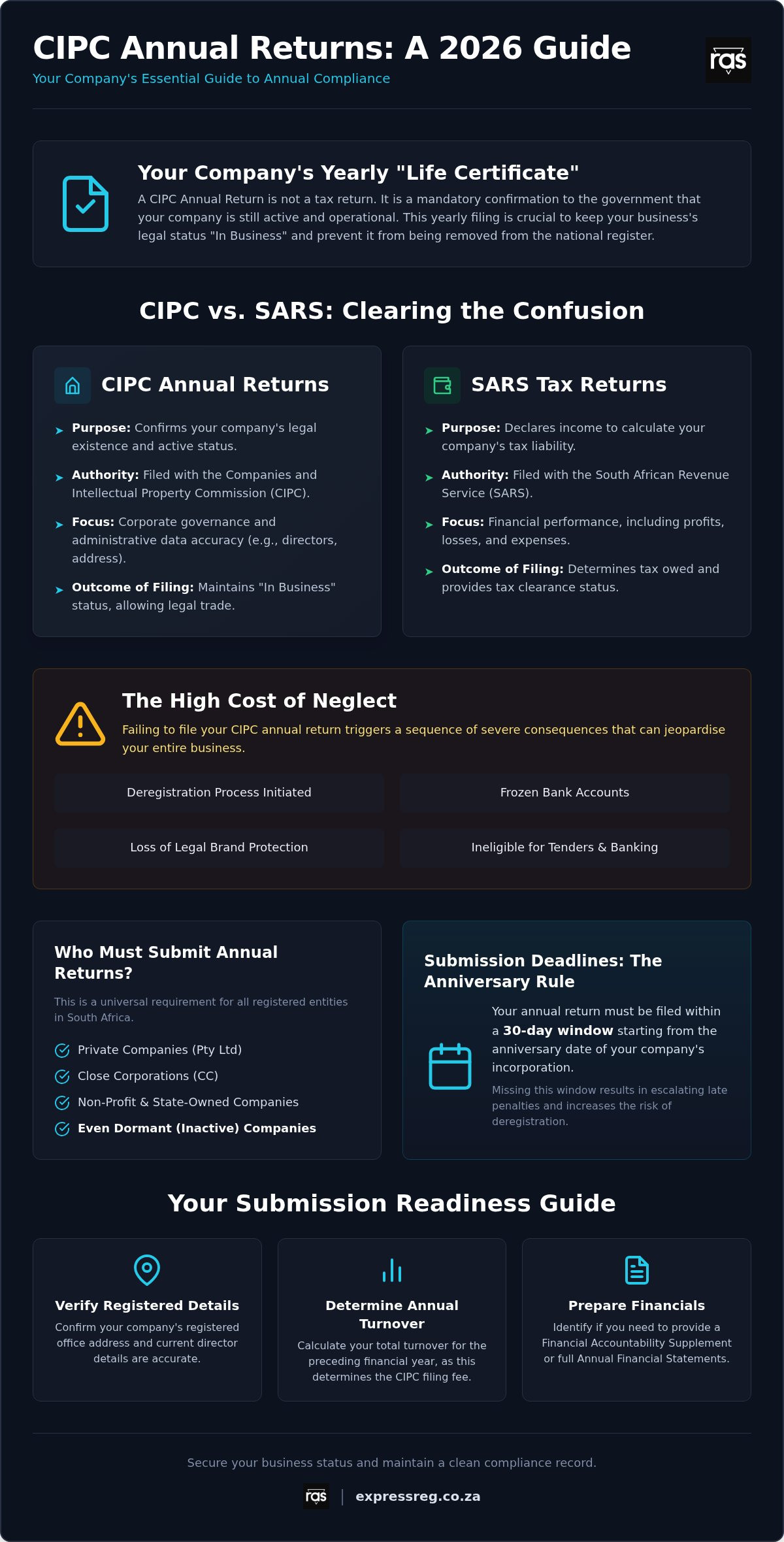
Every company registered with the Companies and Intellectual Property Commission (CIPC) has a statutory obligation to file an annual return. This process isn’t a tax return; it’s effectively a “life certificate” for your business. It serves as a formal confirmation that your entity is still active and that its information on the national register is current. Think of it as a pulse check that keeps your company’s legal status alive.
Under the Companies Act of South Africa, this filing is mandatory for every registered entity. The regulator uses this mechanism to prune inactive or abandoned businesses from the registry. If you neglect your CIPC annual returns submission, the commission may assume your company is dormant and begin the deregistration process. This isn’t just a paperwork issue. Deregistration can lead to frozen bank accounts, the loss of legal protection for your brand, and the inability to trade legally. Understanding how to avoid company deregistration by CIPC is essential knowledge for every South African business owner, particularly given the strict new landscape of digital enforcement in 2026.
View this requirement as a simple administrative formality rather than a complex financial audit. While SARS is interested in your profits and losses for tax purposes, the CIPC simply needs to know you still exist and where your business is located. It’s a fundamental step in maintaining a clean compliance record that allows you to continue operating without interference.
Which Entities Must Submit Annual Returns?
The law is inclusive regarding this requirement. Whether your business is a small Private Company (Pty Ltd) or a legacy Close Corporation (CC), you must file. This also applies to non-profit companies and state-owned entities. Most importantly, dormant companies aren’t exempt. Even if your business had zero turnover for the year, you must still complete the filing to keep your “In Business” status.
What Information is Disclosed in the Return?
The submission process focuses on administrative accuracy. You’ll need to verify several key details to ensure your records are up to date. This includes:
- Registered Details: Confirmation of your registered office address and current director details.
- Financial Dates: Verification of your financial year-end to align with other statutory obligations.
- Turnover Figures: Your annual turnover for the preceding financial year.
The turnover figure is particularly important because it determines the sliding scale of the filing fee. Providing accurate data during your CIPC annual returns submission prevents future administrative headaches and ensures your company remains in good standing for tenders, contracts, and banking facilities.
Annual Returns vs. SARS Tax Returns: Clearing the Confusion
One of the most frequent errors South African entrepreneurs make is assuming that a clean record with SARS means their business is fully compliant. This isn’t the case. While both require annual attention, they serve entirely different masters and govern different aspects of your business. Your CIPC annual returns submission confirms your legal right to exist as a corporate entity, whereas your SARS tax returns calculate what you owe the state based on your financial performance.
CIPC: The Legal Status Authority
The CIPC acts as the official custodian of all corporate entities in South Africa. Its primary focus is corporate governance and ensuring that the national register accurately reflects who is currently trading. This authority determines whether your company is “In Business” or “Deregistered”. Maintaining this status is just as vital as registering a Pty Ltd company in the first place. If you fail to file with the CIPC, your company can be struck off the roll, even if you are fully up to date with your taxes.
SARS: The Revenue Authority
In contrast, the South African Revenue Service (SARS) is the national revenue authority. It manages Income Tax, VAT, and PAYE. SARS requires detailed annual financial statements to verify your tax liability. While you might hold a valid Tax Clearance Certificate, that certificate is only useful if your CIPC status is active. Banks and government departments often check both databases; a “Deregistered” status at the CIPC will immediately invalidate your standing with SARS in the eyes of a potential client or lender.
The destination of your funds also differs. CIPC fees are administrative charges that go directly to the registry to cover the costs of maintaining company records. SARS payments are taxes that contribute to the national fiscus. These two processes rarely align on the calendar either. Your CIPC filing is linked to the anniversary of your incorporation, while your SARS returns follow the specific financial year-end you’ve chosen. As your business grows and your turnover increases, you may also need to consider your obligations under VAT registration in South Africa, which now carries a new compulsory threshold of R2.3 million following the April 2026 changes.
Neglecting your CIPC annual returns submission while focusing only on tax can lead to a “Final Deregistration” status. This creates a dangerous compliance gap where you are paying taxes for a company that technically no longer exists. Dual-agency penalties can accumulate quickly, leaving you with a mountain of paperwork and unnecessary fines. If you’re feeling overwhelmed by these separate deadlines, you can outsource your statutory filings to ensure every box is ticked correctly and on time.
Submission Deadlines and the True Cost of Late Filings
Your CIPC annual returns submission isn’t tied to the calendar year or the tax year. It follows the Anniversary Rule. This means your filing window opens on the exact date your company was originally incorporated. You have exactly 30 business days from this anniversary to complete the process. For Close Corporations, the window is slightly different, opening on the first day of the anniversary month and remaining open for the following 30 days. Missing this window doesn’t just result in a late fee; it signals to the regulator that your company may no longer be active.
The fees for your submission are calculated on a sliding scale based on your annual turnover. For a company with a turnover of less than R1 million, the on-time fee is a manageable R100. This increases to R450 for turnover between R1 million and R10 million. Larger entities with turnover between R10 million and R25 million pay R2,000, whilst those exceeding R25 million pay R3,000. These rates are legislated and apply regardless of whether you file yourself or use a professional service.
Why Deregistration is a Business Nightmare
Missing consecutive filings triggers the deregistration process. This isn’t just an administrative status; it’s a cessation of legal capacity. Your business bank accounts are often frozen immediately because banks monitor the CIPC database for compliance. Directors also lose their limited liability protection, which means they can be held personally liable for the company’s debts. Additionally, any active contracts or government tenders become null and void, as the legal entity holding those agreements technically no longer exists. Many of the common myths about avoiding CIPC company deregistration lead entrepreneurs to underestimate these consequences until it is too late.
The Escalating Penalty Fees
Delaying your CIPC annual returns submission is a costly mistake. If you miss the 30-day window, the R100 fee for a small company jumps to R150. For the largest entities, the penalty is even steeper, rising from R3,000 to R4,000. If the CIPC moves to deregister your business, you’ll face the “Restoration” process. This requires a R200 application fee for form CoR40.5, but that’s only the beginning. You must also settle every outstanding return at the late-filing rate. When you factor in the administrative time and potential professional fees, restoring a company is often ten times more expensive than simply filing on time. Working with a dedicated CIPC filing agent in Randburg can help you stay ahead of these deadlines and avoid the escalating costs of non-compliance.
How to Organise Your Submission: A Step-by-Step Readiness Guide
Organising your CIPC annual returns submission requires more than just logging into a portal. To avoid the common frustration of technical glitches or missing data, you must gather your information before you start the digital process. Follow these five steps to ensure a smooth, error-free filing:
- Step 1: Determine your turnover. Review your financial records for the preceding financial year to establish your exact turnover figure.
- Step 2: Prepare financial documents. Decide if you need a Financial Accountability Supplement (FAS) or full Annual Financial Statements (AFS).
- Step 3: Verify internal details. Check that your director information and beneficial ownership register are current and match your internal records.
- Step 4: Calculate your fee. Use the sliding scale of turnover to ensure you have sufficient funds available for the transaction.
- Step 5: Finalise and file. Complete the submission and download your confirmation certificate immediately for your compliance records.
Beneficial Ownership: The New 2026 Requirement
The CIPC now mandates a Beneficial Ownership (BO) register filing as a prerequisite for your annual returns. This regulation aims to increase transparency by identifying individuals who hold a 5% or more interest in the company. Even if you are the sole director, you must disclose who truly controls the entity. Failing to comply with BO regulations can lead to significant compliance flags on your record, making it difficult to maintain your “In Business” status for tenders and banking.
AFS vs. FAS: Which Do You Need?
Small businesses often find the financial requirements confusing. The key is your Public Interest Score (PI Score). Most small, private companies with low PI scores only need to submit a FAS. This is a simplified supplement that confirms you aren’t required to have audited statements. However, if your PI score exceeds certain thresholds, you must submit full AFS using the iXBRL format. This technical standard ensures that financial data is machine-readable and accurately processed by the commission’s systems. If your turnover is also approaching the new R2.3 million compulsory threshold, it is worth reviewing the complete guide to VAT registration South Africa requirements to ensure you remain fully compliant across all statutory obligations. Businesses pursuing government contracts should also familiarise themselves with the requirements for a Letter of Good Standing in South Africa, as this COIDA certificate is frequently requested alongside your CIPC compliance documents during tender evaluations.
Preparation is the best way to bypass administrative hurdles. If you want to ensure your records are handled with procedural accuracy, you can submit your CIPC annual returns through a professional facilitator. This allows you to focus on your business growth whilst experts manage the heavy lifting of your statutory paperwork.
Securing Your Business Status with Professional CIPC Filing Services
Managing a CIPC annual returns submission often becomes a source of significant stress for busy South African entrepreneurs. Government portals are frequently plagued by technical glitches and unexpected downtime, which can lead to missed deadlines and unnecessary penalties. By choosing to outsource these administrative tasks, you bypass the “system is down” frustration and ensure your filing is handled with procedural accuracy. This approach allows you to focus on your core business operations whilst experts navigate the complex machinery of government administration on your behalf.
Professional consultants provide a vital layer of oversight that automated systems cannot match. They act as a safeguard by spotting director detail mismatches or registration errors before the submission is finalised. This proactive verification process is essential for maintaining a clean compliance record. Additionally, modern statutory requirements now demand a holistic approach. We ensure your returns are perfectly aligned with the latest Beneficial Ownership filings, providing a single point of contact for all your corporate governance needs. Our fixed-fee transparency means you’ll know exactly what your compliance costs are from the outset, with no hidden surprises or escalating administrative charges.
The Express Shelf Company Advantage
We pride ourselves on being a reliable intermediary that understands the high stakes of corporate compliance. Our service includes personalised management of your statutory calendar, ensuring you never miss an anniversary window again. We handle the heavy lifting of coordinating between various administrative bodies, which is crucial for keeping your business “tender-ready” throughout 2026. When your records are handled by seasoned consultants, you gain the peace of mind that your “In Business” status is secure, protecting your ability to apply for funding and secure new contracts.
Taking the First Step Toward Compliance
If you are uncertain about your company’s current standing, your first priority should be requesting a comprehensive status check. Many businesses discover they are in arrears only when a bank account is frozen or a tender application is rejected. If you have missed previous years, prioritise catch-up filings immediately to halt the deregistration process. Don’t leave your company’s legal existence to chance. Let us handle your CIPC annual returns submission to ensure your business remains compliant, protected, and ready for growth.
Secure Your Company’s Future for 2026 and Beyond
Maintaining your business status is a non-negotiable part of sound corporate governance. You’ve learned that your CIPC annual returns submission acts as a vital pulse check, keeping your entity active and visible on the national register. By distinguishing these filings from your SARS tax obligations and respecting the anniversary deadline, you protect your company from the severe risks of deregistration and frozen bank accounts.
Our professional statutory compliance specialists offer a reliable way to manage this administrative burden through fixed-fee processing. We provide a nationwide service for all South African entities, ensuring your data is accurate and your status remains “In Business” for tenders and banking. Ensure your company stays compliant with our expert CIPC filing services. Taking control of your compliance today ensures your business is ready for every growth opportunity that 2026 brings.
Frequently Asked Questions
What happens if I forget to submit my CIPC annual return?
If you miss your deadline, the CIPC applies an immediate late-filing penalty and changes your status to “Deregistration Process.” This status flags your company as non-compliant on the national register. If the omission continues for consecutive years, your entity is eventually deregistered. This leads to the freezing of business bank accounts and the loss of legal protection for directors, effectively ending your company’s legal capacity to trade or secure contracts.
Can I file my CIPC annual returns if I haven’t done my tax yet?
You can complete your CIPC annual returns submission even if your SARS tax returns are not yet finalised. These two statutory requirements are managed by different government bodies and operate on independent timelines. Whilst you need your turnover figures to calculate the CIPC fee, you don’t need a tax clearance certificate to file. In fact, keeping your CIPC status active is a prerequisite for SARS to issue a tax clearance certificate later.
How much are the CIPC annual return fees for 2026?
Fees follow a legislated sliding scale based on your annual turnover. For turnover under R1 million, the fee is R100 if filed on time. This rises to R450 for turnover up to R10 million, R2,000 for up to R25 million, and R3,000 for R25 million or more. If you file outside the 30-day window, these fees increase to R150, R600, R2,500, and R4,000 respectively. These costs are mandatory for all registered South African entities.
Is a dormant company required to file an annual return?
Every registered company and close corporation must file an annual return, regardless of whether it is actively trading. If your business is dormant, you must submit a return with zero turnover. This process confirms to the CIPC that the entity still exists and should not be removed from the register. Failing to file for a dormant company results in the same deregistration penalties as an active business, potentially complicating future re-activation efforts.
What is the difference between an annual return and an annual financial statement?
An annual return is a statutory document that confirms your company’s current details and status with the CIPC. In contrast, an annual financial statement (AFS) is a detailed record of your company’s financial performance and position. Whilst the return is a mandatory yearly filing for all, the requirement to submit a full AFS depends on your Public Interest Score. Most small companies only need to provide a Financial Accountability Supplement alongside their return.
How do I know if my company has been deregistered?
You can verify your company’s status by performing a search on the CIPC e-Services portal or BizPortal. If the status is listed as “Final Deregistration,” the company has been removed from the register. You might also notice signs such as a frozen bank account or being unable to obtain a Tax Clearance Certificate from SARS. It’s advisable to check your status regularly to ensure no administrative errors have triggered a deregistration process.
Can I change my company directors whilst filing an annual return?
You cannot change director details within the actual CIPC annual returns submission process. Director amendments require a separate filing known as a CoR39. It’s best practice to update your director information before you start your annual return to ensure all records on the system are accurate. Once the director changes are confirmed by the CIPC, you can proceed with your return, ensuring that the information provided matches the newly updated registry records.
How long does the CIPC annual return submission process take?
The actual submission is usually processed immediately once the fee is paid and the data is entered. You should receive your confirmation certificate within minutes of a successful digital filing. However, the preparation phase can take longer if you need to calculate turnover or prepare financial supplements. If you use a professional CIPC filing agent to manage your submission, the process is streamlined to ensure procedural accuracy and to manage any technical glitches that might occur on government systems.