Did you know that missing the mandatory 21-day SARS registration window can trigger back-dated penalties before your first employee even receives their payslip? If you’ve just hired your first team member or reached the R99,000 annual tax threshold, the pressure to formalise your status is likely weighing on you. We understand that the SARS eFiling interface often feels like a maze, and the overlap between PAYE, UIF, and SDL remains a source of constant confusion for many entrepreneurs. You want to focus on growing your business, not decoding tax legislation or worrying about administrative errors. Professional PAYE registration services South Africa can bridge the gap between complex government requirements and your need for operational speed.
This guide ensures you don’t have to face the Department of Labour or SARS alone. We’ve compiled the definitive 2026 employer checklist to help you secure your EMP reference number quickly and maintain 100% compliance. You’ll learn exactly which documents to prepare, how to handle the 2026 tax thresholds, and the steps to link your payroll taxes seamlessly. By the end of this article, you’ll have a clear, stress-free roadmap to becoming a fully registered and compliant South African employer.
Key Takeaways
- Identify your specific liability under the 2026 tax thresholds to ensure you register within the mandatory 21-day window.
- Collate the correct CIPC and director documentation to prevent application rejections and unnecessary administrative delays.
- Utilise specialised PAYE registration services South Africa to manage the RAV01 eFiling process and secure your EMP number efficiently.
- Understand how to link UIF and SDL contributions to your payroll profile for total regulatory compliance with the Department of Labour.
- Discover how delegating SARS correspondence can free up your time for business growth while maintaining procedural accuracy.
Determining Your Liability: When is PAYE Registration Compulsory?
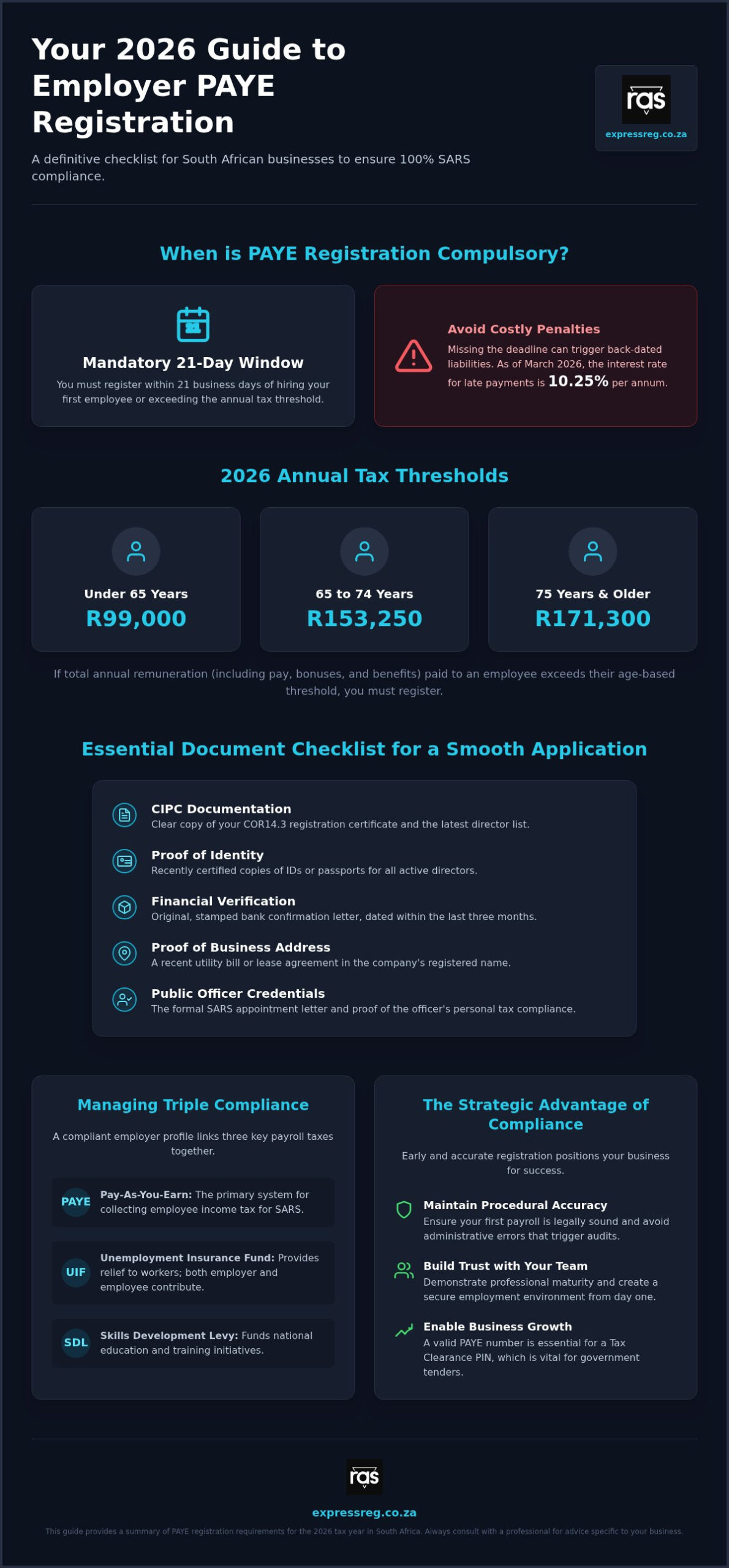
PAYE, or Pay-As-You-Earn, is the primary system for collecting personal income tax from employees in the Republic. Instead of staff paying their tax annually, you, as the employer, deduct a portion of their earnings monthly and pay it over to SARS. This system is a foundational part of Taxation in South Africa, ensuring a steady flow of revenue for national development. If you hire your first employee, you’ve exactly 21 business days to register for PAYE. Missing this window isn’t a minor oversight; it’s a statutory breach that can lead to immediate administrative friction and back-dated liabilities.
For the 2026 tax year, you must register if you pay any individual more than the annual tax threshold. For employees under 65, this threshold is R99,000 per year. For those aged 65 to 74, it rises to R153,250, and for those 75 and older, it’s R171,300. Even if your staff earn below these amounts, you might still need to register for other payroll taxes like UIF. Ignoring these obligations often triggers SARS audits and steep penalties. As of March 2, 2026, the interest rate for late or underpayment of tax is 10.25% per annum. Professional PAYE registration services South Africa help you avoid these costs by ensuring your application is accurate and submitted within the legal timeframe.
Who Qualifies as an Employer in South Africa?
Determining who counts as an employee requires looking at the nature of the work. Full-time and part-time staff are obvious, but directors of a (Pty) Ltd are also employees for tax purposes. If you pay yourself a salary, you’re an employer. Independent contractors differ, provided they meet SARS criteria for independence. In 2026, remuneration covers basic pay, bonuses, and fringe benefits. If these exceed the annual thresholds, you must register immediately.
The Strategic Advantage of Early Registration
Registering early demonstrates professional maturity. By using PAYE registration services South Africa, you ensure your first payroll run is legally sound. This builds trust with your team and simplifies your first tax season. A valid PAYE number is also essential for a Tax Clearance PIN, which is vital for government tenders. Starting with a clean compliance record positions your business as a reliable and organised entity from day one.
The Essential PAYE Registration Document Checklist for 2026
Securing your EMP reference number requires more than just filling in a digital form; it demands a precise collection of statutory documents that prove your business’s legal standing. SARS has tightened its verification protocols for 2026 to combat identity fraud and ensure that only legitimate entities enter the tax base. If your documentation is incomplete or outdated, your application will be rejected, often without a detailed explanation. This delay can push you past the 21-day registration window, leading to unnecessary administrative friction.
To ensure a smooth approval, you must have the following documents ready for upload:
- CIPC Documentation: A clear copy of your COR14.3 registration certificate and the most recent director list.
- Proof of Identity: Recently certified copies of IDs or passports for every active director listed with the CIPC.
- Financial Verification: An original bank confirmation letter, stamped by your branch and dated within the last three months.
- Proof of Business Address: A recent utility bill or lease agreement issued in the company’s registered name.
- Public Officer Credentials: The formal SARS appointment letter and proof of the officer’s personal tax compliance.
Managing these requirements while running a business is a heavy administrative burden. Many entrepreneurs choose professional registration support to ensure every document meets the strict standards set by national authorities.
Organising Your Financial Documentation
Precision is vital when dealing with your company’s banking details. Before you start the application, verify that your business bank account is fully active and that the name matches your CIPC records exactly. SARS will also require an estimate of your monthly payroll figures. These don’t need to be perfect, but they must be realistic based on your current staff contracts. Discrepancies between your bank letter and your eFiling profile are the most common cause of registration failure. Double-check every digit of your account number and branch code to avoid being flagged for manual verification.
The Critical Role of the Public Officer
You cannot successfully register for payroll taxes without an appointed Public Officer. This individual serves as the legal representative for all tax-related matters and must be a South African resident. SARS will verify the Public Officer’s personal tax status as part of the company’s registration. If their personal returns are outstanding, the company’s PAYE application will remain in limbo. Understanding the nuances of Managing PAYE, UIF, and SDL starts with this appointment. Using specialised PAYE registration services South Africa ensures that your Public Officer is correctly linked to your profile, preventing technical errors that often stall the process for months.
Navigating the SARS eFiling Registration Process
Once you’ve gathered your statutory documents, the next stage involves the technical submission through the SARS eFiling portal. This digital environment is where most administrative errors occur, often due to a misunderstanding of the dashboard layout or specific form requirements. To begin, log in to your organisation’s profile and navigate to the “Maintain SARS Registered Details” functionality. This section allows you to update your tax products and is the gateway to the RAV01 form, which is the primary document for Registration, Amendments, and Verification.
Within the RAV01, you must select the “Payroll Taxes” category to initiate the PAYE registration. SARS requires all supporting material to be uploaded in a specific PDF format. Ensure each file is clearly named and does not exceed the size limits dictated by the portal. After submission, you shouldn’t simply wait for an email. Monitor the eFiling “Work Page” daily for status updates or requests for more information. Professional PAYE registration services South Africa provide a distinct advantage here, as experts can interpret cryptic status codes and respond to SARS queries before they turn into formal rejections.
Initiating the Application on the Dashboard
Precision during the initial setup prevents long-term compliance headaches. When you select “Tax Types” and “Employees Tax,” you’ll be asked for your “Trading Name.” This must match your official CIPC records exactly, even if your brand name differs. Perhaps the most critical field is the “Date of Liability.” This should reflect the day you hired your first staff member or reached the 2026 tax threshold. Accuracy is non-negotiable here. Entering an incorrect date can result in back-dated penalties and interest that accrue from the moment you should have been registered.
The Verification and Approval Phase
The approval process in 2026 has become increasingly automated, yet manual intervention remains common for new entities. If your application is flagged, SARS might request a manual interview or additional proof of business activity. In most cases, a successful application results in a “Notice of Registration” appearing in your eFiling inbox within 24 to 48 hours. This document contains your official EMP reference number. However, if a manual review is triggered, turnaround times can extend to 21 business days. Check your dashboard regularly to ensure no correspondence is missed. Using specialised PAYE registration services South Africa ensures that these potential hurdles are managed proactively, keeping your business on track for its first compliant payroll run.
Managing the Triple Compliance: PAYE, UIF, and SDL
Managing your payroll taxes involves more than just calculating income tax. In South Africa, PAYE is intrinsically linked to the Unemployment Insurance Fund (UIF) and the Skills Development Levy (SDL). These three components form a ‘triple compliance’ requirement that most employers must manage via a single monthly return, the EMP201. Whilst your initial focus might be on obtaining an EMP number, failing to account for the other two pillars can lead to significant interest and penalties from both SARS and the Department of Labour. Professional PAYE registration services South Africa ensure that all three tax types are correctly activated on your profile from the outset.
The EMP201 return serves as a consolidated declaration. Every month, you’ll use this form to report the total PAYE withheld, the UIF contributions, and any SDL due. Accuracy is vital because a mistake in one area can trigger a reconciliation error across your entire tax profile. As your business scales and your payroll grows, you may also approach the mandatory VAT threshold, which was adjusted to R2.3 million in April 2026. At that point, obtaining your VAT registration number becomes a critical next step in your compliance journey. You can find more details in our guide on SARS VAT Registration South Africa: The Complete 2026 Guide.
UIF Registration for Employers
UIF registration is mandatory for almost every employer. The contribution is calculated at 2% of an employee’s remuneration, split equally: 1% is deducted from the staff member and 1% is contributed by the business. For 2026, the monthly remuneration ceiling for UIF is R17,712. This means the maximum monthly contribution is capped at R177.12 from the employee and R177.12 from the employer. It’s a common mistake to assume that registering with SARS for PAYE automatically handles your Department of Labour declarations. You must ensure your employees are correctly declared to the Labour Commissioner to remain fully compliant and avoid being flagged during a labour inspection.
The Skills Development Levy (SDL) Explained
The Skills Development Levy is a 1% tax used to fund national sector education and training. However, not every business is liable for this payment. For the 2026 tax year, you’re only required to pay SDL if your total annual remuneration for all employees is expected to exceed R500,000 over the next 12 months. If your payroll stays below this threshold, you’re exempt from the levy, though you must still register for PAYE and UIF if you meet those specific criteria. Certain public benefit organisations and non-profits also qualify for exemptions. Using specialised PAYE registration services South Africa helps you correctly identify your liability so you don’t overpay or miss a mandatory contribution. If the complexity of managing these distinct registrations feels overwhelming, you can register your company for payroll taxes today and let experts handle the administrative burden.
Why Specialised PAYE Registration Services Optimise Business Growth
Attempting to manage complex tax registrations internally often leads to administrative bottlenecks that stall business momentum. Small technical errors on the RAV01 form or mismatched banking details frequently result in application rejections, forcing you to restart the 21-day registration clock. By utilising professional PAYE registration services South Africa, you eliminate these risks. Experts ensure every document meets SARS’s rigorous 2026 standards, allowing you to focus on recruitment and operational strategy instead of deciphering error codes on eFiling.
Efficiency in tax administration creates a ripple effect across your entire corporate structure. A correctly handled registration provides a solid foundation for your CIPC annual returns submission, ensuring that your company’s data remains consistent across all government databases. This synchronisation prevents the common data mismatch flags that often block Tax Clearance PIN applications or tender submissions. Delegating the heavy lifting of paperwork to a seasoned facilitator guarantees procedural accuracy and provides the peace of mind necessary for sustainable growth.
How Express Shelf Company Streamlines Your Compliance
Our organisation acts as a reliable intermediary between your firm and national authorities like SARS and the Department of Labour. We follow a methodical verification process, checking your CIPC records and director documentation before submission to prevent delays. This solution-oriented approach reduces the stress of administrative hurdles and ensures a smooth transition from a newly formed entity to a fully compliant employer. We handle the technical correspondence with SARS officials, saving you hours of frustration and ensuring your EMP number is issued as quickly as possible.
Next Steps: Maintaining Your Good Standing
Securing your PAYE reference number is only the beginning of your compliance journey. You must integrate these payroll tax obligations with your ongoing Pty Ltd registration requirements to remain in good standing. This involves preparing for monthly EMP201 returns and the bi-annual employer reconciliations required by SARS. Maintaining this discipline ensures your business avoids the 10.25% interest rates currently applied to late payments. Contact us today to manage your 2026 statutory and tax filings, ensuring your business remains legally sound while you focus on the road ahead.
Securing Your Company’s Future with Compliant Payroll Systems
Ensuring your business meets its 2026 tax obligations doesn’t have to be a source of administrative anxiety. By understanding your liability thresholds and preparing your statutory documentation in advance, you can navigate the 21-day registration window with confidence. Successful employer registration is a triple commitment that involves linking PAYE, UIF, and SDL within a single, cohesive framework. Achieving this level of procedural accuracy from day one protects your firm from back-dated penalties and establishes a professional reputation with both SARS and your employees.
Managing the heavy lifting of government paperwork is often best handled by a dedicated partner. Our team provides professional facilitation of all SARS and labour registrations, bringing methodical management to complex administrative tasks. We offer deep expertise in South African statutory compliance and CIPC filings, ensuring your transition to becoming a registered employer is smooth and error-free. Secure your 2026 PAYE Registration through Express Shelf Company and gain the peace of mind that comes from using expert PAYE registration services South Africa. Take this essential step today to build a compliant foundation for your organisation’s growth.
Frequently Asked Questions
What is the compulsory PAYE registration threshold in South Africa for 2026?
The compulsory PAYE registration threshold for 2026 depends on the age of your employees. For individuals under 65, you must register if they earn more than R99,000 annually. This threshold increases to R153,250 for those aged 65 to 74, and R171,300 for employees 75 and older. If a single staff member exceeds these limits, your business is legally required to deduct and remit tax to SARS every month.
How long does the SARS PAYE registration process typically take?
The processing time for a new PAYE application typically ranges from 24 hours to 21 business days. If your submission is automated and your documentation is perfect, SARS often issues a Notice of Registration within 48 hours. However, if your profile is flagged for a manual interview or additional verification, the process can extend to three weeks. Professional PAYE registration services South Africa help minimise these delays by ensuring every document is correct before submission.
Can I register for PAYE online via eFiling without a consultant?
You can register for PAYE independently through the RAV01 form on the SARS eFiling dashboard. While this is possible, many entrepreneurs find the interface technically challenging. Errors in selecting tax types or entering the date of liability can lead to application rejections or back-dated penalties. Using a facilitator ensures procedural accuracy, allowing you to focus on your core business operations while experts handle the administrative heavy lifting and correspondence.
What happens if I fail to register for PAYE within 21 days of hiring staff?
Failing to register within the 21-day window triggers immediate compliance risks. SARS can apply back-dated penalties and interest on all unpaid taxes from the date you first became liable. As of March 2026, the interest rate for underpayment is 10.25% per annum. Additionally, your business will struggle to obtain a Tax Clearance PIN, which is essential for securing contracts and proving your legal standing to potential corporate partners.
Do I need to register for UIF and SDL at the same time as PAYE?
You must register for UIF simultaneously with your PAYE application, as these are managed through the same EMP201 return. For SDL, registration is only mandatory if your total annual payroll is expected to exceed R500,000. If you fall below this threshold, you’re exempt from the levy but still need to maintain your PAYE and UIF status. Correctly identifying these liabilities ensures you don’t overpay or miss critical statutory obligations.
What is an EMP reference number and where do I find it?
An EMP reference number is a unique 10-digit identifier that starts with the digit 7. This number is used for all payroll tax correspondence and monthly EMP201 submissions. You’ll find it on your official Notice of Registration (EMP101e) issued by SARS after a successful application. It’s also visible on your eFiling dashboard under the “Tax Types” section once your payroll tax product has been successfully activated and linked. Before beginning this process, ensure your foundational SARS tax number registration is complete, as your income tax reference number underpins all subsequent payroll tax applications.
Can a shelf company be registered for PAYE immediately after purchase?
You can register a shelf company for PAYE immediately after the purchase and transfer process is complete. Before applying, you must ensure that the new directors are correctly updated at the CIPC and that the business bank account is in the company’s name. Once these foundational steps are verified, you can utilise PAYE registration services South Africa to formalise your status as an employer and begin hiring staff under the existing legal entity.
Is a Public Officer mandatory for PAYE registration in 2026?
Yes, appointing a Public Officer is mandatory for PAYE registration in 2026. This individual acts as the company’s legal representative for all tax matters and must be a South African resident. SARS will verify the Public Officer’s personal tax compliance before approving the company’s payroll tax application. If this appointment isn’t handled correctly, your registration will be blocked, preventing you from legally paying salaries or submitting monthly tax returns.