
A single missed administrative deadline can effectively freeze your company’s lifeblood, leaving your bank accounts inaccessible and your legal protections void. If you’ve discovered a CIPC annual return late submission on your record, the fear of losing everything you’ve built is a heavy burden. It’s common to feel overwhelmed by technical filing portals or the confusion regarding how these returns differ from your SARS tax obligations.
The good news is that a late submission is a procedural hurdle, not a business death sentence. You can rectify the situation, avoid final deregistration, and restore your business to good standing with the authorities. We understand the stress these hurdles cause and are here to provide a clear, structured path forward. Our goal is to simplify the administrative burden so you can focus on running your business.
This guide breaks down the updated 2026 penalty structure and the critical Beneficial Ownership prerequisites that now block successful filings. You’ll learn exactly how to navigate the recovery process efficiently, ensuring your company remains a compliant and functional entity. Let’s move your business from a state of administrative complexity back to full legal standing.
Key Takeaways
- Understand the critical difference between SARS tax returns and CIPC filings to ensure your company meets all statutory obligations.
- Identify the specific penalty tiers and the timeline that leads from a missed deadline to final company deregistration.
- Learn the precise steps required to rectify a CIPC annual return late submission and restore your business to good standing with the authorities.
- Gather the necessary turnover data and complete the mandatory Beneficial Ownership declaration before attempting to file outstanding returns.
- Evaluate the benefits of using a professional facilitator to navigate technical portal hurdles and ensure procedural accuracy.
The CIPC Annual Return Deadline: When Does a Submission Become Late?
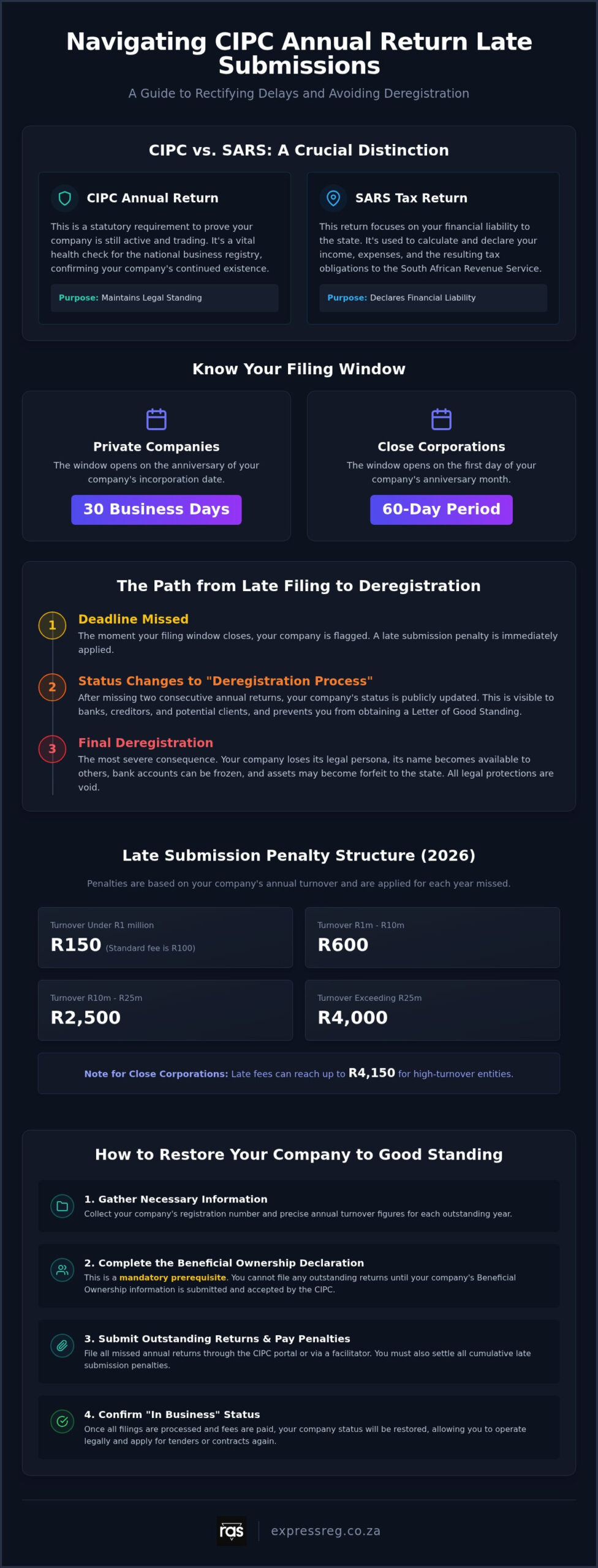
Every entity registered under the South African Companies Act must confirm its continued existence once a year. This process is managed by the Companies and Intellectual Property Commission (CIPC), which acts as the official custodian of all business registrations in the country. This filing is distinct from your SARS tax returns. Whilst SARS focuses on your financial liability to the state, the CIPC return is a statutory requirement to prove your company is still active and trading. It serves as a vital health check for the national business registry.
If you fail to submit this return within the prescribed timeframe, your entity is flagged. A CIPC annual return late submission doesn’t just result in financial penalties; it signals to the registrar that your company may be dormant. This trigger begins a process that can lead to the permanent removal of your business from the official register. The CIPC uses these filings to ensure their database reflects only companies that are actually functional, purging those that fail to communicate their status.
Calculating Your Anniversary Month Filing Window
Your filing window is determined by the specific date your company was incorporated. You can find this date on your Cor14.3 registration certificate. For private companies, the window opens on the anniversary of your incorporation and remains open for 30 business days. Close Corporations follow a slightly different rule, where the window opens on the first day of their anniversary month and lasts for the following 30 days. We recommend initiating the process as soon as the window opens. Waiting until the final day often leads to frustration because technical glitches or high traffic on the eServices portal can prevent a successful lodgement, resulting in an avoidable CIPC annual return late submission.
The Difference Between Compliance and Good Standing
Maintaining your company in “In Business” status is vital for operational continuity. The moment your filing window closes without a submission, the CIPC system automatically updates your record. If you miss two consecutive returns, the status shifts to “Deregistration Process,” which is visible to the public, banks, and potential creditors. Regular CIPC annual returns submission ensures your entity remains legally visible and eligible for business opportunities. Most government tenders and corporate contracts require a Letter of Good Standing, which you cannot obtain if your CIPC filings are outstanding. Staying compliant protects your brand’s reputation and ensures you don’t lose the legal protection provided by a registered entity.
Penalties and the Deregistration Process: What Are the Risks?
Missing your filing window triggers an immediate shift in your company’s standing. While a CIPC annual return late submission begins as a minor administrative oversight, it quickly escalates into a significant legal and financial liability. The system is automated; the moment your 30-business-day grace period expires, the status of your entity is updated, and penalty fees are applied to your account. Understanding the progression from a late filing to final deregistration is essential for every South African business owner who wants to protect their commercial assets.
Late Filing Fees and Financial Implications
The cost of non-compliance is structured according to your company’s annual turnover. For the 2026 calendar year, the CIPC has maintained a tiered penalty system that punishes delays. If your turnover is under R1 million, a late submission increases your fee from R100 to R150. For medium-sized enterprises with turnover between R1 million and R10 million, the late fee sits at R600. Larger entities face steeper costs; companies turning over between R10 million and R25 million pay R2,500, whilst those exceeding R25 million are charged R4,000 for being late. Close Corporations also face increased costs, with late fees reaching up to R4,150 for high-turnover entities. These penalties are cumulative, meaning they apply for every year missed. You can verify these specific tiers on CIPC’s official website to ensure your records match the national registry’s expectations.
The Path to Final Deregistration
The most severe risk is not the financial penalty, but the loss of your legal persona. If you miss two consecutive annual returns, the CIPC initiates the investigative process for deregistration. Your company status will change to “Deregistration Process,” a red flag that is visible to banks and creditors. Once this status is active, your bank accounts may be frozen, and any contracts you sign could be deemed invalid because the company technically ceases to exist. To avoid company deregistration CIPC, you must intervene before the status moves from “Process” to “Final.” Final deregistration is a catastrophic event that often requires a high-court order to reverse, costing significantly more than the original filing fees. If you’re concerned about your current standing, it’s wise to partner with a professional consultant who can audit your status and clear outstanding returns before the CIPC takes final action. Acting early ensures your directors remain protected from personal liability and your business remains a functional, legal entity.
Comparing Solutions: DIY Portal vs. Professional Filing Agents
When facing a CIPC annual return late submission, many directors attempt to resolve the issue themselves via the eServices portal. While the CIPC offers these tools for public use, the reality of navigating government infrastructure often proves more complex than anticipated. The choice between a DIY approach and hiring a professional agent hinges on your tolerance for administrative delays and the complexity of your company’s financial records. For many, the risk of making a procedural error outweighs the perceived savings of a self-service filing.
The Technical Hurdles of the CIPC eServices Portal
Users frequently report significant friction when using the state’s digital platforms. Common issues include persistent login loops and lengthy delays for password reset emails, which can eat into your 30-day filing window. Beyond basic access, the technical requirements for uploading Annual Financial Statements (AFS) or the Financial Accountability Supplement (FAS) are strict. Incorrect file formats or sizes often lead to system rejections without clear error messages. Additionally, the “Payment Pending” status can linger for days after a transaction, causing unnecessary anxiety for directors who are racing to stop a deregistration process. These technical bottlenecks don’t just waste time; they can push a company closer to final deregistration if not resolved quickly.
Benefits of Using a Statutory Compliance Specialist
Engaging an expert facilitator removes the guesswork from the process. A specialist ensures that your turnover declarations align perfectly with the records held by the South African Revenue Service (SARS). Discrepancies between these two authorities can trigger audits or lead to future compliance blocks. Since July 1, 2024, the CIPC has also mandated that Beneficial Ownership information must be up-to-date before any annual return can be submitted. A professional agent handles this prerequisite simultaneously, preventing the system from blocking your CIPC annual return late submission.
Whilst a DIY filing might appear cheaper on paper, the time cost of troubleshooting portal errors is high. For businesses with complex director structures or multiple subsidiaries, the risk of a filing error is a serious concern. Professional agents act as a reliable intermediary, managing the heavy lifting of paperwork and providing a methodical, structured approach to restoring your entity’s legal standing. This expertise provides peace of mind, knowing that your compliance is handled with procedural accuracy and that your business remains a functional entity in the eyes of the law.
Step-by-Step: How to Rectify a Late CIPC Submission
Rectifying a CIPC annual return late submission requires a methodical approach to avoid further administrative delays. Your first step is to perform a status audit on the registry to confirm exactly how many years are outstanding. This prevents the common mistake of paying for the current year whilst leaving previous years in a state of non-compliance. Once you’ve identified the scope of the backlog, you can begin the data collection process. Accuracy at this stage is vital because the CIPC system is increasingly integrated with other regulatory databases.
Gathering Financial Data and Turnover Figures
You must use the exact turnover figures from your company’s most recent financial year-end. These figures determine the base fee and the applicable late penalties for each missed period. It’s vital to ensure these amounts are correct; the CIPC and SARS often share data to cross-reference compliance. Providing incorrect summaries can lead to secondary penalties or formal audits that complicate your company’s standing. If you are unsure of the technical requirements for these summaries, you can learn how to file annual returns CIPC correctly by reviewing our detailed compliance guide. Having your financial statements or a signed financial accountability supplement ready before you log in will save significant time.
Submitting Beneficial Ownership and Annual Returns Together
As of July 1, 2024, the CIPC has enforced a strict prerequisite: you cannot lodge an annual return until your Beneficial Ownership (BO) register is up-to-date. This is a significant hurdle for companies with a CIPC annual return late submission. You must prepare a comprehensive digital file before starting the process. This file typically includes:
- Certified ID copies of all directors and shareholders
- A verified share register reflecting current ownership
- A clear organogram if your company is owned by other legal entities
- A mandate form if you’re using an agent
Missing even one of these components will cause the system to block your submission. The current regulations require these two filings to be perfectly synchronised to restore your company’s status. Once you successfully upload these documents and pay the cumulative fees, the CIPC will issue a Compliance Certificate. This document is your proof that the entity is back in good standing. It’s the final piece of the puzzle that allows you to unfreeze bank accounts or apply for new contracts. If the prospect of managing these multiple digital registers feels daunting, you can request a professional filing assessment to handle the entire recovery process on your behalf.
Express Compliance: Streamlining Your CIPC Annual Returns
Managing a CIPC annual return late submission shouldn’t be a source of constant anxiety for business owners. We act as your professional intermediary, standing between your business and the complex machinery of government administration. Our team specialises in navigating the technical hurdles of the eServices portal, ensuring your filings are processed with procedural accuracy. By taking over the administrative burden, we allow you to focus on your core operations whilst we handle the statutory requirements. We project an image of organised efficiency, ensuring that every step of your recovery is handled with care.
Our approach is grounded in transparency and independence. We operate as a private ally, providing a methodical path to compliance that avoids the common pitfalls of DIY submissions. Whether you’re facing a single missed deadline or a multi-year backlog, we provide the foundational support needed to clear your record efficiently. We function as a knowledgeable guide, helping you transition from a state of administrative complexity back to full legal standing without the stress of navigating legalese on your own.
Fixed-Fee Administrative Support
We remove the guesswork from the equation by providing clear, fixed-fee administrative processing. You won’t have to wonder about the total cost of your penalties or fees; we provide a structured breakdown before the work begins. This clarity is essential for entrepreneurs who need to manage their cash flow whilst resolving compliance issues. Throughout the submission process, we maintain open lines of communication, providing updates as your returns move from “pending” to “finalised.” Our commitment is to simplicity, turning a stressful legal obligation into a manageable, sequential process that respects your time and peace of mind.
Restoring Your Company to Good Standing
Once your filings are processed, we confirm your “In Business” status on the national registry. This is the moment your company’s legal lifeblood is restored. We provide you with the necessary proof of filing, including the Compliance Certificate, which you can present to banks, creditors, and other stakeholders. This documentation is vital for unfreezing accounts or participating in new tenders. It serves as your official shield against the risks of deregistration discussed earlier in this guide. Don’t let a CIPC annual return late submission jeopardise your business’s future or your personal liability as a director. Contact Express Shelf Company to resolve your late submissions today and regain your peace of mind through expert facilitation.
Secure Your Business Future through Proactive Compliance
A CIPC annual return late submission doesn’t have to signal the end of your company’s journey. By understanding the 2026 penalty tiers and the mandatory Beneficial Ownership prerequisites, you’ve already taken the first step toward recovery. Administrative deregistration is a multi-stage process; acting now prevents the catastrophic loss of your legal persona and the freezing of your commercial bank accounts.
Navigating the technicalities of the national registry requires precision and a methodical approach. As professional statutory compliance facilitators, we handle the heavy lifting of paperwork through fixed-fee administrative processing. Our expertise in South African company law ensures your filings are accurate and your business returns to good standing without unnecessary delays. Let Express Shelf Company handle your CIPC late submissions and restore your compliance today. You’ve built a valuable asset. We’re here to help you protect it with organised efficiency and peace of mind.
Frequently Asked Questions
What is the penalty for late CIPC annual return submission in 2026?
Penalties for 2026 are structured based on your annual turnover and are added to the base filing fee. For a small company with turnover under R1 million, the late fee is R150 compared to the standard R100. Large companies with turnover exceeding R25 million face a R1,000 penalty, bringing the total to R4,000. These costs are cumulative for every missed year.
How long before CIPC deregisters a company for late returns?
The CIPC initiates the deregistration process once a company fails to file its annual returns for two consecutive years. Your company status will then change to “Deregistration Process” on the public register. If you don’t rectify the outstanding filings promptly, the commission will proceed to final deregistration, which results in the legal termination of the entity.
Can I still trade if my company is in the deregistration process?
Trading whilst your company is in the deregistration process is technically possible but carries severe financial risks. Banks usually freeze company accounts as soon as the status changes, making daily operations nearly impossible. Directors can also be held personally liable for debts incurred during this period, and any commercial contracts signed may be considered legally invalid.
Do I need to file an annual return if my company was inactive or dormant?
Yes, every registered entity must file a return regardless of its trading status. Even if your company is dormant or inactive, you must submit the return to confirm that the registration should remain on the system. Failing to do so results in a CIPC annual return late submission, which eventually triggers the automated deregistration process used to purge the registry.
What is the difference between an annual return and a tax return?
A CIPC annual return is a statutory requirement to confirm your company is still active and its details are current. It is entirely separate from a SARS tax return, which is used to declare financial income and expenses. Filing your taxes does not satisfy your CIPC obligations; you must manage both processes independently to avoid penalties and legal issues.
How do I check my company compliance status on the CIPC system?
You can verify your standing by using the Enterprise Search tool on the official CIPC website. By entering your registration number, you can see if your status is “In Business” or “Deregistration Process.” This search also reveals which specific years are outstanding, allowing you to plan your recovery and settle all backlogged returns with the necessary accuracy.
Can a company be restored after final deregistration has occurred?
A company can be restored, but the process becomes complex and expensive after final deregistration. For standard administrative restoration, you must pay a R200 application fee and settle all outstanding returns at the late-filing rate. If the deregistration has been finalised for a long period, you might require a High Court order, which involves significant legal costs.
What documents do I need to file a late annual return?
To settle a CIPC annual return late submission, you need your annual turnover figures and a completed Beneficial Ownership declaration. Essential supporting documents include certified ID copies of all directors, an updated share register, and a company organogram. Since 2024, the CIPC system will not allow you to submit your returns until these ownership records are fully updated.