
If you’re asking “what is a certificate of compliance CIPC”, the wording can be confusing. “Certificate of Compliance” is not the formal name of one universal CIPC document. The requester may mean a Disclosure Certificate or a different company record, depending on what they need to verify.
CIPC company filings, SARS tax documents and labour-related records serve different purposes. A document from one authority does not automatically prove compliance with requirements administered by another. Start by identifying the specific information or filing the requester wants to see.
This guide explains what a CIPC Disclosure Certificate shows, how it differs from annual returns and tax or labour documents, and which authority handles each type of record. You’ll also find practical steps for reviewing company filings and identifying what to do if information is missing or out of date.
Key Takeaways
- The phrase “what is a certificate of compliance CIPC” may refer to a company record or filing status, rather than a formal document with that exact name.
- Match the request to its purpose. Incorporation documents, annual returns and beneficial-ownership records provide different evidence.
- Identify whether the requirement relates to CIPC, SARS or the Department of Labour. Each authority’s records serve a different purpose.
- Check the request’s exact wording, recipient and purpose before gathering company documents.
- Once you’ve identified the relevant CIPC filing, assistance with annual returns, director changes or beneficial-ownership filings can help you take the next administrative step.
What does ‘certificate of compliance CIPC’ mean in South Africa?
If you’re asking what is a certificate of compliance CIPC, the short answer is that this phrase is not the formal name of one universal CIPC certificate. A requester may use it informally to ask for company details, a filing status or evidence that a particular requirement has been met. The right document depends on what they need to verify.
Terminology check: “Certificate of Compliance” is not an official CIPC document title. A CIPC Disclosure Certificate, also described as an electronic certificate of confirmation, may show company registration details, director information and current CIPC status. It does not, by itself, prove compliance with every tax, labour or other obligation.
Is ‘certificate of compliance’ an official CIPC document name?
Separate the wording on a request from the formal name of a document issued by an authority. A bank, tender issuer or customer might use “certificate of compliance” as shorthand for the evidence they need, even when that is not the title CIPC uses. CIPC is South Africa’s state agency responsible for company and intellectual property administration. The Companies and Intellectual Property Commission (CIPC) overview provides background on its role.
Don’t assume the phrase refers to one certificate that confirms every company obligation is up to date. The requester may mean a Disclosure Certificate, an incorporation document or evidence of a particular filing. Read the request carefully and identify the information required before choosing what to provide.
What might the requester want to verify?
Requests generally aim to confirm either a company’s identity or a record of its ongoing administration. Incorporation documents relate to registration. A Disclosure Certificate may show registration details, directors and current CIPC status. Annual-return and beneficial-ownership filing records relate to specific submissions, not simply the company’s existence.
The purpose of the request determines which record is relevant. Proof that a company exists is different from evidence of a particular filing.
For example, a customer seeking the registered company name and directors may need different information from a tender administrator checking whether a particular CIPC submission has been made. If the request is vague, ask the requester to name the record or requirement they need evidenced. This helps you avoid sending an unrelated document or presenting a CIPC record as proof of SARS tax or Department of Labour compliance.
CIPC company documents: incorporation proof, status and filings explained
The phrase “what is a certificate of compliance CIPC” can point to different records, depending on what the recipient needs to check. CIPC handles company registration and company filings. Its records can establish company details or show that a particular filing was made, but those are separate purposes.
Use this comparison to narrow down the document you need. The official CIPC website is the primary source for current company registration and filing information.
| Record or filing | What it may evidence | When it may be requested |
|---|---|---|
| Incorporation documents | Information relating to the company’s registration and formation. | To confirm that the company was registered or review its formation details. |
| Disclosure Certificate | Company registration details, director information and current CIPC status. | When a recipient needs an overview of the company’s CIPC record. |
| Annual-return filing record | A record relating to a company’s annual-return submission to CIPC. | When a recipient asks for evidence of a specific annual-return filing. |
| Beneficial-ownership filing record | A record relating to information disclosed about the company’s beneficial owners. | When the request concerns beneficial-ownership information or its filing. |
How is incorporation evidence different from a compliance record?
Incorporation documents relate to a company’s registration. They can help show that the entity was formed, but they do not establish that later filings have been submitted. An annual-return or beneficial-ownership record, by contrast, relates to a particular filing area. Neither is blanket proof that every company obligation is up to date.
Formal document titles and form references matter. If a request names a specific CIPC record or form, use that wording to identify the relevant evidence instead of assuming that all registration documents are interchangeable.
What do annual returns and beneficial ownership filings show?
An annual return is a separate filing with CIPC, not a SARS tax return. For companies, annual returns are due within 30 business days of the registration anniversary. Beneficial-ownership information is a separate filing area, with requirements applying to relevant company disclosures. These records relate to specific CIPC submissions, not tax or workplace compliance.
For more on the annual-return process, read CIPC Annual Returns Submission: The Complete 2026 Compliance Guide. If an annual-return filing is the gap you’ve identified, CIPC annual-return filing assistance can help with that administrative step.
Company registration evidence does not automatically prove tax compliance with SARS or workplace-related compliance. Match each document to the authority and requirement it addresses.
CIPC, SARS and labour documents are not interchangeable
A request for proof of compliance can refer to different records, depending on the obligation being checked. CIPC administers company registration and filings; SARS handles tax administration; and labour-related documents address separate workplace or compensation matters. A document from one authority does not automatically prove that a company has met requirements administered by another.
| Authority or context | What its records relate to | Example of a relevant request |
|---|---|---|
| CIPC | Company registration details and company filings. | Evidence of registration or a particular CIPC filing. |
| SARS | The company’s tax administration and related records. | Information about tax registration or tax status. |
| Department of Labour-related processes | Workplace or compensation-related administrative matters. | A Letter of Good Standing for a relevant purpose. |
Could the requester mean a SARS tax-compliance document?
They might. A CIPC record concerns a company’s registration or filings with CIPC, while tax records concern its dealings with SARS. CIPC registration evidence does not establish the company’s tax position. If a bank, customer or tender administrator needs tax-related evidence, clarify which SARS record they require rather than submitting a CIPC document as a substitute.
VAT is one example of a tax-related matter administered separately from CIPC company filings. If the request concerns VAT registration, see SARS VAT Registration South Africa: The Complete 2026 Guide rather than treating a company registration document as evidence of VAT status.
Could they mean a Letter of Good Standing?
A Letter of Good Standing belongs to a different administrative context from CIPC company records. In South Africa, it is associated with the Compensation Fund and COIDA-related administration. It should not be confused with a CIPC Disclosure Certificate or filing record: each relates to a distinct authority and purpose. If the request names a Letter of Good Standing, treat it as a separate document from CIPC records.
For background, see Requirements for Letter of Good Standing South Africa: A 2026 Compliance Guide. Express Shelf Company assists with COIDA registration and Letter of Good Standing applications, while its CIPC filing assistance covers separate company records and submissions.
Before sending a document, match it to the authority named in the request. If the wording is unclear, ask the recipient whether they need a CIPC company record, SARS tax information or a labour-related document. This distinction helps prevent an unrelated certificate from being mistaken for evidence of a different obligation.
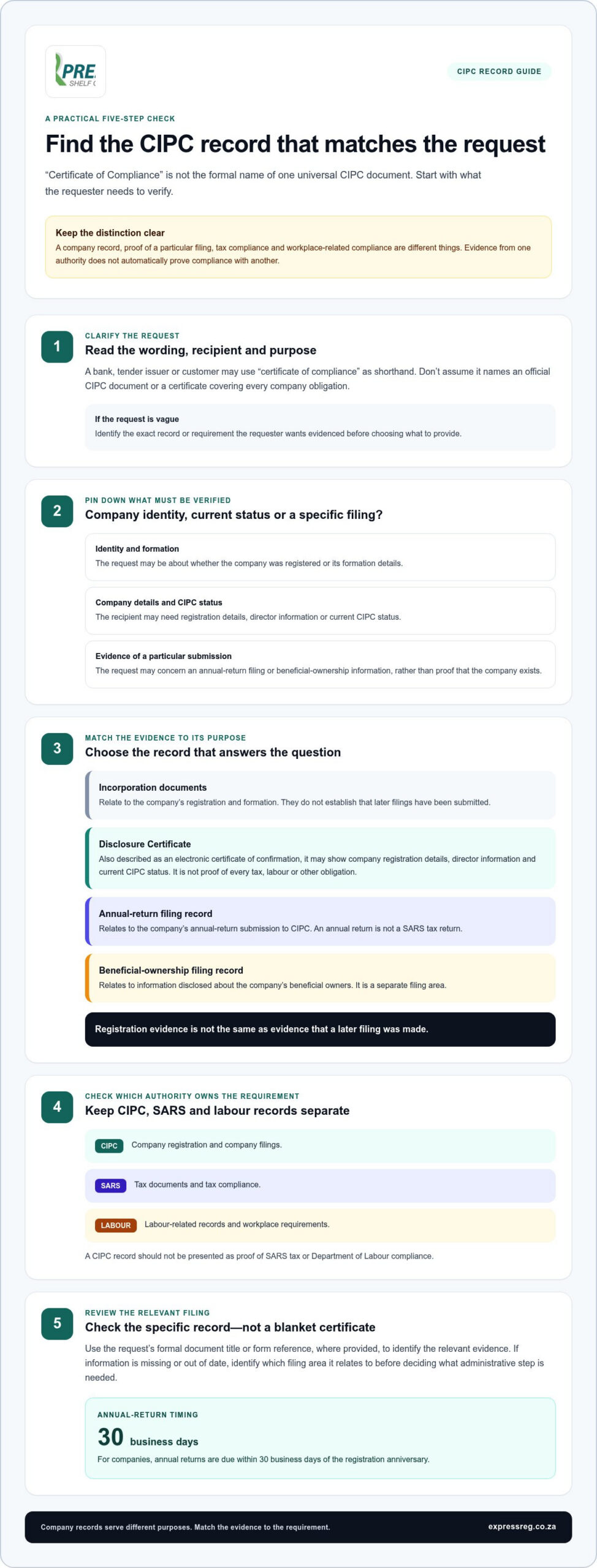
How to identify and check the CIPC document you need
Before searching your company files, pin down what the requester needs to verify. A clear request helps you choose the right authority and record, reducing the risk of sending a document that answers a different question.
- Get the exact wording. Ask for the document title or written requirement rather than relying on a general phrase such as “certificate of compliance”.
- Confirm who needs it and why. Note the recipient and purpose. A bank checking company details may need different evidence from a tender administrator checking a specific filing.
- Identify the authority. Establish whether the request concerns CIPC company registration or filings, SARS tax administration, or a labour-related matter.
- Pinpoint the document category. Check whether they need incorporation evidence, a company-status record, proof of a CIPC filing or a document from another authority.
- Check date and format requirements. The requester may specify a recent issue date, a particular filing period or a specific form of evidence. Confirm these details before obtaining or sending records.
- Review the relevant company record. Use CIPC’s official channels to check the company profile and relevant filing records. Compare details such as the registered company name and directors with the request.
Match each record to the requirement it is meant to evidence. A company-status record, for example, may not demonstrate that a particular annual return or beneficial-ownership submission has been filed.
What if CIPC records or filings need attention?
First identify the specific gap. Check whether a company detail is outdated, a director record needs updating or a filing appears to be missing. Then refer to current CIPC procedures for that record before taking corrective action. Deadlines and consequences can depend on the filing, so do not assume the same process or outcome applies to every case.
If the request concerns directors, compare the details held by CIPC with the company’s current information and review the appropriate procedure for updating them. The guide Managing Director Changes with CIPC: A Complete 2026 Guide explains the record-update process.
Once you’ve identified the relevant filing, Express Shelf Company can assist with CIPC annual returns, director changes and beneficial-ownership filings. Get assistance with your CIPC filing to take the next administrative step.
Getting help with CIPC filings after you identify the requirement
Once you know what the requester needs, confirm the requirement, match it to the responsible authority and prepare the relevant company records. If your search began with “what is a certificate of compliance CIPC”, this distinction helps you focus on the particular CIPC record or filing involved instead of treating one document as proof of every kind of compliance.
Which CIPC filing support may be relevant?
Express Shelf Company assists with three separate CIPC filing areas. Annual-return assistance relates to the company’s annual filing; director-change assistance concerns updates to director details; and beneficial-ownership filing assistance relates to the company’s beneficial-ownership disclosures. Identify which process matches the request before organising the supporting information.
Keep copies of submitted records and related correspondence together. This gives you a clear reference if you need to follow up on a submission or respond to a later request. Administrative filing assistance supports the identified process; it is not a substitute for legal representation or independent auditing.
What should you do next?
Start with the requester’s wording. If it says “CIPC certificate of compliance” without naming a document, ask what information they need to verify and whether they require a specific record or filing evidence. Keep records grouped by authority: CIPC company filings, SARS tax matters and labour-related documents serve different administrative purposes.
For example, if the request concerns a director update, focus on the relevant CIPC record and filing. If it names a SARS or labour document, treat that as a separate requirement rather than assuming a CIPC record will meet it. Once you’ve identified the filing, organise the relevant company information and retain copies of the submission and correspondence.
Express Shelf Company provides assistance with CIPC annual returns, director changes and beneficial-ownership filings. Explore assistance with CIPC compliance filings to take the next administrative step with the requirement clearly identified.
Take the next step with confidence
If you’ve been wondering what is a certificate of compliance CIPC, remember that the phrase may refer to different company records or filing evidence. Clarify what the requester needs, then match the requirement to the responsible authority. CIPC company records, SARS tax documents and labour-related records serve distinct purposes, so one should not be treated as a substitute for another.
Once you’ve identified the relevant CIPC filing, check the company details and organise the records connected to that process. Keep copies of submissions and correspondence for future reference. If an annual return, director update or beneficial-ownership filing is the next step, Express Shelf Company can assist with that administrative process.
Explore assistance with CIPC compliance filings and take the next step with the requirement and relevant records in order.
Frequently Asked Questions
Does CIPC issue a certificate of compliance?
CIPC does not use “Certificate of Compliance” as the formal name of one universal company document. The phrase is often used informally by a bank, tender issuer or customer. They may mean a CIPC Disclosure Certificate, also referred to as an electronic certificate of confirmation, or evidence of a particular filing. Check the exact request and current CIPC terminology to identify the right record.
What is a CIPC certificate of compliance used for?
The phrase is usually used to request evidence about a company’s CIPC record, such as its registration details, directors, current status or a specific filing. The purpose depends on the requester. A Disclosure Certificate may provide an overview of company information, while an annual-return or beneficial-ownership record relates to a particular filing. Neither should be treated as proof of every company, tax or workplace obligation.
How do I get a certificate of compliance from CIPC?
First ask the requester which information or filing they need to verify, since “certificate of compliance” may not be the formal document title. If they need company details and CIPC status, check whether a Disclosure Certificate meets their requirement. If they want proof of a specific submission, look for the relevant filing record. Use CIPC’s current official channels and confirm that the recipient accepts the document.
Is a CIPC certificate the same as a SARS tax-compliance document?
No. CIPC records relate to company registration and filings administered by CIPC, while tax records and tax status are handled separately by SARS. A CIPC Disclosure Certificate or annual-return record does not, by itself, establish a company’s tax position. If the request concerns tax, clarify which SARS record is required and provide evidence intended for that purpose instead of substituting a CIPC document.
Does a CIPC certificate prove that a company is in good standing?
Not as a blanket statement. A CIPC Disclosure Certificate may show company details and current CIPC status, while an annual-return or beneficial-ownership record relates to a specific filing. These records do not automatically establish that every CIPC obligation is up to date or prove tax or labour compliance. Check what “good standing” means to the requester and which records or requirements they expect you to evidence.
What is the difference between a CIPC certificate and a Letter of Good Standing?
A CIPC company record concerns registration information or company filings. A Letter of Good Standing relates to a separate labour and Compensation Fund administrative context associated with COIDA. The documents serve different purposes and are not interchangeable. If the request names a Letter of Good Standing, treat it as distinct from a CIPC Disclosure Certificate or annual-return record and identify the relevant application requirement.
Can I use CIPC annual-return proof as a certificate of compliance?
Only if the requester specifically needs evidence of that annual-return submission and accepts the filing record for that purpose. Annual-return proof shows a particular CIPC filing, not general compliance across all company obligations. It also does not replace SARS tax records or labour-related documents. Ask the recipient to clarify the requested evidence, then match the annual-return record to that requirement instead of presenting it as universal proof.