
What if the biggest hurdle to your business growth isn’t a lack of capital, but a simple administrative oversight? Many entrepreneurs discover too late that a delay in SARS tax number registration can stall contracts, block bank accounts, and trigger unnecessary penalties. It’s a foundational step that often feels buried under layers of bureaucracy, leaving you to wonder where the CIPC’s job ends and the tax office’s begins.
You likely feel that the registration process should be more intuitive, especially when you’re trying to focus on building your brand rather than filing paperwork. We understand that the fear of non-compliance is a heavy burden for any director or individual. This guide simplifies the entire journey, promising to help you master the complexities of the 2026 compliance landscape. You’ll learn how to secure your Notice of Registration (IT150) without rejection, understand the automatic integration between CIPC and SARS, and stay ahead of the latest VAT and PAYE requirements. We provide a methodical overview of the current thresholds and digital channels to ensure your tax affairs remain organised and above board.
Key Takeaways
- Understand the unique ten-digit identifier that serves as the foundation for your business or personal tax profile in South Africa.
- Learn how the CIPC and SARS integration automatically handles SARS tax number registration for new Pty Ltd companies upon formation.
- Identify the exact documentation required, including valid identification and recent proof of address, to ensure a successful application without rejection.
- Discover the specific nuances of shelf companies and why director changes are a prerequisite for active tax participation.
- Explore the necessary steps to transition from basic registration to full compliance through VAT, PAYE, and maintaining a Tax Compliance Status.
Understanding SARS Tax Number Registration in 2026
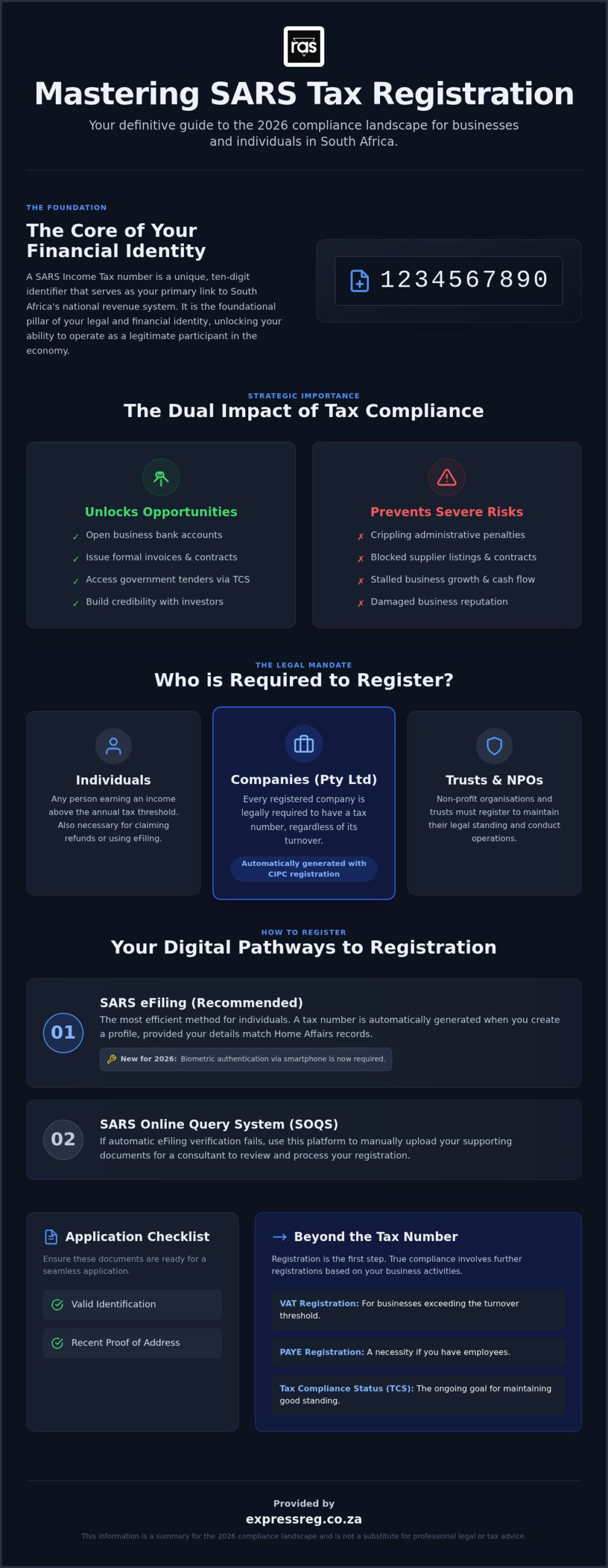
Every individual and entity operating within the South African economy requires a formal identity for fiscal purposes. This identity is encapsulated in the SARS Income Tax reference number, a unique ten-digit identifier that serves as your primary link to the national revenue system. SARS tax number registration is the foundational pillar of your business’s legal identity in South Africa. It’s the key that unlocks your ability to function as a legitimate participant in the marketplace.
Your journey with the South African Revenue Service (SARS) begins the moment this number is issued. It facilitates essential business activities, such as opening a commercial bank account or issuing formal invoices. Similarly, large-scale corporate entities often require proof of registration before they’ll consider your business for their supplier database. Registration ensures you’re not just an informal trader, but a recognised contributor to the economy.
The Importance of Tax Compliance for Entrepreneurs
For the modern entrepreneur, completing your SARS tax number registration is a strategic advantage. A valid tax number is the prerequisite for obtaining a Tax Compliance Status (TCS), which is vital for unlocking government tender opportunities. Without this status, your business is effectively barred from state-funded projects. Beyond public contracts, maintaining a “Good Standing” status builds immediate credibility with financial institutions and potential investors. They view tax compliance as a proxy for operational discipline and reliability.
Neglecting this registration carries significant risks. SARS has intensified its enforcement measures for 2026, focusing on data integration and stricter reporting requirements. Failing to register or missing deadlines results in administrative penalties that can cripple a young company’s cash flow. Staying compliant from day one protects your capital and your reputation.
Who Must Register for a Tax Number?
The legal obligation to register spans across various categories of taxpayers. It’s a broad net designed to ensure every economic actor contributes fairly. The following entities must ensure they have a valid registration:
- Individuals: Any person earning an income above the annual tax threshold must register. Even if you don’t reach the threshold, registration is often necessary for administrative reasons like claiming a refund or registering for eFiling.
- Companies: Every registered Pty Ltd company is legally required to have a tax number, regardless of its annual turnover. Under the current system, this number is typically generated automatically during the CIPC registration process.
- Trusts and NPOs: Non-profit organisations and trusts operating within the country must also secure a registration to maintain their legal standing. Once registered, you receive a Notice of Registration (IT150), which serves as official proof of your tax status.
Primary Pathways for SARS Tax Registration
The South African Revenue Service provides several digital pathways to complete your SARS tax number registration. These channels aim to reduce physical branch queues and provide immediate results for taxpayers. For the vast majority of applicants, the process is now entirely paperless and can be completed from a mobile device or computer.
Choosing the right channel depends on your specific needs and the documentation you have at hand. Whilst most individuals utilise eFiling, businesses and employers often require more structured approaches to ensure their staff or entities are correctly recorded in the national database.
Digital Registration via SARS eFiling
Registering for a SARS eFiling profile is the most efficient method for first-time individual taxpayers. When you create a profile using a valid South African ID, the system performs a real-time check against national records. If you aren’t already on the database, eFiling triggers an automatic tax number generation. Ensure your personal details match your Department of Home Affairs records exactly to avoid “Taxpayer Not Found” errors. SARS has introduced biometric authentication for eFiling registration in 2026; you’ll need a smartphone with a camera to complete this identity verification step.
If the system cannot verify your details automatically, you must use the SARS Online Query System (SOQS). This platform allows you to upload your supporting documents manually for a consultant to review. If you find these digital hurdles overwhelming, you can register your new company through an expert facilitator to ensure all statutory tax links are activated correctly from the outset.
Alternative Channels: WhatsApp and Mobile Services
SARS has moved aggressively toward mobile-first solutions to improve accessibility. You can now initiate a registration request by sending a simple greeting to the official SARS WhatsApp number. The automated system guides you through a series of prompts to capture your data and verify your identity. For those without reliable internet access, the USSD service remains a vital tool. You can dial *134*7277# on your mobile phone to access the menu, which allows you to request your tax number or check your registration status instantly.
Employers also carry a significant responsibility in this process. As of February 2026, the South African Revenue Service requires all employees to have a valid Income Tax Reference Number for PAYE reconciliation submissions. Employers can register their staff in bulk through the eFiling platform. This ensures that every member of your workforce is compliant before the tax season begins, preventing administrative bottlenecks and potential penalties for the business.
- WhatsApp: Use the official SARS channel for guided, prompt-based registration.
- USSD Service: Dial *134*7277# for basic registration and status queries.
- SMS Service: Text your ID number to 47277 to retrieve an existing tax number.
Corporate vs Individual Registration Nuances
SARS tax number registration for a private company involves a different set of administrative triggers than an individual application. Whilst a person typically initiates their own registration through eFiling or mobile channels, a company’s tax identity is born from its CIPC record. This integration aims to streamline compliance; however, it introduces specific legal requirements that many directors overlook during the initial setup phase.
Understanding these distinctions is vital for ensuring your entity is ready to trade. Individuals focus on personal identification, but for a company, the revenue service requires a clear link between the legal entity and a responsible natural person. This ensures accountability for all future statutory filings and payments.
Automatic Company Tax Registration via CIPC
When you register a Pty Ltd in South Africa: 2026 Guide, the CIPC automatically shares your incorporation data with the revenue service. This triggers the generation of an Income Tax reference number without requiring a separate manual application. This “automatic” process relies on perfect data alignment. If your registered office address or director details contain discrepancies between the two systems, the registration may stall in a pending state.
Shelf companies present a unique scenario. These entities are already registered with both the CIPC and SARS. However, they remain dormant until you perform a formal change of directors. You must update these details with SARS immediately after purchase to ensure the tax profile reflects the new ownership. Failing to do so prevents the company from obtaining a Tax Compliance Status or registering for additional taxes like VAT.
The Public Officer: A Legal Necessity
Every company must appoint a Public Officer to act as the primary point of contact for the revenue service. This individual must be a resident of South Africa and is usually one of the company’s directors. SARS will not finalise your registration or allow you to perform statutory filings until this appointment is recorded and verified. It’s a common point of failure where the “automatic” registration hangs because the Public Officer has not been verified through the SARS Online Query System.
You must submit a formal appointment letter and the officer’s identification to activate the company profile fully. Without an active Public Officer, the company cannot legally fulfil its tax obligations. This can lead to administrative penalties and a “Non-Compliant” status, which blocks your ability to apply for tenders or open corporate bank accounts. Documentation requirements also differ significantly between entities and people:
- Individuals: Require a valid Smart ID or passport and recent proof of residential address.
- Companies: Require the COR14.3 (Registration Certificate), a bank statement in the company name, and a signed appointment letter for the Public Officer.
- Trusts: Require the Trust Deed and letters of authority from the Master of the High Court.
Essential Documentation for Successful Registration
Achieving a successful SARS tax number registration relies entirely on the quality and accuracy of your supporting documents. SARS applies stringent verification standards to prevent fraud and ensure data integrity. If your submission contains even a minor discrepancy, such as a name misspelt or an expired document, the system will trigger an immediate rejection. This stalls your compliance journey and can lead to administrative frustration.
Prepare your digital files before starting the application. For both individuals and legal entities, the following core documents are mandatory:
- Valid Identification: Use a clear scan of your South African Smart ID card (both sides), a green barcoded ID book, or a valid passport.
- Proof of Address: Submit a utility bill, bank statement, or lease agreement. This document must clearly show your name and residential or business address and must not be older than three months.
- Bank Account Verification: Provide a bank statement or a formal letter from your financial institution. It must be stamped by the bank and confirm the account holder’s name, account number, and branch code.
- Company Documents: For legal entities, include the COR14.3 registration certificate issued by the CIPC.
Verification Standards for 2026
Modern SARS systems utilise advanced scanning technology to verify documents against national databases. Ensure all uploads are in PDF or JPEG format and do not exceed the file size limits specified on the eFiling platform. Blurry photos or documents where the edges are cut off are the most common reasons for rejection. Always use original digital documents where possible rather than scanning a printed copy.
Adhering to the latest FICA requirements is non-negotiable. If you’ve recently moved or changed your surname, update your details with your bank and the Department of Home Affairs before initiating your tax registration. If you find the documentation requirements confusing, you can request professional administrative support to ensure your filing is correct the first time.
Special Requirements for Foreign Nationals
Foreign nationals operating in South Africa face a more rigorous verification process. You must provide a valid passport along with your work permit or business visa. SARS requires proof that your stay in the country is legally recognised for income-generating purposes. It’s also important to note that you cannot complete the registration without a South African bank account. The revenue service will not pay refunds or verify a tax profile using an international account. Ensure your local bank account is fully FICA-compliant and active before you attempt to secure your tax number.
Beyond the Tax Number: Completing Your Compliance
Obtaining your 10-digit reference number is a significant milestone, yet it’s merely the first phase of a long-term administrative strategy. SARS tax number registration serves as the skeleton upon which you build your company’s full legal standing. Once the initial registration is active, your focus must shift toward secondary tax obligations and the ongoing maintenance of your compliance profile. Professional facilitators can manage this heavy lifting, ensuring that changes in directors or business addresses are reflected across all government databases without delay.
Expanding to VAT and PAYE
As your business scales, your tax requirements evolve. Effective from 1 April 2026, the compulsory VAT registration threshold has increased to R2.3 million in taxable supplies over any 12-month period. If your turnover approaches this figure, you must apply for a VAT registration number to avoid heavy penalties. For those with a turnover between R120,000 and R2.3 million, voluntary registration remains an option to reclaim input tax on business expenses. Review our SARS VAT Registration South Africa: The Complete 2026 Guide to determine your eligibility.
If you employ staff, you must also register as an employer for Pay As You Earn (PAYE). This ensures you correctly deduct and remit income tax on behalf of your workforce whilst staying compliant with national labour laws. From February 2026, you cannot submit PAYE reconciliations without valid tax numbers for every employee, making early registration critical. Use our PAYE Registration Services South Africa: The 2026 Employer Checklist to prepare your payroll systems.
Securing Your Tax Clearance Status
A successful SARS tax number registration eventually leads to the issuance of a Tax Compliance Status (TCS) PIN. This digital token allows third parties, such as government departments or corporate partners, to verify your standing in real-time. Maintaining this status requires more than just paying your taxes; it involves the timely submission of all returns, including those for the CIPC. If you miss a single filing, your status can switch to “Non-Compliant” instantly, halting your business operations.
Your tax status is directly linked to your statutory corporate filings. Neglecting your CIPC Annual Returns Submission: The Complete 2026 Compliance Guide can lead to company deregistration, which immediately invalidates your tax profile. It’s vital to realise that a tax number is only the start of a broader compliance journey that requires constant vigilance and periodic updates to your registration details.
Securing Your Future Through Permanent Compliance
Completing your SARS tax number registration is the most critical step in establishing a legitimate presence within the South African economy. This identifier is not just a requirement for filing returns; it’s the gateway to opening bank accounts, securing government tenders, and building trust with corporate partners. By ensuring your documentation is precise and your Public Officer details are verified, you eliminate the administrative friction that often stalls new ventures.
Compliance is a continuous process that requires constant attention as your turnover grows and your workforce expands. You don’t have to manage these statutory hurdles alone. Our team provides fixed-fee administrative filings and expert CIPC and SARS facilitators to handle the heavy lifting for you. We offer national compliance support to ensure your business remains in good standing throughout its lifecycle.
Streamline your SARS tax number registration with Express Shelf Company today and focus your energy on growing your business. Your path to full legal standing is now clear and manageable.
Frequently Asked Questions
How do I find my SARS tax number if I have lost it?
Retrieve your lost number by using digital channels like the SARS SMS service or USSD. Text your ID number to 47277 or dial *134*7277# on your mobile phone for an immediate response. You can also log into your eFiling profile to view your details under the “Taxpayer Information” tab. If these digital methods fail, call the SARS Contact Centre or use the SARS Online Query System to request a copy of your Notice of Registration.
Can I register for a SARS tax number online for free?
Yes, you can register for an individual tax number at no cost through the SARS eFiling website or the SARS MobiApp. When you create a new profile, the system automatically verifies your details against the Department of Home Affairs database. If you aren’t already registered, it generates a tax number instantly. Whilst the SARS service is free, many businesses choose professional facilitators to ensure their corporate tax links are correctly activated during the company formation process.
How long does SARS tax number registration take for a new company?
Registration is typically instantaneous for new companies because of the direct integration between the CIPC and SARS. Once your Pty Ltd incorporation is finalised, the system generates the Income Tax reference number automatically within 24 to 48 hours. You’ll receive your Notice of Registration (IT150) via email shortly after. If there’s a delay, it usually indicates a mismatch in director details or a pending Public Officer verification that requires manual intervention through the query system.
What happens if I operate a business without a tax number?
Operating without a valid registration constitutes a serious compliance breach that triggers administrative penalties and interest. You’ll be unable to open a commercial bank account, apply for government tenders, or issue valid tax invoices to corporate clients. SARS tax number registration is a legal prerequisite for any business activity in South Africa. Non-compliance can lead to the freezing of business assets or legal action if you’re found to be evading your national tax obligations.
Do I need a tax number to register a company with CIPC?
No, you don’t need an existing tax number to register a company; the process works in reverse. You first incorporate your business with the CIPC, and this action triggers the automatic generation of a new corporate tax number by the revenue service. For individuals, you only need a valid South African ID or passport to start the incorporation. Your personal tax status doesn’t prevent the new legal entity from receiving its own unique ten-digit identifier.
Is it possible for an unemployed person to get a tax number?
Yes, any South African resident can register for a tax number regardless of their current employment status. You might need one to open a high-interest savings account, register a new business, or receive a payout from a deceased estate. Use the eFiling platform to create a profile and request registration. Having a number ready ensures you’re prepared for future income-generating opportunities or statutory requirements that may arise during your career or business journey.
Can a foreign national register for a SARS tax number?
Foreign nationals can register provided they have a valid passport and a legal permit to be in South Africa, such as a work or business visa. You must also possess a local bank account for verification purposes. The process often requires a manual submission through the SARS Online Query System to verify your documentation and residency status. Registering ensures you can legally earn an income and fulfil your fiscal duties whilst residing in the country.
How do I update my bank details with SARS after registration?
Update your banking information through your eFiling profile or by visiting a SARS branch with a stamped bank statement. For security reasons, SARS requires a strict verification process to prevent fraudulent refunds. You must provide a valid ID and proof of account ownership not older than three months. Ensure these details are accurate before filing your annual returns to avoid delays in receiving any potential tax refunds or settlements from the revenue service.