
A company can be active in your plans and still face deregistration if its CIPC compliance falls behind. If you’re asking how to avoid my business being deregistered, treat compliance as a recurring process, not a task to remember once a year. Track annual returns, beneficial ownership information and company records, and keep proof of each filing.
It’s easy to miss a deadline or assume that a dormant company has no filing obligations. Keep CIPC status separate from SARS tax compliance: deregistration with CIPC doesn’t automatically close a company’s SARS tax profile, and resolving one issue doesn’t resolve the other.
This guide explains what to track, how annual returns and beneficial ownership filings fit together, and why current company information matters. It also sets out how to respond if you receive a CIPC notice or find that your company’s status is at risk. A clear filing routine and prompt follow-up can help you address gaps before they become harder to resolve.
Key Takeaways
- Build a regular CIPC compliance routine so annual returns and company details don’t slip off your radar.
- Track beneficial ownership filings separately, and understand how they can affect annual return submissions.
- Keep CIPC company status separate from SARS tax administration; a problem with one doesn’t automatically resolve the other.
- To understand how to avoid my business being deregistered, assign responsibility, record due dates and keep filing confirmations together.
- If CIPC flags your company, check its status, read the full notice and work through the required steps methodically.
How does CIPC deregistration affect a South African business?
CIPC deregistration is a formal change to a company’s status on the register maintained by the Companies and Intellectual Property Commission (CIPC). It isn’t simply a description of a business that has stopped trading. A quiet period or temporary pause in operations doesn’t, by itself, mean the company has been deregistered.
In brief: CIPC deregistration concerns whether the company remains registered as a legal entity. SARS tax deregistration concerns its tax registration with the revenue service. These are separate processes, and one doesn’t automatically complete the other.
What does it mean when CIPC deregisters a company?
Once deregistered, a company no longer has active registered status on the CIPC register. This differs from voluntarily closing a company. Voluntary deregistration is a formal route for winding up a company that is no longer needed, while deregistration for non-compliance can follow unresolved filing obligations. A missed filing doesn’t necessarily mean immediate deregistration, but it can create a risk that needs attention.
Don’t assume an inactive company is exempt from its obligations. Even if it isn’t trading, it may still need to maintain its CIPC filings and records. Check the company’s registered status rather than inferring it from day-to-day activity.
Why should directors act before a status problem escalates?
Out-of-date director or company details, missing filings and unanswered notices can make later administration more difficult. They can also leave directors unsure which issue to resolve first. Check the company’s current CIPC status and read any notice in full before deciding what to do. Don’t rely on old correspondence or assume a quiet company is automatically in good standing.
Include annual returns in your regular checks. They’re a recurring CIPC obligation, and a clear record of filing dates and confirmations can help you spot gaps early. For filing requirements and practical steps, see our CIPC annual returns guide.
If you’re working out how to avoid my business being deregistered, start with three checks: confirm the company’s CIPC status, make sure its details are current, and track each filing through to confirmation. Act on warnings promptly. Resolving a CIPC issue doesn’t, by itself, resolve a separate SARS tax matter.
Which CIPC compliance gaps can put a company at risk?
Company deregistration risk often begins when routine administration falls behind. Annual returns, beneficial ownership information and accurate company records are related parts of compliance, but they aren’t interchangeable filings. Track each obligation separately and follow CIPC’s current instructions when preparing a submission.
How do annual returns and beneficial ownership filings fit together?
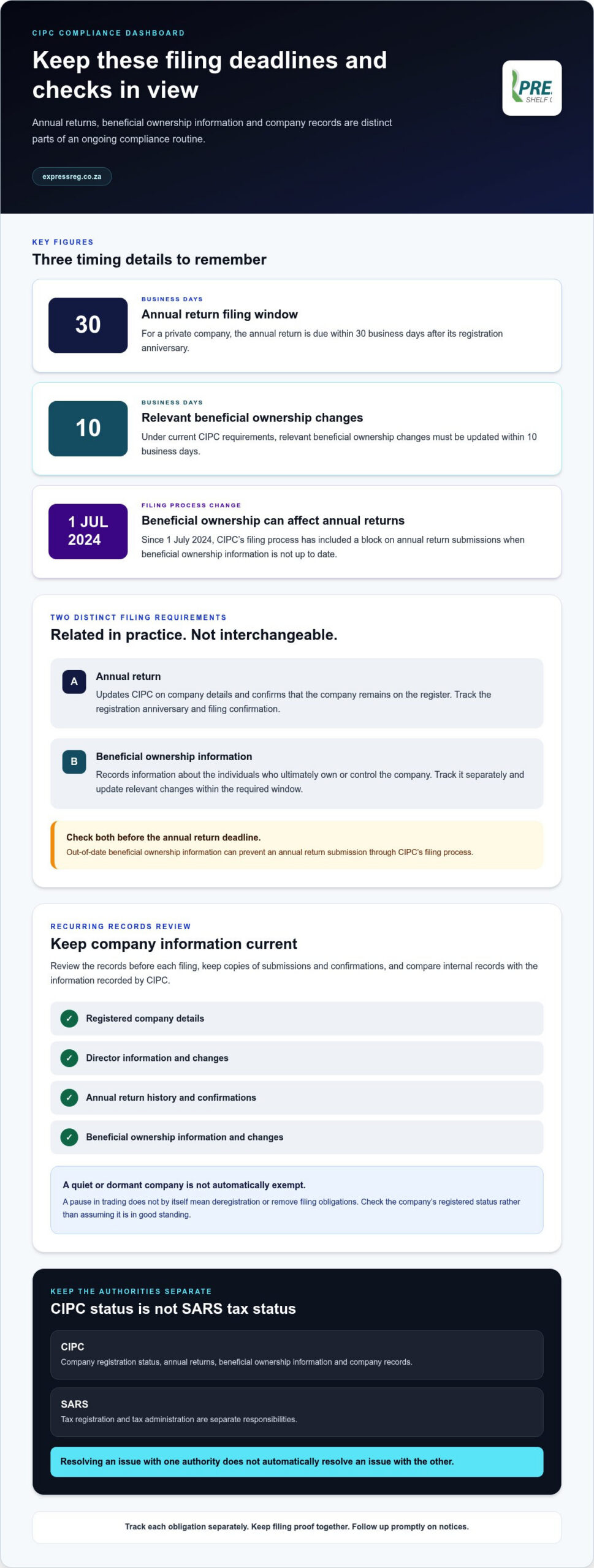
An annual return updates CIPC on a company’s details and confirms that it remains on the register. For a private company, the filing is due within 30 business days after its registration anniversary. Beneficial ownership information has a different purpose: it records information about the individuals who ultimately own or control the company.
These are distinct requirements, but they can affect one another in practice. Since 1 July 2024, CIPC’s filing process has included a block on annual return submissions where beneficial ownership information isn’t up to date. Review both requirements before the annual return deadline, so a gap doesn’t prevent you from submitting the return. For more detail, see our beneficial ownership filing guide.
Ownership changes can also affect filing responsibilities. Under current CIPC requirements, relevant beneficial ownership changes must be updated within 10 business days. Check the latest CIPC instructions for the applicable process and information before submitting.
Why should company and director details stay up to date?
Company records should reflect the business as it operates. If a director leaves or a new director is appointed, record the change through the appropriate CIPC process. Outdated details don’t automatically mean a company will be deregistered, but they can make notices, filings and later administration harder to manage.
For a practical CIPC records review, check the company’s registered details, director information, annual return history and beneficial ownership information. Keep copies of submissions and confirmations, then compare your internal records with the information recorded by CIPC. Reviewing these details before each filing can reveal missing or inconsistent information early.
Keep CIPC duties distinct from tax administration. A company’s CIPC filing position doesn’t settle its SARS obligations; SARS explains the separate process for tax deregistration with SARS.
If you’re asking how to avoid my business being deregistered, make these checks part of a recurring calendar rather than a last-minute exercise. Express Shelf Company assists with annual returns, beneficial ownership filings and director changes. Explore company administration support.
Is CIPC deregistration the same as a SARS compliance problem?
No. CIPC deregistration and a SARS compliance issue concern different records and responsibilities. A company might need to address an annual return with CIPC and, separately, an outstanding tax return with SARS. Resolving one matter doesn’t automatically resolve the other.
What does CIPC handle, and what does SARS handle?
Use the authority named on a notice to identify which issue needs attention. This comparison can help you direct your first checks:
| Area | What it relates to | What to check |
|---|---|---|
| CIPC company status | The company’s registration record and prescribed company filings, such as annual returns and beneficial ownership information. | Company status, filing history and any CIPC notice or reference number. |
| SARS tax administration | Tax registrations, tax returns and other tax obligations administered by SARS. | The relevant tax account, return or SARS correspondence. |
| Employer-related obligations | Responsibilities that may apply when a business employs staff, including payroll-related submissions and other employer registrations. | The obligation named in the notice and the authority responsible for that specific requirement. |
Employer duties can involve more than one authority, depending on the obligation. Don’t assume that a payroll matter and a CIPC filing use the same process. Match each requirement to its own record and instructions.
What should you do when a notice mentions non-compliance?
Start by confirming who issued the notice. Record its reference number and response date, and identify the company or tax account it concerns. Then read the full notice to find the specific requirement, the period involved and the action requested. Don’t rely on a subject line or message summary alone.
Next, compare the notice with the relevant records. A CIPC notice means checking company filings and registration details; a SARS notice means reviewing the specified tax account or return. If you’re unsure which record is involved, pause before submitting information to the wrong authority.
A disputed legal question or complex enforcement matter may require advice from a suitably qualified legal professional. For routine administration, keeping CIPC and tax records separate makes it easier to identify what remains outstanding. If you’re asking how to avoid my business being deregistered, first identify the issue correctly, then respond to the authority responsible for it.
How can you build a routine to prevent company deregistration?
Make CIPC compliance a recurring process with clear ownership, recorded deadlines and proof of completion. A calendar or shared spreadsheet can work well if someone is responsible for keeping it current and following up on outstanding items. Turn “remember to file” into a task with an owner, a due date and a record of what happened.
What should a director’s monthly and annual compliance checklist include?
Assign someone to monitor official communications and maintain the company’s filing records. Set a monthly reminder to review new notices and outstanding actions. Schedule a fuller review ahead of filing deadlines, and confirm the company’s current status through CIPC’s official channels rather than relying on old messages or assumptions.
For each obligation, record the responsible person, due date, status, submission confirmation and any follow-up required. Keep supporting company records and CIPC confirmations together in an orderly digital or physical file. When a director or other company detail changes, add the relevant update to the workflow so it doesn’t disappear among routine correspondence.
Save this five-step checklist:
- Assign: Name an owner for CIPC communications and filing tasks.
- Record: List obligations, due dates and reminders in one compliance calendar.
- Review: Check company information, CIPC status and outstanding notifications regularly.
- File: Submit the required information and keep the confirmation with supporting records.
- Follow up: Compare confirmations with CIPC records and track unresolved items to an outcome.
How can a business close gaps before they become urgent?
At each review, compare the calendar with completed submissions and available CIPC records. If a task is overdue or a confirmation is missing, assign a follow-up date and note who is handling it. For an unclear notice, identify the issuer and requirement, then escalate promptly instead of leaving the item open without an owner.
Keep a short action log with the date, issue, steps taken and outcome. It gives directors a clear view of what remains outstanding and helps prevent the same gap being missed at the next review. If the business has several recurring filings or limited internal capacity, administrative assistance can help manage submissions and confirmations.
A consistent routine is a practical answer to how to avoid my business being deregistered. Express Shelf Company provides CIPC filing administration, including annual returns, beneficial ownership filings and director changes. Explore CIPC filing support.
What should you do if CIPC has flagged or deregistered your company?
A CIPC warning or deregistration status calls for prompt, organised action, not guesswork. First, confirm the company’s current status through CIPC’s official channels and read the complete notice. Check which company it concerns, what issue is identified, the notice date, any response deadline and the steps CIPC requires. Don’t assume that submitting a filing is enough. Look for an acknowledgement or an updated record.
How should you respond to a CIPC warning or pending status change?
Work through the issue in sequence. A clear record of what CIPC has requested helps prevent a rushed response that misses a filing or supporting document.
- Identify the issue: Note the notice date, company details, stated concern, reference number and any instructions or response date.
- Gather records: Compare the relevant CIPC information with your filing history, company records and submission confirmations.
- Address the gap: Follow the applicable CIPC process to submit a missing filing or correct inaccurate information. Use the instructions for the specific issue rather than assuming every notice requires the same response.
- Track the outcome: Save the submission acknowledgement or reference details, record when you acted, and check the company’s status again for confirmation.
If information is unclear or doesn’t match your records, note the discrepancy and seek clarification through the relevant official process. Acting promptly is useful, but accuracy matters too. Incorrect information may leave the underlying issue unresolved.
What if the company already appears as deregistered?
Don’t assume that reinstatement is automatic. The available restoration route, eligibility, evidence and timing depend on the company’s circumstances and current CIPC requirements. Check the latest process before preparing an application. CIPC’s Notice 12 of 2026 sets out strict evidentiary requirements for reinstatement, including evidence in the company’s official name, from an independently verifiable third-party source, dated around the time of deregistration. Gather relevant records carefully and confirm that they meet the current requirements.
Administrative filing assistance can help organise and submit CIPC documents, but it can’t guarantee that a company will be reinstated. If the company’s status is disputed or the matter involves contested legal rights, get advice from a suitably qualified legal professional. Keep any SARS tax matters separate and address them through the appropriate process.
A calm, documented response gives you a clearer basis for addressing an existing status concern and is part of how to avoid my business being deregistered. For assistance with CIPC administrative submissions, get help with CIPC compliance filings.
Make CIPC compliance part of your business routine
The practical answer to how to avoid my business being deregistered is to keep compliance visible and organised. Track annual returns and beneficial ownership filings separately, keep company and director details current, and save proof of each submission. Check your CIPC status and respond promptly to notices instead of assuming a quiet trading period means there’s nothing to do.
Remember that CIPC company status and SARS tax administration are separate. Match a notice from either authority to the relevant record and address it through the appropriate process. If CIPC has flagged your company, confirm its status, read the full notice and work through the stated requirements methodically.
Express Shelf Company assists businesses throughout South Africa with CIPC annual returns, beneficial ownership filings and director changes. For practical help organising these administrative submissions, get help managing your CIPC compliance filings.
With clear responsibility, reliable records and a steady filing routine, you can manage company administration with greater confidence and keep your attention on running the business.
Frequently Asked Questions
Can CIPC deregister a company for not filing annual returns?
Yes. Failure to file required annual returns can put a company at risk of CIPC deregistration, but a missed deadline doesn’t mean the company is deregistered immediately. Check the company’s status and filing history through CIPC’s official channels, and read any notice carefully to identify the issue and next steps. Address overdue returns promptly, keep submission confirmations, and check the current CIPC process if the company’s status has changed.
How do I check whether my company is at risk of deregistration?
Check the company’s current status and filing history through CIPC’s official channels, then review any notices or outstanding filing requirements. Pay particular attention to annual returns, beneficial ownership information and the accuracy of registered company details. Record the notice reference and any response date. If you’re asking how to avoid my business being deregistered, make these checks part of a regular compliance routine rather than waiting for a warning.
Is CIPC deregistration the same as SARS tax deregistration?
No. CIPC deregistration concerns a company’s registration status and company filings, while SARS tax deregistration concerns the company’s tax registrations with SARS. They are separate processes. A CIPC status change doesn’t automatically close the company’s SARS tax profile, and resolving a SARS tax issue doesn’t update the CIPC record. Identify which authority issued a notice, then deal with the specific account or filing it names.
What happens if I miss a CIPC annual return deadline?
A missed annual return deadline can leave the filing overdue and may expose the company to late fees or penalties and a risk of deregistration if non-compliance remains unresolved. For a private company, the return is due within 30 business days after its registration anniversary. Check the latest CIPC instructions, submit outstanding returns through the applicable process, and retain proof. Don’t assume that filing one return resolves any other outstanding compliance items.
Can beneficial ownership information affect my CIPC annual return?
Yes. Beneficial ownership is a separate filing, but CIPC’s process links it to annual return submission. Since 1 July 2024, a company whose beneficial ownership information isn’t up to date may be blocked from filing its annual return. Review and update the relevant information before attempting the return, and check current CIPC instructions for the requirements that apply to your company. Keep confirmation of both submissions with your company records.
Can a deregistered company be restored in South Africa?
Reinstatement may be possible, but the available route and requirements depend on the company’s circumstances and current CIPC rules. The process can involve an application, evidence relevant to the company’s status at deregistration, and addressing outstanding annual returns and related amounts. Check CIPC’s current requirements before applying, as evidentiary standards are important. If status or legal rights are disputed, seek advice from a suitably qualified legal professional.
Who is responsible for keeping a company’s CIPC filings up to date?
The company should ensure its CIPC obligations are managed, and its directors should make sure responsibility is clearly assigned and monitored. A director can nominate an employee or use administrative filing assistance for tasks such as annual returns, beneficial ownership filings and director changes. Keep a calendar of obligations, name an owner for each task, monitor official communications and retain submission confirmations so the company can track what’s complete and what needs attention.