
What if your documents are ready, but don’t tell the same story? This can happen when CIPC details, SARS tax records and financial figures are out of date or don’t match. If you’re looking for the company documents needed for a business loan south africa, treat the application as one joined-up file, not a pile of separate forms.
Lenders may ask for both company and personal information. Registration and director records help identify the applicant and the people authorised to act for it. Bank statements, accounts and tax records help show how the business is performing. Requirements vary by lender, loan type and applicant, but business bank statements commonly cover three to six months.
This 2026 checklist covers company, financial, tax and personal documents a lender may request, what they help assess, and how to spot missing or outdated records before you apply. Use it to organise information consistently and identify administrative gaps early.
Key Takeaways
- Start with the lender’s current checklist. Requirements can differ by finance type, business structure and trading history.
- Keep company records separate from personal identity and address evidence so it’s clear whose details each document verifies.
- Check whether SARS tax-status evidence, VAT records or PAYE information applies to your business before assembling the tax section.
- Use this guide to identify the company documents needed for a business loan south africa and prepare a file that’s easier to review.
- Keep CIPC and tax records current as part of good administration. A complete file doesn’t determine a lender’s decision.
Company documents for a South African business loan: what lenders assess
A business loan application brings together evidence about the business, its owners or representatives, its finances and the purpose of the request. Lenders use this information to understand who is applying, how the business operates and whether its finances indicate it can meet repayments.
Requirements vary by lender, finance type, business structure and trading history. A newer business, for example, may have less historical financial information than an established company, so the lender may request different supporting evidence. The finance type also matters: an application involving security may require information about that security, while an unsecured loan may be assessed differently. See this overview of what lenders assess for background on business loans and their general features.
It helps to divide documents into two groups:
- Commonly requested: Records that help identify the applicant, its owners or representatives, and its financial position.
- Application-specific: Additional evidence requested because of the lender’s process, the finance being considered or the business’s circumstances.
This distinction is useful when preparing the company documents needed for a business loan south africa. Use a general checklist as a starting point, then arrange your file around the requirements for your application. Complete paperwork supports an assessment, but it doesn’t guarantee approval or replace a lender’s decision about risk and affordability.
Why lenders ask for company and financial records
Company records help identify the business applying and the people authorised to act for it. Owner or representative details connect the application to the people responsible for it. Accounts and cash-flow records can help a lender assess income, existing commitments and the business’s capacity to repay. Each document is considered alongside the rest of the application, not as an automatic approval criterion.
Company applicants and sole proprietors may prepare different files
A registered company may need to provide records identifying the legal entity and its directors or authorised signatories, as well as personal identity documents when requested. A sole proprietor’s business and personal affairs aren’t separated in the same way as those of a registered company. The lender may therefore focus on the owner’s identity and the business’s trading and financial evidence. The exact file depends on the lender’s policy and the applicant’s structure.
Before gathering paperwork, identify which documents relate to the company and which relate to an individual. This makes gaps easier to spot, helps prevent records from being mixed up and makes it simpler to respond if the lender requests further evidence.
Core company, director and financial documents to gather
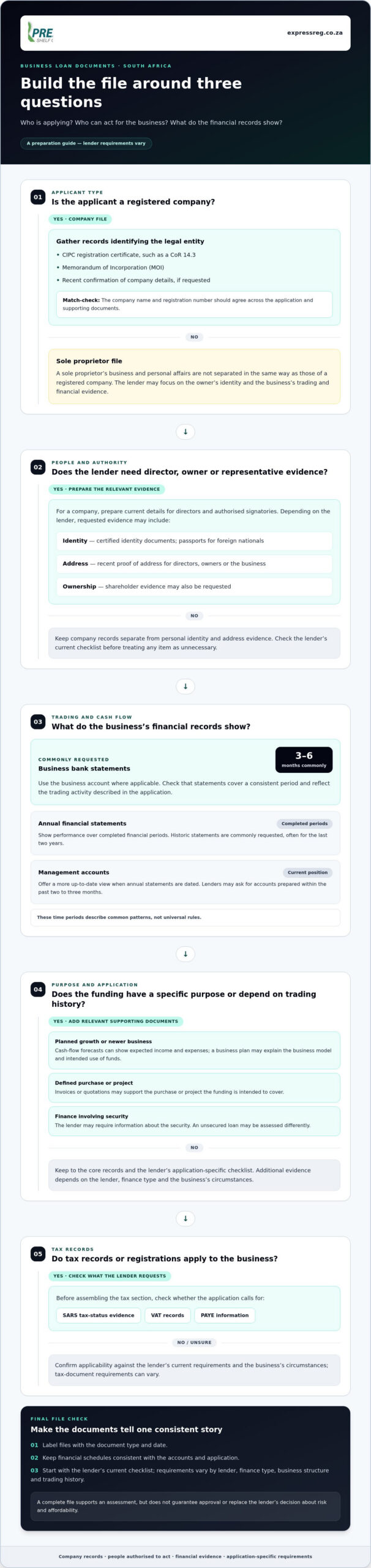
Build your file around three questions: which business is applying, who can act for it, and what do its financial records show? The company documents needed for a business loan south africa vary by lender and application, so use this as a preparation guide rather than a fixed submission list.
CIPC and identity documents for a company applicant
For a registered company, a lender may request its CIPC registration certificate, such as a CoR 14.3, and its Memorandum of Incorporation (MOI). It may also ask for recent confirmation of company details. Check that the company name and registration number match across the application and supporting documents.
Prepare current details for directors and authorised signatories. Depending on the lender’s requirements, this may include certified identity documents, passports for foreign nationals, and recent proof of address for directors, owners or the business. Shareholder evidence may also be requested. Requirements vary, and development-finance institutions may have distinct eligibility criteria, as outlined in this guide to lender-specific requirements.
Financial records that show trading and cash flow
Gather documents covering the business’s financial history and current position. Lenders commonly request three to six months of business bank statements. Use the business account where applicable, and check that the statements cover a consistent period and reflect the trading activity described in your application.
Annual financial statements show performance over completed financial periods. Up-to-date management accounts provide a more current view, which can be useful if the latest annual statements are dated. Lenders commonly request historic statements, often for the last two years, and may ask for management accounts prepared within the past two to three months. These are common patterns, not universal rules.
Depending on the funding purpose and the business’s trading history, prepare supporting documents such as:
- Cash-flow forecasts to show expected income and expenses, particularly for newer businesses or requests involving planned growth.
- A business plan explaining the business model and intended use of funds, where relevant to the application.
- Invoices or quotations supporting a specific purchase or project the funding is intended to cover.
Label each file with its document type and date. Keep financial schedules consistent with the figures in your accounts and application. If company details or CIPC records need attention, CIPC filing support can help keep statutory administration organised while you prepare your application.
Tax records and lender-specific requirements: what changes between applications?
Tax documents form part of an application when they’re relevant to the business and requested by the lender. The company documents needed for a business loan south africa may therefore include different tax evidence for different applicants. CIPC documents establish company details, but registration alone doesn’t show the business’s tax position, trading history or capacity to repay.
SARS, VAT and PAYE records to check
A lender may ask for SARS records or a Tax Compliance Status (TCS) PIN. A TCS PIN allows a third party to view a business’s tax-compliance status through SARS. It provides evidence for assessment, but doesn’t promise finance or replace the lender’s other requirements. Check that the details used for verification correspond with the applicant business.
Include VAT and PAYE information only where it applies. If the business is a registered VAT vendor, a lender may request its VAT registration number or certificate. PAYE records may be relevant if the business is registered for PAYE. Don’t assume every applicant needs both, or that one SARS document covers every tax obligation. Use current SARS terminology and follow the lender’s instructions about the evidence to provide.
New businesses and applicants with limited trading history
An established business may be able to provide annual financial statements, recent management accounts and bank statements covering its trading activity. A newer business may have fewer completed financial periods, so its file may rely more on forward-looking information. The lender’s process determines what it will consider.
Depending on the application, supporting evidence may include a cash-flow forecast, business plan, signed customer contracts, invoices or supplier quotations. These documents can help explain expected trading or the intended use of funds, but they don’t automatically replace historical accounts or other requested documents. Follow the lender’s instructions before treating a forecast or quotation as a substitute.
Before submitting, compare the lender’s checklist with your actual tax and trading position. Note clearly which records don’t apply, and don’t describe a business as VAT or PAYE registered unless that’s accurate. If a tax registration or company record needs attention, addressing that administrative gap can make the application file more consistent. It won’t determine the lender’s decision, which may also depend on its criteria, the finance requested and the other evidence provided.
How to prepare a business loan document pack before applying
Use a consistent checking process before submitting your application. This helps you catch missing pages, inconsistent details and gaps in financial periods while there’s still time to address them. Keep source documents unchanged. If a detail needs correcting, use the appropriate process rather than editing the document yourself.
A practical document-checking sequence
Work through these steps in order:
- Get the current checklist. Start with the lender’s latest application form and exact list of supporting documents. Note any requirements specific to your finance type or business structure.
- Collect the records. Gather company, director, identity, address, financial and relevant tax documents. Keep originals and store secure copies for submission and your own records.
- Check key details. Compare the company name and registration details, director and signatory information, business account details and dates across the application and supporting records. Confirm that financial documents cover the periods requested.
- Organise the files. Group documents by category and label each file with its type and date, such as “Management accounts, June 2026”. Arrange statements in date order so the sequence is clear.
- Review and index. Create a short contents list that maps each checklist item to a file name. Mark anything missing or needing clarification, and resolve gaps before submission where possible.
A consistent file makes it easier to check that the application details match the evidence. For example, an invoice may show a trading name that differs from the registered company name. If the lender requests context, provide supporting information rather than changing the original invoice.
Common gaps that can slow an application
Look for incomplete application fields, outdated proof of address, an expired passport used for identification, missing signatures or company details that don’t match across records. These issues are easy to overlook when documents were collected at different times.
Missing financial periods can also prompt follow-up questions. If a statement or account period isn’t available, don’t alter a document or assume another record will be accepted instead. Note the gap and follow the lender’s instructions. Keep a submission log with the date sent, documents included and any follow-up requests, then provide the specific evidence requested.
If your CIPC records need updating or filing, arrange CIPC filing support to help keep company information orderly. Accurate records support a well-prepared application file, but they don’t guarantee a lending decision.
Keep company records organised and take the next administrative step
A useful application file contains records that are easy to locate and consistent with one another. Keep company details, director and owner identity evidence, financial records and relevant SARS information together, with clear dates and labels. Update the file when company details change or new financial periods are available instead of rebuilding it from scattered documents each time a lender asks for information.
Current CIPC and SARS records support orderly business administration, but they don’t determine whether a lender will approve an application. The company documents needed for a business loan south africa are only part of the assessment, and each lender applies its own criteria. Treat record-keeping as preparation, not a promise of a lending outcome.
Maintain the records behind a lender-ready file
Set a regular time to review company information, director details, tax registrations and financial records. Keep dated copies of relevant filings and make sure internal records reflect changes to company details. If you’re looking for guidance on CIPC Annual Returns or VAT registration, use the relevant guides to understand the administrative steps involved. Include VAT information in a loan file only when it applies to your business and the lender requests it.
Get help with company registration and statutory filings
Express Shelf Company assists with company registration and CIPC filing administration, helping businesses keep key company records organised. The company also assists with SARS tax-registration administration, including relevant VAT and PAYE registrations. These services support company and tax administration, not loan applications or approval decisions.
If you’ve identified a gap in your company registration or statutory records, explore company registration and filing support. Keeping the underlying information current can make it easier to assemble a clear application file when a lender requests it, while leaving the lending decision to the lender.
Prepare your records before you apply
A well-organised loan file brings together company and director details, financial evidence and tax information relevant to your business. Use the lender’s current checklist, check that names and dates align across documents, and address missing or outdated records before submitting your application. The company documents needed for a business loan south africa vary by lender and business circumstances, so a complete file supports assessment but can’t guarantee approval.
Keeping CIPC and SARS records current is also part of sound business administration. Express Shelf Company provides national support with company registration and CIPC filings, as well as assistance with SARS tax registrations, VAT and PAYE where relevant.
If company or tax paperwork needs attention, get help organising your company registration and statutory filings. Take the next administrative step by getting in touch with Express Shelf Company.
Frequently Asked Questions
Is there one standard list of documents needed for a business loan in South Africa?
No. There isn’t one standard document list for every South African business loan. Requirements vary by lender, finance product, business structure, trading history and application purpose. Start with company records, owner or director identity evidence, financial information and relevant tax records, then follow the lender’s current checklist. A general list doesn’t guarantee that every item will be requested or accepted.
What company documents do South African lenders usually ask for?
Lenders may request company registration details, director or authorised-signatory information, identity evidence and financial records. Depending on the application, they may also ask for proof of address or supporting business information. Requirements vary, so check the current list rather than relying on a generic checklist. Before submitting, compare the company name, registration details and people’s names across documents. No single document proves that a loan will be approved.
Can I apply for a business loan if my company is new?
Yes, a newer business can enquire or apply, although limited trading history may affect what evidence a lender requests. Depending on its criteria, the lender may ask for forecasts, a business plan, contracts or other supporting information alongside available financial records. These documents aren’t automatically accepted as substitutes for trading history. Describe your business’s stage accurately and follow the lender’s checklist to understand what it will consider.
Do I need SARS tax documents for a business loan application?
Some lenders may request SARS tax-registration or tax-status information, but requirements differ between applications. VAT records are relevant where the business is a registered VAT vendor; PAYE information matters where the business has PAYE obligations. Check the lender’s current list and make sure tax records show details consistent with the applicant. Tax compliance evidence may form part of an assessment, but it doesn’t secure funding, and not every business needs the same records.
How many months of business bank statements will a lender require?
The required period depends on the lender, finance product and business history, so don’t assume one fixed period applies. Some lenders commonly request three to six months of statements, but the lender’s current checklist takes precedence. Prepare consecutive statements for the business account where applicable, and make sure the period is clear and complete. If your account history has gaps or the business uses multiple accounts, follow the lender’s instructions about what to provide.
What happens if my company documents are outdated or incomplete?
A lender may request updated records, clarification or additional evidence, which can extend its assessment. Before applying, review company details, director information and relevant filings for gaps or outdated information. If a document needs correcting, use the appropriate official process rather than editing the original. Keep a record of what you submit and respond to follow-up requests with the specific information the lender asks for.
Do lenders require a business plan as well as financial statements?
Not always. Whether a lender requests a business plan alongside financial statements depends on its process, the application purpose and the business’s stage. A plan or cash-flow forecast can explain how funds may be used, while financial statements show historical performance where available. Neither is universally mandatory. Follow the lender’s checklist, and label forecasts clearly so projected figures aren’t confused with actual results.