
You could spend weeks waiting for a new company registration, or you could start trading by tomorrow morning. Most entrepreneurs feel the pressure of missing a lucrative tender deadline because of administrative delays at the CIPC. It’s frustrating to watch an opportunity slip away while you wait for paperwork to clear. You might be wondering how to open a bank account for a shelf company quickly to ensure your new entity is fully operational and ready for transactions.
Discover how to fast-track your business operations by acquiring a shelf company whilst navigating the complexities of South African banking compliance. We provide a clear path to immediate legal entity ownership and a functional business bank account. This guide outlines the methodical process of updating director details, managing SARS requirements, and completing the necessary FICA re-verification. You’ll learn how to transition from a dormant shell to a compliant, trading business that meets all 2026 regulatory standards. We focus on removing administrative hurdles and providing foundational support so you can focus on your business growth.
Key Takeaways
- Acquire a pre-registered Pty Ltd entity to bypass lengthy registration queues and secure an aged company status for upcoming tender bids.
- Understand the essential FICA requirements and learn how to open a bank account for a shelf company by completing the mandatory director re-verification process.
- Manage the CIPC transition smoothly by submitting the correct COR39 forms and updating beneficial ownership records to ensure full legal standing.
- Ensure your new business remains compliant with SARS through immediate income tax registration and professional management of administrative filings.
- Minimise financial risk by selecting clean shelf companies with no prior trading history or hidden liabilities, supported by fixed-fee transparency.
What is a Shelf Company with a Bank Account?
A shelf company is a private company (Pty Ltd) that has been pre-registered with the Companies and Intellectual Property Commission (CIPC). It sits “on the shelf” as a dormant entity until a buyer acquires it. The defining characteristic of these companies is that they have never traded, ensuring they are free from liabilities, debts, or previous financial history. Understanding What is a Shelf Company? helps entrepreneurs see why this is a strategic choice for rapid market entry.
The “bank account” component typically refers to an entity that is already bank-ready or has a dormant account linked to its registration number. Many business owners choose this route because they need to know how to open a bank account for a shelf company without the traditional delays associated with new registrations. By taking over an existing structure, you can often begin financial operations much faster than starting from zero, provided you follow the correct handover protocols.
The Anatomy of a Ready-Made Entity
When you acquire a shelf company, you receive a full pack of incorporation documents. This includes the COR14.3 registration certificate and the Memorandum of Incorporation (MOI). Each entity is already registered for income tax with SARS, which is essential for your initial tax clearance. A key part of the setup is the Public Officer, a statutory role required by SARS for every South African company. During the transfer, we assist with the necessary director change CIPC filings to ensure the new owners take full control of the company’s legal and tax profile.
Why the Bank Account Aspect is Highly Sought After
The primary reason for seeking a shelf company with a bank account is the avoidance of administrative bottlenecks. In South Africa, setting up a new business account from scratch can take weeks, involving extensive documentation and verification. A ready-made entity allows you to bypass this wait, which is crucial if you are facing a tight tender deadline or a contract that requires immediate proof of banking. Having an entity that is already “in the system” provides immediate financial credibility with new suppliers and partners who may require a bank-stamped letter to load your business as a vendor.
There is also a distinction between clean and aged shelf companies. While a clean company ensures no prior debt, an aged company registered in 2024 or 2025 provides a sense of longevity. In 2026, showing that your business has been registered for a year or more can be a significant advantage when applying for credit or bidding for large-scale projects. Learning how to open a bank account for a shelf company correctly involves understanding that the bank must verify the new directors before the account becomes fully active, a process we help facilitate through organized paperwork.
The Reality of Banking Compliance and FICA in South Africa
Purchasing a pre-registered entity is a swift way to manage South African company registration requirements, but the banking side requires a methodical approach. Many entrepreneurs believe in the myth of the “plug-and-play” bank account, assuming they can start swiping a card the moment they sign the purchase agreement. In reality, the Financial Intelligence Centre Act (FICA) mandates that banks perform a complete re-verification whenever a company changes ownership. This isn’t a hurdle designed to slow you down; it’s a legal safeguard against financial crime that every legitimate institution must follow in 2026.
Understanding how to open a bank account for a shelf company involves acknowledging that the bank needs to know exactly who is now in control. Whilst the company itself exists, the “mandate” or the list of authorised signatories must be updated. You should expect a transition period where the bank reviews your documents before granting full access to the account. This ensures that the entity remains compliant and that your business reputation starts on a solid, legal foundation.
The FICA Re-verification Process for New Directors
Once the CIPC processes your director change, you must present the bank with a specific set of documents. This usually includes certified copies of your South African ID, proof of residential address not older than three months, and the official COR39 form from the CIPC. Most banks now require a Know Your Customer (KYC) interview, which can often be completed via a secure digital link or a brief in-person visit. Banks typically require several business days to update the signatories and release full control of the account to the new directors.
Maintaining Account Integrity During the Transfer
Transparency is your best tool when dealing with bank managers. You must ensure that previous directors are completely removed from the banking mandate to avoid any residual liability or unauthorised access. Failure to disclose beneficial ownership can lead to the account being frozen under 2026 anti-money laundering regulations. Learning how to open a bank account for a shelf company correctly means preparing for this administrative step early to avoid trading delays. If you feel overwhelmed by the paperwork required for these transitions, our team can help you organise your shelf company transfer with precision and speed.
Strategic Benefits: Shelf Company vs New Registration
Choosing between a new registration and a shelf company depends on your immediate business objectives. While a new (Pty) Ltd registration is a standard procedure, it often involves waiting for CIPC processing times that can delay your start date. A shelf company offers ownership within 24 to 48 hours. This rapid acquisition provides you with an immediate CIPC registration number and an income tax number, allowing you to sign contracts or apply for vendor status without delay.
The strategic value of a shelf company often lies in its registration date. For entrepreneurs bidding for contracts in 2026, having an entity registered in 2024 or 2025 can be the deciding factor. Many procurement departments view an older company as more stable and reliable than one registered yesterday. Although the initial cost is higher than a standard registration, the ability to secure a high-value contract immediately often justifies the investment. This is particularly true when you understand how to open a bank account for a shelf company to support your new operations.
Tender-Ready Status for Government Contracts
Government tenders frequently include specific criteria regarding the “duration of existence” of a legal entity. A new registration might disqualify you from these opportunities. By acquiring an aged shelf company, you meet these requirements instantly. To further enhance your bid, you should consider VAT registration South Africa for contracts exceeding R1 million. Additionally, you must ensure you meet the requirements for Letter of Good Standing South Africa to prove your COIDA compliance and overall regulatory standing.
Operational Momentum and Credibility
An established entity builds trust amongst suppliers and financial institutions. When you look at how to open a bank account for a shelf company, remember that an aged entity often receives better reception during credit applications. Suppliers are generally more willing to offer credit terms to a company that has existed for a year or more. This operational momentum helps you bypass the administrative drag that often stifles new startups.
Immediate credibility also simplifies lease agreements for office or retail space. Landlords often prefer tenants with a documented registration history rather than a brand-new entity with no footprint. By streamlining the acquisition process, you can focus on your core operations rather than getting bogged down in bureaucratic hurdles. Knowing how to open a bank account for a shelf company correctly ensures that your financial infrastructure is ready to support this growth from day one.
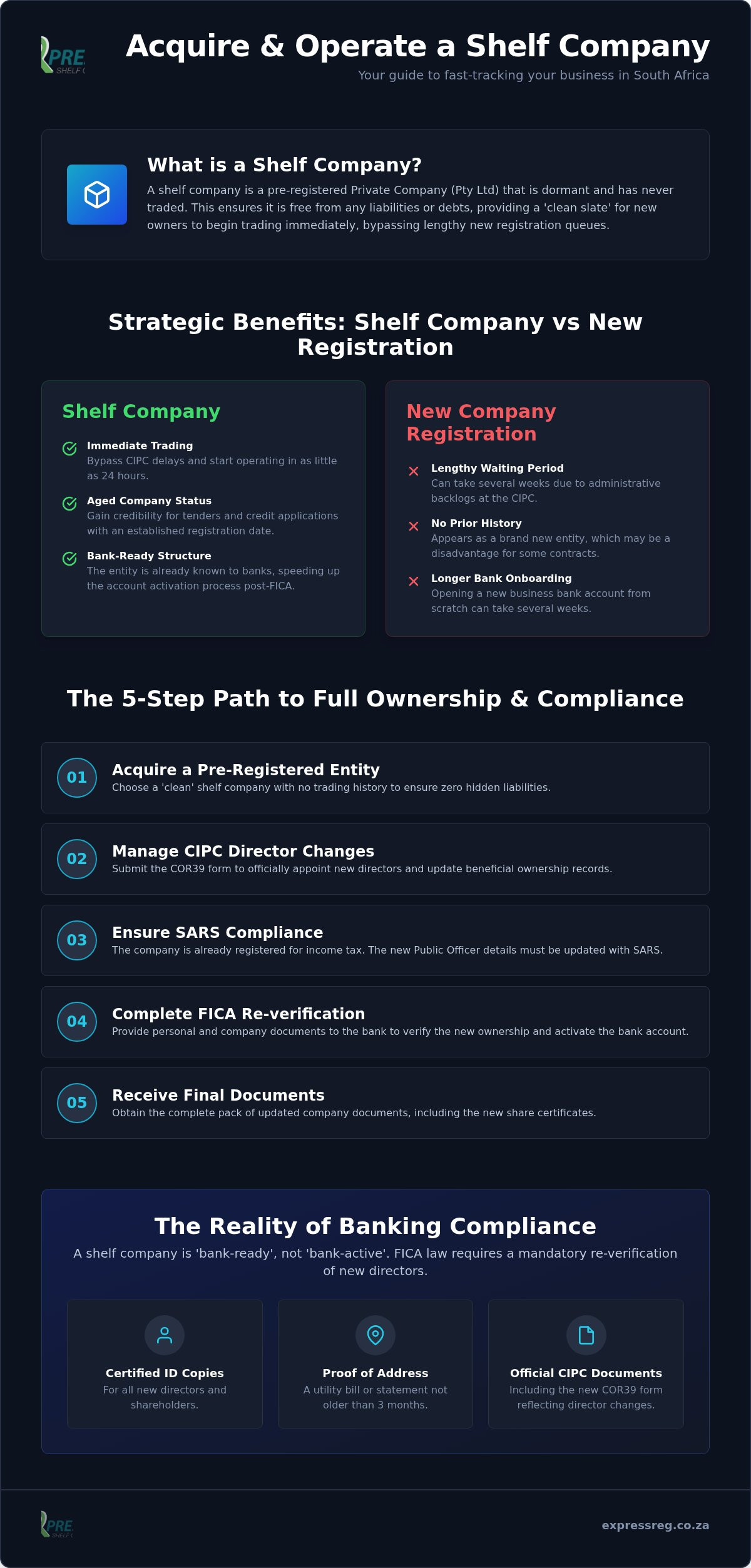
The Compliance Checklist: 5 Steps to Full Ownership
Acquiring a shelf company is a structured administrative handover that involves more than just a simple purchase agreement. To ensure the entity is legally yours and fully compliant with South African authorities, you must complete a series of specific filings. This process moves beyond the initial transaction to secure your standing with both the CIPC and SARS. Following a methodical checklist prevents future legal hurdles and ensures your business is ready for immediate operation.
Step 1: The CIPC Director and Shareholder Transfer
The first priority is the formal director change CIPC application. You must organise signed resignation letters from the original incorporator directors before submitting the COR39 form to the commission. This update officially removes the placeholder directors and installs your new management team. Simultaneously, you must handle the transfer of shares. This involves cancelling the original share certificates and issuing new ones to the incoming shareholders.
Your company’s Minute Book and Share Register must be updated to reflect these changes accurately. These internal documents are often overlooked but are essential for proving legal ownership during audits or contract negotiations. Professional consultants can speed-track the COR39 submission, ensuring that the legal records match the reality of your new control. This step is a critical prerequisite when you consider how to open a bank account for a shelf company, as financial institutions will verify these records against the CIPC database before allowing a change of mandate.
Step 2: Beneficial Ownership and SARS Alignment
In 2026, the CIPC strictly enforces the filing of a Beneficial Ownership register. This is a mandatory requirement designed to increase transparency in company ownership. Failing to disclose who ultimately owns or controls the company can lead to administrative fines and may even result in the company being de-registered. You must submit this filing immediately after the director and shareholder changes are confirmed.
Once the CIPC records are synchronised, you must align your SARS profile. This includes appointing a new Public Officer, who must be a South African resident, and updating the company’s registered address to your physical business location. After these contact details are updated, you can obtain a new Tax Clearance Status (TCS) PIN in the names of the new directors. This PIN is vital for bidding on tenders and proving your tax compliance to suppliers. To ensure your paperwork is handled correctly from the start, buy your shelf company through Express Shelf Company and let our experts manage the heavy lifting of compliance.
Why Express Shelf Company is Your Strategic Partner
Choosing the right facilitator for your business setup is as critical as the business idea itself. Express Shelf Company provides a foundation of trust by offering only clean shelf companies. This means every entity we transfer has no previous trading history, no debt, and zero risk to the new owner. We understand that entrepreneurs often feel overwhelmed by administrative hurdles, so we prioritise organised efficiency to reduce your stress. Our goal is to provide a smooth transition from a state of administrative complexity to full legal standing.
Our service model is built on fixed-fee transparency. You won’t encounter hidden costs for CIPC or SARS administrative filings during the transfer process. We provide national service coverage across South Africa, ensuring that distance is never a barrier to professional compliance. Our team manages the heavy lifting of paperwork on your behalf, providing end-to-end support that extends far beyond the initial purchase. This includes your first CIPC annual returns submission to keep your entity in good standing with the commission.
Expert Facilitation of Statutory Paperwork
We handle the complex machinery of government administration so you can focus on business growth. Our experts ensure that every register pty ltd south africa application or shelf transfer is legally sound and fully compliant with 2026 regulations. We focus on procedural accuracy to prevent future compliance flags that could derail your operations. When you are determining how to open a bank account for a shelf company, our team provides the necessary guidance and documentation to make the bank’s FICA re-verification process as smooth as possible. We act as a knowledgeable guide, ensuring that every step is handled with care.
Securing Your Business Foundation
A successful startup requires more than just a registration number. We assist with COIDA and Department of Labour registrations to ensure you meet all statutory requirements for hiring staff and securing work. This comprehensive approach ensures your new entity is ready for any government tender or corporate contract from the moment the transfer is complete. We act as your private ally, standing between you and the bureaucratic complexity of state departments. Don’t let paperwork slow your momentum. Secure your ready-made shelf company with Express Shelf Company today and start trading with confidence.
Accelerate Your Business Launch with Confidence
Taking ownership of a pre-registered entity is the fastest way to enter the South African market. This strategy provides you with an immediate legal identity and the potential for an aged registration date, which is a significant advantage for 2026 tender bids. Whilst the process is rapid, your success depends on following the correct compliance protocols. Understanding how to open a bank account for a shelf company requires patience during the bank’s mandatory FICA re-verification and beneficial ownership filing stages.
Our team acts as your expert facilitator, removing administrative hurdles so you can focus on operational growth. We are a CIPC Registered Agent providing a 100% Clean Company Guarantee and fixed professional fees to ensure total transparency. We handle the complex SARS and CIPC filings, allowing you to move from a state of paperwork to a state of profit. Secure your ready-made shelf company with Express Shelf Company today and build your business on a foundation of organised efficiency. Your vision deserves a professional start.
Frequently Asked Questions
Is it legal to buy a shelf company with a bank account in South Africa?
It is entirely legal to purchase a shelf company in South Africa as a means to fast-track business operations. Whilst the company itself is a pre-registered legal entity, the “bank account” aspect requires a formal change of mandate. You aren’t buying the account itself but rather the ownership of the entity that holds the account. The bank must perform a full FICA re-verification of the new directors before transactions can resume.
How long does it take to change directors on a shelf company?
The turnaround time for director changes typically ranges from three to five business days, depending on CIPC processing speeds in 2026. This process involves submitting a COR39 form along with signed resignation and appointment letters. Once the commission confirms the update, you receive an official certificate. We manage this administrative filing to ensure accuracy and prevent delays that could impact your ability to sign new contracts or tenders.
Will I have to pay the previous year’s CIPC annual returns?
Yes, every company must submit CIPC annual returns to remain in good standing. When you acquire a shelf company, you take over all statutory obligations. Most reputable providers ensure that all returns are up to date at the point of sale. However, you will be responsible for all future filings from the next anniversary of the company’s incorporation. Keeping these returns current is essential to prevent the company from being de-registered.
Can I change the name of the shelf company after I buy it?
You can change the name of your shelf company at any time after the transfer of ownership is complete. This process requires a formal application to the CIPC to reserve a new name and then amend the company’s Memorandum of Incorporation (MOI). Whilst the registration number remains the same, the name change provides a fresh brand identity. We can assist with the necessary filings to ensure your business reflects your specific brand vision.
What is the difference between a shelf company and a shelf trust?
A shelf company is a pre-registered private company (Pty Ltd) governed by the Companies Act and registered with the CIPC. A shelf trust is a pre-established inter vivos trust registered with the Master of the High Court. Companies are generally preferred for active trading and commercial tenders, whilst trusts are typically used for asset protection or estate planning. Most entrepreneurs seeking rapid startup solutions choose the shelf company route for its operational flexibility.
Do I need a tax clearance certificate immediately after buying a shelf company?
You will likely need a Tax Clearance Status (TCS) PIN immediately if you intend to bid for government tenders or apply for vendor status with large corporates. Once the director changes are finalised with the CIPC, you must update the Public Officer details with SARS. This allows you to generate a new TCS PIN in the names of the current directors, proving that the entity is fully compliant with its tax obligations.
What documents do I need to FICA the bank account for a new shelf company?
To satisfy FICA requirements and learn how to open a bank account for a shelf company, you must provide several documents to the bank. These include certified copies of all new directors’ IDs, proof of residential address not older than three months, and the updated CIPC registration documents showing the recent director changes. The bank also requires a formal resolution signed by the directors authorising the change of signatories and the new banking mandate.
Can a shelf company be registered for VAT immediately?
A shelf company can be registered for VAT as soon as it meets the mandatory or voluntary registration requirements. For voluntary registration, the company must demonstrate that it has already earned R50,000 in income or has signed contracts that will lead to this amount. If you are learning how to open a bank account for a shelf company to handle large contracts, ensuring you meet these SARS criteria is a vital step for professional compliance.