
Imagine identifying a lucrative government contract, only to realise the submission deadline is forty-eight hours away and your new company registration is still caught in a CIPC backlog. It is a common frustration for entrepreneurs who find that administrative hurdles often move much slower than market opportunities. When you decide to buy shelf company south africa entities, you effectively bypass these queues to secure a registration number instantly. You don’t have to let a paperwork delay cost you a significant business milestone.
We understand the pressure of meeting strict tender requirements and the need for a clean, compliant foundation. This 2026 guide provides a clear path to acquiring a pre-registered entity whilst navigating the latest statutory transfer requirements with ease. You will discover how to manage director changes professionally and ensure your business is fully equipped for immediate trade. We cover everything from the impact of the 2026 Companies Act amendments to the essential steps for verifying an entity’s history, giving you the confidence to move forward without the fear of hidden liabilities or administrative errors.
Key Takeaways
- Recognise why entrepreneurs buy shelf company south africa entities to bypass CIPC registration delays and secure immediate trading capabilities for urgent tenders.
- Identify the critical statutory documents required for a legal transfer, including the Cor14.3 certificate and the pre-allocated SARS income tax number.
- Navigate the 2026 compliance landscape by learning how to correctly file Beneficial Ownership details and update director records through official channels.
- Evaluate the trade-offs between rapid market entry and the customisation of a new registration to choose the most efficient path for your business.
- Ensure a clean administrative handover by partnering with a facilitator that manages the heavy lifting of paperwork and prevents hidden liabilities.
The Strategic Advantage: Why Buy a Shelf Company in 2026?
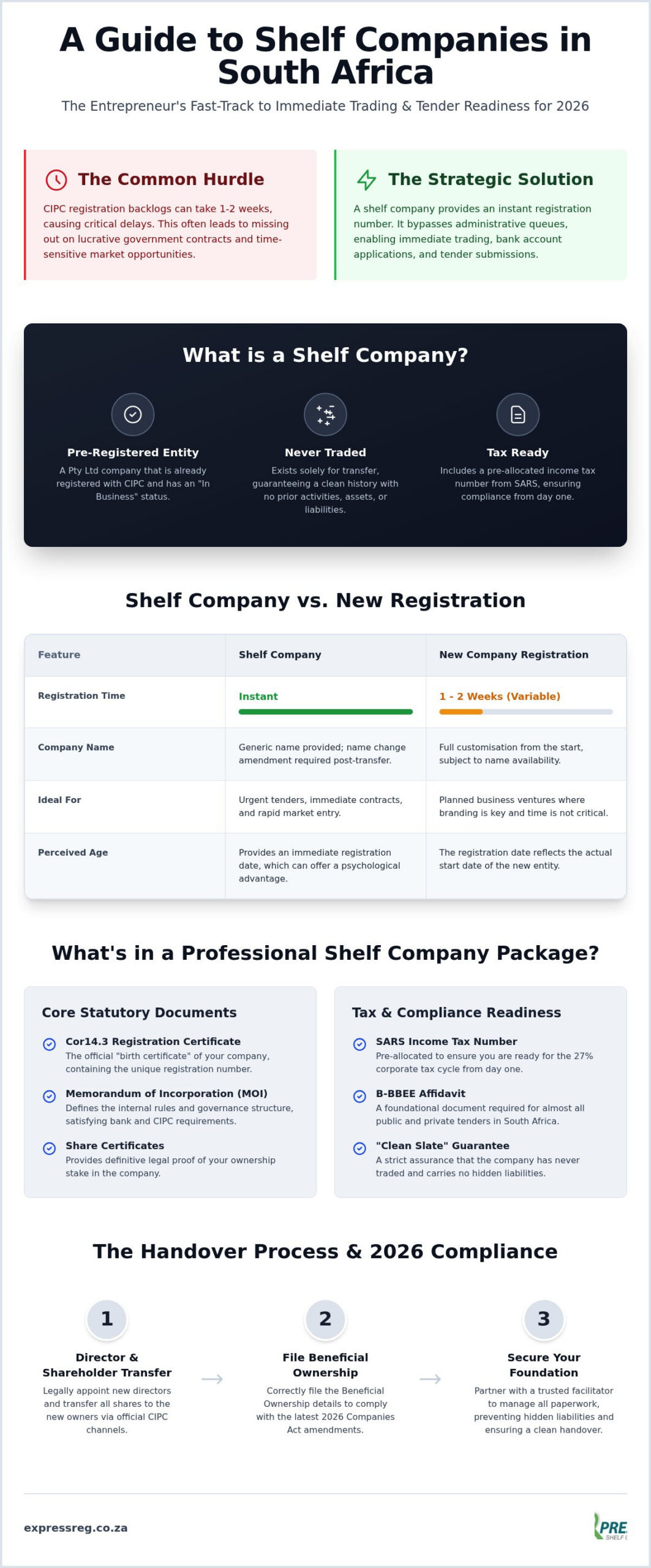
A shelf company is essentially a pre-registered Pty Ltd entity that has never traded. It exists solely to be “taken off the shelf” by a new owner who needs a business registration number immediately. If you are researching what is a shelf company, it’s helpful to view it as a clean administrative vessel that’s already cleared the initial hurdles of the Companies and Intellectual Property Commission (CIPC). When you buy shelf company south africa options, you’re securing a business that is already in “In Business” status, complete with a pre-allocated income tax number from SARS.
Meeting Urgent Tender Requirements
Securing a registration number is the very first hurdle for any Request for Information (RFI) or Request for Proposal (RFP). Procurement officers often look for entities that appear established. Whilst your involvement in the company might be new, the registration date on the Cor14.3 certificate is immediate. This provides a psychological advantage in competitive bidding. When you buy shelf company south africa based entities for tender purposes, you’re prioritising speed. This demonstrates that your business foundation is solid and ready to meet the compliance demands of high-value contracts without the risk of missing a submission window due to a pending registration.
Bypassing Administrative Bottlenecks
The primary reason entrepreneurs opt for this route is the variable timeline of government processing. Standard CIPC queues can often take one to two weeks, depending on system stability and staff capacity. If your project isn’t time-sensitive, registering a Pty Ltd in South Africa is a viable alternative that allows for more customisation from the start. However, when a contract is on the line, the instant availability of a shelf company is a strategic necessity. It removes the uncertainty of waiting for a name reservation to be approved or for a registration certificate to be issued.
A pre-registered entity also serves as a “ready-to-go” foundation for business bank account applications. Because the registration number is already active, you can begin the onboarding process with financial institutions far sooner than if you were waiting for a new registration. In the South African market, maintaining immediate “Good Standing” with regulatory bodies is non-negotiable for trade. Starting with an entity that is already registered for income tax ensures you’re compliant from day one, allowing you to focus on operations rather than paperwork.
What is Included in a Professional Shelf Company Package?
A professional shelf company package is more than just a registration number. It is a curated set of documents that establishes your legal and tax standing in a single handover. When you choose to buy shelf company south africa packages, you’re investing in a streamlined transition from administrative setup to active trading. This ensures you have everything required to satisfy the due diligence requirements of banks, partners, and procurement officers.
The Statutory Document Pack
The Cor14.3 serves as the primary evidence of registration. It contains the unique registration number required for all official correspondence and contract signings. Think of this as the birth certificate of your business. Without it, your entity does not exist in the eyes of the law or the CIPC.
The Memorandum of Incorporation (MOI) provides the internal rules for company conduct. Whilst standard MOIs are common, they provide the necessary structure to satisfy CIPC requirements and bank compliance checks. Additionally, share certificates are included to provide definitive proof of your ownership stake. You cannot legally demonstrate who holds the equity in the business without these, which can stall bank account openings or partnership agreements.
Tax and Compliance Readiness
In 2026, compliance is non-negotiable. Your package includes a pre-allocated Income Tax number from SARS. This ensures you are ready for the 27% corporate tax cycle from the moment of transfer. You will also receive a B-BBEE Affidavit, which is a foundational requirement for almost every private and public tender in South Africa. If your projected turnover exceeds R1 million, or if a contract requires it, you may need to pursue a SARS VAT registration to remain fully compliant.
Every entity we facilitate comes with a strict “Clean Slate” guarantee. This means the company has never traded, holds no bank accounts, and possesses no assets or liabilities. This protection is vital. It ensures you aren’t inheriting someone else’s financial history or legal entanglements. When you secure a clean entity, you are building on a foundation that is entirely your own. A standard professional package includes:
- Official Cor14.3 Registration Certificate
- Memorandum of Incorporation (MOI)
- Pre-allocated SARS Income Tax Number
- Initial Share Certificates for new owners
- B-BBEE Affidavit for EME status
Shelf Company vs New Registration: Making the Strategic Choice
Choosing between a shelf company and a fresh registration is a decision based on your specific operational timeline. Whilst both options result in a standard (Pty) Ltd entity, the strategic application of each differs significantly. When you buy shelf company south africa options, you’re prioritising speed over initial brand identity. Conversely, a new registration is a blank canvas that requires more patience. It’s a choice between immediate action and long-term customisation.
A primary differentiator is the ability to sign legal documents immediately. With a shelf company, you have a registration number the moment the transfer documents are signed. You can enter into a lease or a purchase agreement using the company’s current name, whilst the process to change it to your preferred brand runs in the background. This is a critical advantage for entrepreneurs facing high-pressure deadlines where a delay of even a few days could result in a lost opportunity.
Another factor is the registration date. Some government and private sector contracts specify that a company must have been registered in a previous year, such as 2024 or 2025. In these instances, a brand-new registration won’t qualify. Buying an “aged” shelf entity allows you to meet these specific compliance criteria that a newly registered entity cannot satisfy. This “on-paper” history is often the final piece of the puzzle for complex procurement requirements.
When to Choose a Shelf Company
You should opt for a shelf company if you find yourself in any of these high-stakes situations:
- Tender Deadlines: You have a lucrative contract closing within 48 hours and cannot wait for CIPC processing times.
- Urgent Legal Agreements: You need to sign a commercial lease or a vehicle purchase agreement today to secure a location or asset.
- Specific Compliance History: The RFP requires an entity registered in a specific year to prove a longer existence on paper.
When to Opt for New Registration
A new registration is often the better choice if your circumstances allow for a more methodical setup:
- Brand Identity: You have a unique, non-negotiable brand name that you want reflected on all official documents from the very first day.
- Available Lead Time: You have a 10 to 14 day window before you need to begin trading or applying for contracts.
- Cost Efficiency: You want to keep initial acquisition costs as low as possible and don’t mind the administrative wait period.
Deciding which route to take depends on whether you’re building for the long term or reacting to an immediate market opportunity. Both paths lead to a compliant South African entity, but the shelf company is the tool specifically designed for rapid response.
The Handover Process: Director Changes and Statutory Compliance
The acquisition of a pre-registered entity is a two-part process. First, you secure the registration number to meet your immediate business needs. Second, you must legalise the transition of power through formal statutory updates. When you buy shelf company south africa options, the entity initially lists “shelf directors” who have no intention of trading. Removing these individuals and appointing your own team is a high-priority task that requires precision to avoid administrative rejection from the CIPC.
Updating Director and Ownership Records
To begin the handover, you must submit a CoR39 form to the CIPC. This document officially notifies the commission of the resignation of the shelf directors and the appointment of the new ones. You’ll need to provide clear, certified copies of the new directors’ identity documents or passports. Whilst the CIPC typically processes these updates within a few business days, the company is effectively under your control from the moment the internal share transfer forms are signed.
Don’t overlook the internal share register. Whilst the CIPC tracks directors, your company’s own records track who actually owns the business. You must issue new share certificates and update the register to reflect the change in equity. Ensure your director change with CIPC is handled by an expert to prevent delays that could stall your bank account activation or contract signings. Professional handling of these documents ensures that your public profile matches your internal reality.
The 2026 Beneficial Ownership Mandate
The 2026 regulatory environment has placed a significant emphasis on corporate transparency. The CIPC now requires a Beneficial Ownership (BO) filing for every company on the register. A beneficial owner is any natural person who ultimately owns or exercises effective control over the company. This disclosure is mandatory and must be filed alongside the change of directors to ensure the CIPC records are accurate and up to date.
Failure to file your BO register can lead to severe consequences, including the potential deregistration of your company. This requirement is part of a broader national effort to align South Africa with international anti-money laundering standards. An expert facilitator ensures this disclosure is filed correctly during the transfer process, protecting you from future compliance audits. Once the directors and owners are updated, you can proceed with a formal name change to align the entity with your brand. Manage your company transfer with our team to ensure every statutory requirement is met with procedural accuracy.
Securing Your Business Foundation with Express Shelf Company
Express Shelf Company acts as your private ally, standing between your business goals and the complex machinery of government administration. We handle the administrative heavy lifting so you don’t have to navigate the intricacies of CIPC or SARS alone. When you buy shelf company south africa from our inventory, you receive a fixed-fee service that eliminates hidden compliance surprises. This transparency builds trust and ensures your startup costs remain predictable from the outset.
Our support extends far beyond the initial purchase. We facilitate long-term compliance by managing essential tasks such as CIPC annual returns and registrations with the Department of Labour. This comprehensive approach ensures that your business foundation is not just established, but maintained to the highest regulatory standards as you scale your operations.
Why a Facilitator Beats a DIY Approach
Attempting to update CIPC records without professional guidance often leads to administrative rejection or data mismatches. Common mistakes include incorrect form submissions or failing to provide the specific certification required for identity documents. These errors can stall your progress for weeks, potentially costing you a contract. By contrast, a seasoned consultancy provides speed and procedural accuracy. We ensure your entity is positioned to receive a Letter of Good Standing, giving you the peace of mind that your business is fully compliant and eligible for any tender.
Next Steps: Launching Your Entity
Starting your journey is a straightforward, methodical process. First, select a 2026 shelf company from our current list to ensure you have the most recent registration date. Next, submit your director identity documents through our secure portal for processing. Finally, receive your completed handover pack, including all updated statutory records and share certificates.
To create a full tender-ready pack, consider integrating VAT and COIDA registrations into your acquisition. These additional layers of compliance are often mandatory for larger private and public sector projects. By centralising these tasks with a single facilitator, you ensure a cohesive and professional business profile that is ready for immediate trade. Contact Express Shelf Company to secure your pre-registered business today and move your market entry forward with confidence.
Take the Lead in the 2026 Market
Navigating the South African business landscape requires both speed and precision. The decision to buy shelf company south africa entities is a strategic move that bypasses administrative queues and puts you directly in the running for high-value contracts. By prioritising a clean trading history and ensuring all statutory documents are in order, you protect your business from the risks of hidden liabilities and regulatory rejections.
Our team serves as a professional CIPC filing agent, providing a comprehensive handover that includes the mandatory Beneficial Ownership disclosure. This methodical approach ensures your entity is not just registered, but fully compliant with the latest 2026 mandates. You don’t have to manage the heavy lifting of paperwork alone when a seasoned facilitator can guide you through every director change and tax registration. Secure your 2026 Shelf Company and start trading today. Your next commercial milestone is within reach. Move forward with the confidence that your corporate foundation is solid, compliant, and ready for immediate growth.
Frequently Asked Questions
Is it legal to buy a shelf company in South Africa?
Yes, it is entirely legal to purchase a shelf company in South Africa. This practice is a standard commercial method for entrepreneurs to secure a registration number without waiting for the CIPC to process a new application. After the purchase, the law requires that you update the director records and beneficial ownership details to reflect the new control. Express Shelf Company ensures that these statutory transitions are handled according to the Companies Act requirements.
How long does it take to change the directors of a shelf company?
Changing the directors typically takes between three and five business days, depending on the CIPC’s current processing capacity. Whilst the official public register might take a few days to reflect the update, the company is effectively under your control once the internal transfer documents are signed. We manage the submission of the CoR39 form and the required supporting documents to ensure the transition is as efficient as possible for your team.
Can I change the name of the shelf company I buy?
Yes, you can change the name of the entity after you buy shelf company south africa options. The process involves reserving a new name with the CIPC and then filing a formal name change application. Whilst this process runs in the background, you can start trading immediately under the company’s current registration number. This allows you to meet urgent deadlines whilst your preferred brand name is being officially registered and updated on the Cor14.3 certificate.
Does a shelf company come with a bank account?
A shelf company does not typically come with an active, pre-opened bank account. Financial institutions require the new directors to undergo a formal FICA process and provide proof of identity before an account can be activated. However, because the company already has a registration number and income tax registration, you can begin the application process with your chosen bank immediately after the handover. We provide the necessary statutory documents required by the bank for this setup.
What is the difference between a shelf company and a shelf CC?
The primary difference is that Close Corporations (CCs) can no longer be registered in South Africa following the 2008 Companies Act. All modern shelf entities are private companies (Pty Ltd). Whilst some older shelf CCs may still exist in the market, they are becoming increasingly rare and lack the flexible shareholding structure of a Pty Ltd. Most entrepreneurs choose a Pty Ltd because it is the current standard for corporate governance and compliance in the country.
Will buying a shelf company help me get a government tender faster?
Buying a shelf company helps you meet tender deadlines by providing an immediate registration number. Many RFPs and RFIs have strict closing dates that do not allow for the one-to-two-week wait often associated with new CIPC registrations. Having a pre-registered entity ensures you can complete the submission forms today. However, you must still ensure that your business meets other tender-specific requirements, such as B-BBEE status and tax clearance, to be successful in your application.
Do I need to file annual returns for a shelf company I just bought?
Yes, you are responsible for filing CIPC annual returns starting from the next anniversary of the company’s registration date. Even if the company has not traded whilst sitting on the shelf, the commission requires a return to confirm that the entity is still active. Failing to file these returns can lead to the company being deregistered. We assist new owners by checking the current filing status and managing all future submissions to keep the entity in good standing.
What documents do I need to provide to buy a shelf company?
To facilitate the transfer, you must provide certified copies of the identity documents or passports for all new directors. You will also need to provide proof of address and complete the internal share transfer forms we provide. These documents are essential for the CIPC director change and the beneficial ownership filing. Ensuring that your certifications are clear and recent is the best way to prevent administrative delays during the handover process and subsequent registration updates.