What if the only thing standing between your new business and a lucrative contract was a single piece of paper? For many entrepreneurs, finding the fastest way to register a company in South Africa is the difference between securing a major tender and watching an opportunity vanish due to administrative delays. We recognise that the pressure of meeting strict deadlines is often compounded by the frustration of waiting on CIPC name reservations, which can now take up to 10 working days, whilst your competitors are already operational.
We understand that managing the choice between BizPortal and the CIPC Case Management System feels overwhelming when you need to trade immediately. This guide provides the exact strategies and service options you need to secure a valid CoR14.3 registration certificate and start trading in the shortest possible time. You will discover how to eliminate name reservation bottlenecks, understand the immediate benefits of shelf companies, and master the 2026 compliance requirements, such as mandatory beneficial ownership filings, to ensure your business is ready for growth without any administrative errors.
Key Takeaways
- Compare new Pty Ltd registrations against pre-registered shelf companies to select the most efficient path for your specific business timeline.
- Learn how bypassing the name reservation process and using a standard registration number offers the fastest way to register a company in South Africa.
- Understand the critical 2026 compliance requirements, including beneficial ownership disclosures, that must be completed immediately after your company is formed.
- Discover how professional facilitation helps you avoid common administrative bottlenecks and ensures your entity is ready to trade without delay.
Understanding the Speed of Business Registration in South Africa
Securing a legal entity is the foundational step for any South African venture. Whilst the digital transformation of government services has improved accessibility, the actual timeline for incorporation remains subject to several variables. In 2026, a standard registration through the Companies and Intellectual Property Commission (CIPC) typically takes between one and five working days. However, this period only covers the processing of the registration itself. It doesn’t account for the preliminary name reservation phase, which often stretches to 10 working days due to high application volumes.
The fastest way to register a company in South Africa depends heavily on your immediate business objectives. If your goal is long-term brand building, waiting for a specific name reservation is a logical step. Conversely, if you’re facing a looming tender deadline, you cannot afford a two-week delay. In these instances, the definition of speed shifts from waiting for a custom name to obtaining a registration number immediately. You must also distinguish between registration time and ready-to-trade time. Having a registration certificate (CoR14.3) is only the beginning. To be fully operational, you need to manage post-registration tasks like beneficial ownership filings and SARS tax activations.
Efficiency starts before you even log onto a portal. Ensure all FICA documents, including certified ID copies and proof of residence, are digitalised and ready for upload. Preparedness prevents the back-and-forth communication that often stalls the registration process.
The Role of CIPC and BizPortal
The CIPC manages the official register of companies, whilst BizPortal serves as the primary automated gateway for entrepreneurs. BizPortal aims for one-stop functionality, yet its speed is frequently dictated by technical server stability and the accuracy of the data provided. Private filing agents often provide a faster alternative because they understand the back-end nuances of the CIPC Case Management System. These experts can bypass common user errors that trigger manual reviews, ensuring your application moves through the automated queue without friction. Identifying the fastest way to register a company in South Africa often involves choosing a facilitator who can navigate these technical hurdles on your behalf.
Why Speed Matters for South African Entrepreneurs
Time is a critical commodity when pursuing government or private sector tenders. Missing a submission deadline because your paperwork is stuck in a queue is a common but preventable setback. Rapid registration also allows you to open a business bank account promptly, which is essential for receiving start-up capital or investment. By following a comprehensive small business registration South Africa checklist, you can secure your market position before a competitor can react. Speed provides the agility needed to capitalise on opportunities the moment they arise.
Comparing New CIPC Registrations vs Purchasing a Shelf Company
South African entrepreneurs typically choose between two primary routes when formalising their business. The first is a standard new registration via the official government portal or a private facilitator. The second is purchasing a shelf company. Whilst both result in a legally recognised entity, the speed at which you can trade differs significantly. Your choice depends on whether you value a custom brand name or immediate legal standing more highly.
A shelf company is a pre-registered, “clean” legal entity that has never traded and has no liabilities. It exists purely to be sold to an entrepreneur who needs a registration number immediately. If you require a company number within minutes to sign a contract or meet a tender deadline, this is undeniably the fastest way to register a company in South Africa. In contrast, a new registration requires a sequence of approvals that inevitably take several days to conclude.
New Pty Ltd Registration: The Custom Path
Choosing a new Pty Ltd registration allows you to build a specific brand identity from day one. You’ll submit a unique name for approval, which provides a professional appearance tailored to your specific market. This path is ideal if you have a lead time of 3 to 5 days and aren’t under immediate pressure to produce a registration number for a third party. It’s often the more economical choice for those starting on a budget. For a detailed breakdown of the associated expenses, you can consult our guide on Pty Ltd registration cost South Africa.
Shelf Companies: The Instant Path
Shelf companies represent the absolute peak of administrative speed. Because the entity is already registered with the CIPC, you receive the registration number the moment the purchase is finalised. The process then involves a director change to transfer ownership from the facilitator to you. Whilst the CIPC processes this change, you can often use the existing registration number to begin drafting agreements or preparing tender documents. You can browse our ready-made shelf companies to see how quickly you can take ownership.
Another subtle advantage of a shelf company is the registration date. Some contracts or vendor applications require a business to have been registered for a certain period. A shelf company registered earlier in 2026 or even in previous years can help you meet these criteria instantly. This makes it a strategic choice for established entrepreneurs who are expanding into new sectors where time in business is a perceived metric of stability.
Identifying the Bottlenecks: Name Reservations and Compliance Delays
Understanding the administrative hurdles is essential for any business owner. Whilst the digital systems at the CIPC are designed for efficiency, two specific bottlenecks often derail the timeline: name reservations and compliance filings. If you’re unaware of how to navigate these, a process that should take days can easily stretch into weeks. Recognising these traps early allows you to choose a path that prioritises speed without sacrificing legal accuracy.
The primary cause of delay is the name reservation queue. Current data suggests that name reservations can take between 5 and 10 working days to process due to high application volumes. If your proposed name is rejected because it’s too similar to an existing entity, you’re forced to restart the process and pay the reservation fee again. This cycle is the most common reason entrepreneurs miss their target launch dates.
The Name Reservation Trap
Name rejections often occur because of subtle similarities that the CIPC automated system flags for manual review. To avoid this, you should provide at least four distinct name options in order of preference. However, even with a perfect list, you’re still at the mercy of the processing queue.
Choosing to register with a standard enterprise number is often the fastest way to register a company in South Africa for those who cannot afford the name reservation wait. By using a generated number (such as K2026123456) as your temporary company name, you bypass the reservation phase entirely. This allows you to receive your CoR14.3 certificate almost immediately. You can then trade under this number or a “trading as” name whilst applying for a formal name change at a later, less critical date.
Beneficial Ownership and FICA Compliance
As of 2026, the CIPC has intensified its focus on transparency. Every new company is now required to file a Beneficial Ownership declaration within 10 business days of incorporation. Failing to meet this deadline can lead to hefty administrative fines or even the deregistration of your new entity. This is no longer an optional step; it’s a mandatory part of the registration sequence that determines your “ready-to-trade” status.
Administrative “query” status is another significant delay factor. This happens when uploaded documents are blurry, uncertified, or incorrect. To ensure a smooth process, you must have the following ready:
- Clear, high-resolution scans of all director ID documents or passports.
- Recent proof of residential address for all directors.
- A signed Power of Attorney if you’re using a professional facilitator.
- Accurate contact details that match your SARS eFiling profile.
By preparing these documents in advance and understanding the 2026 disclosure requirements, you eliminate the friction that typically slows down the registration machinery.
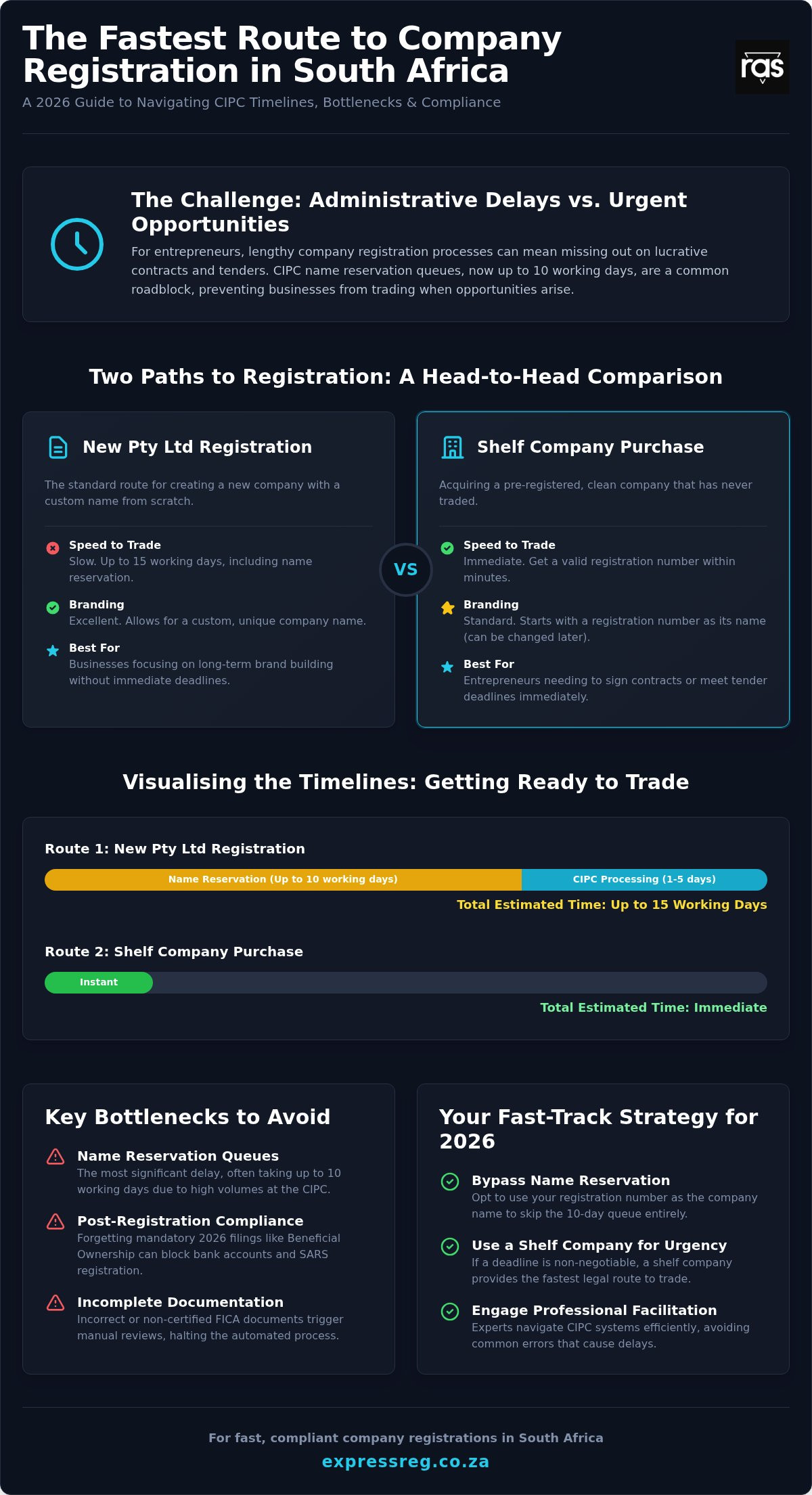
The Step-by-Step Fast-Track Strategy for 2026
Achieving a rapid turnaround for your business setup requires a disciplined approach to the sequence of events. Speed in this context is a result of logic rather than luck. By following a structured timeline, you eliminate the common pauses that occur when an entrepreneur is unprepared for the next administrative requirement. This strategy ensures that you move from a concept to a legal entity with an active tax number in the most efficient manner possible.
One often overlooked factor in the fastest way to register a company in South Africa is the timing of your digital submission. CIPC and BizPortal servers experience peak traffic during standard office hours, which can lead to system lag or session timeouts. To ensure the smoothest experience, aim to submit your final applications during off-peak windows, specifically before 08:00 or after 18:00. This small adjustment can significantly reduce the technical friction that often stalls the registration process.
Phase 1: Preparation and Selection
Your first step is to decide on the path that matches your deadline. If you have an immediate contract to sign, a shelf company is your only viable option. If you have a few days of lead time, a new registration is suitable. Gather high-resolution, digitalised copies of all director IDs and residential proofs. You should also secure digital signatures from all parties involved to avoid the delays associated with printing and scanning documents. For a deeper understanding of the legal nuances, review our detailed guide on the company formation process South Africa before you begin the submission.
Phase 2: Submission and Activation
Once your documents are ready, the submission phase begins. Utilising a professional agent is often the fastest way to register a company in South Africa because they possess the expertise to ensure first-time success. An agent understands how to navigate the CIPC Case Management System and can resolve technical queries that would otherwise cause a manual rejection. After the CIPC issues your CoR14.3 certificate, you must confirm that SARS has automatically generated your Income Tax number. Whilst this is usually an integrated process, it’s vital to verify the tax registration on eFiling to avoid future compliance issues. If you need to expedite this entire phase, view our fast-track registration packages to get started today.
Phase 3: Immediate Compliance for Trading
The final phase involves preparing your business for its first transaction. You must obtain a BEE Affidavit, which is an instant requirement for Exempted Micro Enterprises (EMEs) with an annual turnover under R10 million. This document is essential for opening a business bank account and is often requested by vendors before they will add you to their database. Once you have your registration documents and BEE status, you can approach a financial institution to activate your business banking. For long-term success and to stay ahead of regulatory changes, ensure our register Pty Ltd South Africa parent guide is your primary reference for ongoing compliance.
Professional Facilitation: Why Speed Requires Expert Management
Whilst the CIPC has made significant strides in digitising the incorporation process, navigating these systems as an individual is often fraught with technical hurdles. Many entrepreneurs assume that a digital portal is a guarantee of speed, yet the fastest way to register a company in South Africa is through professional facilitation. An expert consultant acts as a disciplined intermediary, ensuring that every statutory requirement is met before the application is even submitted. This proactive approach prevents the manual queries and rejections that typically stall DIY attempts.
Professional management provides a layer of protection against the administrative friction that occurs when government systems are under high load. By leveraging a facilitator who understands the CIPC back-end, you ensure your application is handled with the procedural accuracy required for immediate approval. This is the fastest way to register a company in South Africa for those who cannot afford to have their registration stuck in a “pending” state due to avoidable clerical errors.
Avoiding Common DIY Mistakes
One of the most frequent errors in self-managed registrations involves incorrect share allocations. Setting up a company with an unsuitable share structure can lead to expensive and time-consuming amendments later. Additionally, many individuals fail to correctly link their new entity to SARS during the initial setup. This oversight prevents the automatic generation of a tax number and can delay your ability to issue invoices or register for VAT. Understanding the Memorandum of Incorporation (MOI) requirements is also critical; using the wrong standard form can limit your business’s operational flexibility from the outset.
The Express Shelf Company Advantage
Express Shelf Company provides more than just a filing service; we offer a comprehensive compliance partnership. With over a decade of experience managing high-priority registrations, our team understands the nuances of the CIPC Case Management System. We handle the administrative heavy lifting, from initial name reservations to the mandatory beneficial ownership disclosures that are now strictly enforced in 2026. This allows you to focus on your growth strategy whilst we ensure your legal foundation is secure.
Our ability to provide ready-made shelf companies offers the ultimate solution for those facing immediate deadlines. Beyond the initial setup, we provide ongoing support for director changes, annual returns, and VAT registration. This continuity of service ensures that your organisation remains compliant as it scales, giving you the peace of mind to trade with confidence. Choosing a partner who values your time and procedural accuracy is the most effective way to transition from a startup concept to a fully operational business.
Launch Your South African Business Without Delay
Navigating the administrative landscape of the CIPC and SARS doesn’t have to be a barrier to your entrepreneurial goals. By prioritising immediate legal standing over custom branding, you can bypass the significant delays associated with name reservations. Whether you choose the custom path of a new Pty Ltd or the instant convenience of a shelf company, success depends on meticulous preparation and strict adherence to the 2026 beneficial ownership regulations.
Partnering with a dedicated facilitator is the fastest way to register a company in South Africa whilst ensuring every statutory detail is correct from day one. Our specialists handle the administrative heavy lifting, allowing you to focus on securing contracts and growing your market presence. With ready-made shelf companies available for immediate transfer and comprehensive startup packages that include BEE and Tax compliance, we provide the foundation your business needs to thrive.
Get your company registered today with Express Shelf Company and take the first step toward your commercial future with confidence. Your vision deserves a professional start.
Frequently Asked Questions
What is the absolute fastest way to get a company registration number?
Purchasing a shelf company is the absolute fastest method to obtain a registration number. Because the entity is already incorporated with the CIPC, you receive the company number the moment the transaction is finalised. This route eliminates the 10 working day wait often associated with new name reservations. It’s the ideal choice for entrepreneurs who must sign contracts or submit tender documents within hours rather than days.
How long does a standard Pty Ltd registration take at CIPC in 2026?
A standard Pty Ltd registration usually takes between 1 and 5 working days at the CIPC. This timeline only begins after your company name has been successfully reserved, which adds another 5 to 10 working days to the total duration. To ensure the quickest possible turnaround, you should verify that all director documentation is certified and uploaded correctly to avoid the system flagging your application for manual query.
Can I register a company in South Africa in one day?
You can register a company in one day if you bypass the custom name reservation process. By choosing to register your business using its automatically generated enterprise number, you can often receive your registration certificate within 24 hours. This is the fastest way to register a company in South Africa for those with an urgent need to trade. You can always apply for a formal name change later once your business is operational.
Is it better to register a new company or buy a shelf company for a tender?
A shelf company is the superior option for meeting urgent tender deadlines. It provides an immediate registration number and an established registration date, which can be a requirement for certain high-value contracts. Whilst a new registration is more cost-effective, it carries the risk of name rejections and processing delays. If your goal is to secure a contract with a fast-approaching closing date, the instant nature of a shelf company is invaluable.
What documents do I need to register a company fast?
To expedite your registration, you must have high-quality digital scans of all director ID documents or passports. You also need recent proof of residential address for each director and digital signatures to avoid the delays of physical paperwork. Ensuring these documents are clear and meet CIPC specifications is vital. Blurry or uncertified copies are the most common reason applications are placed into a “query” status, which stops the clock on your registration.
Does a shelf company come with a tax number?
Every shelf company comes with a pre-allocated Income Tax number issued by SARS. When the company is transferred into your name, the tax number remains the same, but you must update the public officer and registered representative details on SARS eFiling. This ensures you can immediately apply for tax clearance certificates or register for VAT if your projected turnover meets the necessary thresholds. It’s a foundational step for immediate legal trading.
Can I change the name of a shelf company after I buy it?
You have the right to change the name of a shelf company at any point after you take ownership. Many entrepreneurs utilise this as the fastest way to register a company in South Africa because it allows them to trade under the registration number immediately whilst the CIPC processes the name change in the background. This approach balances the need for instant legal standing with the long-term requirement for a specific brand identity.
Why was my company name reservation rejected?
The CIPC rejects name reservations if they are too similar to existing companies or contain restricted terminology. Even a small similarity in phonetics or spelling can trigger a rejection to prevent market confusion. To avoid this bottleneck, you should provide at least four unique name options that do not closely resemble established brands. Using a professional facilitator can also help, as they can perform preliminary checks before submission.