
Your 10-digit vat registration number is more than just a tax requirement; it’s a professional credential that signals your business is ready for high-value corporate contracts and government tenders. Following the significant 2026 legislative updates, the compulsory registration threshold has risen to R2.3 million, marking the first major adjustment in over a decade. This change provides relief for smaller enterprises but also introduces new layers of administrative responsibility for those crossing the limit.
We understand that dealing with SARS can feel like an uphill battle against complex eFiling systems and strict compliance deadlines. You want to focus on growth, not worry about whether you’ve met the 21-day application window whilst navigating administrative hurdles. This guide simplifies the entire process, promising to turn tax confusion into a clear roadmap for your business. We will break down the new R120,000 voluntary threshold, explain how to verify vendor details, and provide a methodical path to securing your number with confidence. By the end of this article, you’ll have the knowledge to handle your tax obligations with organised efficiency and professional accuracy.
Key Takeaways
- Identify your unique 10-digit vat registration number as a vital credential for professional growth and eligibility for high-value tenders.
- Review the updated 2026 thresholds to determine if your turnover meets the R2.3 million compulsory requirement or the R120,000 voluntary floor.
- Organise essential documentation, including CIPC papers and bank statements, to ensure a smooth application through the SARS eFiling system.
- Understand your mandatory obligations, such as displaying your VAT details on all official tax invoices to maintain statutory compliance.
- Discover how professional filing support can handle the heavy lifting of SARS paperwork and reduce the risk of administrative delays.
What is a VAT Registration Number in South Africa?
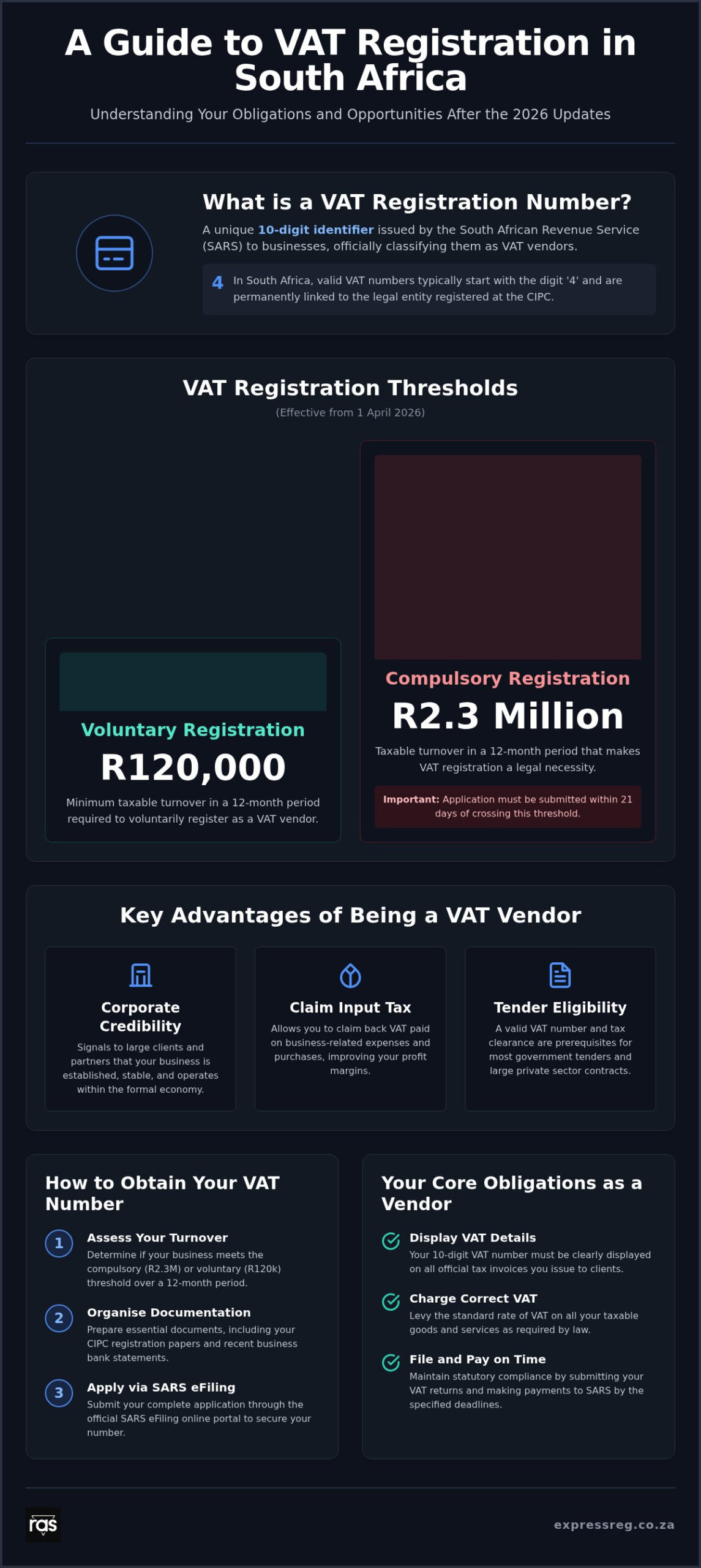
A vat registration number is a unique 10-digit identifier that the South African Revenue Service (SARS) issues to businesses. It serves as official proof that your enterprise is registered under the Value-Added Tax Act. It’s vital to realise that not every business carries this number. Only entities that meet specific turnover criteria or choose to register voluntarily are classified as VAT vendors. Having this number fundamentally changes your financial operations. It authorises you to charge VAT on your goods or services and, perhaps more importantly, enables you to claim back input tax credits on business-related expenses. Without this identifier, you cannot recover the tax you pay to your own suppliers, which can impact your overall profit margins.
The Structure of a SARS VAT Number
SARS follows a specific, methodical format for these identifiers to ensure accuracy across the national tax base. Every valid number consists of 10 digits, and in South Africa, these sequences typically start with the digit 4. This numerical sequence is entirely distinct from your standard income tax number or your PAYE number. Whilst your income tax number tracks your company’s annual profit liabilities, the VAT-specific number focuses exclusively on indirect tax transactions. This identifier is permanently linked to the legal entity registered at the Companies and Intellectual Property Commission (CIPC). This linkage ensures that tax obligations are correctly attributed to the specific business entity rather than the individual directors.
Why Your Business Needs a VAT Number
Understanding What is a VAT Registration Number is the first step toward scaling your operations. If your taxable supplies exceed the R2.3 million compulsory threshold, obtaining this number is a strict legal necessity. However, even for smaller businesses, there are several strategic advantages to holding one:
- Corporate Credibility: Large corporate clients often view a vat registration number as a sign of a stable, established business.
- Tax Neutrality: It allows your business clients to claim back the VAT you charge them, making your pricing more competitive in a B2B environment.
- Tender Eligibility: Most government tenders and large-scale private contracts require a valid tax clearance status, which is tied to your VAT standing.
Securing this number prepares your business for larger opportunities. It signals to the market that you operate within the formal economy and adhere to national statutory requirements. By maintaining this compliance, you protect your business from penalties whilst positioning it for sustainable growth. It moves your business from a state of administrative complexity to full legal standing.
Compulsory vs Voluntary VAT Registration Thresholds
Starting a business requires a clear grasp of tax boundaries to avoid costly administrative errors. SARS has set specific financial markers that dictate your obligation to hold a vat registration number. As of 1 April 2026, the compulsory threshold is R2.3 million. If your taxable supplies exceed this amount in any consecutive 12-month period, registration is mandatory. This requirement ensures that larger entities contribute proportionally to the national tax base whilst maintaining a level playing field for competitors. You can find more details on the Compulsory vs Voluntary VAT Registration requirements on the official SARS website.
To qualify for any form of registration, you must be “carrying on an enterprise.” SARS defines this as any activity conducted continuously or regularly in South Africa where you supply goods or services for a consideration. Failing to register once you hit the compulsory limit carries significant risks. You’ll be liable for the VAT you should’ve collected from the date you were required to register, even if you didn’t charge it to your customers. This often results in substantial back-dated tax bills that can threaten your cash flow.
When Registration Becomes Mandatory
SARS uses two primary tests to determine if you’ve met the R2.3 million limit. The retrospective test looks at your past 12 months of trade. If your turnover crossed the threshold, you’ve met the criteria. The prospective test applies if you’ve signed a written contract that will push your turnover above R2.3 million within the next 12 months. Once either condition is met, you have a 21-day window to submit your application. Missing this deadline typically triggers a 10% late payment penalty plus interest on any outstanding tax liabilities.
The Strategic Choice: Voluntary Registration
Many startups choose to register before they reach the compulsory turnover limit. The voluntary registration floor is currently R120,000. For businesses with high initial setup costs, such as manufacturing or specialised retail, this is a strategic move. It allows you to claim back input VAT on significant capital expenses, effectively reducing your initial investment costs. If you’re considering this route, our SARS VAT Registration South Africa: The Complete 2026 Guide provides a deeper look at the long-term benefits for new enterprises.
Choosing to register early can also improve your professional standing with corporate clients who only work with VAT-compliant vendors. If you’re ready to secure your status, we provide professional assistance for VAT Registration to ensure your application is handled correctly from the start. This proactive approach helps you avoid the stress of manual filing whilst ensuring your business remains fully compliant with the latest 2026 regulations.
How to Obtain and Verify a VAT Registration Number
Securing your 10-digit vat registration number requires a methodical approach to documentation and a clear understanding of current SARS requirements. The application process primarily takes place through the SARS eFiling platform, where you’ll need to submit the VAT 101 application form. This document is the cornerstone of your request; it details your business activities and expected turnover. SARS has escalated measures to combat fraudulent submissions, so you should anticipate a high level of scrutiny. In many cases, new vendors are selected for site visits or mandatory interviews to validate the legitimacy of their operations before a number is allocated.
To avoid delays, ensure you have your essential documentation ready in a digital format. You’ll need recent bank statements (not older than three months), proof of your business address, and your official CIPC registration papers. Having these files organised and correct from the start reduces the risk of rejection. If you find the administrative burden overwhelming, using a professional filing agent can simplify the transition from complexity to full legal standing.
Step-by-Step Application Guide
The journey to becoming a VAT vendor starts with ensuring your foundational tax affairs are in order. Follow these steps to navigate the process efficiently:
- Preparation: Organise your SARS tax number registration and CIPC documents. You cannot apply for VAT without an active income tax number.
- Submission: Complete the VAT 101 form via eFiling. If you aren’t comfortable with the technical requirements, a registered tax practitioner can handle the submission on your behalf.
- Validation: Monitor your eFiling profile for requests for supporting documents. Once SARS approves the application, they’ll issue a Notice of Registration (VAT201).
Verifying an Existing VAT Number
Once you’re part of the VAT system, you must also learn How to Obtain and Verify a VAT Registration Number belonging to your suppliers. Using the SARS VAT Vendor Search tool is a critical step in your procurement process. Before you pay an invoice that includes a 15% tax charge, you should verify that the supplier’s number is valid and currently active. This practice protects your business from participating in tax fraud and ensures that your input tax claims remain valid during an audit.
Recognising fraudulent or invalid numbers isn’t always easy at a glance. Valid numbers must follow the 10-digit format and, as previously discussed, typically begin with the digit 4. If a supplier’s trading name doesn’t match the name registered against the vat registration number on the SARS database, treat the transaction with caution. Maintaining this level of administrative discipline ensures your business stays compliant whilst protecting your financial interests.
Obligations: Using Your VAT Number Correctly
Receiving your 10-digit vat registration number marks a significant shift in your business’s administrative profile. You’re no longer just a business owner; you’ve become an agent for the state. This role requires you to collect output tax on behalf of SARS and allows you to deduct input tax from your legitimate business expenses. Accuracy is vital. SARS mandates that you maintain all VAT-related records, including invoices, credit notes, and bank statements, for at least five years. Don’t treat this lightly. Failure to produce these documents during a routine audit can lead to the immediate reversal of your input tax claims and heavy financial penalties.
The Anatomy of a Compliant Tax Invoice
Once registered, your billing process must evolve to meet strict statutory standards. For any transaction exceeding R5,000, you must issue a full tax invoice. This document serves as the primary evidence for tax deductions. A compliant invoice must contain eight essential elements:
- The words “Tax Invoice” displayed in a prominent place.
- The name, address, and vat registration number of the supplier.
- The name, address, and VAT number of the recipient (if they’re a registered vendor).
- An individual serialised invoice number.
- The date the invoice was issued.
- A full and proper description of the goods or services provided.
- The quantity or volume of the goods supplied.
- A clear breakdown of the price excluding tax, the tax amount charged, and the total including VAT.
For smaller transactions between R50 and R5,000, you may use an abridged tax invoice. This version omits the recipient’s details but must still clearly show the tax charged. Transactions under R50 only require a standard till slip. Managing this output tax collection and input tax deduction cycle is the core of your new accounting responsibility.
Managing SARS Deadlines and Filings
Compliance is a continuous cycle. Most small to medium enterprises fall into Category A or B, which requires submitting a VAT201 return every two months. Category A vendors file in even months, whilst Category B vendors file in odd months. You must submit these returns and settle any liabilities by the last business day of the month following the tax period. Don’t let deadlines slip. Late submissions trigger automatic 10% penalties plus interest.
Staying compliant involves more than just tax. It’s often a parallel requirement alongside your CIPC annual returns submission, which keeps your legal entity active. If the dual burden of tax and company secretarial work feels overwhelming, we can handle the heavy lifting for you. Our team provides professional VAT Registration and ongoing support to ensure your business remains in good standing. We offer organised efficiency for entrepreneurs who value their time and peace of mind.
Simplifying VAT Compliance with Express Shelf Company
Managing the transition from a newly formed entity to a fully compliant VAT vendor can be a daunting administrative hurdle. Whilst the rewards of securing a vat registration number are clear, the path through SARS bureaucracy is often filled with technical pitfalls. Express Shelf Company acts as your reliable intermediary, standing between the complex machinery of government administration and your business goals. We handle the heavy lifting of paperwork so you can move from a state of administrative complexity to full legal standing with organised efficiency.
Professional assistance significantly reduces the risk of SARS application rejection. In 2026, the revenue service has increased its scrutiny of new applications, often requiring precise validation of taxable supplies and business intent. Our team ensures your application is correct the first time, preventing the delays that often plague manual attempts. We provide a seamless path for those who have just finished registering a Pty Ltd and need to move immediately into the tax-active phase of their business growth.
Why Use a Professional Filing Consultant?
Common errors in the VAT application process, such as incorrect bank details or insufficient proof of address, frequently lead to month-long delays. A professional consultant anticipates these hurdles before they occur. We ensure that all statutory requirements, including PAYE registration services South Africa, are handled simultaneously if your business is ready to employ staff. This holistic approach ensures that your tax profile is robust and compliant across all departments, allowing you to focus on running your business whilst the experts manage the regulatory paperwork.
Getting Started with Your Registration
Whether you’re starting with a shelf company or a fresh registration, the goal is to become a VAT-active entity as quickly as possible. We offer fixed-fee statutory compliance services that provide transparency and peace of mind. There are no hidden costs or unexpected bureaucratic loops. Our methodical process moves you logically from identifying your business needs to receiving your official 10-digit vat registration number. Contact our team today to experience a disciplined, professional approach to VAT Registration and secure your business’s future in the corporate marketplace.
Secure Your Business Future with Full Compliance
Achieving your growth targets in 2026 requires more than just high turnover; it demands a disciplined approach to statutory obligations. Mastering the use of your vat registration number ensures your business remains eligible for high-value tenders and maintains trust with corporate partners. Remember that crossing the R2.3 million threshold necessitates prompt action within the 21-day SARS window, whilst voluntary registration remains a strategic tool for recovering significant input tax on startup costs.
Don’t let administrative hurdles slow your momentum. As professional SARS and CIPC filing agents, we provide nationwide service to South African entrepreneurs through our fixed-fee compliance solutions. We handle the technical complexities of registration so you can focus on building your enterprise with peace of mind. Secure your VAT registration number with our expert team today and move your business into its next phase of professional standing. You’ve built the foundation; now let’s ensure your compliance is just as solid.
Frequently Asked Questions
How many digits are in a South African VAT registration number?
A South African vat registration number consists of exactly 10 digits. These sequences typically begin with the number 4 to differentiate them from other tax identifiers like income tax or PAYE numbers. You’ll find this number on your official Notice of Registration issued by SARS. It’s mandatory to display this identifier on all your tax invoices to ensure your clients can claim their input tax credits correctly and verify your business’s status.
How long does it take to get a VAT number from SARS in 2026?
The processing time for a new application in 2026 generally ranges from five to ten business days. However, this timeline depends entirely on the accuracy of your supporting documents and whether SARS selects your business for a site visit. If the revenue service requires a face-to-face interview or physical verification of your premises, the process can take several weeks. Using a professional filing agent helps ensure your submission is correct from the start.
Can I search for a company’s VAT number online?
Yes, you can verify any business’s status using the SARS VAT Vendor Search tool available on the eFiling platform. This system allows you to search by either the trading name or the specific 10-digit identifier. Verifying a supplier’s vat registration number before making a payment is a critical security measure. It prevents your business from participating in tax fraud and ensures that the 15% VAT you pay is actually being directed to the revenue service.
What happens if I lose my VAT registration certificate?
If you lose your original certificate, you can easily download a new Notice of Registration (VAT201) through your eFiling profile. Log into the system, navigate to the SARS correspondence section, and request a reprint of your registration details. It’s vital to keep a digital copy saved in your business records. SARS requires you to maintain these documents for at least five years to remain compliant during potential audits or routine inspections.
Is it possible to register for VAT if my turnover is below R50,000?
No, you cannot register for VAT if your turnover is below the 2026 voluntary threshold of R120,000. SARS requires proof that your taxable supplies have already exceeded this floor or will likely do so in the near future through signed contracts. If your business doesn’t meet this minimum financial requirement, you don’t qualify as a VAT vendor. This rule ensures that the administrative costs of managing the tax don’t outweigh the revenue collected.
Do I need a new VAT number if I change my company directors?
You don’t need a new number if your company directors change. The vat registration number is tied specifically to the legal entity, such as a Pty Ltd, rather than the individuals who manage it. However, you are legally obligated to notify SARS and the CIPC of any director changes within 15 days. Failing to update these records can lead to delays in your tax clearance status or issues when you need to verify your business identity.
What is the difference between a tax reference number and a VAT number?
A tax reference number is used for your annual corporate income tax liabilities, whilst a VAT number is specifically for transactional tax. Both are 10-digit codes, but they serve entirely different purposes within the SARS ecosystem. Your income tax number tracks the profits your business makes over a financial year. In contrast, your VAT identifier is used for the continuous collection and deduction of the 15% value-added tax on goods and services.
Can I use my personal VAT number for my Pty Ltd company?
You cannot use a personal VAT number for a Pty Ltd company. A private company is a separate legal person with its own rights and liabilities. Because the company is the entity “carrying on the enterprise,” it must apply for its own unique registration. Using an individual’s tax details for a corporate entity is a serious compliance error. It can lead to the rejection of tax claims and potential legal issues for both the directors and the business.