
Did you know that a single administrative oversight in your Memorandum of Incorporation can stall your business launch for weeks? While the dream of entrepreneurship is built on innovation, the reality of legal standing relies on strict adherence to CIPC protocols. You likely want to focus on securing your first contract, yet the fear of name rejection or the complexity of tax and labour law overlaps can feel like an unnecessary hurdle. It’s completely normal to feel overwhelmed by the technicalities of starting a new entity in a shifting regulatory environment.
This guide clarifies the pty ltd registration requirements south africa mandates for 2026, giving you the confidence to establish a fully compliant company from day one. We’ll provide a transparent roadmap to master your documentation and statutory criteria without the typical bureaucratic delays. You will learn exactly which identity documents are required, how to select the correct MOI for your specific needs, and how to manage essential post-registration duties like Beneficial Ownership filings and COIDA registration. By following this structured checklist, your business will be ready for tenders and trade with a rock-solid legal foundation.
Key Takeaways
- Understand the core statutory framework of the Companies Act 2008, including the requirement for at least one director and one incorporator.
- Prepare the essential pty ltd registration requirements south africa demands, such as certified identification and verified registered office details.
- Navigate the post-incorporation ecosystem with confidence by mastering mandatory Beneficial Ownership filings and automatic SARS tax registration.
- Minimise the risk of CIPC name rejection and administrative delays by aligning your data with Department of Home Affairs records.
- Evaluate whether a new registration or a pre-registered shelf company best serves your immediate commercial goals and tender deadlines.
The Statutory Framework for Pty Ltd Registration in South Africa
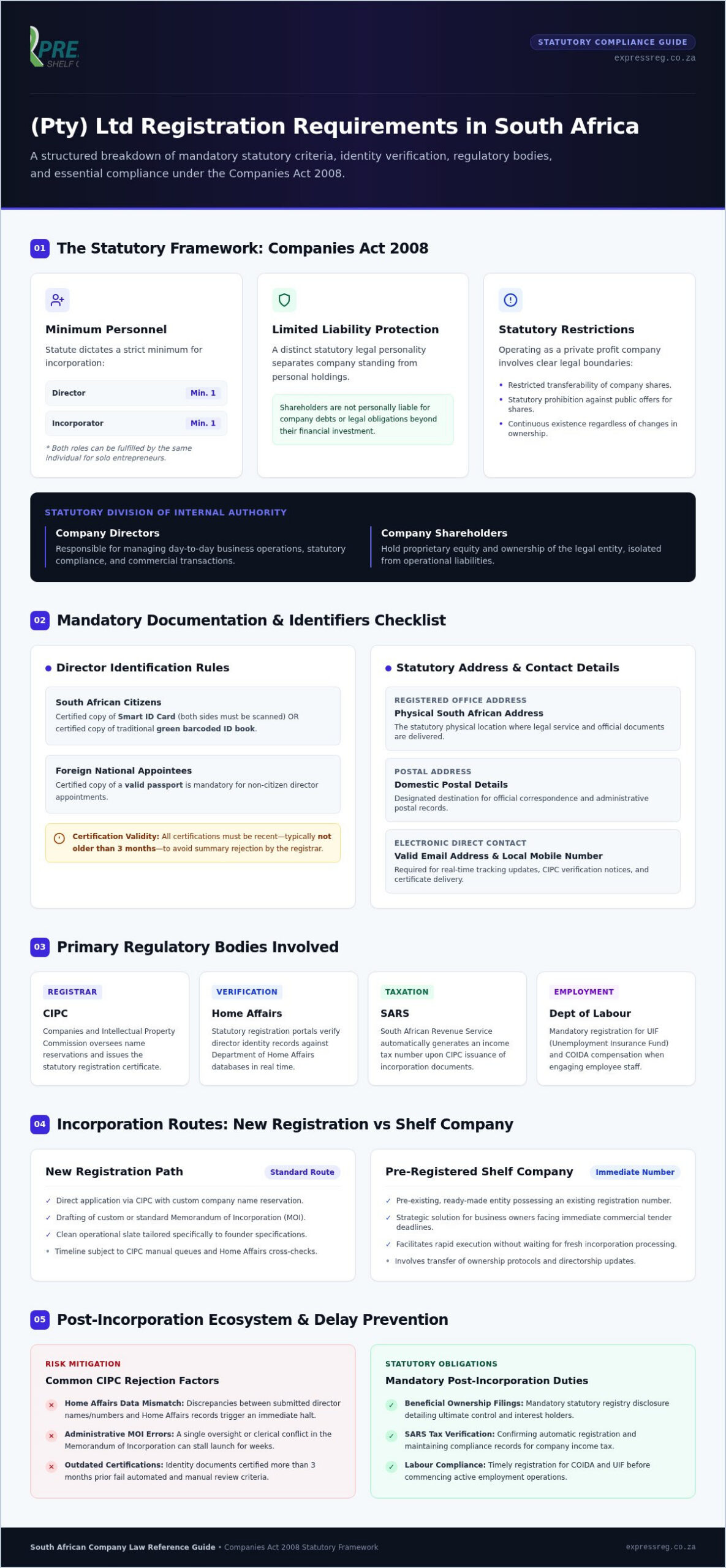
A Proprietary Limited company, commonly known as a (Pty) Ltd, is a private profit company defined under the Companies Act 2008. It’s the most popular vehicle for profit-seeking ventures in the country because it creates a distinct legal personality. This means the company exists independently of its owners. To meet the basic pty ltd registration requirements south africa mandates, you need a minimum of one director and one incorporator. These roles can be held by the same person, making it ideal for solo entrepreneurs.
Choosing this structure provides a robust foundation for growth. Unlike a sole proprietorship, a (Pty) Ltd allows for the inclusion of multiple shareholders, facilitating capital investment and easier ownership transitions. It remains the preferred choice for South African SMEs in 2026 because it signals professional intent to banks, suppliers, and government tender boards. By formalising your business, you transform a simple idea into a statutory entity capable of entering into contracts in its own name.
Understanding the Pty Ltd Meaning and Structure
The defining feature of a (Pty) Ltd is limited liability. This legal principle ensures that shareholders aren’t personally responsible for the company’s debts or legal obligations beyond their investment. It’s a critical safeguard for personal assets like your home or car. Under South African company law, there is a clear distinction between directors, who manage daily operations, and shareholders, who own the equity. While a private company restricts the transferability of its shares and prohibits offers to the public, this structure ensures business continuity even if an original founder leaves.
Regulatory Bodies Involved in Your Incorporation
Your journey toward full compliance involves three primary authorities. The Companies and Intellectual Property Commission (CIPC) manages the actual incorporation and name reservation process. Once the CIPC issues your registration certificate, the South African Revenue Service (SARS) automatically generates an income tax number for the entity. Finally, if you intend to hire staff, you must register with the Department of Labour for COIDA and UIF. Managing these overlaps correctly from the start prevents administrative bottlenecks that could delay your trading start date.
Meeting the pty ltd registration requirements south africa requires can be done through a new application or by acquiring a shelf company South Africa if you need a registration number immediately for an urgent tender. Regardless of the path you choose, understanding these statutory pillars ensures your business operates within the bounds of the law from its first day of trading. This organised approach reduces the stress of future audits and keeps your focus on commercial success.
Mandatory Documentation and Information Requirements
Meeting the pty ltd registration requirements south africa demands is a structured process that begins with gathering specific administrative data. You can’t proceed without a clear set of identifiers for all involved parties. Providing accurate information from the start prevents the CIPC from flagging your application for manual review, which can add weeks to your timeline.
Identity Verification and Director Details
Every director must provide a certified copy of their identification. For South African citizens, this means either the Smart ID card (both sides must be scanned) or the traditional green barcoded ID book. If you’re appointing a foreign director, a certified copy of their valid passport is mandatory. Ensure all certifications are recent, typically not older than three months, to avoid rejection. Since the South African Government company registration portal verifies details against Home Affairs records, any discrepancy in names or ID numbers will cause an immediate halt.
Beyond personal identification, you must provide a physical South African address for the company’s registered office. This is the legal location where official documents will be served. A postal address is also required for general correspondence. To receive real-time updates from the CIPC, provide a valid email address and a local mobile number. These contact details are vital for tracking your application status and receiving your final incorporation certificates.
The Memorandum of Incorporation (MOI)
The MOI is the governing document of your company. It sets out the relationship between shareholders and directors, outlining their respective rights and duties. For most startups in 2026, the standard CIPC “Short Form” MOI is the preferred choice. It’s pre-approved and follows the default regulations of the Companies Act, which significantly accelerates the registration timeline. Customised MOIs are available for complex shareholding structures, but they often require legal oversight and longer processing times.
Choosing the standard form ensures your entity remains compliant with basic statutory requirements without the need for bespoke legal drafting. It covers essential clauses regarding director powers and shareholder voting rights. If your business needs are straightforward, sticking to the standard MOI is the most efficient path to securing your registration number. If you find the documentation phase daunting, you can simplify the process by opting for a New (Pty) Ltd Registration service that handles the paperwork on your behalf.
Proposed Company Names
You must submit at least four proposed names in order of preference. The CIPC checks these against existing trademarks and registered entities. Selecting unique, descriptive names reduces the risk of rejection. If your first choice is too similar to an existing brand, the registrar will automatically move to your second or third option. This step is often the biggest bottleneck in the process, so research your names thoroughly before submission to ensure they’re distinctive.
Post-Incorporation Compliance: The Full Ecosystem
Receiving your CoR14.3 registration certificate is a significant milestone, but it doesn’t mark the end of your administrative journey. To trade legally and qualify for high-value contracts, you must look beyond the initial pty ltd registration requirements south africa mandates. The 2026 compliance ecosystem is highly integrated, linking the CIPC directly with tax and labour authorities to ensure transparency from the first day of trading.
Beneficial Ownership Register (BOR) Requirements
A critical requirement for 2026 is the mandatory Beneficial Ownership disclosure. This regulation requires every company to identify the natural persons who ultimately own or control the entity, even if those individuals are hidden behind other companies or trusts. You’re required to file your first BOR disclosure with the CIPC within 30 days of your company’s incorporation. Failing to maintain an accurate register can lead to heavy administrative fines or the eventual deregistration of your business. It’s a measure designed to improve national transparency, making it a non-negotiable step for every new director.
Tax and Labour Readiness
While the CIPC automatically triggers your SARS income tax registration, your duties to the revenue service involve several additional steps. If your projected turnover exceeds R1 million over a 12-month period, you’re legally obligated to complete a VAT registration South Africa process. Many startups also choose voluntary registration if their turnover is at least R50,000, as this allows them to claim back input VAT on business expenses. Linking your CIPC profile to your SARS eFiling account is the most efficient way to manage these obligations in one central location.
Workplace compliance is equally vital if you intend to hire employees. You’ll need to register with the Department of Labour for the Unemployment Insurance Fund (UIF) and the Compensation for Occupational Injuries and Diseases Act (COIDA). Securing a Letter of Good Standing South Africa is a standard prerequisite for almost all government tenders and private sector supplier databases. This document serves as proof that your workplace insurance assessments are paid up and your employees are protected. Balancing these statutory duties alongside your daily operations ensures your business remains a legitimate going concern in a competitive market.
Avoiding Common CIPC Rejection Factors
Many entrepreneurs find that their biggest hurdle isn’t the business plan, but the administrative scrutiny of the CIPC. Most delays occur because of minor technical errors that trigger an automated rejection. Understanding the pty ltd registration requirements south africa mandates means anticipating where these systems might flag your data before you hit submit. A single typo or a mismatched ID number can halt your progress, forcing you to restart the process and pay reservation fees again.
Name Reservation Strategies for 2026
The name reservation phase is the most frequent point of failure. CIPC often rejects names that are “too descriptive” or lack a unique identifier. For example, a name like “Apex Logistics” is likely to be rejected for being too generic. You should include at least one distinctive, made-up, or brand-specific word that sets your entity apart. Additionally, ensure your chosen name doesn’t infringe on existing trademarks. CIPC’s database is linked to national trademark registers, so a name that’s phonetically similar to a major brand will be blocked. Using a professional facilitator to pre-screen your list of four names can save you days of frustration.
Administrative Accuracy and Verification
Accuracy is vital when dealing with the Department of Home Affairs link. CIPC verifies all director details against this national database in real-time. If the names or ID numbers on your application don’t match your official records exactly, the system will reject the filing. A common mistake is using a shortened name or a nickname instead of your full name as it appears in your ID book. Ensure all certificates are scanned clearly and certifications are within the 3-month validity period.
Efficiency also depends on your responsiveness to verification emails. CIPC sends One-Time Pins (OTPs) and confirmation links to all directors. These must be actioned within a strict timeframe, usually 72 hours. If a single director misses this window, the entire application may lapse. Ensure your team is briefed and ready to check their inboxes. If you discover a mistake after your certificate is issued, you’ll need to initiate a director change CIPC process to rectify the records. This is a separate statutory filing that requires fresh documentation and board resolutions.
To avoid these bureaucratic pitfalls and ensure your company is set up correctly the first time, you can utilise a professional New (Pty) Ltd Registration service via Express Shelf Company. This ensures every technical detail is handled by experts who understand the nuances of the 2026 CIPC system.
Streamlining Your Registration with Professional Assistance
Deciding how to approach your incorporation is a strategic choice that affects your speed to market. While a DIY approach might seem cost-effective initially, it often leads to administrative bottlenecks due to minor filing errors. Professional consultancies act as a reliable intermediary between you and the CIPC. They ensure every detail of the pty ltd registration requirements south africa mandates is addressed correctly before submission. This proactive management reduces the risk of rejection and allows you to focus on your core business strategy rather than paperwork.
When to Choose a New Registration
Establishing a new entity is the best path if you want a specific, unique brand name from the first day. It’s an excellent choice for founders who have a lead time before they begin trading. Express Shelf Company simplifies the process of registering a Pty Ltd South Africa by preparing all necessary CIPC documentation and managing the name reservation workflow. This route ensures your company structure is built specifically for your vision, providing fixed-fee transparency throughout the incorporation process.
When to Opt for a Shelf Company
If you’re facing a tight deadline for a government tender or a private contract, a shelf company South Africa is the superior option. These are pre-registered entities that already possess a registration number and an income tax number. The speed advantage is significant; you skip the name reservation wait times entirely. The transfer process involves changing the directors and shareholders to your team. While you may submit a name change later if the original name doesn’t fit your brand, the immediate legal standing allows you to apply for tenders without delay.
Beyond the initial setup, professional agents handle the heavy lifting of ongoing statutory filings. A company’s legal status is not permanent; it requires active maintenance to remain compliant with the Companies Act. Failure to manage your CIPC annual returns submission can lead to the CIPC assuming the business is inactive, which triggers deregistration. Professional management ensures your entity remains in good standing, protecting your limited liability and keeping your business ready for any commercial opportunity that arises in 2026.
Launching Your Compliant Business with Confidence
Establishing a new company is about more than just obtaining a certificate; it’s about building a foundation for growth. You’ve learned how to navigate the pty ltd registration requirements south africa mandates, from selecting the correct MOI to managing mandatory Beneficial Ownership disclosures. By prioritising administrative accuracy and synchronising your data with Home Affairs records, you eliminate the common bottlenecks that stall so many startups.
Compliance is an ongoing duty rather than a one-time event. Maintaining your legal standing through annual returns and SARS updates ensures you’re always ready for the next tender or commercial partnership. If you want to bypass the bureaucratic complexity, professional assistance provides a clear path to full statutory readiness. This structured approach protects your limited liability status and keeps your focus on what matters most: your customers.
Register your Pty Ltd with Express Shelf Company today. As a CIPC Registered Agent, we provide fixed-fee compliance solutions that include your SARS tax registration, allowing you to focus on your commercial vision. Your journey toward a successful South African enterprise starts with the right administrative support.
Frequently Asked Questions
What are the basic requirements for a Pty Ltd in South Africa?
The core pty ltd registration requirements south africa mandates include at least one director and one incorporator, who can be the same individual. You must provide a valid South African physical address for the registered office and a postal address for official correspondence. Additionally, you need certified copies of identity documents for all directors and a list of four unique proposed company names for CIPC reservation to ensure your brand is distinctive.
Can a foreign national be a director of a South African company?
Yes, foreign nationals can serve as directors of a South African company. The primary requirement is a certified copy of a valid passport. While the CIPC doesn’t strictly require a local work visa for the act of registration itself, the director must ensure they comply with Department of Home Affairs regulations if they intend to reside or work within the country. Opening a local business bank account usually requires additional residency or tax verification.
How long does the Pty Ltd registration process take in 2026?
In 2026, the registration timeline depends largely on the name reservation process. Reserving a name typically takes between one and three business days, provided there are no trademark conflicts. Once the name is approved, the final incorporation through the CIPC usually takes another two to three days. If you require a registration number immediately for a tender, opting for a pre-registered shelf company is a much faster alternative to a new application.
Do I need a business bank account to register a company?
You don’t need a business bank account to register a company; in fact, you usually cannot open one until the company is already registered. Banks require your official CoR14.3 registration certificate and income tax number to initiate the account opening process. Once your entity is legally incorporated, you should open a dedicated business account to keep your personal and company finances separate, which is essential for tax compliance and professional accounting.
What is the difference between a shareholder and a director?
The distinction lies in ownership versus management. Shareholders are the owners of the company who provide capital and hold equity, while directors are responsible for the daily management and strategic operations of the business. In many small South African private companies, the same individual holds both roles. However, the Companies Act treats these roles as legally distinct, with directors carrying specific fiduciary duties to act in the company’s best interests at all times.
What is a Memorandum of Incorporation (MOI)?
The Memorandum of Incorporation is the mandatory governing document that defines the rights, duties, and responsibilities of shareholders and directors. It replaces the old Memorandum and Articles of Association under the 2008 Companies Act. Most new businesses use the standard CIPC Short Form MOI, which follows default statutory rules. This document is a foundational part of the pty ltd registration requirements south africa requires to ensure the entity operates within a clear legal framework.
Is it mandatory to register for VAT immediately?
Immediate VAT registration isn’t mandatory unless your business turnover has exceeded, or is expected to exceed, R1 million within a 12-month period. This is known as compulsory registration. However, you can choose to register voluntarily if your turnover has exceeded R50,000 in the past 12 months. Voluntary registration is often beneficial for startups that need to claim back input VAT on significant setup costs or equipment purchases during their initial trading phase.
How much does it cost to register a Pty Ltd company?
The total investment for registration includes statutory CIPC filing fees and professional service fees. The CIPC charges specific amounts for name reservation and the lodgement of the Memorandum of Incorporation. If you choose professional assistance, fees will cover the preparation of all legal documentation and initial tax registration. Many entrepreneurs prefer fixed-fee compliance solutions because they provide cost certainty. Total costs depend on whether you need a new registration or a pre-registered shelf company.