What if your entire business identity vanished because of a simple R100 administrative oversight? It’s a frustrating reality for many South African entrepreneurs who find the CIPC portal confusing and the distinction between turnover tiers or financial statements unclear. You’ve worked hard to build your brand; the last thing you want is to face administrative deregistration or lose your Letter of Good Standing because of a missed deadline. Understanding the CIPC annual return fees south africa is the first step in protecting your commercial asset whilst ensuring your legal standing remains intact.
This guide simplifies the 2026 statutory requirements, ensuring you pay the correct amount and meet every obligation with confidence. We’ll break down the latest turnover-based fee structures for companies and close corporations, clarify the mandatory beneficial ownership disclosures, and provide a clear roadmap to keep your company fully compliant and active. By following this methodical approach, you can avoid late penalties and maintain the organised efficiency your business deserves.
Key Takeaways
- Distinguish between CIPC compliance filings and SARS tax returns to ensure your company remains legally active whilst meeting all statutory obligations.
- Master the CIPC annual return fees south africa by identifying your specific turnover tier to ensure accurate payments and avoid unnecessary administrative costs.
- Learn to calculate turnover correctly using the Financial Accountability Supplement (FAS) or Annual Financial Statements (AFS) to simplify your reporting process.
- Recognise the critical filing deadlines and the severe consequences of late payment to protect your business from the risk of administrative deregistration.
- Understand the mandatory requirement for Beneficial Ownership declarations to ensure your annual return submission is processed successfully on the CIPC portal.
Understanding CIPC Annual Returns: More Than Just a Fee
A CIPC annual return is essentially a statutory renewal of your company registration. It serves as a formal declaration to the Companies and Intellectual Property Commission (CIPC) that your firm is still in business. This process confirms critical details such as current directors, registered addresses, and your financial status for the preceding year. Think of it as a mandatory health check for your legal entity that keeps your business data current on the national registry.
Don’t confuse this requirement with your SARS tax returns. Whilst both are mandatory, they serve entirely different purposes. Your SARS return focuses on revenue and taxable income for the South African Revenue Service. In contrast, the CIPC return focuses on corporate compliance and legal existence. Understanding the CIPC annual return fees south africa is vital because every registered entity amongst South African businesses must file, regardless of whether you traded or remained dormant. If your company exists on paper, you have a legal obligation to file.
The Legal Framework for Annual Returns
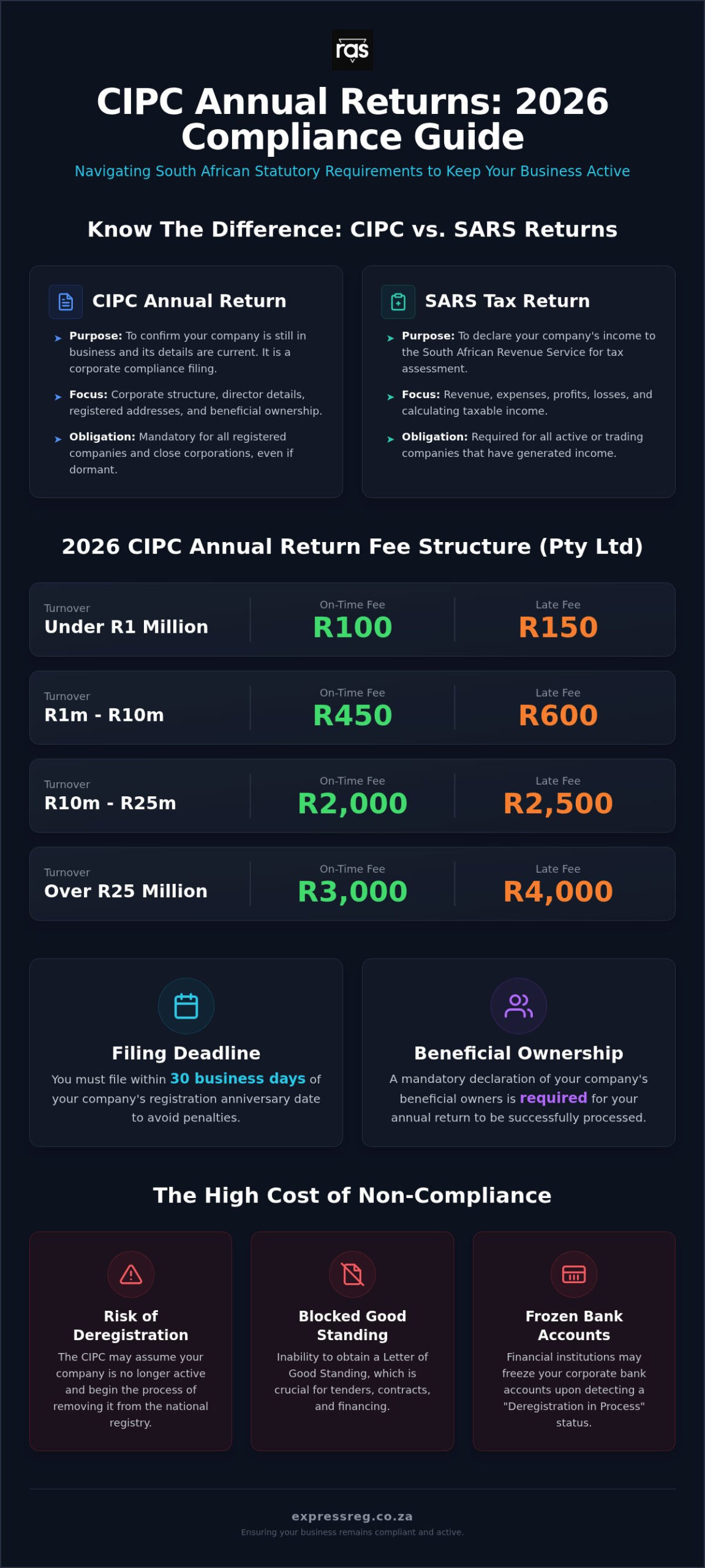
The Companies Act mandates these annual disclosures to ensure the national business registry remains accurate and transparent. Your filing window opens during your “Anniversary Month”, which is the month your company was originally registered. You then have 30 business days from the date of your anniversary to complete the submission. Failing to act within this window triggers late penalties and moves your company closer to administrative deregistration.
Dormant companies often fall into the trap of thinking they are exempt from these requirements. This is a costly mistake. Even if your turnover was zero and you didn’t trade for the entire year, you must still file a return and pay the minimum fee. This action confirms to the CIPC that you intend to keep the entity active for future use. Neglecting this leads to the “nightmare” restoration process which is far more expensive and time-consuming than a simple annual filing.
Why Staying in Good Standing Matters
Maintaining an “Active” status on the CIPC database is non-negotiable for operational firms. If you fail to file, the CIPC assumes your company is no longer in business and begins the deregistration process. This status change has immediate, practical consequences for your daily operations. Non-compliance blocks Letter of Good Standing applications, which are essential for securing most private and public contracts. Furthermore, it disqualifies your firm from government tender eligibility and may cause corporate bank accounts to be frozen if the bank detects a “Deregistration” status. Staying ahead of CIPC annual return fees south africa ensures your business asset remains protected and ready for commercial opportunities.
CIPC Annual Return Fee Structure for 2026
The CIPC annual return fees south africa follow a turnover-based model. This means the amount you pay depends entirely on your gross revenue for the financial year being reported. It’s a common misconception that profit dictates these fees; in reality, your total sales volume determines the tier. Whether your business is VAT-registered or exempt, you must calculate your turnover accurately to ensure you select the correct category during the filing process. Total turnover should include all income generated before expenses are deducted.
The CIPC allows a specific window for “on-time” payments. For private companies, this is exactly 30 business days from the date of your registration anniversary. If you miss this window, even by a single day, the system automatically applies a late filing penalty. To ensure your submission is processed without these extra costs, you can outsource your CIPC filing to specialists who monitor these deadlines for you.
Fee Tiers for Private Companies (Pty) Ltd
Private companies, including (Pty) Ltd, Public, and Non-Profit entities, operate on a four-tier system. Paying on time is the most cost-effective way to maintain compliance and avoid the higher late-filing rates.
- Tier 1: For turnover under R1 million, the fee is R100 if filed on time, rising to R150 if late.
- Tier 2: Turnover between R1 million and R10 million requires a R450 fee, increasing to R600 for late submissions.
- Tier 3: Turnover between R10 million and R25 million costs R2,000 on time or R2,500 if late.
- Tier 4: Entities with turnover exceeding R25 million pay R3,000, which jumps to R4,000 for late filings.
Fee Tiers for Close Corporations (CC)
Close Corporations follow a different regulatory structure. The thresholds for CCs are broader, which often simplifies the process for smaller firms that still operate under this older legal format. Unlike companies, CCs have a longer filing window that spans from the first day of their anniversary month until the end of the following month.
- Turnover between R1 million and R50 million: The standard fee is R100.
- Turnover exceeding R50 million: The fee increases significantly to R4,000.
If you fail to file within the two-month window, the CIPC categorises the return as late. This doesn’t just increase the CIPC annual return fees south africa; it also flags your entity for potential deregistration. Staying disciplined with these payments is a small price to pay for the security of your business registration and your ability to trade legally.
Calculating Turnover: FAS vs AFS Requirements
Calculating your turnover accurately is the only way to ensure you don’t overpay or trigger a compliance audit. When you log onto the CIPC portal, the system asks for specific financial data to determine your CIPC annual return fees south africa. The method you use to provide this data depends on your company’s Public Interest (PI) Score. This score acts as a regulatory filter, sorting businesses into those that require full Annual Financial Statements (AFS) and those that can submit a simpler Financial Accountability Supplement (FAS).
The PI score is calculated by awarding one point for every employee, one point for every R1 million in turnover, and one point for every R1 million in third-party debt. Additionally, you must count one point for every individual who holds a beneficial interest in the company’s securities. Knowing your score before you begin the filing process prevents technical errors and ensures you choose the correct reporting path.
The Financial Accountability Supplement (FAS)
Smaller private companies that aren’t legally required to have their financial statements audited or independently reviewed usually qualify for the FAS. This is a shorter form that captures essential data without the need for a full XBRL upload. To complete it, you’ll need three primary figures: your annual turnover, the average number of employees during the year, and your total third-party liabilities.
Mistakes here can be costly. A common error involves miscalculating turnover by excluding certain revenue streams or failing to align the figures with what you’ve reported to SARS. Discrepancies between these two authorities often flag a company for a manual review. Ensure your figures represent the total gross income before any deductions to remain compliant with the 2026 guidelines. Accuracy at this stage is vital for maintaining your legal standing without unnecessary administrative delays.
Audited vs Independent Review Statements
Your reporting obligations are determined by your PI score thresholds. If your PI score exceeds 350 points, or if it’s between 100 and 350 and your financial statements were internally compiled, a full audit is mandatory. Companies that fall below these thresholds but still have significant public interest may require an independent review instead. This ensures that larger entities or those with significant debt are held to a higher standard of transparency.
Filing an AFS requires the use of XBRL (Extensible Business Reporting Language), a digital format that allows the CIPC to analyse financial data automatically. This process is more complex than the FAS and usually requires professional assistance to ensure the technical tags match the statutory requirements. Regardless of the method, the CIPC annual return fees south africa remain linked to the turnover tier you declare. Aligning your CIPC turnover with your SARS declarations isn’t just good practice; it’s a fundamental requirement to avoid legal complications and maintain your company’s active status.
Late Filing Penalties and the Risk of Deregistration
Missing the 30-day filing window isn’t just a minor administrative oversight. It triggers an immediate financial penalty that inflates your CIPC annual return fees south africa. The CIPC system is automated; the moment your anniversary deadline passes, the fee structure shifts to the late-payment rate. This initial penalty is the first warning sign of a deteriorating compliance status. If you continue to ignore these obligations, the commission begins a systematic process to remove your company from the register entirely.
The transition from “In Business” to “Deregistration Process” happens faster than most directors realise. Once a company misses two or more consecutive annual returns, the CIPC assumes the entity is no longer active. This status change is visible to the public and financial institutions. Banks often freeze corporate accounts when they detect a deregistration flag, as the company’s legal capacity to trade is technically suspended. Resolving this early by paying the late fees is significantly cheaper and less stressful than the alternative.
The “Final Deregistration” cliff represents a total loss of legal identity. At this stage, the company ceases to exist as a juristic person. Any assets held by the firm, including property or intellectual property, can technically vest in the State as bona vacantia. Contracts become unenforceable and directors may face personal liability for ongoing debts. Protecting your business from this outcome requires disciplined attention to the 2026 filing calendar.
Late Fee Calculations
The penalty for late submission is calculated based on your turnover tier. For Tier 1 companies with turnover under R1 million, the fee increases from R100 to R150. Whilst a R50 penalty seems small, the costs scale sharply for larger entities. Tier 4 companies with turnover exceeding R25 million see their fee jump from R3,000 to R4,000. These costs compound if you have multiple years of outstanding returns, creating a significant debt that must be settled before you can regain your Letter of Good Standing.
The Restoration Process: A Compliance Warning
Restoring a company after final deregistration is a complex, multi-step process often described as a regulatory nightmare. You must pay a statutory application fee of R200 and obtain written consent from the Department of Public Works and National Treasury. Additionally, you are required to publish advertisements in a local newspaper and the Government Gazette to notify the public of your intent to restore the entity.
Before the restoration is finalised, you must complete every outstanding CIPC annual returns submission at the maximum late-filing rate. This process can take several months to complete, during which time your business cannot legally operate or secure tenders. To avoid these complications, you should act now to settle your CIPC annual return fees south africa and keep your registration active. Maintaining compliance is a small investment compared to the high price of corporate resurrection.
How to File and Pay: A Streamlined Approach
Completing your statutory obligations requires more than just a basic understanding of the CIPC annual return fees south africa. Success depends on meticulous preparation before you even log into the eServices portal. You must gather your financial data, verify your turnover for the reporting period, and ensure your company records are up to date. This proactive approach prevents technical delays and ensures that your submission reflects the true state of your business.
The CIPC operates a virtual wallet system for all transactions. This means you cannot pay for your return using a standard checkout process with a credit card at the final step. Instead, you must deposit the exact amount into the CIPC bank account using your unique Customer Code as the reference. Once the funds reflect in your virtual wallet, you can allocate them to settle your outstanding CIPC annual return fees south africa. It’s essential to allow for banking delays, as the filing is only considered complete once the payment is successfully processed within the system.
A critical change for 2026 is the mandatory link between returns and transparency. The CIPC will not accept an annual return submission unless you have also completed your Beneficial Ownership Filing. This regulation ensures the commission has an accurate record of who truly owns and controls the entity. Failing to synchronise these two filings will block your submission and potentially lead to late penalties.
Step-by-Step Submission Guide
Begin by verifying your Customer Code and password access to the CIPC eServices platform. Once logged in, select the “Annual Returns” tab and enter your enterprise number. The system will prompt you to input your turnover data, which automatically generates the fee quote based on the tiers discussed earlier. For smaller firms, you will complete the Financial Accountability Supplement (FAS) online. Larger entities must upload their Annual Financial Statements (AFS) in the specific iXBRL format. Ensure all data matches your SARS records to avoid future compliance audits.
Outsourcing Your Statutory Compliance
Many businesses choose to use a professional filing agent to manage this process. The benefits extend beyond simply avoiding portal errors or technical timeouts. A dedicated service ensures that Director Changes and Beneficial Ownership disclosures are handled concurrently with your annual return. This coordinated management maintains a continuous track record of “Good Standing”, which is vital for your future growth and tender eligibility. By outsourcing these administrative hurdles, you can focus on your core business operations whilst experts handle the heavy lifting of statutory paperwork and procedural accuracy.
Securing Your Company’s Statutory Future
Maintaining a compliant South African company requires disciplined attention to the 2026 filing calendar. By accurately calculating your turnover and understanding the distinction between FAS and AFS reporting, you protect your entity from the high costs of administrative deregistration. Remember that your Beneficial Ownership disclosure must now be submitted alongside your annual return to ensure successful processing. Staying informed about the CIPC annual return fees south africa allows you to manage these obligations with organised efficiency rather than administrative stress.
Expert statutory compliance management is the most effective way to ensure your business remains in good standing whilst you focus on growth. We provide a seamless transition from complex paperwork to full legal standing, integrating your filings with SARS and Department of Labour requirements. Let us handle your CIPC Annual Returns and Beneficial Ownership filings today to avoid the risk of administrative deregistration. Take the final step toward complete peace of mind and keep your business asset active and protected for the years ahead.
Frequently Asked Questions
What is the minimum CIPC annual return fee for a small company?
The minimum fee for a small company with an annual turnover of less than R1 million is R100. This rate applies specifically when you file within your 30-business-day anniversary window. If you miss this deadline, the fee increases to R150. These CIPC annual return fees south africa ensure that even micro-entities maintain their legal standing without incurring heavy financial burdens. Always verify your turnover tier before submitting to avoid overpayment errors.
Can I file my annual return if I haven’t traded this year?
Yes, you’re legally required to file an annual return even if your company hasn’t traded or generated any income. In this scenario, you’ll submit a zero-turnover return and pay the minimum statutory fee. This action confirms to the commission that the entity is still active and prevents administrative deregistration. Neglecting this requirement because the business is dormant is a common mistake that leads to the expensive and lengthy restoration process later.
How is the late filing penalty calculated for a (Pty) Ltd?
Late filing penalties are calculated as a flat-rate addition to your standard turnover-based fee. For Tier 1 companies, the penalty is R50, whilst Tier 4 entities with turnover exceeding R25 million face a R1,000 penalty. These costs apply the moment you exceed the 30-business-day filing window. It’s vital to settle these CIPC annual return fees south africa promptly, as outstanding penalties compound if multiple years of returns are left unpaid over time.
What happens if my company is deregistered for not paying fees?
Deregistration results in the total loss of your company’s legal identity. Once the process is finalised, your firm can’t legally trade, enter into contracts, or defend itself in legal proceedings. Any assets held by the company technically vest in the State as bona vacantia. Furthermore, banks will freeze your corporate accounts once they detect the change in status. Reversing this requires a complex restoration process involving the Government Gazette and National Treasury consent.
Do I need an auditor to file my CIPC annual returns?
You don’t necessarily need an auditor for your CIPC filing. Most small to medium businesses qualify to submit a Financial Accountability Supplement (FAS) instead of audited statements. However, if your Public Interest (PI) score exceeds 350, or if it’s over 100 and your statements were internally compiled, an audit becomes mandatory. Always calculate your PI score first to determine whether you can file independently or if professional auditing services are a statutory requirement.
Is the CIPC annual return fee the same as company tax?
No, the CIPC annual return fee is entirely separate from your SARS company tax obligations. The CIPC fee is a statutory renewal cost paid to the national registry to keep your entity active. In contrast, company tax is paid to the South African Revenue Service based on your taxable profit. You must fulfil both requirements annually to remain fully compliant. Missing your CIPC return can block your tax clearance certificates and other essential business documents.
How do I check if my company is in good standing with CIPC?
You can check your company’s status by performing a disclosure search on the CIPC eServices portal or BizPortal. An entity in good standing will display an “Active” status. If the status shows “Deregistration Process”, it indicates that you’ve missed multiple annual returns and must act immediately to settle outstanding fees. Regularly monitoring this status ensures you can address compliance issues before they escalate into bank account freezes or tender disqualifications.
Can I pay CIPC fees directly via EFT or credit card?
You cannot pay CIPC fees directly using a credit card at the point of submission. Instead, you must use the CIPC virtual wallet system. This involves depositing funds into the CIPC bank account via EFT, using your unique Customer Code as the reference. Once the funds reflect in your account, which can take up to three business days, you can allocate them to your return. Professional filing agents often manage this wallet system on your behalf for speed.