
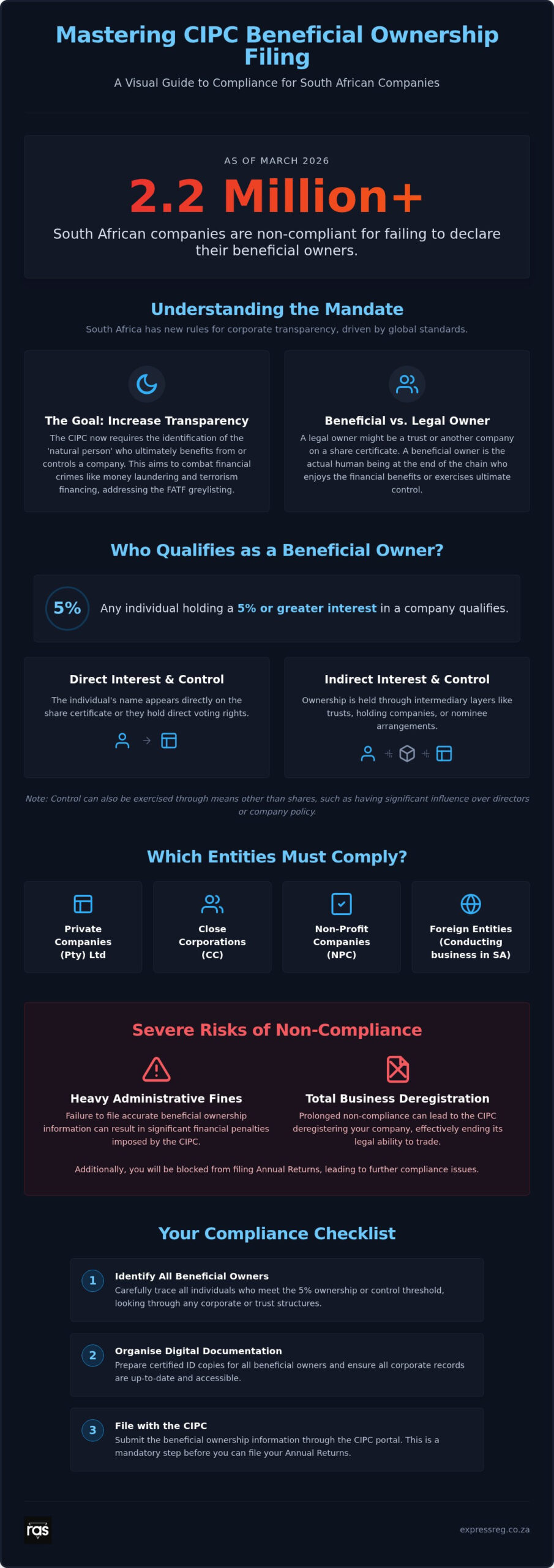
Did you know that as of March 2026, over 2.2 million South African companies are currently on the non-compliance list for failing to declare their controllers? This staggering figure highlights how many entrepreneurs struggle to manage the beneficial ownership filing CIPC requirements effectively. If you’re feeling frustrated by complex government portals or confused by the 5% ownership threshold, you’re certainly not alone in this administrative struggle.
It’s natural to worry about the threat of heavy penalties or the sudden deregistration of your business. We understand that your priority is running your company, not untangling statutory red tape. This guide provides the clarity you need to master these disclosures and ensure your South African company remains fully compliant with the latest CIPC regulations.
You’ll gain a clear understanding of the legal requirements and a definitive checklist of the documents required for a successful submission. We’ll walk you through the process of moving from administrative complexity to total legal standing, giving you the peace of mind that your business interests are protected.
Key Takeaways
- Understand how global transparency standards have reshaped South African regulations and why ultimate disclosure is now mandatory for every registered entity.
- Identify individuals meeting the 5% ownership threshold to ensure your beneficial ownership filing CIPC is accurate and complete.
- Organise your digital documentation using a definitive checklist to avoid procedural errors and submission delays.
- Master the critical link between ownership disclosures and annual returns to prevent administrative blocks on the CIPC portal.
- Recognise the severe risks of non-compliance, ranging from heavy administrative fines to the total deregistration of your business.
Understanding the Beneficial Ownership Filing CIPC Mandate
The regulatory environment in South Africa has shifted significantly since 2023. Central to this change is the requirement for beneficial ownership filing CIPC, a process designed to increase transparency within corporate structures. While a share certificate might name a trust or another company as the owner, the CIPC now requires the identification of the natural person at the end of that chain. This ensures that the individuals who truly benefit from the company’s activities are known to the authorities.
Beneficial ownership differs from legal ownership because it focuses on ultimate control rather than just the names on a share register. An individual might not own a single share directly, yet they could still exercise effective control through voting rights or influence over directors. South Africa introduced these strict transparency measures to address the country’s greylisting by the Financial Action Task Force (FATF). By creating a central register, the government aims to prevent the misuse of corporate vehicles for money laundering or terrorism financing.
The Legal Framework: Companies Act Amendments
The primary driver behind these changes is the General Laws (Anti-Money Laundering and Combating Terrorism Financing) Amendment Act 22 of 2022. This legislation amended the Companies Act 71 of 2008, making it a statutory duty for entities to disclose their controllers. The CIPC acts as the central registry for this sensitive data. It ensures that law enforcement and regulatory bodies can quickly identify who is truly behind a business entity. For directors, compliance is no longer optional; it’s a foundational requirement for maintaining a company’s legal standing in 2026.
Who Does This Apply To?
Most business entities registered in South Africa must comply with these disclosure rules. This includes:
- Private Companies (Pty) Ltd: Every private firm must identify and report its beneficial owners.
- Close Corporations (CC): Despite being an older registration type, CCs are fully subject to these transparency laws.
- Non-Profit Companies (NPC): Transparency is vital here to ensure funds aren’t diverted for illicit purposes.
- Foreign Entities: Any external company registered to conduct business within South Africa must also submit their details.
There is a distinction for “affected companies,” which are typically entities listed on a public exchange. These companies follow different disclosure paths because they already operate under strict public scrutiny. However, for the vast majority of South African entrepreneurs, the beneficial ownership filing CIPC mandate is a mandatory annual task that must be prioritised to avoid severe administrative consequences.
Who Qualifies as a Beneficial Owner in South Africa?
Identifying the correct individuals for your beneficial ownership filing CIPC starts with the 5% rule. Anyone who holds a 5% or greater interest in your company qualifies as a beneficial owner. However, this definition extends well beyond mere shareholding. It specifically refers to the “ultimate” natural person who owns or controls the entity. Legal entities like trusts or holding companies cannot be beneficial owners; you must look through these layers to find the actual human being at the end of the chain.
Many entrepreneurs confuse directors with beneficial owners. While a director manages the daily operations, a beneficial owner is the person who enjoys the financial fruits of the business or holds the power to steer its long-term direction. In many small businesses, these roles overlap. In larger corporate groups, the beneficial owner might be several layers removed from the local board. Tracing these connections is vital to ensure your records reflect the true power dynamics within the organisation.
Direct vs Indirect Beneficial Interest
Direct interest is straightforward; it’s when your name appears on the share certificate. Indirect interest is more complex. It involves holding shares through another company, a trust, or a nominee. Indirect control occurs when a natural person exercises authority over a company through an intermediary entity, trust, or nominee arrangement rather than through direct shareholding. If you’re unsure how to trace these connections, you might consider professional assistance for your beneficial ownership filing to ensure every link is correctly identified.
Control Through Means Other Than Shares
Ownership isn’t the only way to exercise control. An individual qualifies as a beneficial owner if they have the right to appoint or remove the majority of the board of directors. They also qualify if they exert significant influence over company decisions via voting rights agreements or other contractual arrangements. Even without owning a single share, a person who can dictate the company’s strategic path must be disclosed to the CIPC. This ensures the registry remains transparent and reflects who truly holds the reins of the business.
Essential Documentation for a Successful CIPC Filing
Success with your beneficial ownership filing CIPC depends entirely on the accuracy of your digital uploads. The portal is strictly procedural; even a minor formatting error or an uncertified document can lead to an immediate rejection. To ensure a smooth transition to compliance, you must gather and organise your records before starting the online process. This methodical approach reduces administrative stress and guarantees that your submission is processed without unnecessary delays.
The core of your application consists of these primary documents:
- Certified Identification: You need clear, valid copies of ID documents or passports for every individual identified as a beneficial owner. Ensure the certification is recent, typically within the last three calendar months.
- Securities or Member’s Interest Register: This internal record must be up to date and reflect the current shareholding or membership structure of the entity.
- The Mandate Form: If you’re using a professional facilitator to handle the heavy lifting, you must provide a signed mandate form. This document explicitly authorises the agent to submit the disclosure on your behalf.
Prepare these files in PDF format to ensure compatibility with the CIPC eServices portal. Double-check that all signatures are clear and that the resolution of scanned documents is high enough for the text to be legible. Taking these steps early prevents the frustration of having to restart the process due to technical failures.
The Beneficial Interest Register
The Beneficial Interest Register is a specific requirement that differs from your standard share register. It must detail the full names, ID numbers, and the specific nature of the interest held by each individual. Ensure the data matches your share certificates exactly. The CIPC portal accepts standardised formats, but the information must be logically structured to pass the initial verification phase. It’s your company’s responsibility to maintain this register as a living document, updating it whenever ownership changes occur.
Supporting Evidence for Complex Structures
When your company is owned by a trust or another corporate entity, the documentation requirements become more stringent. You’ll need to provide Trust Deeds or Letters of Authority to trace the ownership back to natural persons. We refer to these individuals as the “warm bodies” at the end of the chain. Creating an organogram is a highly effective way to visualise these multi-tiered structures for the CIPC. This diagram should clearly illustrate the chain of ownership from the reporting company up to the ultimate controllers. Organising these complex layers into a single file helps the regulator understand your structure quickly, which is essential for maintaining your company’s full legal standing.
The Filing Process: Timelines and Annual Return Integration
The CIPC eServices portal serves as the primary gateway for your submission. Since July 1, 2024, the regulator has enforced a “hard stop” functionality. This mechanism prevents any CIPC annual returns submission until the beneficial ownership data is successfully captured. This integration ensures that transparency isn’t an afterthought but a prerequisite for corporate activity. To complete the process, log into the portal, select the Beneficial Ownership option, and upload your prepared digital documents for verification.
Timing is everything when managing your company’s standing. For companies incorporated before May 24, 2023, the beneficial ownership filing CIPC must occur alongside the annual return. For newer entities, the window is much tighter. Missing these windows leads to administrative complications that hinder your company’s operational capacity. It’s best to treat these filings as a unified compliance task rather than separate administrative hurdles.
Initial Filing vs Annual Updates
When you complete a new pty ltd registration south africa, you must file your beneficial ownership declaration within 10 business days of incorporation. This initial step establishes your transparency record with the regulator from day one. Once filed, you’re required to confirm or update this information every year. Synchronising your filing calendar with your financial year-end is the most effective way to maintain an “In Business” status and avoid administrative lapses that could lead to penalties. Entrepreneurs who want to build a fully compliant foundation from the outset should explore professional business registration services south africa to ensure every statutory requirement is met correctly from day one.
Managing Changes and Amendments
Compliance isn’t a one-time event; it requires ongoing vigilance. You must notify the regulator of any changes in ownership or control within 10 business days of the change occurring. This includes share transfers between individuals or updates following a director change CIPC if that director also held a beneficial interest. If you discover an error in a previous submission, you must follow the correct procedures to nullify the incorrect filing and resubmit accurate data. Keeping your securities register updated in real-time makes these amendments straightforward and stress-free.
Let our experts manage your beneficial ownership filing CIPC to ensure procedural accuracy and total peace of mind for your business.
Consequences of Non-Compliance and Professional Support
Ignoring the beneficial ownership filing CIPC requirements carries severe operational risks that can halt your business activities. The regulator issues formal compliance notices to entities failing to disclose their controllers. If these notices aren’t resolved, the CIPC can impose administrative fines that drain your company’s resources. Beyond financial penalties, the most significant threat is the involuntary deregistration of your company. This process effectively ends your legal right to trade and often leads to the immediate freezing of business bank accounts.
Commercial credibility depends on your company’s standing in the centralised registry. Financial institutions and government departments use this data to verify your entity’s legitimacy. If your status isn’t “In Business” due to non-compliance, you’ll likely face rejection when applying for corporate credit or submitting tender bids. Maintaining transparency is now a prerequisite for participating in the formal economy. It’s a foundational requirement that protects your business from being excluded from vital commercial opportunities.
Risks to Directors and Business Continuity
Directors face personal liability risks if they fail to maintain accurate securities and beneficial interest registers. The law places the burden of accuracy squarely on the board’s shoulders. Since the “hard stop” prevents annual return filings for non-compliant firms, a single missed disclosure can lead to a cascade of administrative failures. Keeping your status active is essential for securing contracts and maintaining the trust of your suppliers. It’s the only way to ensure your business remains a going concern in a strictly regulated environment.
How Express Shelf Company Simplifies Compliance
Managing statutory paperwork shouldn’t distract you from growing your business. Outsourcing the administrative burden to professional consultants ensures your records are handled with procedural accuracy. We specialise in managing the heavy lifting of CIPC documentation, ensuring your filings are correct the first time to avoid frustrating rejections. Our team acts as a reliable intermediary, moving your business from administrative complexity to full legal standing with ease. We prioritise speed and correctness to give you total peace of mind. For a comprehensive overview of how statutory compliance services south africa can protect your business standing across all regulatory requirements, explore our dedicated 2026 guide. Contact our team for beneficial ownership filing CIPC assistance today.
Secure Your Corporate Standing Today
Maintaining a transparent corporate structure is no longer just a best practice; it’s a foundational requirement for doing business in South Africa. You’ve seen that identifying every individual at the 5% threshold is the first step toward ensuring your beneficial ownership filing CIPC is accurate. By tracing and organising your records back to the ultimate natural persons, you protect your entity from the severe risks of deregistration and asset freezing. Compliance is your shield. These transparency measures are essential to keep your business operational and credible in a strictly regulated market.
Don’t let the “hard stop” on annual returns disrupt your operations or lead to costly compliance notices. Our team provides national compliance support with fixed-fee transparency, handling the heavy lifting of your documentation with expert administrative processing. Ensure your company remains compliant with professional CIPC filing services and move from administrative complexity to full legal standing. Taking these proactive steps today guarantees that your business is ready for the commercial opportunities of tomorrow. You’ve built a valuable enterprise; let us help you protect its future with procedural accuracy and total peace of mind.
Frequently Asked Questions
Is beneficial ownership filing mandatory for all South African companies?
Yes, the mandate applies to all business entities registered within South Africa, including private companies, close corporations, and non-profit organisations. Whilst listed entities follow different disclosure paths, the vast majority of local firms must comply to maintain their legal standing. Failing to submit this data puts your business at risk of administrative fines or involuntary deregistration. It’s a foundational requirement that ensures your company remains transparent and fully compliant with current legislation.
What is the deadline for filing beneficial ownership with the CIPC?
The deadline depends on when your company was incorporated. For entities registered on or after May 24, 2023, you must complete your beneficial ownership filing CIPC within 10 business days of incorporation. Existing companies registered before this date must file their information alongside their annual returns. Maintaining these timelines is critical to avoid the “hard stop” mechanism that prevents you from submitting other essential statutory documents to the regulator.
Can I file my annual returns without completing the beneficial ownership disclosure?
No, you cannot file your annual returns until your beneficial ownership information is successfully captured on the system. The CIPC introduced a “hard stop” functionality on July 1, 2024, to ensure total compliance across the board. If you attempt to submit a return without an updated ownership register, the portal will block the transaction. This makes it essential to prepare your ownership disclosures well in advance of your annual return deadline.
How much interest must an individual hold to be considered a beneficial owner?
An individual is considered a beneficial owner if they hold a direct or indirect interest of 5% or more in the company. This threshold applies not only to shareholding but also to voting rights or the ability to exercise significant influence over the entity’s management. Identifying everyone at or above this 5% mark is the primary trigger for your disclosure obligations. You must look through corporate layers to find the natural persons holding this interest.
What documents do I need to upload for a beneficial ownership filing?
You are required to upload several specific digital documents in PDF format to complete the process. These include certified copies of ID documents or passports for every beneficial owner, which must be certified within the last three months. You also need an updated Securities Register or Member’s Interest Register and a signed Mandate Form if you’re using an agent. Organising these files correctly first time prevents administrative rejections and ensures a smooth submission process.
Do non-profit companies (NPCs) need to file beneficial ownership information?
Yes, non-profit companies are strictly required to file beneficial ownership information just like for-profit entities. The legislation aims to prevent the misuse of any corporate vehicle, including charities and non-profits, for illicit financial activities. NPCs must identify the natural persons who exercise ultimate effective control over the organisation. This transparency helps maintain the NPC’s status and ensures it remains eligible for various grants, tenders, and public funding opportunities.
What happens if the beneficial owner of my company is a trust?
If a trust owns your company, you must look through the trust structure to identify the natural persons who ultimately control it. This includes the trustees, the founder, and the named beneficiaries of the trust. You cannot list the trust itself as the beneficial owner; the CIPC registry requires the details of the actual human beings involved. You will likely need to provide the Trust Deed and Letters of Authority as supporting evidence during your filing.
How often do I need to update my beneficial ownership information with CIPC?
You must update your information annually or whenever a change in ownership occurs. Every company is required to confirm its beneficial ownership status during the annual return window to maintain an “In Business” status. Additionally, if there is a share transfer or a change in control, you must notify the regulator within 10 business days. Keeping your beneficial ownership filing CIPC current ensures your business remains fully compliant and avoids sudden administrative blocks on the portal.