
Registering a business name is the easiest part of entrepreneurship, but failing to manage the subsequent statutory requirements is the fastest way to lose it. If you are researching how to start a company in south africa, you have likely encountered the frustration of CIPC delays or the confusion surrounding SARS VAT thresholds. It’s common to feel overwhelmed by the administrative burden that comes with turning a vision into a legal entity. You need a logical process that prioritises long-term compliance over a simple registration certificate.
We understand that your priority is trading, not untangling red tape. This 2026 founder’s guide provides a comprehensive roadmap to help you navigate CIPC registration, SARS tax compliance, and Department of Employment and Labour requirements with absolute confidence. We’ll outline the exact steps to secure your Pty Ltd status, explain the latest 2026 tax rates, and clarify your ongoing annual obligations. By the end of this guide, you’ll have a clear path to building a tax-compliant entity that’s ready for the South African market.
Key Takeaways
- Learn why the (Pty) Ltd structure is the preferred choice for entrepreneurs seeking limited liability and a professional corporate identity.
- Discover how to start a company in south africa using a shelf company as a strategic speed hack for immediate trading and contract applications.
- Understand the 2026 SARS VAT thresholds and the automatic process for obtaining your corporate income tax number upon registration.
- Identify the essential documentation required for CIPC filings to avoid common errors that lead to bureaucratic delays or deregistration.
- Explore how professional administrative support manages ongoing obligations like COIDA registration and annual returns to ensure your entity remains in good standing.
Understanding Company Structures in South Africa
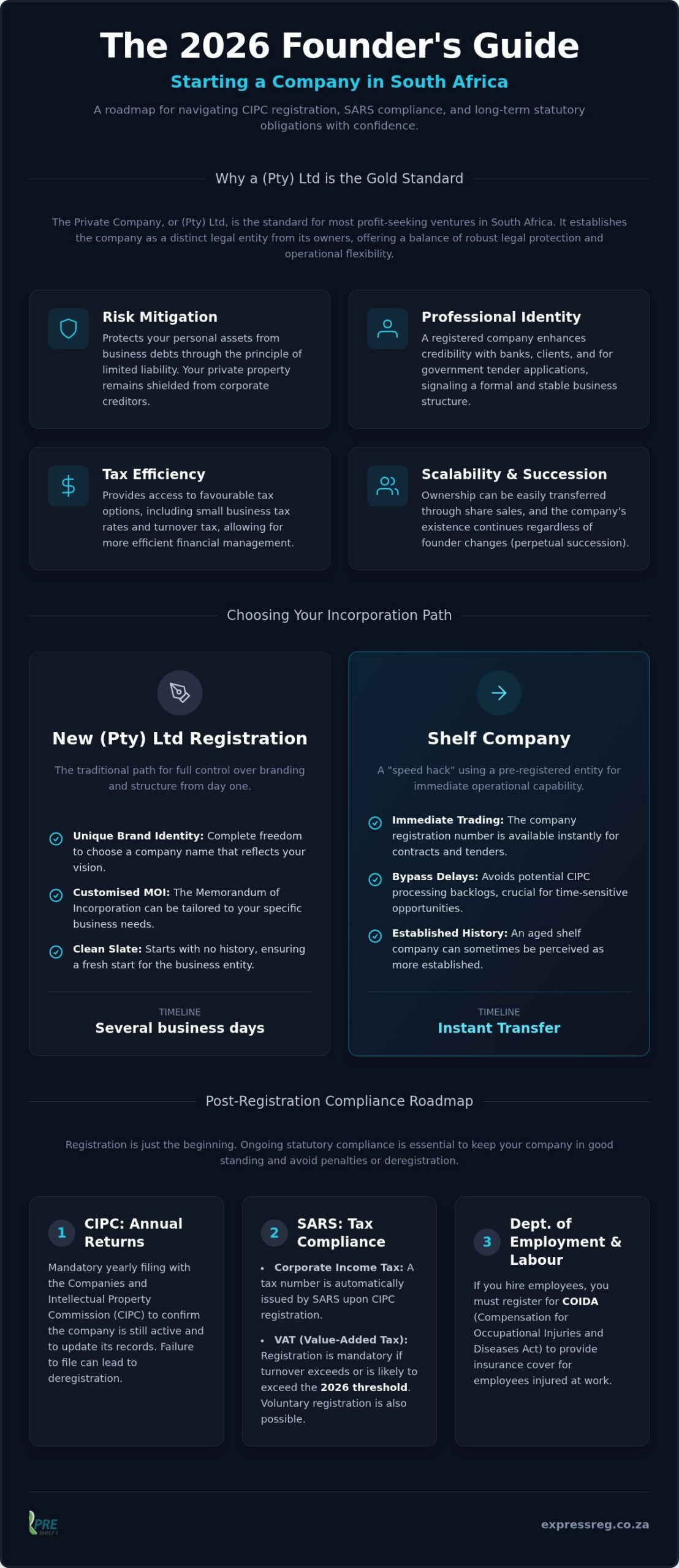
Selecting the correct legal framework is the foundational step when you research how to start a company in south africa. The Companies Act 2008 provides the regulatory basis for all entities, establishing the Private Company, or (Pty) Ltd, as the standard for profit-seeking ventures. A central pillar of this structure is the concept of separate legal personality. This ensures the company exists as a distinct legal entity from its owners, protecting your personal assets through limited liability. If the business faces financial distress, your private property remains shielded from corporate creditors; this separation is vital for managing risk in a competitive market.
Whilst the (Pty) Ltd is the most common choice, South African company law also defines specialised structures for specific needs. Non-Profit Companies (NPCs) serve social or cultural objectives rather than financial gain. Personal Liability Companies, denoted by the suffix “Inc.”, are typically used by professionals such as attorneys or auditors where directors are held jointly liable for debts. However, for the vast majority of startups, the private company remains the gold standard because it balances ease of registration with robust legal protections for its founders.
The Meaning and Benefits of a Pty Ltd
The term “Proprietary Limited” signifies that the company is privately held and its shareholders’ liability is restricted to their investment. This structure is particularly attractive to investors because it allows for the clear issuance of shares to raise capital. It also provides perpetual succession. This means the company continues to exist as a legal entity regardless of changes in ownership or the death of a founder, ensuring long-term stability for your brand and operations. You can scale your business with the knowledge that the entity’s existence is not tied to your personal circumstances.
Key reasons why founders choose this structure include:
- Risk Mitigation: Personal assets are protected from business debts.
- Professionalism: A registered company carries more weight with banks and government tenders.
- Tax Efficiency: Access to small business tax rates and turnover tax options.
- Scalability: It’s easier to transfer ownership through share sales as the business grows.
Legal Requirements for Incorporation
The administrative requirements for a (Pty) Ltd are straightforward but mandatory. You must appoint at least one director and one shareholder, though these roles can be filled by the same individual in a single-owner business. Every company must also adopt a Memorandum of Incorporation (MOI). This document serves as the internal rulebook governing the rights and duties of shareholders and directors, providing a clear framework for decision-making and dispute resolution. The Pty Ltd structure is the primary vehicle for commercial enterprise in South Africa. Following these guidelines is the first step in understanding how to start a company in south africa with a focus on long-term compliance.
Choosing Your Incorporation Path: New Registration vs Shelf Company
When you begin the process of how to start a company in south africa, you’ll reach a fork in the road: do you wait for a fresh registration or buy an existing entity? This choice is often dictated by your business’s immediate needs. A new (Pty) Ltd registration allows for complete control over your brand identity from day one. In contrast, a shelf company is a pre-registered entity that has never traded, offering a “speed hack” for those who need a registration number immediately. Choosing the right path is a critical decision when learning how to start a company in south africa with maximum efficiency.
The primary difference lies in the timeline. A new application requires a name reservation and CIPC processing, which can take several business days depending on current backlogs. A shelf company is ready for transfer instantly. This immediate availability is vital for entrepreneurs who discover a lucrative tender opportunity with a looming deadline. An OECD report on South African entrepreneurship highlights that administrative speed is a significant factor in business agility. By selecting a pre-registered entity, you bypass the initial waiting period entirely.
The Benefits of a New Pty Ltd Registration
Opting for a new registration ensures your company name is exactly what you envisioned. You aren’t restricted to pre-selected names, which is essential for building a unique brand presence in the market. This path also allows you to customise the Memorandum of Incorporation (MOI) to reflect specific shareholder rights or voting powers. It is the most cost-effective method if your launch timeline allows for the standard CIPC processing window.
Why Entrepreneurs Buy Shelf Companies
Buying a shelf company is about speed and tactical positioning. You receive a registration number the moment the purchase is finalised, allowing you to sign contracts or apply for bank accounts without delay. Some founders also prefer the perception of longevity that an older registration number provides, even if the entity has not yet traded. The transfer process involves a simple change of directors and shareholding, which we handle as part of our service. For more details on this process, read our Shelf Company South Africa: The Strategic Guide. If you need to begin trading today, you can secure a shelf company to bypass the standard waiting period.
Navigating Statutory Compliance with SARS and Labour
Securing your CIPC certificate is a significant milestone, but it isn’t the finish line. The next phase of how to start a company in south africa involves synchronising your new entity with national authorities to ensure you can trade legally. When CIPC completes your registration, they automatically share your data with the South African Revenue Service (SARS). This triggers the issuance of an Income Tax number, which usually arrives via email or SMS shortly after incorporation. Whilst this automation simplifies the start, you should still visit the official government business portal or the SARS eFiling platform to manage your specific tax types and ensure your profile is fully active.
SARS Tax and VAT Obligations
VAT registration is a strategic choice for some and a legal mandate for others. From 1 April 2026, the compulsory VAT registration threshold is R2.3 million in taxable supplies per year. If your turnover is below this but exceeds R50,000, you can opt for voluntary registration. This allows you to claim back input tax on business expenses, which is often beneficial for startups with high initial overheads. Read our SARS VAT Registration South Africa Guide for a detailed breakdown of the application process. Additionally, if you plan to hire staff, you must register for Pay As You Earn (PAYE) to deduct and remit employee taxes correctly. Maintaining a clean tax clearance status is vital if you intend to apply for government work or corporate contracts.
Labour Compliance: UIF and COIDA
Protecting your workforce is both a moral and legal requirement. Every employer must register with the Compensation Fund under the Compensation for Occupational Injuries and Diseases Act (COIDA) within seven working days of hiring their first employee. This insurance protects your business from civil claims if an employee is injured or falls ill whilst on duty. A critical component of this compliance is the Letter of Good Standing. This document proves your assessments are paid up and is a non-negotiable requirement for construction and service tenders.
You’ll also need to register for the Unemployment Insurance Fund (UIF), where the total contribution is 2% of the employee’s monthly remuneration, split equally between the employer and employee. The maximum monthly salary for these calculations is R17,712, resulting in a maximum monthly deduction of R177.12 for both parties. For a deeper look at these mandates, consult our guide on the Requirements for Letter of Good Standing South Africa. Mastering these statutory steps is the only way to ensure the long-term health of your venture as you navigate how to start a company in south africa.
Step-by-Step Roadmap to Launching Your Firm
Transitioning from a business concept to a registered entity requires a disciplined sequence of actions. When you plan how to start a company in south africa, following a structured roadmap prevents administrative bottlenecks and ensures your entity is compliant from its inception. The process is now largely digital, requiring precise data entry and valid identification documents for all involved parties. Missing a single step can lead to delays at the CIPC or complications with your initial tax filings.
- Step 1: Name Reservation. Submit up to four proposed names to the CIPC to check for availability and conflicts with existing trademarks. This currently costs R50 per application.
- Step 2: Documentation Preparation. Collect certified ID copies or passport documents for all directors, along with verified residential and business addresses.
- Step 3: CIPC Filing. Lodge the incorporation documents and pay the required fees to trigger the registration process.
- Step 4: Financial and Tax Setup. Open a dedicated business bank account and activate your SARS eFiling profile using your new tax number.
- Step 5: Ongoing Statutory Filings. Complete your initial Beneficial Ownership disclosure and diarise your annual return dates to avoid deregistration.
The Name Reservation Process
Choosing a name is often the most time-consuming part of the journey. To avoid rejection, ensure your name is unique and does not include prohibited words or suggest government patronage. If your preferred name is already taken, the CIPC will reject the application, and you will need to submit a new set of choices. Some entrepreneurs choose to register the company using its enterprise number, such as “K2026123456 (South Africa) (Pty) Ltd”, whilst waiting for a formal name approval. This allows you to begin the registration process immediately without being stalled by name conflicts.
Post-Incorporation Admin and Beneficial Ownership
Once you receive your registration certificate, your focus must shift to transparency and digital presence. The 2026 regulatory landscape places a heavy emphasis on the disclosure of all individuals who exercise effective control over the entity. Beneficial Ownership filing is now a mandatory annual requirement for all South African companies. This measure is designed to combat financial crimes and ensure that the ultimate owners of every Pty Ltd are known to the authorities. Beyond these legalities, establishing a corporate identity through a professional website and email domain is essential for building trust with your first clients. If you want to ensure your filings are handled correctly from day one, you can register your new company through our streamlined portal to avoid common submission errors.
Following this roadmap ensures you understand how to start a company in south africa without falling into common bureaucratic traps. Each step builds the foundation for a legally sound and commercially viable business.
Streamlining Your Setup with Professional Consultancy
Using a professional intermediary is a strategic move to ensure procedural accuracy from day one. Whilst the technical steps of how to start a company in south africa are accessible online, the risk of filing errors remains high for first-time founders. Professional consultants act as a knowledgeable guide between your business and the complex machinery of national authorities. We handle the heavy lifting of paperwork, allowing you to focus on operational growth whilst we manage the statutory details. This partnership ensures your entity moves from administrative complexity to full legal standing without the stress of bureaucratic delays.
Managing Director and Address Changes
Appointing new leadership or moving your registered office requires formal notification to the CIPC. As your firm grows, you must keep these details current to receive legal notices and maintain transparency. Managing director changes with CIPC involves specific documentation and digital verification that can be cumbersome if handled internally. Our service streamlines this transition, ensuring that every director change or address update is filed correctly and reflected on your disclosure certificates immediately. Keeping your registered office details current is equally vital for receiving critical correspondence from SARS and the Department of Labour.
The Role of Annual Returns
Filing your annual return is a mandatory health check that confirms your company is still active and compliant. This is separate from your tax returns; it’s a statutory requirement to prevent your entity from being placed into deregistration. For the 2026 assessment period, fees range from R100 for companies with zero turnover to over R3,000 for high-turnover entities. For example, a company with turnover between R1 million and R10 million must pay a fee of R450. Missing a deadline results in immediate penalties and risks the permanent loss of your company name.
A consultant prevents these outcomes by tracking your anniversary dates and handling the submission on your behalf. Consult our CIPC Annual Returns Submission Guide to understand the deadlines and fees involved. If you are ready to begin with a clean, professionally managed setup, follow our comprehensive Register a Pty Ltd in South Africa: 2026 Guide to ensure every statutory box is ticked from the start. Maintaining “Good Standing” is the only way to protect your business’s legal identity and ensure you remain eligible for corporate contracts and government tenders.
Launch Your South African Venture with Confidence
Successfully navigating how to start a company in south africa requires balancing your immediate operational needs with long-term regulatory discipline. Whether you choose the custom identity of a new (Pty) Ltd or the strategic speed of a shelf company, your focus must remain on maintaining a state of good standing. This involves managing your CIPC annual returns, SARS tax profiles, and labour requirements like COIDA and UIF with absolute precision to avoid the risk of deregistration or penalties.
We handle the administrative heavy lifting so you can focus on building your brand and serving your clients. Our team provides fast-tracked CIPC filings, comprehensive compliance management, and expert support for all your SARS and Labour registrations. Organise your company registration today with Express Shelf Company to move from paperwork to profit with ease. Your entrepreneurial journey starts with a solid legal framework, and we’re here to ensure that your foundation is unbreakable.
Frequently Asked Questions
How much does it cost to start a company in South Africa in 2026?
It costs R175 to register a standard Private Company (Pty) Ltd with a name reservation in 2026. If you choose to register without a name reservation, the CIPC fee is R125. A standalone name reservation application costs R50. Whilst these are the base government fees, many entrepreneurs choose to pay professional service fees to ensure the application is handled correctly and to include initial tax registrations.
How long does the CIPC company registration process take?
The CIPC registration process typically takes several business days to complete once all documentation is submitted. This timeline depends heavily on current CIPC backlogs and whether you are performing a name reservation simultaneously. If you require a registration number immediately to sign a contract, buying a shelf company is a faster alternative. This provides an instant entity that is already registered and ready for ownership transfer.
Can a foreigner start a company in South Africa?
Yes, foreigners can start a company in South Africa, provided they meet specific legal requirements. You must provide a valid passport and may need to demonstrate a significant capital investment or show that the business is in the national interest. Whilst the process for how to start a company in south africa is similar for residents and non-residents, foreign directors often face additional scrutiny during bank account openings and SARS registrations.
What is the difference between a shelf company and a new registration?
A shelf company is a pre-registered entity that has never traded, allowing for an instant transfer of ownership. This is ideal for meeting urgent tender deadlines. A new registration allows you to choose a custom name from the start and tailor the Memorandum of Incorporation to your specific needs. New registrations are generally more cost-effective but involve a waiting period for CIPC processing and name approval.
Is it compulsory to register for VAT immediately?
No, registration for VAT is only compulsory if your annual taxable supplies exceed the R2.3 million threshold, effective from 1 April 2026. You may choose to register voluntarily if your turnover exceeds R50,000 per year. This voluntary path is often beneficial for startups that wish to claim back input tax on significant initial expenses, provided they can maintain the necessary SARS record-keeping standards and compliance requirements.
What happens if I do not file my CIPC annual returns?
Failing to file your annual returns leads to immediate administrative penalties and eventually triggers the deregistration process by the CIPC. Once a company is deregistered, it ceases to exist as a legal entity, and its assets may be forfeited to the state. This status also prevents you from obtaining a Tax Clearance Certificate or a Letter of Good Standing, making it impossible to trade legally with government clients.
Do I need a lawyer to register a Pty Ltd company?
You don’t need a lawyer to register a Pty Ltd company in South Africa. The process of how to start a company in south africa can be handled directly through the CIPC or via a professional business consultancy. Many founders prefer using a consultant to manage the administrative details, such as director changes and beneficial ownership filings. This approach ensures all statutory requirements are met without the costs associated with legal representation.
How do I get a Letter of Good Standing for a tender?
To obtain a Letter of Good Standing, your company must first be registered with the Compensation Fund under COIDA. You must ensure that all your annual Return of Earnings (ROE) are filed by the 30 June deadline and that all assessment fees are paid in full. Once your account is up to date, the Department of Employment and Labour issues the letter, which confirms you are compliant with workplace insurance requirements.