
Imagine you’ve identified a lucrative tender with a deadline only forty-eight hours away. You need a registration number immediately to qualify, and a shelf company seems like the perfect solution. However, the wrong choice could leave you inheriting undisclosed tax liabilities or a company flagged for non-compliance. Understanding how to choose between shelf company providers in South Africa is critical to ensuring your new venture starts on solid ground rather than with unexpected debt.
It’s natural to feel anxious about the 2026 beneficial ownership filing requirements or the potential for administrative delays at the CIPC. You want a clean, legally compliant (Pty) Ltd entity that allows you to focus on your business goals rather than paperwork. You need clarity, not complexity. We promise to show you exactly how to vet providers so you can acquire a company without any inherited liabilities. In this guide, we’ll help you recognise the red flags whilst outlining the essential steps for verifying SARS standing, managing director changes, and ensuring your new entity meets every modern statutory requirement with speed and precision.
Key Takeaways
- Differentiate between truly dormant shelf companies and risky second-hand businesses to ensure your new entity is free from prior trading history.
- Learn how to choose between shelf company providers by evaluating whether they offer comprehensive administrative facilitation or just a basic registration number.
- Master a practical vetting sequence that uses official CIPC disclosures to verify the current standing and shareholding of any potential acquisition.
- Understand the necessity of professional SARS integration to confirm tax clearance and manage mandatory beneficial ownership filings for 2026.
- Identify why a fixed-fee service model provides the most reliable route to a compliant (Pty) Ltd whilst avoiding hidden administrative costs.
Understanding the Risks and Rewards of Shelf Company Providers
A shelf corporation, or shelf company as it’s commonly known in South Africa, is a pre-registered (Pty) Ltd entity that’s been kept dormant since its incorporation. It’s a “clean slate” business that already has a registration number, which allows you to bypass the initial waiting period at the Companies and Intellectual Property Commission (CIPC). Whilst the concept is simple, the quality and compliance of these entities vary significantly depending on the source.
Deciding how to choose between shelf company providers is the most significant decision you’ll make in the acquisition process. A reliable provider doesn’t just sell you a registration number; they ensure the entity’s administrative hygiene is spotless. This means the company has no trading history, no debt, and a clear record with both the CIPC and the South African Revenue Service (SARS). Without this foundation, the speed you’re looking for could be replaced by long-term legal hurdles.
The Strategic Advantage of Company Age
Many entrepreneurs seek older companies to meet specific criteria for private and government tender applications. An older registration date suggests stability and experience, even if the entity was dormant. This perceived longevity can have a positive impact on potential suppliers or creditors who may be hesitant to work with a brand-new registration. If you need to sign a contract or apply for a vendor number immediately, an aged registration provides a functional foundation that a fresh registration cannot match in the same timeframe. It’s about establishing instant credibility in a competitive market.
The Hidden Dangers of Poorly Managed Entities
The convenience of a shelf company can quickly turn into a liability if the provider hasn’t maintained strict compliance. Some providers sell “second-hand” companies that were previously used or poorly maintained. This leads to several critical risks:
- Undisclosed SARS liabilities or historic VAT complications that the new owner inherits upon transfer.
- Lapsed CIPC annual returns, which can lead to the company being placed in “Deregistration in Process,” effectively freezing its operations.
- Difficulty updating records because the original directors are unreachable or the share transfer documents are incomplete.
A “dirty” entity creates an administrative nightmare that negates the speed you were looking for. You must ensure the provider guarantees the entity has never traded and that all statutory filings are up to date. This due diligence is the only way to protect your business from inherited debts or administrative delays that could derail your momentum.
The Hallmarks of a Legitimate Shelf Company Inventory
Identifying a high-quality inventory is the primary hurdle in your acquisition journey. When evaluating how to choose between shelf company providers, you must distinguish between a truly dormant entity and a “second-hand” business. A legitimate shelf company is a virgin (Pty) Ltd that has never engaged in any commercial activity, held a bank account, or entered into contracts. Conversely, second-hand businesses often carry the baggage of previous owners, which might include hidden debt or unresolved legal disputes. Always insist on a written guarantee that the entity has remained dormant since its date of incorporation.
Statutory health is non-negotiable. An active “In Business” status on the CIPC database confirms that the company is recognised as a legal, functioning entity. If a company is marked as “Deregistration in Process,” it indicates a failure to maintain annual returns. For a dormant company with a turnover under R1 million, the annual return fee is only R100, so there is no excuse for a provider to let these filings lapse. Acquiring such an entity forces you to resolve someone else’s administrative negligence before you can even begin trading. A professional provider ensures all filings are current, allowing for a seamless transition to your leadership.
Verification of Dormant Status
Demand a formal “Letter of No Liabilities” from your provider. This document serves as an indemnity, protecting you against any claims that may arise from the period before you took ownership. You should specifically avoid entities that have previously held bank accounts. Even if the balance is zero, an existing banking history complicates the due diligence process and increases the risk of undisclosed financial footprints. For those seeking immediate readiness, choosing a clean shelf company ensures you start with a spotless record.
Compliance with CIPC and SARS Standards
Confirm that the provider has filed all necessary CIPC annual returns. These filings are mandatory to keep the entity active, even whilst it sits on a shelf. You should also verify that the company is registered for income tax with SARS but has no outstanding returns or debt. A reputable facilitator handles the initial tax registration correctly, ensuring the income tax number is active and ready for your first turnover declaration. As of April 2026, the voluntary VAT registration threshold is R120,000, so ensure your provider understands these current limits if you plan to register for VAT shortly after acquisition.
Comparing Service Levels: Beyond the Initial Registration Number
Acquiring a registration number is only the first step in a multi-stage administrative process. When you evaluate how to choose between shelf company providers, you must look past the initial price tag and examine the level of post-sale support on offer. Some “sellers” operate as high-volume clearing houses, providing you with a registration number and little else. This often leaves the entrepreneur to navigate the CIPC e-services portal alone, which can lead to errors and delays. In contrast, professional facilitators act as reliable intermediaries, handling the complex machinery of government administration on your behalf.
Transparency regarding costs is equally important. A professional service should operate on a fixed-fee basis that covers all necessary statutory filings. This model builds trust through simplicity and ensures you aren’t surprised by hidden charges for SARS updates, address changes, or share certificate issuances. Choosing a provider that prioritises organised efficiency allows you to transition from a state of administrative complexity to full legal standing without the stress of per-document billing.
The Ownership Transfer Process
A shelf company is initially registered with nominee directors who must resign to make way for your leadership. A professional provider manages this transition with precision, ensuring that the resignation of the original directors and the appointment of new ones are lodged correctly with the CIPC. This process must be handled with speed, particularly if you’re working against a tender deadline. Alongside the director changes, the provider must facilitate the share transfer and issue formal share certificates immediately. These certificates are your primary proof of ownership; without them, your legal claim to the entity’s equity remains undocumented and vulnerable.
Post-Transfer Statutory Compliance
The administrative work continues after the ownership transfer is complete. Most entrepreneurs prefer to change the company name from its generic numerical format to a unique brand name. You also need to update the registered office address and appoint a public officer to handle SARS communications. Leading providers include director change CIPC services as a standard part of their package to ensure your records are accurate from day one. This comprehensive approach prevents the administrative nightmare of “dirty” records, where old addresses or former directors remain linked to your new business in the public registry.
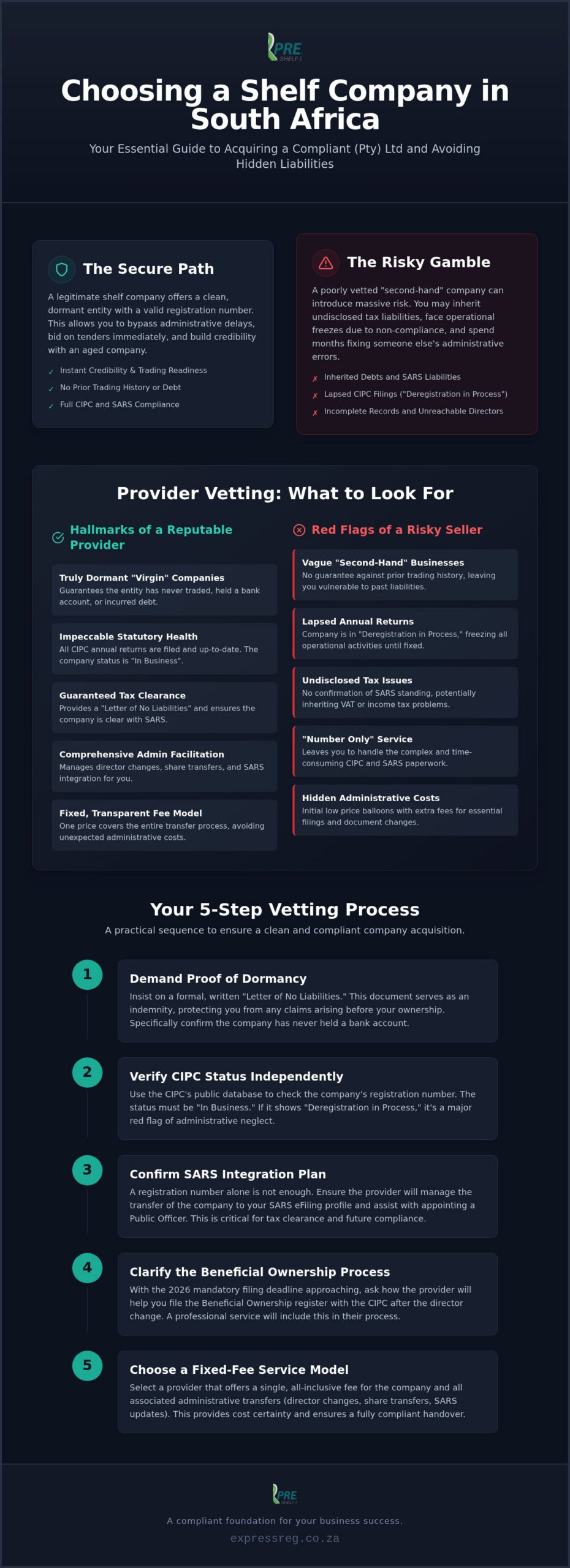
A Step-by-Step Vetting Process for South African Entrepreneurs
Establishing a new business requires more than just a registration number; it demands a rigorous verification of the entity’s history. When you determine how to choose between shelf company providers, follow this structured vetting sequence to protect your investment. Begin by requesting a current CIPC disclosure document. This certificate is the only definitive way to verify that the company is “In Business” and that no unauthorised director changes have occurred. Next, enquire about the entity’s SARS standing. A reputable provider must prove that all tax returns are up to date, even if they reflect zero turnover, to ensure you don’t inherit legacy debt.
Your vetting process should also include these critical checks:
- Confirm the provider’s specific procedure for Beneficial Ownership disclosure to meet 2026 standards.
- Review the consultancy’s physical presence and track record to avoid “fly-by-night” operators.
- Compare the total cost of ownership, ensuring the price includes the company name change, registered office update, and SARS public officer appointment.
Focusing on the total cost rather than the initial sticker price prevents budget overruns. Many low-cost sellers omit essential post-transfer filings, leaving you with a company that is legally yours but administratively non-compliant. To secure a fully vetted entity with transparent pricing, you can buy a shelf company today and receive professional support for every statutory requirement.
The 2026 Beneficial Ownership Requirement
The regulatory landscape has shifted significantly with the mandatory filing of beneficial ownership registers. All South African companies must now disclose the individuals who ultimately own or control the entity to the CIPC. This filing is not optional. It must be completed within 10 business days of the company’s incorporation or any subsequent change in ownership. Your chosen provider must demonstrate a deep understanding of this requirement. Failing to lodge an accurate register can lead to administrative penalties or even criminal prosecution under the Companies Act. Ensure your facilitator handles this disclosure as a standard part of the transfer process to maintain transparency and legal standing.
Assessing Provider Credibility and Speed
Identify established consultancies by looking for clear, upfront timelines rather than vague promises of “instant” results. Whilst you receive the registration number immediately, the formal director change at the CIPC involves a specific turnaround time that no private provider can bypass. A credible partner manages your expectations regarding these government processing speeds. Choosing a shelf company South Africa through an experienced intermediary ensures that whilst the CIPC works through its queue, your documentation is prepared with organised efficiency, reducing the risk of rejection or further delays.
Securing Your Business Foundation with Express Shelf Company
Selecting a partner for your business registration shouldn’t be a source of anxiety. When you consider how to choose between shelf company providers, the primary factor should be the provider’s commitment to administrative hygiene. Express Shelf Company prioritises clarity and reassurance by offering entities that are guaranteed to be 100% dormant. We ensure that every (Pty) Ltd in our inventory has never traded, held a bank account, or incurred a single cent of debt. This foundational security allows you to focus on your commercial strategy whilst we manage the intricate statutory requirements.
Our service model is built on organised efficiency. We understand that the transition from a registration number to a fully functional business involves significant paperwork. By adopting a fixed-fee approach, we eliminate the confusion often associated with statutory filings. You won’t face unexpected costs for director changes or share transfers. We handle the heavy lifting of CIPC and SARS communications, acting as a seasoned consultant that values your time and peace of mind. This disciplined approach is essential for entrepreneurs deciding how to choose between shelf company providers in a complex regulatory environment.
Total Compliance Management
Maintaining a company’s legal standing requires ongoing attention to detail. Our role extends beyond the initial sale; we act as a professional facilitator to keep your business in good standing with national authorities. This includes managing the CIPC annual returns submission process to prevent unwanted deregistration. We also ensure that the director change process is handled with procedural accuracy, giving you the confidence that your public records correctly reflect your leadership from the moment you take control.
Ready for Tenders and Contracts
Success in the South African market often depends on your ability to meet strict procurement criteria. We prepare your documentation for immediate professional use, ensuring your entity is ready for contract signings and vendor applications. If your business plan involves large-scale contracts, we assist with the VAT registration South Africa requirements to ensure you’re fully compliant from day one. Start your journey with a secure, compliant shelf company today and let us manage the administrative hurdles whilst you build your legacy.
Launch Your Business with Statutory Certainty
Identifying a reliable partner is the foundation of your new venture. You now understand how to choose between shelf company providers by prioritising administrative hygiene and verifying “In Business” status through official CIPC disclosures. Always ensure your chosen consultancy provides a 100% clean, dormant company guarantee to avoid inheriting undisclosed liabilities from the outset. Compliance is your competitive advantage.
A successful acquisition requires expert CIPC and SARS facilitation to manage director changes and the mandatory 2026 beneficial ownership filings correctly. By selecting a provider that operates on a fixed-fee basis, you eliminate the risk of hidden costs whilst ensuring every statutory requirement is handled with organised efficiency. This methodical approach allows you to move from administrative complexity to full legal standing without unnecessary stress or procedural rejection.
View our available shelf companies and start trading today to secure an entity that is ready for immediate professional use. You have the tools to build a lasting legacy; start your journey with the peace of mind that your company’s foundation is legally sound and fully compliant.
Frequently Asked Questions
How do I check if a shelf company provider is legitimate?
Verify the consultancy’s track record and physical presence before committing. Legitimate providers offer full transparency regarding the entity’s history and provide a current CIPC disclosure document to prove the company is active. Check for fixed-fee models that include all necessary statutory filings. Understanding how to choose between shelf company providers involves identifying those who act as reliable intermediaries with proven expertise in dealing with national business and tax authorities.
Can I change the name of a shelf company after I buy it?
Yes, you can change the company name at any time once the transfer of ownership is complete. This process involves reserving a new name and filing a formal name change with the CIPC. Most professional facilitators manage this as part of their administrative package. Whilst the registration number remains the same, your business will trade under your preferred brand identity once the CIPC approves the new name reservation.
Does a shelf company come with a VAT number?
Basic shelf companies are typically registered for income tax but don’t come with an active VAT number. Compulsory VAT registration is only required if your taxable supplies exceed R2.3 million in any consecutive 12-month period. If you need to register for VAT immediately, your provider should assist with the application post-transfer. Be cautious of any claims regarding “instant” VAT status, as SARS performs its own independent verification process.
How long does the transfer of a shelf company take in 2026?
You receive the registration number immediately upon purchase, but the formal director change at the CIPC involves a specific processing period. In 2026, the administrative turnaround for updating director records typically takes several business days. This depends on CIPC system availability and the accuracy of the submitted documents. A professional facilitator manages this timeline by preparing all paperwork correctly to prevent unnecessary delays during the transition to your leadership.
Are there hidden debts when buying a shelf company?
Hidden debts are a potential risk if you acquire an entity from an unverified source. Legitimate providers offer a 100% clean, dormant company guarantee, ensuring the entity has never traded, held a bank account, or entered into contracts. Always request a “Letter of No Liabilities” and verify the tax standing with SARS. This due diligence is a critical step when learning how to choose between shelf company providers safely.
What is a beneficial ownership filing and why does it matter for shelf companies?
Beneficial ownership filing is a mandatory disclosure to the CIPC identifying the individuals who ultimately own or control the company. This is a strict requirement under the Companies Act to ensure transparency. For shelf companies, this register must be updated within 10 business days of the ownership transfer. Failure to comply can lead to penalties, making it essential that your provider handles this disclosure as part of their standard service.
Is it better to register a new company or buy a shelf company?
Buying a shelf company is the better choice if you need an immediate registration number for a tender or contract. It allows you to bypass the initial CIPC incorporation queue. However, if speed isn’t your primary concern, a new (Pty) Ltd registration allows you to choose your company name from the start. Both routes lead to a compliant entity, so the choice depends entirely on your specific business deadline.
What documents should I receive after buying a shelf company?
You should receive a comprehensive document pack confirming your ownership. This includes the COR14.3 registration certificate, the Memorandum of Incorporation (MOI), and formal share certificates. Additionally, the pack must contain the share transfer forms, the resignation letters of the initial directors, and proof of the CIPC director change. Your provider should also supply the income tax number and a confirmation that the beneficial ownership register has been filed.