Did you know that the South African government’s annual procurement budget now exceeds R1 trillion? Despite this massive pool of opportunity, many entrepreneurs find themselves sidelined because of minor administrative errors or misunderstood regulations. You likely know the stress of rushing to meet a deadline, only to worry that a small mistake in your government tender requirements south africa paperwork will lead to immediate disqualification. It’s exhausting to balance daily operations whilst trying to decipher the complex overlap between CIPC filings and CSD profiles under immense time pressure.
This guide provides the clarity you need to master the essential compliance documents and statutory requirements for a winning bid in 2026. We outline a methodical checklist that clarifies the order of priority for registrations, incorporating the latest VAT thresholds and the Public Procurement Act 28 of 2024 updates. You will gain a clear understanding of how to maintain your statutory good standing, covering everything from CIPC annual returns to successful CSD registration. We also explore how options like a shelf company can help you meet specific “years in business” criteria quickly. By following this structured approach, you can eliminate the fear of paperwork errors and focus on securing government contracts.
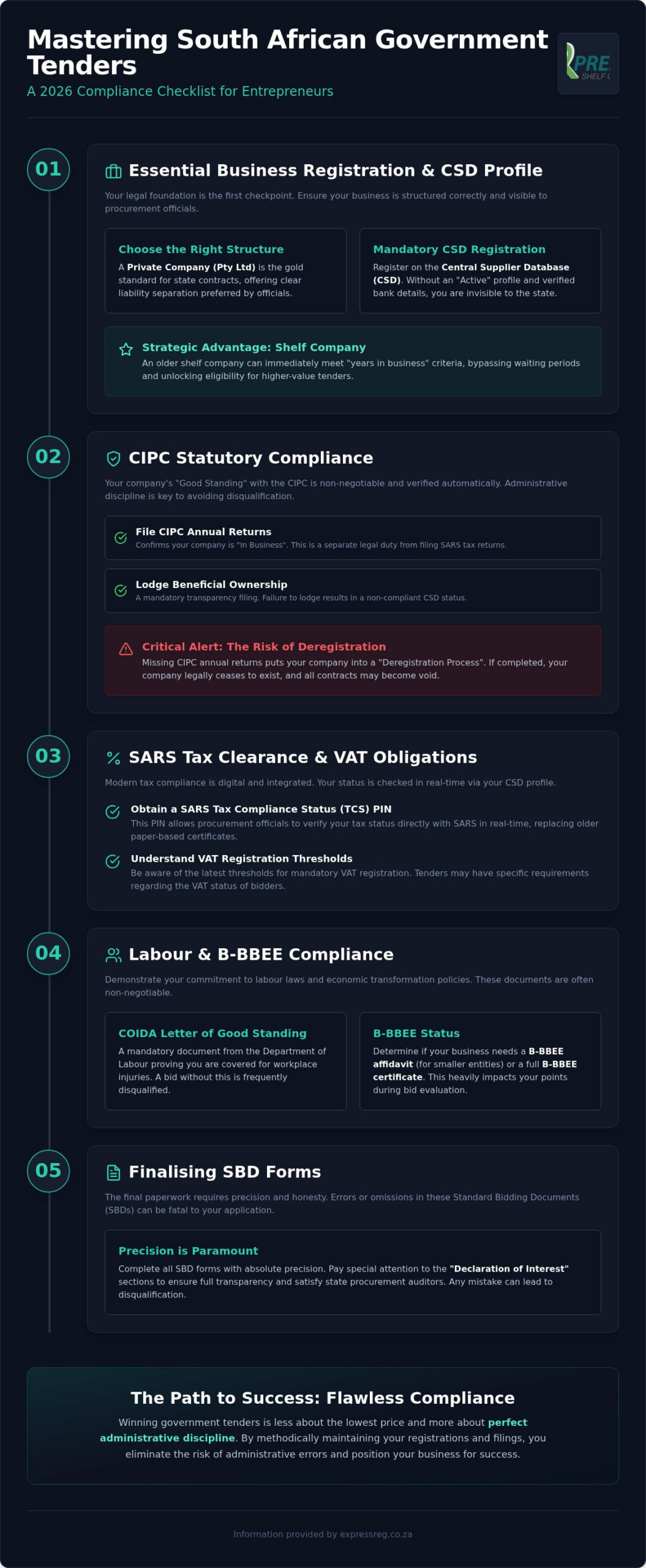
Key Takeaways
- Verify your legal entity status and learn how a shelf company can help you meet specific “years in business” criteria for immediate tender eligibility.
- Maintain your CIPC “Good Standing” by ensuring all annual returns and beneficial ownership filings are accurately lodged to prevent automatic disqualification.
- Master the 2026 government tender requirements south africa by navigating the shift to the SARS Tax Compliance Status (TCS) PIN and updated VAT registration thresholds.
- Secure non-negotiable labour documents, including the COIDA Letter of Good Standing, and clarify whether your business requires a B-BBEE affidavit or a certificate.
- Learn to complete mandatory SBD forms with precision, ensuring full transparency in your declaration of interest to satisfy state procurement auditors.
Essential Business Registration and CSD Profiling
Success begins with your legal foundation. Most government tender requirements south africa specify a private company (Pty Ltd) as the minimum standard for participation. This structure provides a clear separation between personal assets and business liabilities, which procurement officials prefer for risk management. If you haven’t formalised your entity yet, you can register pty ltd south africa to ensure you meet the basic eligibility criteria for 2026 bids.
Some tenders require a track record of several years to prove operational stability. A shelf company offers a strategic advantage here. By purchasing an older registration, you immediately meet the “years in business” threshold that often disqualifies brand-new startups. It’s a legitimate way to bypass the waiting period whilst remaining fully compliant with CIPC regulations. This helps you bid for higher-value contracts that are typically reserved for established businesses.
The Public Procurement Act 28 of 2024 reinforces the move toward a single, central platform for all tender information. Linking your CSD profile to your CIPC and SARS data is now essential for automated verification. This integration allows the system to check your tax status and director details in real-time, reducing the administrative burden on your side. If your data isn’t synchronised, you risk being flagged as non-compliant during the initial screening phase.
Choosing the Right Business Structure
The Pty Ltd is the gold standard for state contracts. During evaluation, officials examine your Memorandum of Incorporation (MOI) to understand your company’s internal governance. Your entity must also align with Broad-Based Black Economic Empowerment (B-BBEE) policies, as your registration details directly influence your initial BEE rating. A standard MOI usually suffices, but larger projects may require specific clauses regarding director powers and shareholding structures.
CSD Registration Steps
The Central Supplier Database (CSD) is the mandatory portal for all public sector procurement. You can’t receive payment or submit a formal bid without a valid profile. Once you register, the system generates a unique Supplier Number and Registration Reference Number. These digits act as your identity within the state’s financial system. Ensure your bank account verification is completed via the CSD system to maintain an “Active” status, otherwise, your business remains invisible to procurement officers.
CIPC Statutory Compliance and Beneficial Ownership
Maintaining your company’s active status with the Companies and Intellectual Property Commission (CIPC) is a fundamental pillar of government tender requirements south africa. Whilst many entrepreneurs focus on the bid document itself, the evaluation committee first verifies your “Good Standing” via the CSD’s automated link to the CIPC database. If your entity is flagged for overdue filings, your bid is often discarded before the technical assessment even begins. Success in the public sector requires more than just a good price. It demands administrative discipline.
The 2026 regulatory environment has introduced stricter transparency measures, most notably the beneficial ownership filing CIPC mandate. This requirement ensures the state knows exactly who owns and controls the entities bidding for public funds. Failing to file this disclosure results in a non-compliant status that blocks your progress on the CSD. Whilst the official South African Government tenders portal provides the platform for finding work, your CIPC compliance acts as the key to the door.
Filing CIPC Annual Returns
It’s a common misconception that filing tax returns with SARS covers your CIPC obligations. These are two distinct processes. CIPC annual returns are statutory declarations that confirm your company is still in business. If you miss these filings, the CIPC will move your company into a “Deregistration Process”. Once deregistered, your company legally ceases to exist, and any contracts you’ve signed could become void. You can follow our CIPC annual returns submission guide to ensure your status remains “In Business”.
Managing Director Records
Your CSD profile must mirror your CIPC records perfectly. If a director has resigned or a new one has been appointed, these director change CIPC updates must be officially lodged before you submit a bid. Discrepancies between your listed directors and your bank account signatories or CSD profile will trigger a verification failure. Ensure all listed directors have valid, certified ID documents on file to avoid delays during the vetting process. If you’re unsure of your current standing, you can verify your company records to secure your eligibility.
SARS Tax Clearance and VAT Obligations
Tax compliance is no longer a static requirement. In the past, businesses submitted paper certificates that quickly became outdated. Today, the SARS Tax Compliance Status (TCS) PIN system provides a real-time view of your standing. This shift is a core part of the modern government tender requirements south africa. Procurement officers don’t just look at your documents; they use your PIN to verify your status on the Central Supplier Database (CSD) at the exact moment of evaluation. If you have a single unfiled return or an outstanding debt, your status will flip to non-compliant instantly. This digital link ensures that only businesses with a clean tax record can proceed to the technical evaluation phase.
Obtaining Your Tax Compliance PIN
You must navigate SARS eFiling to request your status. When you log in, you’ll see options for “Good Standing” and “Tender”. For bidding purposes, always select the “Tender” option. This generates a specific PIN that authorises the state to view your compliance profile for procurement purposes. A “Good Standing” status is generally used for bank accounts or grants, but it won’t satisfy a tender board. If your profile shows a red “Non-Compliant” indicator, you must resolve the underlying cause; whether it’s a missing return or an administrative error. Unfiled returns are the most common reason for a failed status. Even if you don’t owe money, a missing administrative filing suggests poor governance to a procurement committee. Ensure your eFiling profile is entirely clean before the tender closing date.
VAT Registration Requirements
VAT registration is often the deciding factor for eligibility on larger contracts. Whilst smaller entities can operate without it, many departments require a VAT-registered vendor for projects exceeding certain values. You can simplify this transition by using a professional service for VAT registration south africa. As of 1 April 2026, the compulsory VAT registration threshold is R2.3 million in taxable supplies over any consecutive twelve-month period. If your turnover is below this but above R120,000, you can still apply for voluntary registration to increase your bidding power. Being VAT-registered signals to procurement officers that your business is prepared to handle significant contract volumes and maintain the necessary financial records required for state-funded projects.
Labour Department Compliance and B-BBEE Status
Government contracts carry a social responsibility that extends beyond simple service delivery. The state requires assurance that your employees are protected against workplace accidents and that your business contributes to national transformation goals. These social compliance factors are often the most scrutinised parts of the government tender requirements south africa. If you fail to prove your standing with the Department of Labour, your technical expertise won’t save your bid. Procurement boards view workplace insurance and transformation status as non-negotiable prerequisites for any public sector partnership.
The Letter of Good Standing is a vital document issued by the Compensation Fund. It proves you are registered under the Compensation for Occupational Injuries and Diseases Act (COIDA) and that your assessments are paid up to date. This insurance protects both the worker and the state from liability in the event of a site accident. You can review the full requirements for letter of good standing south africa to ensure your application is processed without administrative delays.
Securing Your Letter of Good Standing
Registering with the Compensation Fund is only the first step. You must submit your Return of Earnings (ROE) annually to remain compliant. The fund then calculates your premium based on your industry risk category and your annual wage bill. Once you pay this assessment, you receive your letter. Many businesses forget that these letters have a fixed expiry date. An expired letter leads to immediate tender disqualification; procurement officers won’t wait for you to renew it during the evaluation phase. Keep your account in credit to ensure you can pull a fresh letter whenever a new tender is advertised.
B-BBEE Compliance for Small Businesses
Broad-Based Black Economic Empowerment (B-BBEE) remains a cornerstone of the 80/20 and 90/10 preference point systems used in 2026. For Exempted Micro Enterprises (EMEs) with an annual turnover of R10 million or less, a full audit is not required. Instead, you can use a sworn affidavit. This document is a powerful tool for small businesses to compete with larger firms on an equal footing. Your B-BBEE level is primarily determined by your black ownership percentage. A 100% black-owned EME automatically qualifies for Level 1 status, whilst at least 51% ownership secures Level 2. You must ensure your affidavit is commissioned by a Commissioner of Oaths on the correct template. If the dates are incorrect or the template is outdated, the tender board will reject your submission.
Finally, ensure your business is registered for Unemployment Insurance Fund (UIF) and Pay As You Earn (PAYE) if you have employees. These registrations are verified against your SARS profile during the CSD automated checks. If you need to formalise your workplace insurance immediately, apply for your COIDA registration through our expert team to secure your compliance status.
Finalising the Tender Document and SBD Forms
Completing the Standard Bidding Documents (SBD) is the final administrative hurdle in meeting the government tender requirements south africa. These forms translate your statutory standing into a format the evaluation committee can score. Whilst your technical proposal proves you can do the work, the SBD forms prove you’re legally allowed to do business with the state. Accuracy here is vital; a single digit error in your Supplier Number or a missing signature can lead to an immediate administrative rejection before your pricing is even considered.
The SBD 1 form acts as your invitation to bid and must contain standardised contact details that mirror your CSD profile. Equally critical is the SBD 4 Declaration of Interest. You must be entirely transparent about any relationships with persons employed by the state. Transparency doesn’t necessarily lead to disqualification, but non-disclosure almost certainly does. For claiming your preference points, the SBD 6.1 form is where you apply your B-BBEE status to the 80/20 or 90/10 scoring system. Ensure the points you claim match the level on your sworn affidavit or certificate exactly.
Your technical proposal must align perfectly with the specific Terms of Reference (ToR) provided in the tender advert. Don’t submit a generic company profile. Instead, use a clear methodology that shows how you’ll meet the department’s specific goals. If you’re feeling overwhelmed by these administrative layers, utilising professional statutory compliance services south africa can ensure your business foundation remains solid whilst you focus on the technical side of your bid.
Common SBD Pitfalls to Avoid
Small mistakes often cause the most damage. Evaluation committees frequently disqualify bids because a director failed to sign every page where a signature is required. Inconsistencies are another major risk; if your SBD 1 lists a different address than your CSD profile, it creates a verification red flag. Always attach recently certified copies of ID documents for all directors. If your certifications are older than three to six months, many departments will consider them invalid. Double-check that every checkbox on the SBD 4 is marked, as leaving a section blank is often interpreted as an incomplete submission.
The Submission Protocol
The closing date and time are absolute. If a tender closes at 11:00, a submission at 11:01 is legally invalid and won’t be accepted. Whether you’re using a physical tender box or a digital portal like eTenders, aim to submit at least 24 hours in advance. Digital portals can experience high traffic or technical glitches near the deadline, whilst physical submissions can be delayed by traffic or security checks at government buildings. Treat the submission process with the same disciplined accuracy you applied to your government tender requirements south africa checklist to ensure your hard work actually reaches the evaluation stage.
Secure Your Future in Public Procurement
Navigating the 2026 regulatory landscape requires a shift from manual paperwork to real-time digital compliance. Mastering the government tender requirements south africa means ensuring your CIPC filings, SARS standing, and Labour Department registrations are perfectly synchronised before you even download a bid document. By maintaining your beneficial ownership records and keeping your tax status active via the TCS PIN, you remove the administrative hurdles that often lead to immediate disqualification. Success in the public sector is built on a foundation of statutory accuracy and disciplined record-keeping.
You don’t have to manage these complex hurdles alone. Our professional company registration consultants and CIPC and SARS compliance specialists provide the foundational support you need to bid with confidence. We offer Letter of Good Standing fast-track assistance to ensure your workplace insurance never expires during a critical submission window. Ensure your business is tender-ready with our expert compliance services and focus your energy on delivering high-quality technical proposals. With the right administrative partner, you can turn statutory complexity into a competitive advantage and secure the contracts your business deserves.
Frequently Asked Questions
What are the minimum documents required for a government tender in South Africa?
You must provide a CSD registration report, a SARS Tax Compliance Status (TCS) PIN, and a B-BBEE affidavit or certificate. Additionally, a COIDA Letter of Good Standing and completed Standard Bidding Documents (SBD forms) like SBD 1, 4, and 6.1 are mandatory. These documents verify your legal standing and tax compliance. Missing just one of these foundational items typically results in automatic disqualification during the initial administrative screening phase.
How do I register on the Central Supplier Database (CSD)?
Visit the official National Treasury CSD website and create a user profile. You’ll need your company registration number, tax reference number, and bank account details. The system verifies this information against CIPC and SARS databases in real-time. Once the automated checks are complete, you receive a unique Supplier Number and Registration Reference Number. Maintaining an active status on this portal is essential for meeting government tender requirements south africa in 2026.
Can I bid for a tender if my company is newly registered?
Yes, new companies can bid, but you may face challenges if the tender specifies a minimum number of years in business. If a contract requires a proven track record, purchasing a shelf company with an older registration date is a strategic way to meet those criteria immediately. Whilst a new Pty Ltd is a valid legal entity, older entities often signal stability to procurement officers who are evaluating long-term project risks.
Is a Tax Clearance Certificate still required for tenders in 2026?
No, the physical Tax Clearance Certificate has been replaced by the SARS Tax Compliance Status (TCS) PIN system. You must generate this PIN on your SARS eFiling profile under the “Tender” category. Procurement officers use this code to check your real-time tax standing on the CSD. If you have outstanding debt or unfiled returns, the system will show you as non-compliant, even if you previously held a valid paper certificate.
What happens if my CIPC annual returns are not up to date?
Your company will eventually be moved into a “Deregistration Process” and eventually be final deregistered. Once this happens, your business legally ceases to exist, making you ineligible for any government contracts. The CSD automatically syncs with CIPC records, so any lapse in “Good Standing” will be visible to procurement officials. It’s vital to file these returns every year to ensure your entity remains active and compliant for bidding.
How long is a Letter of Good Standing valid for?
A Letter of Good Standing is generally valid for one year, but all letters expire on 30 April each year regardless of when they were issued. You must submit your Return of Earnings and pay your assessment to the Compensation Fund to receive a new one. An expired letter is a common reason for tender disqualification. Ensure you renew your COIDA registration early to avoid missing out on opportunities during the renewal period.
Do I need a B-BBEE certificate or an affidavit for a small business tender?
For Exempted Micro Enterprises (EMEs) with an annual turnover under R10 million, a sworn affidavit is usually sufficient. You don’t need a certificate from a rating agency unless you’re a Qualifying Small Enterprise (QSE) with specific ownership structures. The affidavit must be commissioned by a Commissioner of Oaths on the latest official template. This document allows you to claim preference points that are essential for the government tender requirements south africa scoring system.
Where can I find the latest government tender opportunities?
The primary source is the National Treasury’s eTender Publication Portal. You should also check the official government tender bulletin and individual department websites. Many opportunities are now listed directly on the Central Supplier Database (CSD) through the “Tender Management” module. Regularly monitoring these platforms ensures you don’t miss closing dates, as late submissions are never accepted under the current government tender requirements south africa regulations.