
You don’t need a South African partner or a local passport to hold 100% ownership of a business in the Republic. Many international entrepreneurs frequently ask, “can a foreigner register a company in South Africa” while fearing that complex bureaucracy or specific ID requirements will halt their progress. It’s common to feel a sense of uncertainty when faced with the administrative hurdles of a foreign legal system, especially regarding the nuances of local bank account openings and FICA verification.
This 2026 legal guide provides the clarity you need to move forward with confidence. We outline the exact documentation required for non-resident directors and provide a structured path to full statutory compliance. You’ll learn how to navigate the CIPC registration process, understand your tax obligations with SARS, and manage the essential filings that keep your entity in good standing. By following this methodical approach, you can transition from administrative complexity to a fully registered, operational South African company. Secure your business foundation by mastering the specific regulatory protocols that welcome foreign investment into the local market.
Key Takeaways
- Confirm your legal right to 100% ownership of a South African Pty Ltd under the Companies Act without requiring a local resident partner.
- Discover the exact documentation needed to answer “can a foreigner register a company in South Africa” and how to navigate CIPC biometric verification protocols.
- Learn why appointing a Public Officer is a mandatory step for maintaining SARS tax compliance as a non-resident director.
- Identify the specific FICA requirements that international entrepreneurs must meet to successfully open a South African business bank account.
- Evaluate the benefits of a shelf company versus a new registration to determine the fastest route for your specific market entry goals.
The Legal Framework: Can a Foreigner Own a South African Company?
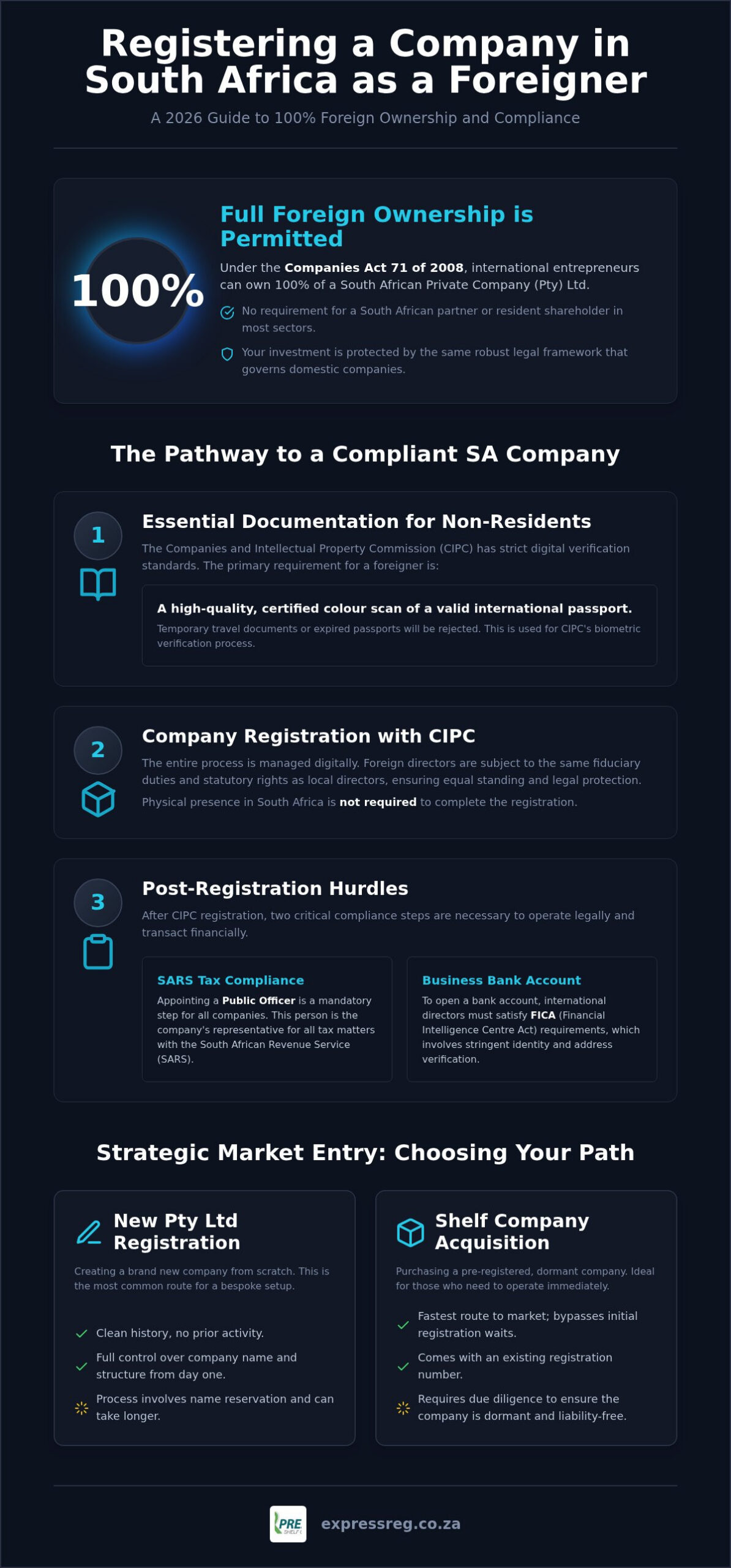
Many international investors ask can a foreigner register a company in South Africa before they commit to local expansion; the answer is a resounding yes under the Companies Act 71 of 2008. This legislation serves as the bedrock for all corporate activity in the country, explicitly permitting non-residents to serve as both shareholders and directors of local entities. For international investors, a South African Private Company (Pty) Ltd is a profit-seeking legal entity that provides limited liability protection to its owners whilst maintaining a separate legal personality from its directors.
The Companies Act and Foreign Investment
South Africa’s legal system is designed to facilitate international trade and investment. The Constitution provides robust protection for property rights, which extends to the ownership of business interests by foreign nationals. Under the Companies Act, there’s no legal distinction between the fiduciary duties or statutory rights of a local director and those of a foreign director. Both are held to the same standards of accountability and care. This equal standing ensures that your investment is protected by the same legal framework that governs domestic enterprises. Whilst you should familiarise yourself with South African immigration laws for investors if you plan to relocate, the act of forming a company is purely an administrative process governed by the CIPC (Companies and Intellectual Property Commission).
The Pty Ltd structure is the preferred vehicle for foreign subsidiaries because it offers a clear separation between personal assets and corporate liabilities. It allows for a scalable corporate hierarchy that can accommodate everything from a single-owner startup to a complex multi-national branch office. You don’t need to be physically present in the country to complete the registration; the process is handled digitally through verified channels that maintain high standards of procedural accuracy.
100% Foreign Ownership Explained
One of the most significant advantages for international entrepreneurs is that most industry sectors don’t require a local partner or a South African citizen to hold shares. You can maintain 100% foreign ownership of your (Pty) Ltd from day one. This flexibility is particularly beneficial for parent companies looking to establish a local presence without diluting equity. Share capital structures are equally flexible, allowing for various classes of shares to suit your specific funding and governance needs.
It’s vital to distinguish between company registration and the right to work. Registering an entity doesn’t require a business visa, but if you intend to move to South Africa to manage operations, you’ll need to follow the relevant Department of Home Affairs protocols. For those who need to move quickly, a shelf company in South Africa provides a pre-registered option that can be transferred into your name, allowing you to bypass the initial name reservation wait times. Whether you choose a fresh Pty Ltd registration or a shelf entity, the legal right to full ownership remains constant.
Essential Documentation for Non-Resident Company Registration
The administrative phase is where many entrepreneurs encounter delays. Whilst the legal framework is welcoming, the Companies and Intellectual Property Commission (CIPC) maintains strict standards for identity verification. To answer the question of how can a foreigner register a company in South Africa, one must look at the specific documentation that replaces the standard South African identity document. Precise filing is the only way to avoid bureaucratic bottlenecks and ensure your business starts on a compliant footing.
Passport Requirements and Biometric Verification
The CIPC has transitioned to a digital-first environment. For South African citizens, this involves verification against the Department of Home Affairs database using a 13-digit ID number. For non-residents, this process relies entirely on a valid international passport. You must provide a high-quality colour scan of your passport. CIPC will reject temporary travel documents, expired passports, or low-resolution copies that obscure security features or the MRZ (Machine Readable Zone) code.
Certification is a critical step. If you’re outside South Africa, your passport copy must be certified by a Notary Public or at a South African Embassy. The certification must explicitly state that the document is a “true copy of the original” and must be dated within three months of the application. In 2026, biometric verification for foreign passport holders often requires a live facial recognition check or manual validation. This process confirms can a foreigner register a company in South Africa without possessing a local ID, provided the international credentials are authenticated correctly.
Registered Office and Contact Details
Every South African company must have a physical registered office address within the Republic. This address serves as the official location for the delivery of legal documents and the storage of statutory records. A PO Box or Private Bag is not acceptable for this purpose. Whilst directors and shareholders can reside anywhere in the world, the entity itself must have a physical “seat” in South Africa to satisfy the requirements of the Companies Act.
If you don’t have a local office yet, you can use the address of a professional service provider to maintain compliance. Additionally, foreign directors must provide valid contact details, including a functional email address and a mobile number. These details are used for the CIPC’s automated notification system, which alerts you to annual return deadlines and beneficial ownership filing requirements. If you’re ready to begin, starting a New (Pty) Ltd Registration ensures all these technical details are handled correctly from the outset. You can also explore professional assistance at Express Shelf Company to manage the heavy lifting of your documentation.
Director Requirements: The Local Representative Rule
A common myth suggests that you must have a South African partner or co-director to launch a business in the Republic. This is factually incorrect. When asking can a foreigner register a company in South Africa, you’ll find that you can be the sole director and shareholder without any local involvement at the registration level. However, whilst the Companies and Intellectual Property Commission (CIPC) allows for 100% foreign directorship, the South African Revenue Service (SARS) introduces a specific requirement for a local representative known as a Public Officer.
The Role of the Public Officer
Every South African company must appoint a Public Officer within one month of incorporation. This individual acts as the primary point of contact for the Revenue Service for all tax-related matters. Unlike a director, the Public Officer must be a resident of South Africa. They’re responsible for ensuring the company meets its statutory tax obligations, including Income Tax and VAT registrations. For foreign-owned firms, this usually involves appointing a local professional or a trusted resident employee to fill the role.
This appointment is critical for administrative efficiency. Without a designated Public Officer, your company cannot complete its tax registration or obtain a Tax Clearance Certificate. These documents are essential for opening business bank accounts and participating in local tenders. Appoint your representative early to avoid delays in your operational timeline. They handle the heavy lifting of tax correspondence, allowing you to focus on your core business strategy from abroad.
Fiduciary Responsibilities Across Borders
Holding a directorship from another country doesn’t lessen your legal obligations under the Companies Act. Foreign directors are subject to the same fiduciary duties as local residents. You must act in good faith, avoid conflicts of interest, and ensure the company remains solvent at all times. Failure to meet these standards can lead to personal liability, regardless of where you’re physically located. Stay proactive by managing director changes with CIPC promptly whenever your board structure evolves.
Maintain a minute book and a statutory register from the day your company is incorporated. These records should document all major decisions, share issuances, and director appointments. Keeping organised records ensures transparency and simplifies the process of annual returns and beneficial ownership filings. By adhering to these disciplined procedural habits, you project an image of organised efficiency that builds trust with local authorities and financial institutions.
Post-Registration Hurdles: SARS and Business Banking
Once the CIPC process concludes, your company exists as a legal entity, but it isn’t yet ready to trade. A common question remains: can a foreigner register a company in South Africa and immediately start operations? In reality, the post-registration phase involves critical steps with the South African Revenue Service (SARS) and local financial institutions. CIPC registration automatically triggers the issuance of a SARS income tax number, but you must still activate this profile and register for additional taxes like VAT if your annual turnover exceeds R1 million.
Navigating SARS for Foreign-Owned Entities
Activating your tax profile via the SARS eFiling system is a priority. This platform allows your Public Officer to manage submissions and payments digitally. However, SARS requires a verified local bank account to process tax refunds or set up debit orders for payments. Maintaining your standing with the authorities also depends on your CIPC annual returns submission. If these returns are neglected, the CIPC may deregister your company, which automatically freezes your SARS tax profile and complicates your legal standing. For businesses scaling quickly, you must also ensure timely VAT registration in South Africa to avoid penalties.
Banking and FICA for Non-Residents
Opening a business bank account is often the most time-consuming part of the journey. South African banks are governed by the Financial Intelligence Centre Act (FICA), which mandates rigorous “Know Your Customer” (KYC) checks. Foreign directors must provide certified copies of their passports and proof of residential address, which often needs to be apostilled if issued outside the country. Whilst some digital-first banks are emerging, major institutions typically require at least one director to be physically present in South Africa to sign the final account opening documents.
Preparing a comprehensive KYC pack with the help of a professional facilitator can reduce the risk of application rejection. This pack should include your company incorporation documents, director IDs, and a resolution authorising the account opening. If you find these administrative layers overwhelming, you can contact Express Shelf Company for expert guidance on statutory compliance. We help you transition from a state of administrative complexity to full legal standing by handling the heavy lifting of your paperwork.
Strategic Market Entry: New Registration vs. Shelf Company
Choosing the right entry method depends on your operational timeline and immediate business needs. Whilst the legal answer to can a foreigner register a company in South Africa is a definite yes, the method you choose affects how quickly you can sign your first contract. A fresh Pty Ltd registration is often the most cost-effective route if you have a specific brand name in mind and can wait for the CIPC name reservation process. However, if you’re facing a deadline for a tender or a commercial lease, a shelf company in South Africa provides a significant speed advantage.
Why Foreigners Choose Shelf Companies
A shelf company is a pre-registered entity that has never traded and has no liabilities. Its primary value lies in its immediate availability. Foreign investors often opt for this route because it provides an instant registration number, which is a prerequisite for applying for import or export permits. Additionally, some commercial applications or finance requests favour entities with an older registration date. Once you acquire the entity, the process of transferring ownership involves formalising director changes and updating the share register. This transition is transparent and ensures that the international parent company gains full control of a clean, compliant vehicle without the standard waiting periods associated with new incorporations.
Professional Facilitation for International Clients
Managing the interface with the CIPC and SARS from abroad requires a disciplined approach to procedural accuracy. A professional consultancy acts as your local facilitator, handling the administrative heavy lifting so you don’t have to navigate the complex machinery of government administration alone. They ensure that every step, from beneficial ownership filing to annual return submissions, is handled correctly. This “compliance-first” strategy protects the international parent company from the risks of administrative neglect.
By using fixed-fee compliance services, you gain financial transparency and the peace of mind that your South African subsidiary is built on a solid legal foundation. Trusting an expert to manage these statutory requirements allows you to focus on growth whilst your administrative obligations are met with organised efficiency. This methodical approach ensures that your business remains in good standing with all national authorities from the moment of market entry.
Establishing Your Business Presence in South Africa
The legal framework in 2026 remains highly supportive of international investment. You have a clear right to 100% ownership of a local entity, provided you adhere to the specific verification protocols set by the CIPC. Success depends on submitting high-quality documentation and appointing a resident Public Officer to manage your relationship with SARS. If you’ve been wondering, “can a foreigner register a company in South Africa,” the answer is a definite yes, provided you follow the methodical steps for registration and tax activation.
We simplify this journey by providing expert handling of CIPC and SARS documentation. Our fixed-fee compliance management offers financial transparency, so you don’t have to worry about hidden costs during your expansion. We offer national support for international investors to ensure every statutory requirement is met with procedural accuracy. Secure your South African market entry with our professional registration services and launch your venture with peace of mind. South Africa is ready for your business; it’s time to build your foundation with organised efficiency.
Frequently Asked Questions
Can a foreigner be the sole director of a South African company?
Yes, a foreigner can be the sole director and shareholder of a South African (Pty) Ltd company. The Companies Act doesn’t require a local resident to sit on the board of directors at the time of registration. This allows for 100% foreign ownership and control. However, whilst you can manage the company alone, you’ll still need a resident Public Officer to handle your statutory tax communications with SARS.
Do I need a South African work visa to own a company in the country?
No, you don’t need a work visa or residency permit to own shares or be a director. The process of registering an entity is separate from your personal immigration status. You can register your business whilst living abroad. However, if you intend to move to South Africa to physically manage the company’s daily operations, you must apply for the appropriate business or work visa through the Department of Home Affairs.
What documents does a foreigner need to register a Pty Ltd?
To answer “can a foreigner register a company in South Africa,” you must prepare specific identity documents. You need a high-quality, certified colour copy of your valid international passport. The certification should be done by a Notary Public or at a South African Embassy. You also need a physical South African address for the registered office and contact details for all directors, including email addresses and mobile numbers for CIPC verification.
How long does it take for a foreigner to register a business with CIPC?
Most private companies are incorporated within 3 to 5 working days once the CIPC receives all verified documents. For foreign directors, the timeline may extend slightly due to the manual verification of international passports. If you require an immediate solution, purchasing a shelf company allows for a faster transition, as the entity is already registered and ready for an ownership transfer through a formal director change process.
Is a local bank account mandatory for a foreign-owned South African firm?
Yes, a local bank account is practically mandatory for any company trading within South Africa. SARS requires a verified South African bank account to activate your tax profile and process any potential refunds. Additionally, most local clients and suppliers will only transact with a domestic account. Opening this account involves strict FICA checks, which often require the physical presence of at least one director at a local bank branch.
Do I need a local partner to satisfy B-BBEE requirements as a foreigner?
You don’t need a local partner to register your company, but B-BBEE (Broad-Based Black Economic Empowerment) levels are critical for securing government tenders or large corporate contracts. Foreign-owned companies can often obtain an EME affidavit if their turnover is below R10 million. However, to achieve higher B-BBEE ratings, you might need to consider local equity partners or specific enterprise development programmes to remain competitive in the South African market.
What is the “Public Officer” requirement for foreign companies?
The Public Officer is a mandatory local representative required by the South African Revenue Service (SARS). This individual must be a resident of South Africa and serves as the official point of contact for all corporate tax matters. Whilst foreign directors can live abroad, they must appoint this resident representative within one month of the company’s incorporation to ensure the entity remains compliant with national tax legislation and filing deadlines.
Can I register a South African company remotely from my home country?
Yes, you can register a South African company entirely from your home country. By using a professional facilitator, you can submit your certified passport copies and digital signatures electronically. This allows you to establish a legal footprint without the immediate need for international travel. It’s a highly efficient route for entrepreneurs who want to secure their company name and tax number before finalising their physical market entry or relocation plans.