
Receiving your company registration certificate from the CIPC is not the finish line; it’s the starter’s pistol for a complex race against regulatory deadlines. Most entrepreneurs feel a surge of pride when those official papers arrive, yet that excitement often turns to anxiety when they discover the certificate doesn’t automatically satisfy tax or labour laws. It’s natural to feel confused about the distinction between CIPC and SARS requirements or to worry about missing a critical filing date.
This guide clarifies exactly what to do after your company is registered to ensure you move from a simple certificate to a fully operational, compliant South African business. By following this structured 2026 checklist, you can protect your firm from legal risks and administrative penalties. We’ll outline the sequential steps for setting up your tax profile, managing mandatory labour registrations like COIDA and UIF, and establishing the banking infrastructure required for professional trade. You’ll gain the confidence to lead your business whilst we handle the heavy lifting of statutory paperwork and ensure your enterprise is built on a stable, legal foundation.
Key Takeaways
- Establish a secure legal foundation by verifying your COR14.3 certificate and organising your Memorandum of Incorporation immediately after receipt.
- Navigate the essential steps of what to do after your company is registered to ensure a seamless transition from a CIPC certificate to a fully operational trading business.
- Separate personal and business finances by opening a dedicated corporate bank account and preparing the necessary FICA documentation for your directors.
- Secure your firm’s future by scheduling mandatory CIPC Annual Returns and Beneficial Ownership filings to avoid the risk of administrative deregistration.
- Streamline your tax and labour obligations by identifying precisely when VAT and PAYE registrations become mandatory for your business turnover and staff complement.
Confirming Your Statutory Identity: CIPC and SARS Foundations
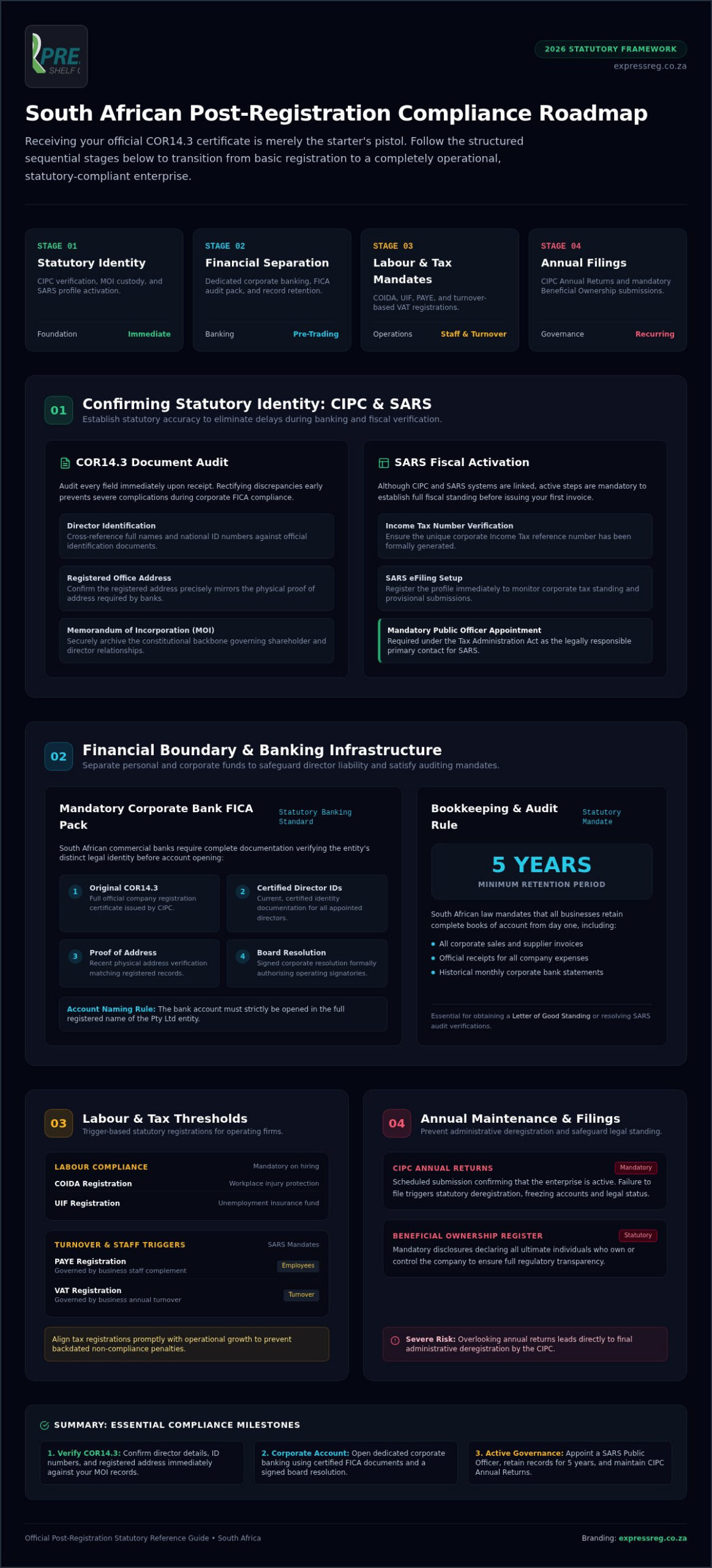
Every successful venture begins with administrative precision. Once you receive your COR14.3 Registration Certificate, your first priority is to confirm that the data captured by the Companies and Intellectual Property Commission accurately reflects your intended structure. Knowing what to do after your company is registered starts with a thorough audit of these initial documents, as even a minor typo in a director’s ID number or a business address can complicate future banking applications or tax registrations.
Reviewing Your Registration Documents
Check every field on your COR14.3 certificate immediately. You must ensure that all director details are correct and that the registered office address is current. Errors caught now are far easier to rectify than those discovered during a bank’s FICA audit. You should focus on these specific areas:
- Director Information: Cross-reference ID numbers and full names against official identification.
- Registered Address: Confirm this matches your proof of address documents for banking purposes.
- MOI Access: Download and securely file your Memorandum of Incorporation.
The MOI defines the relationship between shareholders and directors, serving as the constitutional backbone of your Pty Ltd registration in South Africa. Keep digital copies in a centralised, secure location to avoid delays when third parties request proof of registration.
Activating Your SARS Tax Profile
Whilst the CIPC and SARS systems are linked, you must verify that your corporate Income Tax number has been generated. This number is your gateway to fiscal compliance. Determining what to do after your company is registered regarding tax starts with registering on SARS eFiling as soon as possible to manage your submissions and monitor your tax standing. During this setup, you’ll need to confirm your business category, which influences your future provisional tax and VAT obligations.
You must also formally appoint a Public Officer. This role is a mandatory requirement under the Tax Administration Act to ensure SARS has a single, legally responsible individual to contact regarding the company’s tax affairs. Establishing this statutory identity early protects your business from the risk of non-compliance penalties before you’ve even issued your first invoice. It’s a simple but vital step in moving from a registered name to a legitimate, trading entity.
Setting Up Your Financial Foundation: Banking and Bookkeeping
Establishing a clear financial boundary is the next critical phase in understanding what to do after your company is registered. Mixing personal and corporate funds is a common mistake that complicates tax audits and obscures your business’s true profitability. By creating a distinct financial identity for your Pty Ltd, you ensure that every transaction is legally attributed to the entity rather than the individual directors.
Choosing the Right Business Bank Account
Opening a dedicated business account is essential for professional trade. Most South African banks require a comprehensive FICA pack, which includes the original COR14.3 registration certificate, certified copies of all directors’ IDs, and recent proof of the business’s physical address. You must ensure the account is opened in the full registered name of the company to maintain statutory correctness. Compare transaction fees and digital banking capabilities amongst major national providers to find a solution that scales with your growth. You’ll also need a formal corporate resolution, signed by the board, to authorise specific directors as signatories for the account.
Implementing Robust Bookkeeping Habits
Clean records are the best defence against administrative stress. Select an accounting software programme that allows you to track income and expenditure from day one. Digital systems simplify the process of categorising expenses and preparing for future tax submissions. South African law requires you to retain all invoices, receipts, and bank statements for a minimum of five years. This ‘clean’ audit trail is vital when applying for a Letter of Good Standing or during a SARS verification process.
As you begin to hire staff, your bookkeeping system must also accommodate payroll requirements. Refer to the SARS Pay As You Earn guidelines to understand your obligations regarding employee tax deductions and monthly EMP201 submissions. Deciding between manual spreadsheets and automated cloud-based solutions early on will save significant time. If the administrative burden feels heavy, seeking professional administrative support can ensure your books remain compliant whilst you focus on core operations. Consistency in your financial record-keeping is the most effective way to manage what to do after your company is registered whilst protecting your firm’s legal standing.
Registering for Employer Obligations: Labour and Tax Compliance
Transitioning from administrative setup to operational activity requires a shift in focus toward the Department of Labour and SARS. Many entrepreneurs find this phase daunting because the requirements often overlap and carry strict deadlines. Understanding what to do after your company is registered involves identifying which tax and labour registrations apply specifically to your business model and staff complement to avoid unnecessary penalties.
Navigating SARS Tax Registrations
Compulsory VAT registration is required if your taxable supplies exceed R1 million in any consecutive 12-month period. However, you might choose a voluntary SARS VAT registration if your turnover exceeds R50,000, which often helps in building trust with larger corporate clients. If you intend to hire employees, you must register for Pay As You Earn (PAYE) to manage monthly tax deductions. Additionally, you’re required to register for the Skills Development Levy (SDL) if your annual payroll exceeds the statutory threshold. You can find comprehensive guidance on these SARS business tax obligations to ensure all tax types are correctly linked to your single corporate tax number.
Labour Department Compliance and Tenders
Protecting your workforce and your business assets is a statutory necessity that starts with the Department of Labour. You must register for the Unemployment Insurance Fund (UIF) to provide a safety net for your staff. Simultaneously, securing a COIDA registration is vital, as it acts as a specialised insurance policy that protects your firm from civil claims if a staff member is injured whilst on duty. This registration is a foundational requirement for any business that employs one or more people, regardless of their role or salary level.
If you intend to apply for government tenders or private sector contracts, you’ll need formal proof of this compliance. Meeting the requirements for a Letter of Good Standing is only possible once your COIDA assessments are paid and your account is up to date. This certificate is often the deciding factor in successful procurement bids and serves as a badge of administrative excellence. Correctly managing these employer obligations is a core part of what to do after your company is registered, as it builds the legal credibility required to secure and sustain large-scale projects.
Securing Your Operational Future: Annual Returns and Disclosures
Compliance isn’t a one-off event; it’s a recurring cycle of disclosures that keeps your entity in good standing. When planning what to do after your company is registered, you must look beyond the initial setup and focus on the statutory duties mandated by the Companies Act. These obligations ensure the transparency of your business operations and protect your company from being struck off the national register.
The Critical Role of Annual Returns
Every year, on the anniversary of your registration, you have a 30-day window to complete the submission of CIPC Annual Returns. This filing is not a tax return; it is a confirmation to the CIPC that your company is still active and trading. The fee for this return is calculated based on your company’s annual turnover for the previous financial year. If you miss this window, you’ll face immediate late penalties. Failing to file for two consecutive years triggers administrative deregistration, which effectively freezes your business bank accounts and halts your legal ability to trade.
Mandatory Beneficial Ownership Disclosures
South African companies are now required to maintain and file a Beneficial Ownership register. This filing identifies the natural persons who ultimately own or control the entity, aligning local business practices with international anti-money laundering standards. You must submit this register to the CIPC within the prescribed timeframe after registration or whenever a change in ownership occurs. Keeping this information current is essential for maintaining your company’s status as a compliant, transparent enterprise.
Internal Governance and Record Keeping
Maintaining an accurate Minute Book is a non-negotiable requirement for every director. You must record all shareholder and director resolutions, documenting the formal decisions that shape your firm’s direction. If your leadership team changes, you’re legally obliged to update your director information on the CIPC database within 10 business days. Keeping these records current simplifies future banking updates and ensures you’re always ready for a due diligence check. Consistent record-keeping is a fundamental part of what to do after your company is registered to ensure long-term stability.
Avoid the risk of administrative deregistration by letting our experts handle your Beneficial Ownership Filing and Annual Returns with professional precision.
Simplifying Your Compliance Journey: Professional Administrative Support
The volume of administrative duties described in this checklist can feel overwhelming for a new business owner. When you’re determining what to do after your company is registered, the decision to handle filings personally or via an agent is a critical strategic choice. Whilst a DIY approach might seem cost-effective initially, the risk of administrative errors is high. Incorrectly filed documents can lead to months of delays or, in severe cases, trigger a SARS audit that drains your resources. Outsourcing these tasks allows you to dedicate your energy to business growth whilst experts manage your statutory compliance with precision.
Why Professional Facilitation Matters
Professional facilitation simplifies the entire process of what to do after your company is registered, ensuring that your firm is protected from legal risk from day one. Experts bring a level of procedural accuracy that is difficult to replicate without specialist experience. They understand the specific requirements for different business sectors and can anticipate common hurdles before they arise. By using a professional facilitator, you avoid the frustration of navigating government online portals that are often prone to technical glitches. This partnership provides peace of mind, as every statutory deadline is monitored by a disciplined intermediary, ensuring your business remains in ‘Good Standing’ for all future commercial opportunities.
Taking the Next Step with Express Shelf Company
We specialise in providing the foundational support required to turn a CIPC certificate into a resilient, trading business. You can access transparent, fixed-fee services for every stage of your compliance journey, including VAT applications, COIDA registrations, and Beneficial Ownership disclosures. If you’re unsure of your current status, enquire about a comprehensive compliance audit to ensure no deadlines have been missed. We act as a seasoned consultant to handle the heavy lifting of paperwork, allowing you to build your business on a stable, legal foundation. Our goal is to provide a smooth transition from administrative complexity to full legal standing without the stress of managing government machinery yourself.
Organise your company compliance with Express Shelf Company today.
Building a Resilient Trading Entity
Moving from a registered name to a functional business requires a methodical approach to statutory maintenance. You must secure your financial foundation through dedicated corporate banking and establish a rigorous record-keeping system for tax and labour compliance. By prioritising your CIPC Annual Returns and Beneficial Ownership filings, you protect your firm from administrative deregistration and ensure you remain eligible for commercial tenders. Understanding what to do after your company is registered provides the clarity needed to navigate South Africa’s regulatory landscape with confidence.
We provide national South African coverage and act as expert CIPC and SARS intermediaries to handle the heavy lifting of your paperwork. Our fixed-fee administrative processing ensures your filings are correct and submitted on time, allowing you to focus on your core operations. Secure your business compliance with our expert filing services and build your enterprise on a foundation of professional excellence. Your journey from registration to growth is a significant milestone, and we’re here to ensure your legal standing remains unshakeable.
Frequently Asked Questions
How soon after registration must I register with SARS?
Income tax registration occurs automatically through the CIPC-SARS interface, but you must activate your profile on SARS eFiling immediately to manage your submissions. Whilst the number is generated, the activation ensures you can file returns and appoint your Public Officer. Knowing what to do after your company is registered includes verifying this link early to prevent administrative delays when you begin trading or hiring staff.
Is a business bank account mandatory for a Pty Ltd?
Opening a dedicated business bank account is essential for every Pty Ltd in South Africa. Since your company is a separate legal entity, mixing personal and corporate finances can jeopardise your limited liability status and complicate SARS audits. You’ll need your COR14.3 certificate and director FICA documents to complete this process. It’s a foundational step in what to do after your company is registered to ensure financial transparency.
What happens if I forget to file my CIPC Annual Returns?
Failing to file your CIPC Annual Returns leads to immediate late penalties and the eventual risk of administrative deregistration. If filings are missed for two consecutive years, the CIPC will begin the process of striking your company off the register. This results in your business losing its legal personality, which often leads to frozen bank accounts and the inability to enter into valid legal contracts or tenders.
Do I need to register for VAT immediately after incorporation?
You aren’t required to register for VAT immediately unless your turnover is expected to exceed R1 million in a 12-month period. This is the compulsory threshold for South African businesses. However, you may choose voluntary registration if your turnover has exceeded R50,000. This is often beneficial for businesses that deal with large corporate clients or those wanting to claim back VAT on significant start-up capital expenses.
What is a Public Officer and why do I need one?
A Public Officer is the primary individual legally responsible for representing your company in all tax-related matters with SARS. Under the Tax Administration Act, every company must appoint a Public Officer within one month of beginning business. This person must be a resident of South Africa and serves as the official point of contact for tax notices, ensuring the firm remains compliant with its monthly and annual filing obligations.
Can I change my company directors after registration?
You can update your company’s leadership at any stage by filing a director change with the CIPC. This process requires a formal resolution from the board or shareholders and the submission of a COR39 form. You must provide certified ID copies for all newly appointed directors. Keeping these details current is vital for banking security and ensures your company’s disclosure records accurately reflect your current management structure.
How do I get a Letter of Good Standing for a tender?
To obtain a Letter of Good Standing, your business must first be registered for COIDA with the Department of Labour. You are required to submit your annual Returns of Earnings and pay any outstanding assessments. Once your account is fully paid and compliant, the Department issues the letter. This document is a mandatory requirement for most government and private sector tenders to prove you protect your employees.
What is the difference between a shelf company and a new registration?
A new registration allows you to choose a unique name from the start, whilst a shelf company is a pre-registered entity that already has a registration number. Shelf companies are useful for entrepreneurs who need a registration number instantly to meet a tender deadline. Once purchased, you can change the name and directors of the shelf company to suit your specific business requirements through the standard CIPC amendment process.