
Could your company survive being deregistered by the CIPC simply because of a missing administrative update? It’s a question many directors are asking as the 2026 compliance season approaches. Staying on top of the beneficial ownership register south africa requirements is no longer just a suggestion; it’s a fundamental necessity for every Pty Ltd in the country. We recognise that the pressure to get every detail right can be overwhelming, especially when you’re managing complex shareholding structures or trying to decipher the 5% ownership threshold.
You don’t have to tackle these bureaucratic hurdles alone or risk the future of your business through simple filing errors. This guide will help you master the legal requirements of the South African beneficial ownership register with a comprehensive checklist for 2026. We’ll provide a clear path through the CIPC portal, explain exactly which documents you need to organise, and show you how to maintain your company’s good standing with absolute confidence. From identifying your ultimate owners to submitting the final disclosure, we’ve simplified the process into manageable, sequential steps that ensure your business remains compliant and secure.
Key Takeaways
- Identify the specific natural persons who ultimately own or control your legal entity to satisfy the CIPC 5% ownership threshold.
- Organise your latest share register and certified identification documents to ensure a smooth submission process.
- Master the legal requirements of the beneficial ownership register south africa to protect your business from the risk of administrative deregistration.
- Observe the 30-day rule for reporting any changes in ownership or control to maintain continuous statutory compliance.
- Reduce administrative stress by outsourcing your filing to an expert facilitator who manages the technical hurdles of the CIPC portal.
Understanding the Beneficial Ownership Register in South Africa
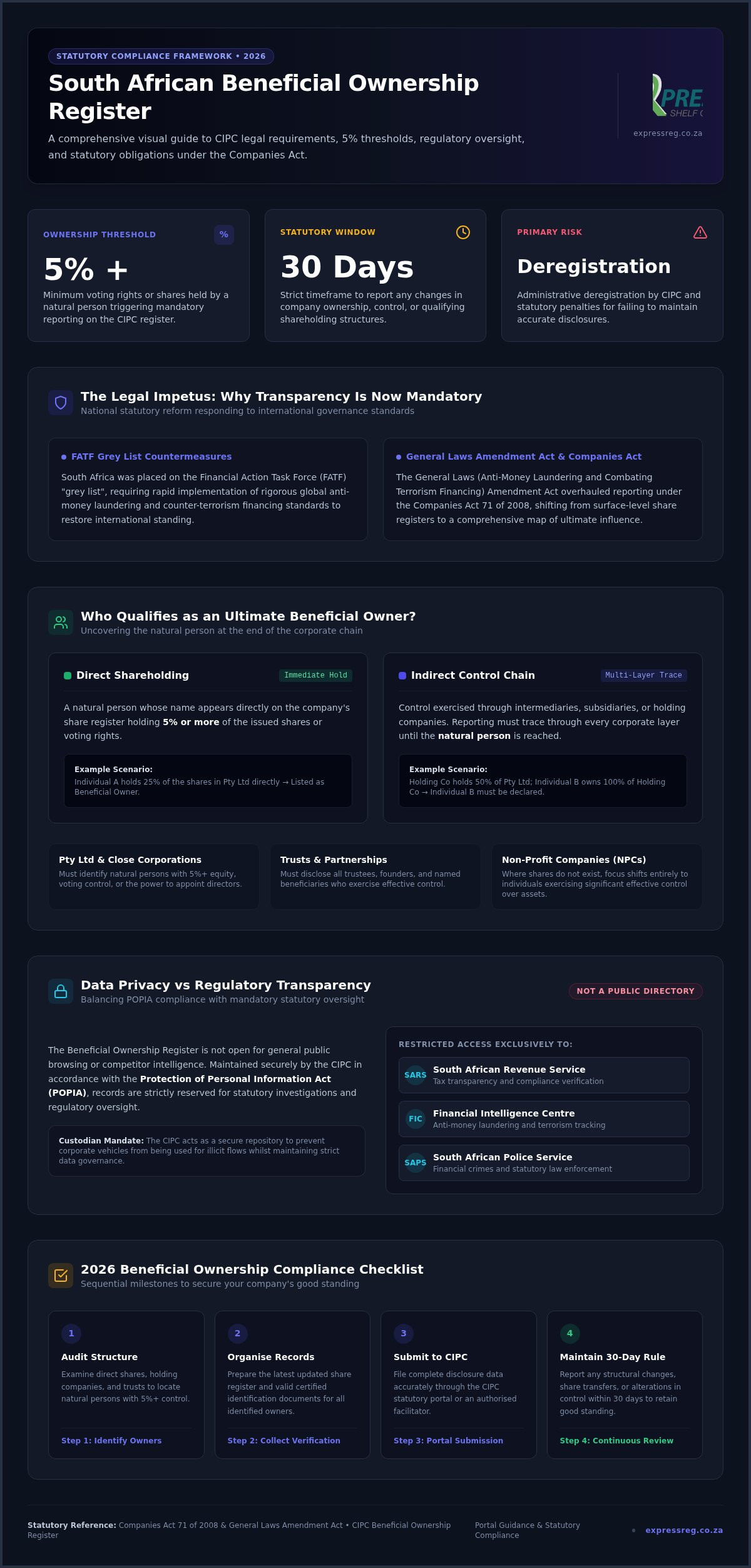
The beneficial ownership concept identifies the natural person who truly reaps the rewards or holds the power within a company. In the past, companies only had to report their registered shareholders. Now, the Companies and Intellectual Property Commission (CIPC) requires a deeper level of disclosure. The beneficial ownership register south africa was created to pull back the curtain on complex corporate structures that might otherwise hide the true controllers of an entity. It’s about finding the human being at the end of the ownership chain.
This shift wasn’t random. South Africa faced significant international pressure after being placed on the Financial Action Task Force (FATF) “grey list.” To combat money laundering and terrorism financing, the government passed the General Laws (Anti-Money Laundering and Combating Terrorism Financing) Amendment Act. These reforms are designed to bring our corporate transparency in line with global standards. By making it harder for illicit funds to move through South African businesses, the country aims to restore its international financial reputation and secure a more stable economic future.
The Legal Framework for Transparency in 2026
The Companies Act 71 of 2008 hasn’t stayed static. Recent amendments have transformed statutory reporting from a simple list of names into a comprehensive map of influence. You can’t just list a holding company or a trust as the owner anymore. You must identify the individuals who exercise effective control. As part of the beneficial ownership register south africa mandate, this is now a compulsory requirement for every private company, non-profit, and close corporation. If your entity is active, you have a legal obligation to maintain and file this data accurately to avoid administrative penalties.
Who has Access to this Information?
Maintaining the register requires a careful balance between corporate transparency and the Protection of Personal Information Act (POPIA). Security is a valid concern for directors, but the register isn’t a public directory for anyone to browse. The CIPC acts as a secure custodian, ensuring that access is primarily restricted to government authorities and law enforcement agencies. These include the South African Revenue Service (SARS), the Financial Intelligence Centre (FIC), and the South African Police Service (SAPS). Your data is used for regulatory oversight, not for general public consumption or competitive analysis.
Determining Who Qualifies as a Beneficial Owner
Identifying a beneficial owner starts with a simple number: 5%. In South Africa, any natural person holding 5% or more of the total voting rights or shares in a company must be recorded. However, compliance with the beneficial ownership register south africa isn’t always a straightforward calculation of share certificates. It requires looking past the legal entities to find the human beings who exercise effective control. You’re searching for the person who actually pulls the strings, regardless of whose name is on the formal share register.
It’s a common misconception that directors are automatically the ultimate beneficial owners. Whilst directors manage daily operations, the register specifically seeks those with the power to appoint directors or influence the company’s financial destiny. For state-owned entities or Non-Profit Companies (NPCs), where traditional shares don’t exist, the focus shifts entirely to “effective control.” In these cases, you must identify the individuals who hold significant weight in decision-making processes or exercise control over the entity’s assets.
Direct vs Indirect Control Explained
Many entrepreneurs find “indirect control” confusing. This occurs when an individual controls a company through an intermediary, such as a holding company or a series of subsidiary layers. To satisfy FATF beneficial ownership standards, you must trace these layers until you reach the “ultimate” natural person. If a holding company owns 50% of your Pty Ltd, you must identify who owns that holding company. The CIPC requires you to disclose the human at the end of the chain, no matter how many corporate shells sit in between.
The Role of Trusts and Partnerships
Trusts present a unique challenge for statutory reporting because a trust isn’t a natural person. The CIPC requires the identification of all trustees, founders, and named beneficiaries who meet the control criteria. Similarly, if a partnership holds a qualifying interest in your business, each individual partner’s influence must be assessed. These structures often change over time. Managing these shifts is a core part of staying compliant with the beneficial ownership register south africa requirements. If you find these layers difficult to unbundle, you can outsource your beneficial ownership filing to ensure every link in the chain is correctly documented and submitted.
Your 2026 Beneficial Ownership Filing Checklist
Preparing for the beneficial ownership register south africa filing requires a methodical approach to documentation. You can’t simply log in and guess; the CIPC requires specific, verified evidence for every natural person identified in your ownership chain. Start your process early to ensure all certifications are current and all internal records match your intended disclosure. This organised preparation prevents technical rejections and keeps your company in good legal standing.
Step 1: Document Preparation and Verification
Your first task is to gather and verify the core documents that support your filing. The CIPC is strict about the quality and age of these records. Ensure your checklist includes the following:
- Certified ID or Passport Copies: Every beneficial owner must provide a clear copy of their identification. These certifications must not be older than three months at the time of submission.
- Updated Share Register: Organise your latest share register and securities transfer records. These must accurately reflect the current shareholding of the company.
- Mandate or Resolution: If you are filing on behalf of the company, you need a formal mandate or a signed director’s resolution authorising the specific person to perform the filing.
- Organisational Chart: For companies with multi-layered structures, create a clear diagram showing the link between the company and the ultimate natural persons.
Step 2: Navigating the CIPC Disclosure Portal
Once your documents are ready, access the CIPC e-services or the dedicated beneficial ownership portal. Capture the personal data for each beneficial owner, including their full names, ID numbers, and residential addresses. You’ll then need to upload your supporting documents. Ensure every file is in the correct PDF format and is legible. Small errors in data entry or blurry document scans are the most common reasons for filing delays. Double-check that all director information is current before you begin, as discrepancies here can block the entire process.
Step 3: Confirmation and Compliance Certificates
After submission, don’t assume the process is finished. Download the confirmation of filing immediately and store it in your corporate records. You should also check the status of your filing periodically to ensure it hasn’t been moved to a “rejected” status due to document discrepancies. It’s also vital to link this process to your CIPC annual returns submission. The CIPC now requires an updated beneficial ownership filing as a prerequisite for completing your annual returns, making these two processes inseparable for 2026 compliance.
Deadlines, Penalties, and the Risks of Non-Compliance
Compliance with the beneficial ownership register south africa is a continuous obligation rather than a one-time task. You must report any change in ownership or control within 30 days of the actual event. If a shareholder sells a qualifying stake or a new trustee is appointed, the clock starts ticking immediately. This applies to any shift that affects the 5% threshold we covered previously. Waiting until your next annual return to report these changes is a common mistake that leads to technical non-compliance and potential administrative blockages.
For companies where ownership remains static, the CIPC still requires an annual confirmation of your status. This update is designed to align with your company’s anniversary month. It creates a dual filing requirement where both your annual return and your beneficial ownership verification must be completed to maintain your active status. Failing to meet these deadlines puts your business at risk of administrative deregistration. Once a company is deregistered, it loses its legal personality, which effectively freezes bank accounts and halts all commercial operations.
Annual Update Requirements
Even if your shareholding remains identical to the previous year, you must log in and confirm the status to satisfy the CIPC. Many directors find it efficient to integrate these updates with other statutory tasks, such as a director change CIPC filing. If you’re already updating your board members, it’s the perfect time to verify your beneficial owners. This proactive approach ensures your corporate records remain synchronised across all CIPC databases and prevents the stress of last-minute filing during your anniversary month.
Fines and Legal Implications in 2026
The legal stakes are high in 2026. Providing false or misleading information to the CIPC can result in significant monetary fines for directors personally. Beyond direct fines, non-compliance affects your ability to secure a Letter of Good Standing. Without this document, you cannot apply for government tenders or maintain essential professional certifications. It’s now a foundational requirement for any business seeking to participate in the public sector supply chain. Banks have also integrated the CIPC’s register into their FICA verification systems. If your BO data is outdated, you may face account restrictions or difficulty opening new credit facilities, as financial institutions must verify the ultimate human controller of every corporate client.
Avoid the risk of deregistration and keep your business running smoothly by choosing Express Shelf Company for professional beneficial ownership filing today.
Professional Management of Your CIPC Statutory Filings
Managing the beneficial ownership register south africa requirements shouldn’t be a source of constant stress for directors. Whilst the CIPC has provided digital tools for disclosure, the administrative burden of gathering certified documents and navigating portal downtime often takes focus away from core business operations. Many entrepreneurs choose to outsource these tasks to ensure that every filing is handled with precision. Professional management offers a layer of protection against the simple administrative errors that frequently lead to CIPC rejections and subsequent compliance risks.
A fixed-fee service model provides clarity and predictability for your business budget. You don’t have to worry about hidden costs or hourly rates when updating your corporate records. Instead, you gain a reliable intermediary who understands the technical nuances of statutory reporting. This ensures your business remains in good standing, which is essential for maintaining bank accounts, applying for financing, or scaling your operations through new partnerships. Professional filing provides the foundational support necessary for long-term growth.
The Value of an Independent Statutory Facilitator
An independent facilitator handles the heavy lifting of CIPC paperwork whilst you focus on growing your company. They provide expert guidance on complex shareholding disclosures, especially when dealing with trusts or multi-layered corporate structures. By maintaining a consistent and organised filing history, a professional agent helps you build a robust corporate foundation. This history is invaluable during due diligence processes or when government authorities request proof of compliance. It moves your business from a state of administrative complexity to one of organised efficiency.
How to Get Started with Professional Filing
Getting started is a straightforward process that begins with identifying which services your business currently requires. You might only need a once-off beneficial ownership disclosure, or you may require a bundle that includes CIPC annual returns and director changes. Once you’ve selected your services, you simply provide the necessary documentation to your professional agent. They will verify your ID copies, check your share register for accuracy, and manage the entire submission through the CIPC portal on your behalf.
Take the first step towards total administrative peace of mind. You can simplify your beneficial ownership filing today by partnering with an expert who values your time and procedural accuracy. This partnership ensures that your business stays ahead of regulatory changes and remains fully compliant throughout 2026 and beyond.
Future-Proof Your Corporate Standing
Maintaining an accurate beneficial ownership register south africa is now a foundational requirement for any business operating in the local market. By identifying individuals at the 5% threshold and adhering to the 30-day reporting window, you protect your company from the severe risks of administrative deregistration. These steps ensure your business remains eligible for government tenders and maintains a clear path for future growth. Organised record-keeping isn’t just a legal duty; it’s a strategic advantage that builds trust with financial institutions and regulatory bodies.
You can eliminate the stress of the CIPC portal by partnering with a reliable intermediary for your statutory compliance. Our team provides expert CIPC administrative filing with full fixed-fee transparency, handling the heavy lifting of paperwork so you can stay focused on your operations. Secure your company compliance with our professional BO filing services and enjoy the confidence that comes with knowing your corporate records are in expert hands. Taking proactive control of your compliance today ensures a stable and successful 2026 for your business.
Frequently Asked Questions
What is the beneficial ownership register in South Africa?
The register is a secure database managed by the CIPC that identifies the natural persons who ultimately own or control a legal entity. It moves beyond simple shareholder lists to find the human beings who exercise effective control. This system was introduced to align South African corporate law with international transparency standards and helps the government combat financial crimes like money laundering and terrorism financing.
Is it mandatory for all companies to file beneficial ownership information?
Yes, filing is a compulsory statutory requirement for all profit companies, non-profit companies, and close corporations registered in the country. Whether you manage a small family business or a large private firm, you must disclose your ultimate owners. Only certain entities, such as those listed on a local stock exchange, follow different reporting paths, but the vast majority of Pty Ltd companies must comply.
How often must the beneficial ownership register be updated?
You must update the beneficial ownership register south africa whenever a change in control occurs, specifically within 30 days of that event. Additionally, every company must confirm its beneficial ownership information annually. This annual update usually coincides with your company’s anniversary month and the filing of your annual returns. Keeping this data current is essential to avoid administrative penalties or compliance blocks.
Can a company be deregistered for not filing beneficial ownership?
Yes, the CIPC can initiate administrative deregistration for companies that fail to meet their statutory filing obligations. Non-compliance is treated as a serious breach of the Companies Act. If your company is deregistered, it loses its legal standing. This can lead to frozen bank accounts, the inability to trade, and the loss of protection for the company name, causing significant disruption to your operations.
What is the 5% threshold for beneficial ownership in South Africa?
The 5% threshold is the minimum level of interest or power that triggers a disclosure requirement. If a natural person holds 5% or more of the shares, voting rights, or exercises equivalent control through other means, they must be recorded as a beneficial owner. This rule applies to both direct ownership and indirect influence exerted through holding companies, trusts, or other intermediate entities.
Who is responsible for filing the beneficial ownership disclosure?
The directors of a company hold the legal responsibility for ensuring that beneficial ownership information is filed accurately and on time. Whilst the board is accountable, many directors appoint a professional administrative facilitator to handle the technical submission. This ensures that the data captured on the CIPC portal matches the company’s internal share register and meets all the specific formatting requirements for supporting documents.
Is beneficial ownership information public in South Africa?
No, the beneficial ownership register south africa is not a public directory available for general browsing. The CIPC acts as a secure custodian of this data to protect the privacy of individuals. Access is restricted to authorised government authorities and law enforcement agencies. These include SARS and the Financial Intelligence Centre, who use the information for regulatory oversight and to maintain the integrity of the financial system.