
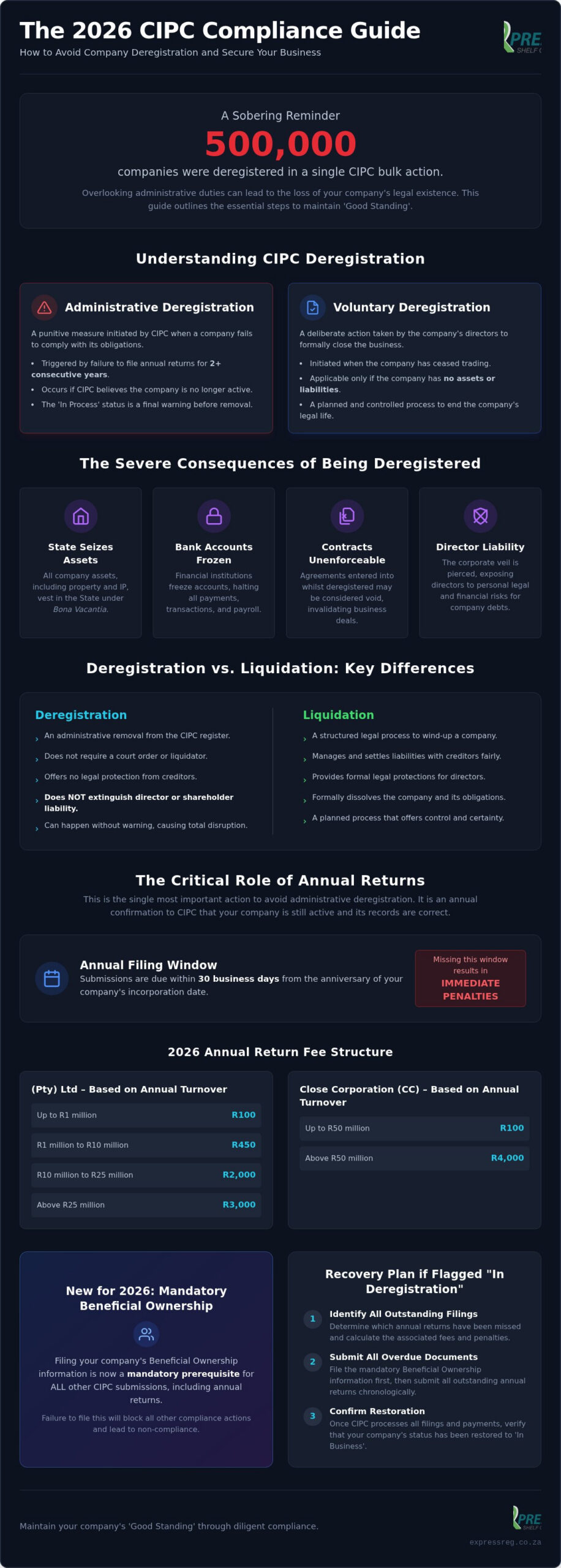
Did you know that approximately 500,000 companies were deregistered in a single CIPC bulk action in December 2024? This staggering figure serves as a sobering reminder of how easily a business can vanish from the official register when administrative duties are overlooked. If you want to avoid company deregistration CIPC and protect your business from being struck off, understanding the current regulatory landscape is essential.
It’s natural to feel frustrated by the complex web of statutory requirements, but protecting your entity doesn’t have to be a source of constant stress. We understand the fear of losing access to business bank accounts or facing personal liability for compliance gaps. This 2026 guide provides the clarity you need to maintain a permanent “Good Standing” status and ensure your operations continue without interruption.
We’ll walk you through the essential steps to secure your legal standing, from mastering the mandatory Beneficial Ownership rules to setting up a reliable schedule for future filings. You’ll gain the peace of mind that comes from knowing your company is fully compliant and your paperwork is handled with professional precision.
Key Takeaways
- Learn the distinction between voluntary and administrative deregistration to prevent the accidental loss of your company’s legal standing.
- Identify the critical 30-day window for annual returns to effectively avoid company deregistration CIPC and maintain an active status.
- Understand the new Beneficial Ownership filing requirements that serve as a mandatory prerequisite for all statutory submissions in 2026.
- Access a clear recovery framework to resolve outstanding fees and restore your business if it has already been flagged for deregistration.
- Discover how professional administrative management can streamline your compliance cycle and eliminate the risk of missing future CIPC deadlines.
Understanding CIPC Deregistration and Why it Happens
Deregistration is the formal process of removing a business entity from the active register. This action, taken by the Companies and Intellectual Property Commission (CIPC), effectively ends the company’s legal existence. Understanding the mechanics of this process is the first step to ensure you avoid company deregistration CIPC and maintain your right to trade within South Africa.
There are two primary paths to this status. Voluntary deregistration occurs when directors choose to close a business that has no remaining assets or liabilities. In contrast, administrative deregistration is a punitive measure. The commission initiates this when a company fails to file its annual returns for two or more consecutive years or when the regulator has reasonable grounds to believe the entity is no longer active. If your company enters the “In Process” phase, consider this a final warning. This status indicates that the commission has started the deregistration cycle but hasn’t yet struck the entity off. You have a limited window to rectify outstanding filings before the business loses its legal personality.
The Legal Consequences of Being Deregistered
The shift from an active status to being deregistered carries severe penalties that can paralyse your operations. Firstly, all company assets vest in the State under the principle of Bona Vacantia. This means the business loses legal ownership of its property, equipment, and intellectual property. The state effectively becomes the custodian of everything the company once owned.
Financial institutions monitor CIPC records closely. Once your status changes, bank accounts are typically frozen immediately, preventing any further transactions, supplier payments, or payroll processing. Additionally, any contracts entered into whilst the company is deregistered may be considered void or unenforceable. This leaves directors personally exposed to significant legal and financial risks that wouldn’t exist under a compliant structure.
Deregistration vs. Liquidation: Knowing the Difference
It’s a common misconception that deregistration is a simple way to deal with business debt. Liquidation is a structured legal process designed specifically to manage and settle liabilities with creditors. Deregistration is merely an administrative removal from the register. It doesn’t require a court order or the appointment of a liquidator, but it offers none of the protections found in formal winding-up proceedings.
Crucially, deregistration doesn’t wipe away the liabilities of directors or shareholders. If a company is struck off whilst owing money, those debts remain. Creditors can still pursue the individuals involved or apply to have the company reinstated to recover funds. For an active business, an administrative strike-off is often far more disruptive than a planned winding up because it happens without warning, leading to a total loss of control over the company’s affairs.
The Critical Role of Annual Returns in Maintaining Good Standing
Many entrepreneurs mistakenly conflate CIPC annual returns with SARS tax returns. Whilst both are mandatory, they serve entirely different purposes. A tax return reports your income and expenses to the revenue service, whereas a CIPC annual return is an administrative update that confirms your company is still active and its records are current. Submitting these returns is the primary mechanism to avoid company deregistration CIPC and ensure your business remains visible on the national register.
The filing window opens on the anniversary of your company’s incorporation date. You have exactly 30 business days from that date to complete the submission. Missing this window triggers immediate penalties that increase the longer the return remains outstanding. This process is not merely a formality; it’s a data-update exercise that validates your company’s ongoing existence in the eyes of the regulator.
The fee structure for a (Pty) Ltd is tiered based on your annual turnover. For a turnover up to R1 million, the statutory fee is R100. This rises to R450 for turnover between R1 million and R10 million, R2,000 for turnover between R10 million and R25 million, and R3,000 for anything above R25 million. Close Corporations follow a different model, with a R100 fee for turnover up to R50 million, jumping to R4,000 if turnover exceeds that threshold. These rates were published on 10 February 2026 and represent the standard costs for maintaining your legal standing.
Why “Good Standing” is Essential for Tenders and Contracts
Maintaining a status of “Good Standing” is a commercial necessity. Most government departments and private sector procurement offices require a valid CIPC compliance certificate before they will consider your bid for a contract. A lapse in compliance can disqualify your business from lucrative opportunities instantly. For businesses looking to scale, securing professional CIPC annual returns submission support ensures that these growth avenues remain open and protected.
Common Mistakes When Filing Annual Returns
Errors often occur when directors rush the administrative process. A frequent mistake is declaring incorrect turnover figures, which leads to incorrect fee calculations and potential compliance notices. Others simply miss the 30-day window because they haven’t tracked their original incorporation anniversary. Finally, many forget that certain companies must also submit a Financial Accountability Supplement (FAS) along with their return. If you find these requirements overwhelming, you can simplify your statutory obligations by using an expert intermediary to handle the heavy lifting of the paperwork for you.
New Compliance Frontiers: Beneficial Ownership and Address Maintenance
Compliance in 2026 has moved far beyond simple fee payments. The CIPC now prioritises transparency through the Beneficial Ownership (BO) register. This shift aims to combat financial crime by ensuring the regulator knows exactly who owns and controls every business entity in South Africa. If you fail to maintain these records, the commission won’t hesitate to issue compliance notices that can escalate to a total strike-off. To avoid company deregistration CIPC, you must treat these newer requirements with the same rigour as your annual financial returns.
Beneficial Ownership (BO) Filing Requirements
A beneficial owner is any natural person who holds 5% or more of a company’s securities or exercises effective control over the business. Since the “hard-stop” implementation on 1 July 2024, the CIPC system prevents you from submitting an annual return without first filing a compliant BO declaration. This means a single oversight in your ownership records can block your entire compliance cycle. You must file any changes to your ownership structure within 10 business days of the change occurring. Because BO compliance is now a prerequisite for your annual submissions, it’s a central pillar in any strategy to avoid company deregistration CIPC.
Keeping Your Registered Office Details Current
The Companies Amendment Act 16 of 2024, which gained significant attention following its publication on 29 July 2026, places a heavy emphasis on accurate registered address records. The CIPC uses your registered office to serve official legal notices and compliance warnings. If your business has relocated but your records still show an old, vacated address, you’ll miss these critical alerts. This creates a dangerous “blind spot” where your company could be moved into the deregistration process without your knowledge.
Updating your records is a straightforward administrative task that provides essential protection. If you’ve moved offices, you must update your physical and postal addresses on the CIPC database immediately. When a move coincides with leadership shifts, it’s also a wise time for managing director changes with CIPC to ensure all contact details for the board are current. This proactive approach ensures that legal notices reach the right hands, allowing you to respond to any compliance issues before they threaten your company’s existence.
A Step-by-Step Recovery Plan if Your Company is “In Deregistration”
Discovering that your business status is “In Deregistration” is a critical signal that the CIPC has flagged your entity for non-compliance. You must act immediately to prevent the permanent loss of your legal personality. Check your company status on the official CIPC database to confirm exactly where you stand. Once you’ve identified the number of outstanding annual returns and the total fees owed, you can begin the work to avoid company deregistration CIPC by settling these debts and updating your records.
Halting the process requires a combination of payment and data correction. You must submit all overdue returns and pay the associated penalties to stop the commission’s administrative action. At the same time, verify that all director information and registered addresses are up to date. This ensures that any future correspondence from the regulator reaches you directly, preventing a repeat of this compliance crisis. If you’re currently facing a compliance backlog, you can manage your CIPC restoration process through a professional intermediary to ensure every document meets the regulator’s strict standards.
Stopping the Deregistration Process Before it is Final
If your company status is still “In Deregistration”, you have a narrow window to lodge an objection. This is only possible if the company is still active or holds assets. Immediate payment of all back-fees remains the most effective way to restore an “In Business” status. The commission typically processes these payments and updates the register relatively quickly, provided all previous years’ returns are filed in the correct sequence. Acting whilst the status is still “In Process” saves your business from the much more arduous reinstatement path.
Reinstating a Fully Deregistered Company
When a company is fully struck off, the recovery path becomes significantly more difficult and expensive. You must file a formal reinstatement application using Form CoR40.5, which carries a CIPC fee of R200. This is not a simple “pay and play” scenario. You must provide concrete proof that the company was active or owned property at the time of deregistration. This often involves obtaining letters of no objection from both the National Treasury and SARS, a process that can take months to conclude.
Once the reinstatement is approved, you have a strict 30-business-day window to file all outstanding annual returns and Beneficial Ownership declarations. Failure to meet this secondary deadline will result in the company being deregistered again. It’s clear that prevention through consistent filing is significantly cheaper and less labour-intensive than navigating the reinstatement minefield. Maintaining an organised compliance schedule is the only reliable way to protect your business assets from vesting in the State.
Simplifying Your Statutory Compliance with Express Shelf Company
Managing the administrative requirements of a South African business can feel like a full-time job. Express Shelf Company acts as your reliable intermediary, handling the complex machinery of government administration so you don’t have to. Our primary objective is to help you avoid company deregistration CIPC through organised, efficient management of your statutory obligations. By outsourcing these tasks to a specialist, you ensure that your business remains in good standing whilst you focus on core operations.
We operate on a fixed-fee model for our administrative filings. This approach provides you with absolute cost certainty, allowing you to budget for your compliance needs without worrying about hidden administrative charges. Choosing a professional filing agent eliminates the risk of human error that often leads to compliance notices or frozen bank accounts. We provide a grounded, matter-of-fact service that reduces the stress associated with legal and tax deadlines, ensuring a smooth transition from administrative complexity to full legal standing.
Our Comprehensive Compliance Services
Our team provides a methodical approach to keeping your company compliant throughout 2026. We manage the entire lifecycle of your statutory needs, including CIPC Annual Returns and the mandatory Beneficial Ownership filings. If your leadership structure changes, we handle Director Changes with precision to ensure your records reflect your current board. Beyond CIPC, we assist with VAT Registration and COIDA Registration, providing a foundational support system that covers your obligations to both the revenue service and the Department of Labour.
Staying ahead of the CIPC’s “hard-stop” systems requires a proactive strategy. We track your incorporation anniversary and ensure all data updates, including registered office changes, are processed within the prescribed timeframes. This disciplined approach prevents the administrative lapses that trigger the deregistration process in the first place.
Why Entrepreneurs Trust Express Shelf Company
Entrepreneurs value their time and peace of mind. We handle the heavy lifting of paperwork, acting as a knowledgeable guide between your business and the regulator. Our service is built on transparency and procedural accuracy, positioning us as a private ally in your business journey. Whether you are starting fresh with a New (Pty) Ltd Registration or securing a Letter of Good Standing for a major tender, we provide the speed and correctness required in a competitive market.
Maintaining your company’s legal existence is too important to leave to chance. A single missed deadline can jeopardise your contracts and assets. Get help with your CIPC compliance today and ensure your business remains active and protected for years to come.
Securing Your Business Legacy through Consistent Compliance
Maintaining an active company in 2026 requires a disciplined approach to statutory record-keeping. It’s no longer enough to simply pay an annual fee; you must also manage complex Beneficial Ownership declarations and ensure your registered office details are perfectly accurate. By treating these duties as a strategic priority, you avoid company deregistration CIPC and protect your business from the severe consequences of being struck off the register. Compliance is the foundation upon which your commercial success is built.
Express Shelf Company acts as a reliable intermediary, providing expert statutory compliance management that removes the administrative burden from your daily operations. Our fixed-fee administrative processing ensures you have total cost certainty whilst we handle the technical requirements of CIPC and SARS filings. This professional oversight allows you to focus entirely on growth, knowing your legal standing is secure and your future deadlines are handled with precision.
Secure your company status with professional CIPC filing services. Taking proactive steps today ensures your business remains a resilient, compliant, and thriving entity for years to come.
Frequently Asked Questions
How many annual returns can I miss before CIPC starts deregistration?
CIPC generally initiates the administrative deregistration process after a company has failed to file its annual returns for two or more consecutive years. This non-compliance signals to the regulator that the business may no longer be active. Once this threshold is reached, the commission moves the entity into an “In Process” deregistration status. It is vital to monitor your filing anniversary to ensure you avoid company deregistration CIPC and maintain your right to trade.
What happens to my company bank account if the business is deregistered?
Your company bank account will typically be frozen by your financial institution immediately once they receive notification of the change in CIPC status. Banks perform regular compliance checks and cannot legally facilitate transactions for an entity that has lost its legal personality. This freeze prevents all incoming and outgoing payments, including payroll and supplier settlements. You must restore the company to “In Business” status before the bank will consider unfreezing the accounts.
Can I still trade if my company status is “In Deregistration”?
Whilst you can technically still trade whilst the status is “In Process”, it serves as a final warning that your legal standing is at risk. If the status moves to “Deregistered”, the company effectively ceases to exist in the eyes of the law. Any contracts signed or transactions made during full deregistration may be considered void. It is safer to resolve outstanding filings immediately to ensure your business operations remain legally protected and fully enforceable.
How much does it cost to stop a CIPC deregistration process?
The cost to stop the process depends on the number of outstanding annual returns and your company’s annual turnover. You must pay the statutory filing fee for each missing year plus a penalty for late submission. For a standard (Pty) Ltd with turnover under R1 million, the annual fee is R100. Professional fees for an intermediary to manage the recovery process are typically charged separately on a fixed-fee basis to ensure administrative accuracy and speed.
What is the difference between a tax return and a CIPC annual return?
A SARS tax return is a report of your company’s financial earnings and expenses used to calculate tax liability. In contrast, a CIPC annual return is a statutory administrative update required to confirm that your company is still active and its information is current. Filing your taxes does not satisfy your CIPC obligations. You must complete both processes independently each year to avoid company deregistration CIPC and maintain a status of good standing.
Do I need to file annual returns if my company is not currently making a profit?
Yes, filing annual returns is a mandatory statutory requirement for all registered companies, regardless of whether they are profitable or even actively trading. The CIPC uses these filings to confirm that the entity still exists and intends to remain on the register. If your company is dormant, you still need to file a return and pay the minimum fee based on a zero or low turnover to prevent administrative deregistration and asset forfeiture.
How long does it take for CIPC to update my status back to “In Business”?
The CIPC system usually updates your status from “In Deregistration” back to “In Business” within a few business days once all outstanding returns are filed and payments are processed. However, if the company has been fully deregistered, the reinstatement process is far more complex and can take several months to complete. This is because reinstatement requires additional documentation, such as letters of no objection from National Treasury and SARS, before the commission approves the application.
What is a beneficial ownership filing and is it mandatory for all companies?
A beneficial ownership filing is a mandatory declaration of the natural persons who ultimately own or control 5% or more of a company. As of July 2024, the CIPC has implemented a “hard-stop” that prevents companies from filing their annual returns until their beneficial ownership information is up to date. This requirement applies to all companies and close corporations. It is designed to increase transparency and assist the regulator in combating financial crimes like money laundering.