
What if your company lost its legal right to trade, hold a bank account, or sign contracts because of one missed administrative deadline? It’s a harsh reality for many South African business owners who confuse their CIPC obligations with SARS tax returns. You likely started your business to innovate and grow, not to struggle with technical glitches on a portal or fear accidental deregistration. Managing a CIPC annual returns submission often feels like a hurdle that creates more confusion than clarity, especially whilst the threat of being marked as non-compliant looms over your daily operations.
You can protect your business and secure its future by mastering these statutory requirements today. This 2026 guide provides the essential roadmap you need to ensure your company remains in good standing throughout the year. We’ll clarify the exact filing timelines, detail the updated fee structures based on your turnover, and offer a structured approach to handling your paperwork without the usual frustration. Follow this methodical breakdown to navigate the CIPC system with confidence and maintain your legal status with ease.
Key Takeaways
- Identify the core purpose of annual returns as a mandatory statutory health check that confirms your company’s active status and contact details.
- Ensure a successful CIPC annual returns submission by accurately calculating your turnover and completing the non-negotiable Beneficial Ownership filing.
- Recognise the severe risks of non-compliance, including the “Final Derogatory” status and the immediate freezing of corporate bank accounts.
- Organise your administrative timeline around your company’s anniversary month to prevent late penalties and the threat of permanent deregistration.
- Discover how fixed-fee professional services can manage the heavy lifting of paperwork to maintain your business’s legal standing with precision.
What is a CIPC Annual Returns Submission?
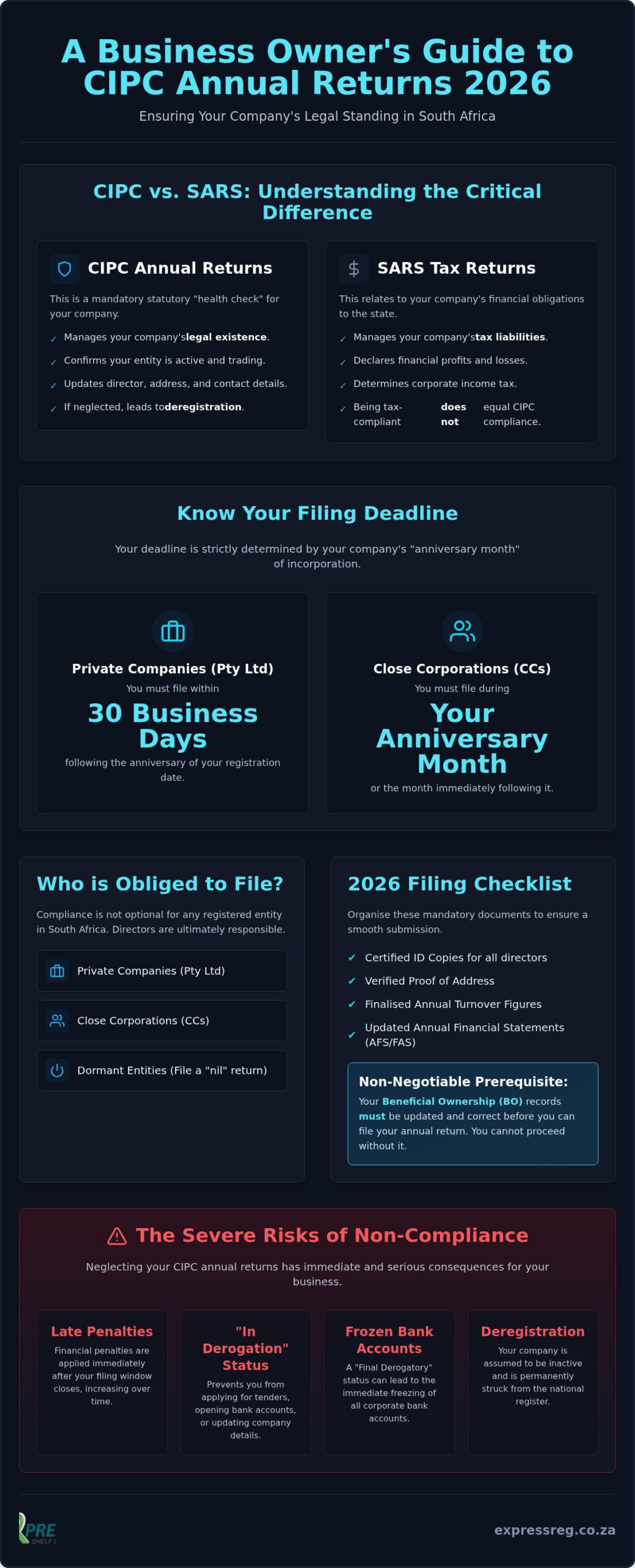
A CIPC annual returns submission is a mandatory yearly filing required by the Companies and Intellectual Property Commission (CIPC) to confirm that your entity is still active and trading. Think of it as a formal “health check” for your business. This process ensures the national registry possesses your latest contact details, director information, and registered office address. It’s a statutory requirement that serves as the foundation for your company’s legal standing in South Africa.
Many entrepreneurs mistakenly believe that filing with the CIPC is the same as submitting a tax return to SARS. It’s vital to understand the distinction. Whilst SARS manages your tax liabilities and financial profits, the CIPC manages your legal existence. A company might be tax-compliant but still face deregistration if it neglects its annual returns. If you don’t file, the commission assumes your business has ceased operations and will initiate the process to strike it from the register.
The timeline for this filing is strict. Your deadline is determined by the “anniversary month” of your company’s incorporation. For standard companies, you must complete the process within 30 business days following the anniversary of your registration date. Close Corporations have a slightly different window; they must file during their anniversary month or the month immediately following it. Missing this window leads to immediate penalties and a status change on the public registry.
The Difference Between Returns and Financial Statements
When you handle your return, you must provide specific financial disclosures. Most companies are required to upload their Annual Financial Statements (AFS) as part of the submission. If your business doesn’t meet the public interest score for an audit, you may be eligible to submit a Financial Accountability Supplement (FAS) instead. The CIPC uses this data to monitor corporate governance trends and ensure that businesses aren’t being used for illicit activities. It’s a tool for transparency that helps maintain the integrity of the South African business environment.
Who is Obliged to File in 2026?
Compliance is not optional for any registered entity. The following groups must file in 2026:
- Private Companies (Pty Ltd): All active and dormant private companies.
- Close Corporations (CCs): All registered CCs, regardless of their size.
- Dormant Entities: Even if your company hasn’t traded or generated turnover, you must still file a “nil” return to keep the entity alive.
Directors carry the ultimate responsibility for ensuring a CIPC annual returns submission is completed accurately and on time. Neglecting this duty can lead to the company being marked as “In Derogation,” which prevents you from opening bank accounts or applying for tenders. Keeping your filings up to date is the simplest way to protect your corporate veil and your professional reputation.
Requirements for a Successful 2026 CIPC Filing
Securing a successful CIPC annual returns submission requires more than just a basic understanding of your company’s registration date. It demands a precise collection of data and a clear distinction between statutory and accounting requirements. Whilst the return acts as a declaration of your company’s status, it remains separate from your Annual Financial Statements (AFS). Your AFS provides the granular accounting data of your fiscal year, whereas the return uses those finalised turnover figures to determine your administrative fee and confirm your legal status.
To maintain a status of “Good Standing,” you must ensure all information is current and accurate. This status is essential for any business aiming to trade legally, open corporate bank accounts, or apply for government and private tenders. Before you begin the process, organise the following mandatory documents:
- Certified ID Copies: Current copies for all active directors.
- Proof of Address: Verified physical address for the company’s registered office.
- Turnover Figures: Finalised annual turnover for the most recent financial year.
- Beneficial Ownership Records: Updated registers of all individuals with significant control.
The Beneficial Ownership Link
In 2026, the CIPC has made Beneficial Ownership (BO) disclosure a non-negotiable prerequisite for filing returns. You cannot complete your annual submission if your BO records are outdated or missing. Beneficial Ownership is the ultimate natural person who owns or controls the entity. To identify these individuals, look for anyone who holds at least 5% of the shares or voting rights, or who exercises significant influence over the company’s management. Ensuring your Beneficial Ownership filing is accurate is the first step toward a compliant submission.
Turnover-Based Fee Structures
The fee for your filing is determined by your annual turnover and whether you submit on time. For companies filing within the 30-day window, the 2026 fee tiers are as follows:
- Turnover under R1 million: R100
- R1 million to R10 million: R450
- R10 million to R25 million: R2,000
- R25 million or more: R3,000
Paying the incorrect amount or failing to use the correct CIPC reference number will result in system rejections and unnecessary delays. If you find these administrative layers overwhelming, you can delegate the heavy lifting to professionals who ensure every tier and reference is handled correctly.
The Risks of Late Submission and Company Deregistration
Neglecting a CIPC annual returns submission triggers a sequence of administrative actions that can jeopardise your entire business operation. The CIPC does not merely view these filings as a data collection exercise; they are a legal requirement used to verify that your company is still active. When you miss the 30-business-day window following your anniversary date, the commission automatically updates your status to “non-compliant.” This change is visible to the public, including potential partners, creditors, and government agencies.
If your company remains non-compliant for an extended period, it enters what is known as “Final Derogatory” status. This is the last warning stage before the CIPC initiates final deregistration. Once a company is deregistered, it ceases to exist as a legal entity. You lose the right to trade under that name, and any assets held by the company technically become the property of the state. Reversing this process is a demanding, multi-step ordeal that involves advertising in national newspapers and paying significant restoration fees.
The operational consequences of deregistration are immediate and severe. South African banks regularly cross-reference their client databases with the CIPC registry. If they find your business is no longer in good standing, they will freeze your corporate bank accounts to mitigate their own legal risks. Additionally, directors may lose the protection of limited liability. If you continue to trade whilst the company is deregistered, you could be held personally liable for the debts and obligations of the business.
CIPC Penalties and Late Fees
The financial cost of non-compliance starts with immediate penalties. For a private company with a turnover of less than R1 million, the filing fee increases from R100 to R150 if submitted late. For larger entities with turnover exceeding R25 million, the late penalty reaches R4,000. These fees create a snowball effect of administrative debt. If you eventually need to restore a deregistered company, you must pay a R200 reinstatement fee in addition to all outstanding annual returns and their associated penalties.
The Impact on Business Continuity
Maintaining compliance is the only way to secure a Letter of Good Standing, which is a prerequisite for most government tenders and private contracts. Suppliers and landlords often request proof of CIPC compliance before entering into long-term agreements. A history of timely filings builds a profile of transparency and reliability, which is essential when seeking investment or business loans. By prioritising your statutory duties, you protect your professional reputation and ensure that your business remains an attractive partner for future opportunities.
How to Organise Your CIPC Annual Returns Submission
Organising your CIPC annual returns submission requires a methodical approach to avoid the pitfalls of technical errors. The 2026 compliance environment is more integrated than in previous years, meaning you must have all your documentation ready before you even attempt to log in to the portal. Following a structured sequence ensures that you meet every statutory requirement without triggering unnecessary system rejections.
Follow these five steps to manage your filing effectively:
- Step 1: Determine your anniversary month, which is the month your company was originally incorporated. Gather your finalised turnover figures for the preceding financial year.
- Step 2: Ensure your Beneficial Ownership filing is up to date. The CIPC portal now blocks annual returns if this register is not current.
- Step 3: Calculate the required fee based on your turnover tier. Ensure you have the funds available in your CIPC customer account or via a valid payment method.
- Step 4: Submit the return. You can do this through the official CIPC portal or by delegating the task to a registered agent.
- Step 5: Verify the status. Once submitted, check the public registry to ensure your company status has been updated to “In Business.”
DIY vs. Professional Submission
Whilst the CIPC provides a self-service terminal, many entrepreneurs find the process frustrating due to frequent system downtime and cryptic validation errors. Using a professional filing agent eliminates these technical hurdles. A seasoned consultant ensures that any necessary director changes or address updates are captured simultaneously. This integrated approach prevents the need for multiple separate filings later in the financial year.
Common Mistakes to Avoid
One of the most frequent errors is incorrect turnover reporting. You must be precise; the CIPC and SARS share data to verify the accuracy of statutory filings. Another common pitfall is simply missing the 30-day window. Set up recurring calendar reminders for your anniversary month to avoid late penalties. Finally, remember to update your registered office address whilst you are in the portal. Failing to do so can lead to missed legal notices and further compliance issues.
If you want to avoid the technical glitches of the official portal, you can submit your annual returns through our expert service for guaranteed accuracy and peace of mind.
Professional CIPC Filing Services: Accuracy and Speed
Express Shelf Company acts as your dedicated facilitator for all statutory requirements, ensuring your CIPC annual returns submission is handled with precision. We bridge the gap between the complex administrative machinery of the government and your business needs. By delegating this task, you ensure that your company details remain accurate and that your legal standing is never compromised by a missed deadline or a technical error.
Our fixed-fee approach provides the transparency entrepreneurs value. You won’t encounter surprise administrative charges or hidden costs whilst we manage your filings. This predictable pricing model allows you to budget effectively for your annual compliance without worrying about the complexity of the paperwork involved. We specialise in managing the transition from administrative confusion to full legal standing, providing a smooth path for South African firms to maintain their operational status.
Maintaining a status of “In Good Standing” is critical for meeting bank requirements and qualifying for lucrative tenders. Financial institutions and procurement officers view your CIPC status as a primary indicator of your business’s reliability. By ensuring your filings are correct and timely, we help you protect your company’s reputation and its ability to trade without interruption. This focus on correctness allows you to reduce the stress associated with regulatory hurdles and shift your energy back to business growth.
Why Delegate Your Compliance?
Delegating your compliance tasks offers the peace of mind that comes from professional management. Many business owners struggle with the CIPC portal’s frequent system timeouts and validation failures, which can turn a simple filing into a multi-day frustration. Our seasoned consultants handle the heavy lifting, navigating these technical glitches on your behalf. We ensure that every document is verified and every field is populated correctly, preventing the risk of accidental deregistration or costly system rejections.
Your Next Steps for 2026
Start your 2026 compliance journey by conducting a comprehensive audit of your company’s current status. Verify your incorporation date, review your latest turnover figures, and ensure your director information is up to date. This proactive approach identifies potential issues before they become legal liabilities. Once your data is organised, you can move forward with a professional submission to secure your business’s future.
Let us handle your CIPC annual returns submission today to ensure your business remains compliant, protected, and ready for growth throughout the coming year.
Secure Your Company’s Future and Legal Standing
Maintaining your corporate compliance is a foundational pillar of business success in South Africa. You now understand that a CIPC annual returns submission is far more than a simple administrative task; it’s a vital health check that protects your entity from the irreversible risks of deregistration. By aligning your filings with your anniversary month and ensuring your Beneficial Ownership records are current, you safeguard your access to banking services and tender opportunities.
Managing these statutory requirements doesn’t need to be a source of frustration or administrative dread. You can delegate the heavy lifting to a reliable intermediary that specialises in expert statutory compliance management and fixed-fee administrative processing. Our team acts as a professional facilitator to ensure your records are correct and your business remains in good standing throughout 2026.
Secure your business status with our CIPC filing services and experience the peace of mind that comes with organised efficiency. Your focus belongs on growth and innovation; let us handle the paperwork that keeps your legal foundation solid.
Frequently Asked Questions
What is the deadline for CIPC annual returns submission?
Companies must file their CIPC annual returns submission within 30 business days after the anniversary of their incorporation date. Close Corporations have a slightly different window; they must file during their anniversary month or the month immediately following it. Missing these specific windows results in immediate late penalties. It’s best to set a recurring calendar reminder to ensure your business remains in good standing and avoids the risk of being marked for deregistration.
Can I file my annual returns if I haven’t done my taxes yet?
Yes, you can file your annual returns even if your SARS tax returns are outstanding. These are two distinct statutory requirements managed by different authorities. Whilst the CIPC requires your turnover figures to calculate the filing fee, they don’t require proof of tax compliance to process the return. However, keeping both updated is essential for maintaining your company’s full legal standing and avoiding complications with corporate bank accounts.
What happens if my company is already in the process of deregistration?
If your company is marked as “In Derogation,” you must urgently file all outstanding annual returns and pay the associated penalties to stop the process. If the status has moved to “Final Deregistration,” the entity technically ceases to exist. You’ll then need to follow a complex restoration process, which includes paying a R200 reinstatement fee and advertising in the Government Gazette. Act quickly to prevent your bank accounts from being frozen.
How much does it cost to submit CIPC annual returns in 2026?
The cost depends on your company’s annual turnover and whether you file on time. For companies with turnover under R1 million, the fee is R100, increasing to R150 if late. Medium-sized firms with turnover between R1 million and R10 million pay R450 on time or R600 if late. Larger entities with turnover exceeding R25 million face fees of R3,000, rising to R4,000 for late submissions. These legislated fees are standard across all platforms.
Is Beneficial Ownership filing really required for annual returns?
Yes, updating your Beneficial Ownership register is now a non-negotiable prerequisite for a successful CIPC annual returns submission. The portal is designed to block annual return filings if the Beneficial Ownership information is missing or outdated. This regulation ensures transparency regarding who ultimately owns or controls the entity. You must ensure this register is finalised before attempting to submit your annual return to avoid technical rejections and delays.
How do I check if my company is in good standing with the CIPC?
You can check your status by performing a free enterprise search on the official CIPC website or BizPortal. Enter your company name or registration number to view your current status, which should ideally be “In Business.” If the status shows “In Derogation” or “Deregistration Process,” it indicates that you have missed filings. Checking this regularly ensures you can address compliance gaps before they impact your ability to trade.
Can I submit annual returns for a company that is not trading?
Yes, even “dormant” companies that have generated zero turnover must still file annual returns every year. In this scenario, you’ll submit a “nil” return and pay the minimum fee tier. Neglecting this requirement for a non-trading company will still lead to deregistration. Keeping a dormant entity compliant is much cheaper and simpler than trying to restore it later if you decide to resume business operations.
How long does the CIPC annual return process take through an agent?
A professional agent can typically process your submission within 24 to 48 hours once they have received your turnover figures and Beneficial Ownership details. Whilst the filing itself is electronic and happens quickly, the agent’s role is to ensure the data is correct to prevent system errors. This speed allows you to resolve compliance issues rapidly and move from administrative complexity to full legal standing without the stress of navigating the portal yourself.