
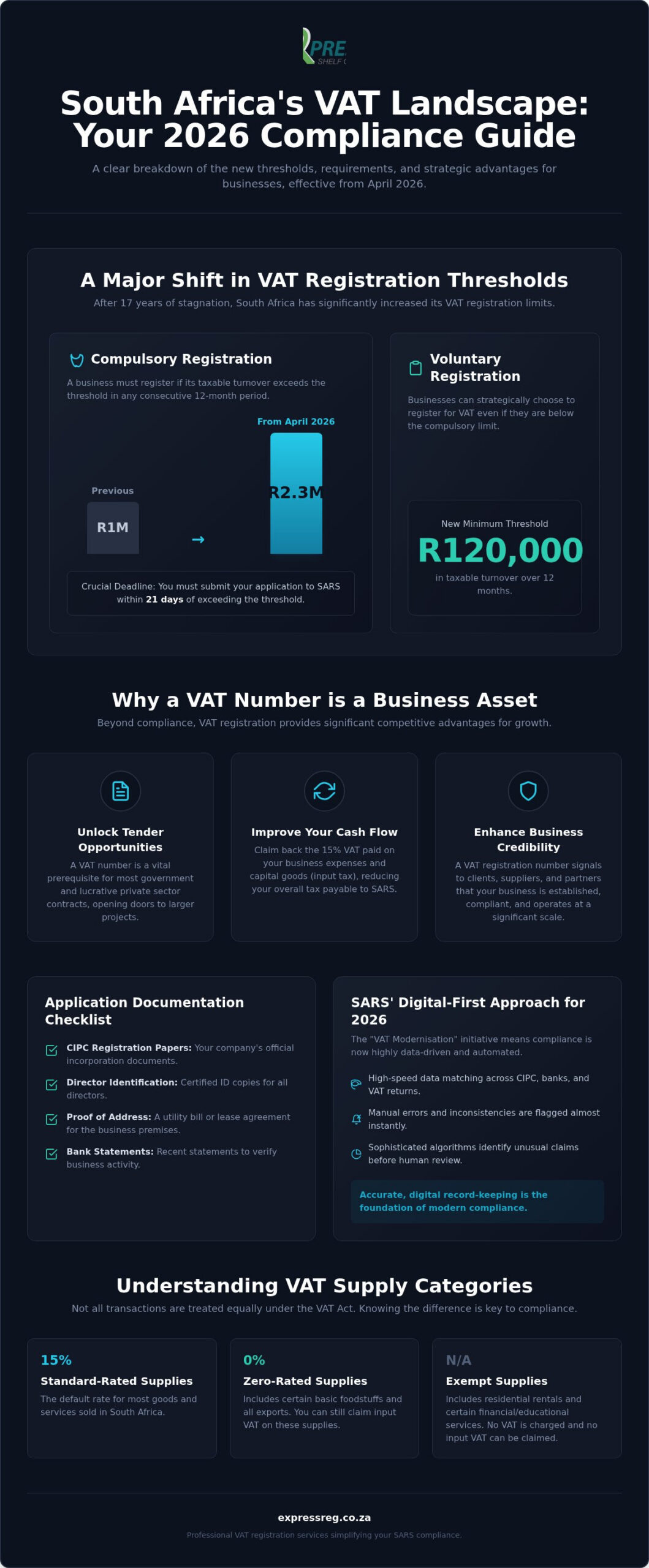
After seventeen years of stagnation, South Africa’s VAT landscape has undergone its most significant shift yet, with the compulsory registration threshold leaping to R2.3 million as of April 2026. This change has left many entrepreneurs questioning whether their current status remains compliant or if they’re missing out on the competitive edge that a VAT number provides for government tenders. You probably feel overwhelmed by the documentation requirements or fear that a simple administrative slip-up could lead to a costly SARS penalty. It’s a common anxiety for business owners who want to focus on growth rather than wrestling with tax bureaucracy whilst trying to manage daily operations.
We understand that navigating these updates is daunting, which is why we’ve designed this guide to provide clarity and reassurance. By utilising professional VAT registration services South Africa, you can transition from administrative confusion to full legal standing with ease. This article outlines everything you need to master the 2026 requirements, including the new R120,000 voluntary threshold and the strategic benefits of registration. We’ll walk you through the essential documentation and the exact steps to ensure your business is organised, compliant, and ready for the 2026 financial year.
Key Takeaways
- Learn about the significant 2026 threshold updates, including the new R2.3 million compulsory limit and the R120,000 voluntary registration mark.
- Identify the essential documentation required by SARS, including CIPC registration papers and director identification, to ensure a seamless application.
- Secure a competitive edge for your business by obtaining a VAT number, which is a vital prerequisite for most lucrative government and private sector tenders.
- Minimise administrative stress by utilising professional VAT registration services south africa to handle the complex SARS application process on your behalf.
- Master the strategic balance between voluntary registration and business growth whilst maintaining full tax compliance throughout the 2026 financial year.
Understanding VAT and the Concept of an Enterprise in 2026
Value-Added Tax (VAT) is an indirect tax levied on the consumption of goods and services in South Africa. Unlike direct taxes like income tax, VAT is collected by businesses at each stage of the production and distribution chain. To gain a broader Overview of Taxation in South Africa, one must recognise that VAT is a cornerstone of the national revenue system. For SARS purposes, an “enterprise” isn’t just a registered company. It’s any activity carried on continuously or regularly by any person in the Republic, where goods or services are supplied for a consideration. This legal definition is purposefully broad to include individuals, companies, and trusts under the umbrella term of a “person.”
Not all supplies are treated equally under the VAT Act. Most transactions attract the standard rate of 15%, which was maintained after a proposed increase to 16% was reversed. Zero-rated supplies, such as certain basic foodstuffs and exports, carry a 0% rate but still allow the vendor to claim back tax paid on expenses. Conversely, exempt supplies, including residential rental and certain educational services, don’t allow for any VAT collection or input tax recovery. Distinguishing between these categories is essential to avoid administrative errors that could trigger an audit.
The Role of a VAT Vendor
Becoming a registered vendor changes your relationship with the state. You effectively become a collection agent for SARS. Your primary responsibility is to charge output tax on your taxable supplies and ensure this money is paid over during your designated tax periods. The mechanics of this system can actually assist with cash flow if managed correctly. You’re entitled to deduct “input tax”, which is the VAT you paid to your suppliers, from the “output tax” you collected from customers. Only the net difference is payable to SARS. If your input tax exceeds your output tax, you may be eligible for a refund.
Why 2026 Compliance is Different
The 2026 landscape is defined by the “VAT Modernisation” initiative. SARS is shifting towards a system where tax “just happens” through high-speed data integration. Automated data matching now allows the revenue service to cross-reference your CIPC filings with your bank statements and VAT returns in real-time. This level of digitisation means that manual errors are flagged almost instantly. Using professional VAT registration services south africa ensures that your initial setup aligns perfectly with this digital-first approach. Accurate record-keeping is no longer optional; it’s the foundation of modern compliance, as SARS now uses sophisticated algorithms to identify unusual refund claims or export irregularities before they even reach a human auditor.
Compulsory vs Voluntary VAT Registration: Knowing Your Thresholds
Determining the exact moment your business must enter the VAT system is a critical compliance milestone. SARS distinguishes between those who are legally required to register and those who choose to do so for strategic reasons. For the 2026 financial year, the landscape has shifted significantly following the National Budget announcements. Understanding these new benchmarks ensures you avoid administrative friction and potential penalties that arise from late filing or incorrect status claims.
The R2.3 Million Compulsory Rule
A business must register for VAT if the total value of its taxable supplies exceeds R2.3 million within any consecutive 12-month period. Historically, the compulsory threshold was set at R1 million, but for the 2026 tax year, this has been increased to R2.3 million to provide relief for small enterprises. This calculation isn’t based on your financial year-end but on a rolling 12-month basis. You must monitor your turnover monthly to identify when you’ve crossed this line. Once the threshold is exceeded, you have a 21-day window to submit your application to SARS. Failing to meet this deadline can lead to retrospective penalties and interest, effectively making you liable for VAT that you failed to collect from your customers during the period you remained unregistered.
Compliance also involves the “reasonable expectation” rule. If you’ve signed a contract or have a written agreement that guarantees your turnover will exceed the compulsory limit within the next 12 months, you’re required to register immediately. It’s often safer to engage professional VAT registration services south africa to assess your specific turnover patterns and ensure your application is submitted before you reach the 21-day deadline.
When Voluntary Registration Makes Sense
Businesses that haven’t reached the compulsory limit may still choose to register voluntarily. For 2026, the minimum floor for voluntary registration has increased from R50,000 to R120,000 in taxable supplies. SARS implemented this R120,000 floor to prevent micro-entities with negligible turnover from burdening the administrative system. According to the Official SARS VAT Registration Requirements, you must prove you’ve already exceeded this minimum or show a history of regular trading to qualify.
Voluntary registration is particularly advantageous for start-ups with high initial capital expenditure. By becoming a VAT vendor, you can claim back the 15% input tax paid on equipment, stock, and professional services, which provides a significant cash flow injection. Furthermore, being VAT-registered enhances your corporate credibility. Many large B2B clients and government departments prefer working with registered vendors as it allows them to claim input tax on their own purchases, making your business a more attractive partner in the supply chain.
Essential Requirements and Documentation for a SARS Application
SARS has refined its documentation standards for the 2026 financial year to ensure only legitimate enterprises enter the VAT system. Gathering your documents beforehand reduces the risk of a verification audit or a flat rejection. You’ll need your latest CIPC registration documents, specifically the COR14.3 certificate. Every active director must provide a clear, high-resolution copy of their South African ID or passport. If you haven’t yet formalised your business structure, you should first Register a Pty Ltd in South Africa: 2026 Guide to obtain the necessary statutory papers.
Your banking setup is equally critical. SARS requires a dedicated business bank account in the name of the enterprise. They won’t accept personal accounts or “trading as” accounts that don’t match the CIPC record exactly. You must provide a bank confirmation letter or a stamped statement not older than three months. For proof of address, ensure you have a utility bill or lease agreement that clearly displays the business’s physical location. Accuracy here is vital; even a minor typo in the address can result in a rejected application.
The Proof of Turnover Hurdle
Proving your turnover is often where DIY applications fail. For the 2026 tax year, you must demonstrate taxable supplies exceeding R120,000 for voluntary registration or R2.3 million for compulsory status. Valid evidence includes a minimum of three months of bank statements showing trading activity or copies of issued tax invoices. If you’re a new start-up, a signed, binding contract from a client is acceptable evidence of “expected” turnover. SARS frequently rejects applications due to poor scan quality or expired documents. Ensure every digital copy is legible and current to avoid these common delays.
Banking and Registered Representative Details
Before you can effectively utilise VAT registration services south africa, you must appoint a Registered Representative (RR). This is a specific director who takes legal responsibility for the company’s tax affairs. SARS won’t process a VAT application until this individual is verified on the eFiling system. It’s vital that your CIPC records and SARS profile are perfectly aligned. If a director has changed recently but hasn’t been updated at the CIPC, SARS will flag the discrepancy and pause your application. This administrative hurdle is a primary reason why businesses seek professional facilitation to ensure every statutory detail is synchronised.
Strategic Advantages: Why VAT Registration Matters for Tenders and Growth
VAT registration is often viewed as a statutory burden, yet it serves as a powerful catalyst for commercial expansion. For South African enterprises aiming to scale, a VAT number acts as a badge of fiscal maturity. It signals to potential partners that your business has achieved a certain turnover threshold or is committed to formal growth. This perception is vital when engaging with large corporates; these entities typically prefer working with registered vendors to ensure they can claim input tax on their own procurement.
Winning Tenders in 2026
In the current economic climate, public and private sector tenders remain the primary vehicles for large-scale revenue. Most tender boards list a valid VAT number as a non-negotiable prerequisite. Without it, your bid is often disqualified before the technical evaluation begins. This requirement is part of a broader compliance ecosystem. To be tender-ready, you must also secure a Tax Clearance Certificate and meet the Requirements for Letter of Good Standing South Africa: A 2026 Compliance Guide. Managing these moving parts simultaneously ensures your business is positioned to capture high-value contracts.
Cash Flow Benefits of Input Tax
The most immediate financial advantage is the ability to recover VAT paid on business-related expenses. As a registered vendor, you can offset the 15% tax you pay on equipment, office rent, and professional fees against the VAT you collect from your clients. This mechanism effectively lowers your operating costs. For example, if you purchase R115,000 worth of specialised machinery, R15,000 of that is input tax you can potentially claim back. This cash flow injection is especially beneficial for capital-intensive industries like manufacturing or logistics.
Navigating these strategic benefits requires a precise application process. Utilising professional VAT registration services south africa ensures your application is handled correctly from the start, allowing you to focus on your tender submissions whilst experts handle the administrative complexities. Apply for your VAT number today to unlock these growth opportunities and ensure your business is fully compliant for the 2026 financial year.
Professional VAT Registration Services: Simplifying Your SARS Compliance
Managing SARS interactions requires a disciplined approach to procedural accuracy. While the revenue service encourages DIY eFiling, the reality for many business owners involves cryptic error messages and repeated document requests. This is where professional VAT registration services south africa provide a distinct advantage. Express Shelf Company acts as your dedicated intermediary, bridging the gap between complex government requirements and your business needs. Our fixed-fee model ensures you won’t encounter unexpected costs, providing the peace of mind needed to focus on your core operations whilst we handle the heavy lifting of paperwork.
Why Use an Administrative Expert?
The primary benefit of an expert facilitator is the elimination of the frustrating “back-and-forth” that often plagues manual applications. SARS frequently flags applications for minor clerical discrepancies that an untrained eye might miss. By ensuring your submission is “first-time right”, we help you avoid the lengthy delays that can stall your entry into the VAT system. This administrative precision extends to other areas of statutory compliance as well. For instance, maintaining your company’s standing involves more than just tax; you must also stay current with your CIPC Annual Returns Submission: The Complete 2026 Compliance Guide to ensure your registration remains valid and active.
Getting Started with Express Shelf Company
Initiating your application is a straightforward, modular process designed for efficiency. Once you engage our team, we’ll provide a clear checklist of the documents required for the 2026 tax year. After you’ve supplied these materials, our consultants handle the entire SARS interaction, from the initial upload to managing any follow-up queries from the revenue service. You don’t need to visit a branch or spend hours waiting on hold. We ensure your data aligns perfectly with CIPC records to prevent the common rejection triggers that delay DIY applicants.
Throughout the processing period, we provide regular updates so you’re always aware of your application’s status. Managed applications through our team are typically processed with greater speed and accuracy because we understand the specific data-driven compliance triggers SARS uses in 2026. Don’t let administrative friction hold your business back from winning tenders or claiming input tax. Using professional VAT registration services south africa is a strategic investment in your company’s growth. Organise your VAT registration with Express Shelf Company today and secure your company’s financial future with expert support.
Secure Your Competitive Advantage for the 2026 Tax Year
Navigating the updated VAT thresholds is no longer just a matter of compliance; it’s a strategic move to unlock high-value tenders and improve your cash flow through input tax claims. With the compulsory limit now at R2.3 million and the voluntary floor at R120,000, understanding your specific standing is essential for long-term growth. Utilizing professional VAT registration services south africa offers a streamlined path to obtaining your VAT number without the administrative friction of DIY applications.
Express Shelf Company provides a reliable intermediary service with national reach, ensuring your CIPC and SARS records are perfectly aligned. Our expert consultants handle the technical heavy lifting through a transparent, fixed-fee model that prioritises your time and peace of mind. By choosing a professional facilitator, you ensure your business is organised and ready to scale within the modernised SARS ecosystem. Take the next step toward full compliance and commercial readiness today. Register for VAT with Express Shelf Company and position your enterprise for success in the 2026 financial year.
Frequently Asked Questions
What is the current VAT rate in South Africa for 2026?
The standard VAT rate in South Africa for 2026 remains at 15%. Although there was a previously proposed increase to 16%, the government reversed this decision to provide economic stability for consumers and businesses alike. This rate applies to most taxable supplies, excluding zero-rated or exempt goods. Understanding this rate is the first step in managing your output tax obligations correctly throughout the 2026 financial year.
Can I register for VAT if my turnover is below R50,000?
You cannot register for VAT if your taxable supplies are below the new voluntary threshold of R120,000. Effective 1 April 2026, the floor for voluntary applications increased from R50,000 to R120,000 to reduce administrative burdens on micro-entities. If your business earns less than this amount, SARS will generally refuse the application. You must provide proof of turnover or a signed contract to meet this minimum requirement.
How long does the VAT registration process actually take in 2026?
The processing time for a VAT application in 2026 typically ranges from a few business days to several weeks, depending on whether SARS selects your case for a manual verification audit. Using professional VAT registration services south africa can expedite this by ensuring all documentation is “first-time right.” Our consultants monitor the application’s progress to resolve any administrative queries quickly, preventing the common delays associated with DIY eFiling submissions.
Do I need a dedicated business bank account to register for VAT?
Yes, a dedicated business bank account is a non-negotiable requirement for a successful application. SARS requires the account to be in the exact legal name of the registered entity, whether it’s a Pty Ltd or a trust. They won’t accept personal accounts for business VAT purposes. You must provide a bank confirmation letter or a stamped statement not older than three months to prove the account’s validity and ownership.
What happens if I forget to register for VAT after hitting R1 million?
It’s vital to note that the compulsory threshold increased to R2.3 million on 1 April 2026. If you exceed this rolling 12-month turnover and fail to register within 21 days, you face severe retrospective penalties and interest. SARS will backdate your liability to the date you should have registered. This means you’ll owe 15% VAT on all sales made since that point, even if you didn’t collect it from your customers.
Is there a difference between a VAT number and a Tax Reference Number?
A Tax Reference Number is automatically assigned by SARS when you register your company for Income Tax, whereas a VAT number is a separate identifier specifically for Value-Added Tax. You only receive a VAT number after a successful application process. While every company has a tax reference, only those that meet the specific thresholds or opt for voluntary registration will possess a valid VAT number for their tax invoices.
Can I backdate my VAT registration if I missed the compulsory deadline?
You can, and often must, backdate your registration if you missed the compulsory deadline. SARS typically requires the registration to be effective from the first day of the month following the period you exceeded the R2.3 million threshold. This process often triggers a review of your financial records. Our VAT registration services south africa help manage this complex retrospective filing to ensure you settle your outstanding liabilities whilst remaining fully compliant.
How do I check if my VAT registration is active with SARS?
You can verify your active status through the SARS eFiling portal or by using the official VAT Vendor Search tool on the SARS website. Once your application is approved, your VAT number will appear on your Notice of Registration (VAT103) form. It’s important to keep this document safe. You’ll need to provide it to clients and tender boards to prove your business is a registered vendor in good standing.