
Failing to adapt your tax strategy to the April 2026 threshold changes could be the most expensive mistake your business makes this year. With the compulsory registration limit now set at R2.3 million, many entrepreneurs are left wondering where they stand with the South African Revenue Service. Understanding how to register for VAT South Africa is no longer just about filling in forms; it’s about protecting your cash flow and ensuring you can claim back input VAT on essential business expenses.
We recognise that the fear of SARS penalties and the frustration of document rejections can feel overwhelming. You want a valid VAT number without the bureaucratic headache. This guide provides a clear, step-by-step roadmap to master the registration process with confidence. We will examine the difference between compulsory and voluntary registration, outline the specific documents you need to succeed, and show you how to maintain full compliance from day one.
Key Takeaways
- Identify your registration status by reviewing the updated 2026 thresholds for compulsory and voluntary VAT compliance.
- Avoid application rejections by mastering the “Golden Rule” of documentation for your SARS submission.
- Follow our detailed eFiling walkthrough to learn exactly how to register for VAT south africa while maintaining procedural accuracy.
- Unlock significant financial benefits by learning how to claim back input VAT on business expenses and improve tender readiness.
- Explore how professional VAT registration services can manage the administrative burden and fast-track your business compliance.
Understanding the VAT System in South Africa (2026)
Value-Added Tax (VAT) serves as the primary consumption tax within the South African VAT system. It is an indirect tax. This means that whilst the financial burden falls on the final consumer, the responsibility for collecting and paying the tax rests with businesses. As an entrepreneur, understanding this mechanism is the first step before you learn how to register for VAT south africa.
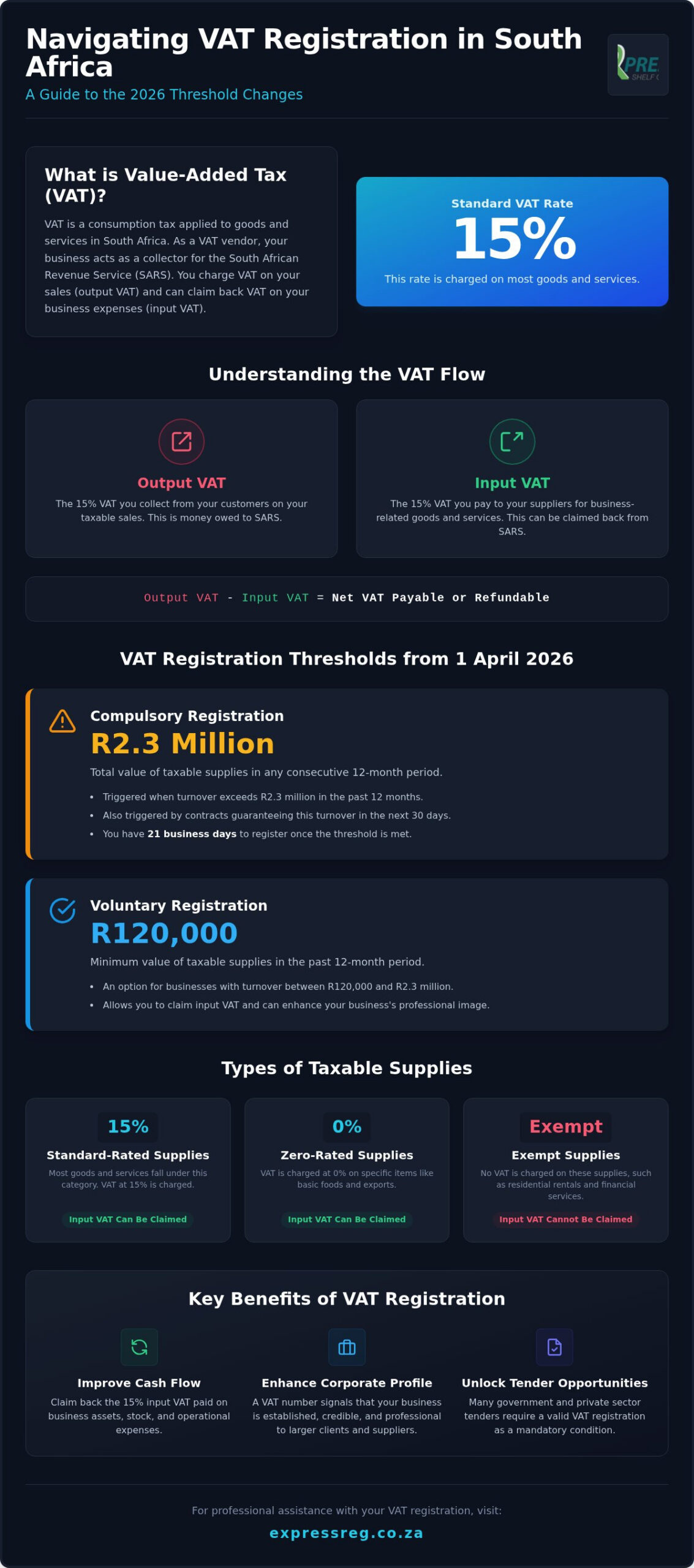
Operating as a VAT vendor means you act as a temporary custodian for the South African Revenue Service (SARS). You collect tax on behalf of the state and remit it at regular intervals. The standard rate remains 15% in 2026. This rate directly influences your pricing strategy and cash flow. If you don’t account for this 15% margin when setting your prices, your net profit will decrease significantly. Proper planning ensures that the tax you collect doesn’t become a drain on your operational capital.
SARS distinguishes between three types of supplies. Standard-rated supplies carry the 15% charge. Zero-rated supplies, such as certain basic food items or exported goods, are taxed at 0%. This allows vendors to remain competitive internationally whilst still claiming input tax. Exempt supplies, including residential accommodation and financial services, carry no VAT. Crucially, vendors cannot claim input tax on expenses related to exempt supplies. This distinction is vital for accurate bookkeeping.
Why VAT Registration Matters for Your Business
Registration is often a strategic decision rather than just a legal hurdle. The most immediate benefit is the ability to claim back input VAT. This allows you to recover the 15% tax paid on business assets, stock, and essential services. Beyond the financial recovery, a VAT number enhances your corporate profile. Large-scale clients and corporate suppliers often prefer dealing with VAT-registered entities. It signals that your enterprise is established and professional. Furthermore, holding a valid VAT registration is a mandatory requirement for most government and private sector tenders.
The Concept of Output vs. Input VAT
Your relationship with SARS revolves around two specific figures. Output VAT is the tax you charge your customers on your taxable sales. Input VAT is the tax your suppliers charge you for business-related purchases. To calculate your net liability, you subtract your total input VAT from your total output VAT. When your output tax exceeds your input tax, you pay the difference to SARS. If your input tax is higher, you may be eligible for a refund. Understanding this balance is essential when you decide how to register for VAT south africa to ensure your business remains compliant and liquid.
Compulsory vs. Voluntary VAT Registration: Which Applies to You?
VAT compliance requirements shifted significantly on 1 April 2026. Understanding where your business sits on the spectrum of turnover is the first step in learning how to register for VAT south africa. SARS now mandates registration for any person or entity whose total value of taxable supplies exceeds R2.3 million in any consecutive 12-month period. This represents a substantial increase from previous years, designed to reduce the administrative burden on smaller enterprises whilst focusing enforcement on larger entities.
Voluntary registration remains an option for those who haven’t yet reached the compulsory limit but wish to enter the system. As of April 2026, the minimum threshold for voluntary registration is R120,000 in taxable supplies over a 12-month period. If your turnover falls between these two figures, you have the choice to remain outside the VAT net or join it to gain certain commercial advantages. Failing to register when you’ve crossed the R2.3 million mark can lead to severe penalties and backdated tax liabilities that could cripple your cash flow. You can find official guidance on these categories at the South African Revenue Service (SARS) website.
When Compulsory Registration is Triggered
You must monitor your turnover continuously. Compulsory registration is triggered the moment your taxable supplies exceed R2.3 million in a 12-month period, or if you expect to exceed this amount within the next 30 days based on a written contractual obligation. Once you hit this threshold, you have exactly 21 business days to notify SARS. Key triggers include:
- Exceeding the R2.3 million threshold in the past 12 months.
- Signing a contract that guarantees turnover above the threshold within the next 30 days.
- Acquiring a business as a going concern that is already VAT-registered.
Delaying this notification often results in SARS backdating your registration to the date you were first liable. This means you’ll owe VAT on all sales made since that date, even if you didn’t charge it to your customers. If the paperwork feels daunting, you can outsource your VAT registration to ensure every deadline is met precisely.
The Benefits and Risks of Voluntary Registration
Registering voluntarily is often a strategic move for startups with high initial capital expenditure. By entering the VAT system early, you can claim back the 15% tax paid on machinery, equipment, and stock before you even make your first sale. However, this comes with a trade-off. You’ll be required to file bi-monthly VAT201 returns and maintain meticulous records. To qualify, you must prove a genuine intent to carry on an enterprise, usually by providing evidence of business activities or contracts. It’s a commitment to transparency that requires organised bookkeeping from the start.
Essential Documentation and Requirements for a Successful SARS Application
SARS application success depends on the precision of your paperwork. The “Golden Rule” for SARS VAT Registration is that every document must be clear, valid, and recently issued. SARS officials routinely reject applications where scans are blurry or if the supporting evidence is older than three months. This strictness ensures the integrity of the tax system but requires business owners to be meticulous when figuring out how to register for VAT south africa.
When you provide proof of identity, ensure you include every director listed on your company’s CIPC profile. Authorised representatives must also provide a letter of authority and their own identification. For business addresses, requirements vary. If you own the premises, a recent municipal account is sufficient. If you rent, you’ll need a formal lease agreement accompanied by a utility bill in the landlord’s name. Financial evidence remains the most scrutinised area. You must provide three months of bank statements and copies of invoices or signed contracts that prove you meet the turnover requirements discussed in the previous section.
The Core Document Checklist
Organising your file before starting the online process saves time and prevents technical errors. Gather these specific items to ensure a smooth submission when learning how to register for VAT south africa:
- Certified copies of IDs for all directors and the appointed public officer.
- Original CIPC registration documents, specifically the COR14.3 form.
- A stamped bank statement or an original bank letter, issued within the last 90 days.
- Proof of business activity, such as signed purchase orders or service level agreements.
- Recent utility bills or lease agreements to verify the physical business location.
Common Reasons for Application Rejection
Most delays occur because of simple administrative mismatches. If your business address on eFiling doesn’t align perfectly with your CIPC records, SARS will likely flag the application for manual review or rejection. For voluntary registrations, the most common pitfall is providing “inadequate proof of turnover.” SARS requires more than just a projection; they need evidence of actual or imminent transactions. Finally, ensure the VAT701 form is completed without any empty mandatory fields. Even a small clerical error can lead to a formal rejection letter, forcing you to restart the entire process from the beginning.
Step-by-Step Guide: How to Register for VAT Online
Transitioning your business into a VAT-registered entity requires a methodical approach to the SARS eFiling system. Whilst the platform is designed for self-service, the interface can be intricate for those unfamiliar with statutory filings. Success depends on ensuring your digital profile is fully updated before you begin the formal request. Understanding how to register for VAT south africa online starts with a clean administrative foundation and an active eFiling profile.
Navigating the eFiling Platform
Follow these steps to initiate your application. First, log in to your eFiling profile and verify that your company is correctly linked under the ‘Organisations’ tab. If the entity isn’t visible, you’ll need to complete a ‘Tax Type Transfer’ first. This ensures that the specific tax profile of your business is under your control. Once linked, select ‘Organisations’ from the top menu, then click on ‘Tax Type Integration’ followed by ‘VAT’. This path allows you to open the registration wizard specifically for consumption tax.
The system will prompt you to complete an online application form. Completing this form accurately is the most critical part of learning how to register for VAT south africa independently. Ensure your turnover figures match the financial evidence you’ve prepared. After submitting the form, the system generates a case number. Use the ‘Case Management’ menu to upload your supporting documents. Each file must be clearly labelled and meet the size requirements specified by the portal to avoid technical rejections.
The Verification and Interview Phase
Submission is only the first half of the process. SARS will assign a case officer to review your evidence. You can track your application status using your case number on the eFiling dashboard. In 2026, many applications trigger a mandatory verification interview. These are often conducted virtually, though in-person appointments at a SARS branch may still be required for certain high-value or complex registrations. SARS uses these sessions to confirm the physical existence of the business and the identity of its directors.
Prepare for this interview by having your original documents and a deep understanding of your business model ready. The case officer may ask specific questions about your taxable supplies, your client base, and your reason for registration. They want to ensure your business is a legitimate enterprise. Typically, if your documentation is flawless and the interview is successful, a VAT number is issued within 21 business days. Tracking this progress daily via the ‘Queries’ section on eFiling helps you stay informed of any requests for additional information. If you prefer to avoid the technical complexity of the eFiling system, you can register for VAT through our professional service to ensure your application is handled correctly from the start.
Streamlining Your Compliance with Professional VAT Services
Managing the intricate details of SARS compliance whilst scaling a business is a significant challenge for any entrepreneur. Whilst software can assist with daily bookkeeping, it cannot navigate the initial complexities of a VAT application or resolve document disputes with revenue officials. Choosing a professional intermediary ensures that you don’t just learn how to register for VAT south africa, but that you achieve a successful, error-free outcome on your first attempt. Expert facilitators act as a buffer, translating complex statutory requirements into manageable administrative steps.
A professional submission minimises the risk of administrative errors that lead to costly delays. By ensuring your SARS tax number registration is correctly aligned with your VAT profile, you create a unified compliance standing. This holistic approach extends to your corporate governance. Your VAT status remains dependent on your company’s active status, which requires regular CIPC annual returns submission to avoid administrative deregistration.
Why Choose a Specialist Facilitator?
Appoint a specialist to benefit from their deep understanding of the latest SARS procedural changes. In 2026, the shift in registration thresholds and the move towards digital verification interviews require precise handling. You’ll save valuable time that should be spent on core business growth rather than getting bogged down in bureaucratic queues. A fixed-fee service model ensures total transparency, allowing you to budget for compliance without the fear of hidden costs. You gain the peace of mind that comes from knowing compliance professionals are managing your application with procedural accuracy.
The Path to Full Business Compliance
Think of VAT registration as one piece of a larger compliance puzzle. To operate effectively in the South African market, you must integrate your tax status with your foundational Pty Ltd registration. This synergy is particularly vital for companies pursuing government or private sector contracts. Maintaining your Letter of Good Standing ensures you remain eligible for tenders, as it proves your COIDA and tax contributions are up to date.
Professional facilitators stand between the business owner and the machinery of government administration. They provide a layer of protection against the frustration of document rejections and bureaucratic delays. When you understand how to register for VAT south africa through an expert lens, you avoid the common pitfalls that trap DIY applicants. This disciplined approach ensures that your business transitions from administrative complexity to full legal standing with speed and correctness. Contact Express Shelf Company today to manage your VAT registration and secure your business’s legal standing.
Secure Your Business Compliance for 2026 and Beyond
Mastering the VAT system is a foundational step for any growing South African enterprise. By understanding the updated 2026 thresholds and preparing a precise document trail, you protect your business from unnecessary penalties whilst unlocking the ability to claim back input tax. We have explored the critical differences between compulsory and voluntary registration and provided a clear roadmap for the eFiling process. Knowing exactly how to register for VAT south africa ensures your business remains tender-ready and fully compliant with national regulations.
You don’t have to navigate the complex machinery of SARS alone. Our team of SARS and CIPC compliance specialists offers national coverage to handle the administrative heavy lifting on your behalf. We provide a fixed-fee professional service that prioritises accuracy and speed, ensuring your application meets every statutory requirement. Let us handle your VAT registration for you so you can focus your energy on scaling your operations. Take the first step toward organised efficiency and peace of mind today.
Frequently Asked Questions
How long does it take to get a VAT number in South Africa in 2026?
It typically takes approximately 21 business days for SARS to issue a VAT number once you’ve successfully submitted all required documentation and completed any necessary verification interviews. This timeline can vary based on the complexity of your application and the current volume of requests at the revenue service. Using a professional service to ensure your paperwork is flawless on the first attempt helps prevent administrative delays that often extend this period.
Can I register for VAT if my business has not yet started trading?
Yes, you can register for VAT before you begin trading if you can demonstrate a clear intention to carry on an enterprise. You must be able to provide evidence such as signed contracts, purchase orders, or proof of capital expenditure exceeding the R120,000 voluntary threshold. This is often beneficial for new startups as it allows them to claim back input tax on initial setup costs and equipment purchases before making their first sale.
What is the difference between a VAT number and a Tax Reference Number?
A Tax Reference Number is a unique identifier issued automatically by SARS for corporate income tax when your business is first incorporated. In contrast, a VAT number is a specific registration for consumption tax that you must apply for separately once you meet the turnover criteria. Whilst every company has a tax reference number, only those that have successfully completed the process of how to register for VAT south africa will possess a valid VAT number.
Is it possible to claim VAT back on expenses incurred before registration?
You can generally claim input tax on goods that were acquired for the business and are still on hand at the date of your registration. This typically applies to goods purchased up to six months before your registration date. However, you must possess valid tax invoices that meet all SARS requirements to qualify for these claims. It’s essential to keep meticulous records of these early expenses to ensure your first VAT201 return is accurate and compliant.
What are the penalties for late VAT registration with SARS?
Failing to register within 21 business days of exceeding the compulsory threshold can lead to severe financial consequences. SARS will typically backdate your registration to the date you first became liable, meaning you must pay all output tax on sales made since that time. Additionally, you may face a 10% late payment penalty and ongoing interest charges. These costs can quickly escalate, making it vital to monitor your turnover against the R2.3 million limit.
Do I need to register for VAT if I only provide services to international clients?
You’re still required to register if your total value of taxable supplies exceeds the R2.3 million compulsory threshold, even if those supplies are zero-rated. Services provided to international clients are often taxed at 0%, but you must still be a registered vendor to apply this rate legally. Registering allows you to claim back input tax on your local business expenses whilst maintaining a 0% output rate on your international service exports.
How do I check if my VAT registration application has been approved?
You can track the status of your application directly through the SARS eFiling platform under the “Case Management” or “Tax Type Integration” menus. Once approved, SARS will issue a VAT103 Notice of Registration, which confirms your official VAT number and your effective date of registration. You should also check your registered email and eFiling profile regularly for any “Request for Relevant Material” letters that might indicate a need for additional documentation or a verification interview.
What is the turnover threshold for compulsory VAT registration in 2026?
As of 1 April 2026, the compulsory turnover threshold for VAT registration in South Africa is R2.3 million in any consecutive 12-month period. If your business reaches or is expected to reach this amount within the next 30 days due to a contractual obligation, you must notify SARS immediately. Understanding how to register for VAT south africa becomes a legal necessity at this point to ensure you remain compliant with the Value-Added Tax Act and avoid backdated liabilities.