
Did you know that a single administrative error during your small business registration in South Africa can delay your launch by weeks or even months? It’s frustrating to watch your entrepreneurial momentum stall because of a CIPC name rejection or confusion over the difference between tax and labour compliance. You aren’t alone in feeling that the red tape is designed to be difficult, but your focus should remain on your customers rather than administrative hurdles. Most founders simply want a clear, reliable path to follow that guarantees they won’t fall foul of the law before they’ve even made their first sale.
We understand that the transition from a great idea to a fully compliant entity feels like a daunting task. This guide provides a definitive roadmap to navigate these requirements with confidence, ensuring you achieve full legal standing without unnecessary delays. We will walk you through the essential 2026 checklist, covering everything from the initial CIPC filing and beneficial ownership declarations to SARS tax registrations and COIDA requirements. By the end, you’ll have a structured plan to organise your business for growth and ensure you’re ready to compete for government tenders with total peace of mind.
Key Takeaways
- Learn the fundamental steps of formalising your venture with the CIPC to unlock access to lucrative government tenders and corporate contracts.
- Identify the exact documentation required for directors and FICA compliance to prevent unnecessary delays during the application process.
- Master the 2026 requirements for small business registration south africa, including mandatory SARS income tax and COIDA registrations.
- Discover how to maintain your company’s legal standing through timely CIPC annual returns and the filing of beneficial ownership declarations.
- Finalise your launch by leveraging your new registration number to open a business bank account and build a professional commercial identity.
Understanding Small Business Registration in South Africa
Small business registration south africa is the foundational step for any entrepreneur looking to move beyond informal trading. By formalising your venture with the Companies and Intellectual Property Commission (CIPC), you create a separate legal entity that exists independently of its owners. This distinction is vital. It means the company can own assets, enter into contracts, and incur debts in its own name. It’s the moment your idea transforms into a recognised commercial participant.
Many entrepreneurs find that registration is the primary key to unlocking growth. Without a formal registration number, you cannot apply for government tenders or secure contracts with large corporate entities. These organisations require proof of compliance to mitigate their own operational risks. The Department of Small Business Development often emphasises that formalisation is the first step toward accessing state-backed support and specific funding initiatives. It moves your business from the sidelines into the formal economy.
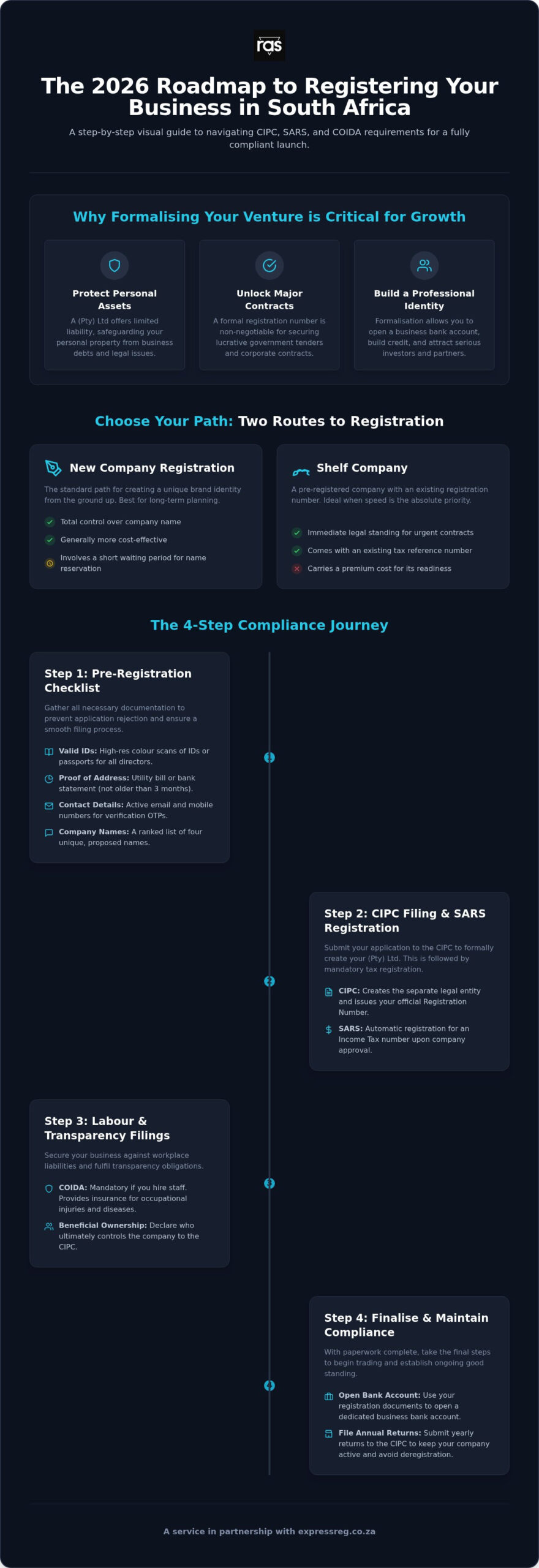
New Registration vs Shelf Company: Which is Right for You?
Deciding how to register depends on your specific timeline and branding needs. A new registration allows you to customise your company name and structure from the start. You’ll submit your preferred names to the CIPC and wait for their approval, which ensures your brand identity is unique and tailored to your vision. While this involves a short waiting period for name reservation, it’s often the most rewarding path for long-term brand building.
A shelf company is a pre-registered entity that already has a registration number and tax reference. This is the fastest route for entrepreneurs who need to submit a tender application immediately. Because the entity already exists, ownership is transferred to you through a director change process. Choose this option if speed is your absolute priority. Consider these factors when making your choice:
- Speed: Shelf companies offer immediate legal standing for urgent contracts.
- Identity: New registrations provide total control over the company name.
- Cost: New registrations are generally more cost-effective, while shelf companies carry a premium for their readiness.
What is a (Pty) Ltd and Why Does it Matter?
The Private Company, or (Pty) Ltd, is the standard vehicle for small business registration south africa. It offers the benefit of limited liability, which protects your personal assets if the business faces financial difficulty. Because the company is a separate legal person, your personal property and savings remain safe from business creditors in most standard scenarios. This protection is a critical safety net for any business owner.
This structure also makes it easier to bring in investors or partners as your venture grows. You can issue shares and scale the business professionally without the limitations of a sole proprietorship. If you’re ready to take this step, you can register a Pty Ltd in South Africa through a streamlined service that handles the technical filing for you. This ensures your foundation is solid and compliant from day one.
The Essential Pre-Registration Documentation Checklist
Success begins with preparation. Before you initiate your small business registration south africa, you must ensure your administrative foundation is flawless. The CIPC is strict regarding document quality. A blurry scan or an expired ID will result in immediate rejection, costing you valuable time. Gathering your materials beforehand prevents these common setbacks and keeps your application moving forward.
Ensure you have these essential items ready before you start the digital filing process:
- Valid Identification: High-resolution colour scans of South African green ID books, smart cards (both sides), or valid international passports for all proposed directors.
- Proof of Address: Recent utility bills or bank statements, usually not older than three months, for both residential and business locations to satisfy FICA requirements.
- Verified Contact Details: Active mobile numbers and email addresses for every director. The CIPC system relies on One-Time Pins (OTPs) for identity verification during the filing.
- Proposed Names: A list of four unique names, ranked from your most preferred to your least preferred option.
While focusing on the CIPC, remember that legal standing also involves the tax man. Reviewing the requirements for SARS business registration early helps you understand your future obligations as a taxpayer and ensures you’re ready for the automatic tax number generation that follows incorporation.
Director Requirements and Qualifications
To serve as a director, an individual must be at least 18 years old and have full legal capacity. Certain individuals, such as unrehabilitated insolvents or those convicted of fraud, are disqualified from holding these positions. During the application, one person acts as the ‘Incorporator’. This individual is responsible for the initial filing and signs the Memorandum of Incorporation (MoI). If you’re managing multiple directors, ensure every person is available to provide their OTPs promptly to avoid session timeouts.
Naming Your Business: CIPC Rules and Restrictions
The CIPC requires you to submit four proposed names in order of preference. Your first choice should be your most desired brand name, but you must ensure it’s unique amongst existing entities. Avoid prohibited words or terms that imply government affiliation unless you have specific permission. If the registrar rejects all four names due to conflicts, you don’t need to panic. You have the option to register the company using its enterprise number (e.g., K2026123456) and apply for a formal name at a later stage. This allows you to secure your registration number immediately for urgent needs.
If the prospect of managing these technical details feels overwhelming, you can delegate the paperwork to a professional facilitator who understands the nuances of CIPC rejections and name reservations.
Statutory Compliance: SARS, COIDA, and Labour Requirements
Completing your initial small business registration south africa through the CIPC company registration portal is a significant milestone, but it’s only the first step toward full legal standing. Many entrepreneurs mistakenly believe their administrative work ends once they receive their registration certificate. In reality, a business must integrate with national tax and labour authorities to avoid penalties or being barred from lucrative contracts. A unified approach to compliance ensures your venture remains active and ready for growth.
Tax Compliance: SARS and VAT Basics
When the CIPC processes your incorporation, it automatically generates an income tax reference number through a direct link with the South African Revenue Service (SARS). You should verify this number on your registration documents immediately. If you plan to employ staff, you’ll also need to register for Pay-As-You-Earn (PAYE) to manage monthly tax deductions. This ensures you’re meeting your obligations as an employer from the very first payday.
Understanding your Value-Added Tax (VAT) obligations is equally critical. As of April 1, 2026, the compulsory VAT registration threshold stands at R2.3 million in turnover over a 12-month period. Startups often find that voluntary registration is beneficial if their turnover exceeds R120,000. This allows you to claim back VAT on significant initial capital expenses or equipment purchases, which can provide a vital cash flow boost during your first year of operation.
Labour Compliance: COIDA and Workplace Insurance
If you employ even one person, you must register with the Department of Labour. This involves two distinct but related processes: Unemployment Insurance Fund (UIF) and Compensation for Occupational Injuries and Diseases Act (COIDA) registration. UIF contributions are calculated at 2% of an employee’s salary, with the total contribution capped at a monthly salary of R17,712 for the 2026 period.
COIDA registration provides workplace insurance that protects you from being sued by employees for injuries sustained on the job. It’s a non-negotiable requirement for most industries, especially in sectors like construction or manufacturing. Once registered, you must submit your Return of Earnings by June 30, 2026, to remain compliant. Successful registration and payment of assessment fees allow you to obtain a Letter of Good Standing. This document is frequently requested by clients and is a mandatory requirement for almost all government tender submissions.
Navigating the Red Tape: Avoiding Delays and Deregistration
The initial phase of small business registration south africa is where many entrepreneurs face the most friction. Administrative delays usually stem from two avoidable sources: name disputes and document errors. If your proposed name is too similar to an existing trademark or entity, the CIPC will reject it. Similarly, uploading a low-resolution scan of your ID can pause your application for days. Ensuring your paperwork is pristine from the start is the most effective way to protect your timeline. Entrepreneurs who are under pressure to meet contract deadlines should explore the fastest way to register a company in South Africa to understand how to eliminate name reservation bottlenecks and secure a valid registration certificate in the shortest possible time.
The Annual Return Trap: Don’t Get Deregistered
Many founders confuse CIPC annual returns with SARS tax returns. They are entirely separate requirements. Your annual return is a statutory declaration that confirms your company is still active and that your information is up to date. You must file this return every year during the anniversary month of your company’s incorporation. Missing this deadline triggers a sequence of penalties. If you fail to file for two consecutive years, the CIPC will move your company into a state of “Final Deregistration,” effectively terminating your legal entity and freezing your business bank accounts.
Beneficial Ownership: 2026 Transparency Rules
As of 2026, the CIPC has tightened regulations regarding corporate transparency. Every company must now file a Beneficial Ownership declaration within 10 business days of incorporation. This filing identifies the individuals who ultimately own or control the entity, even if they aren’t listed as directors. It’s a critical tool for national anti-money laundering efforts. You must update this register whenever there is a shift in shareholding or control. Failing to maintain an accurate Beneficial Interest Register can lead to significant compliance risks and may disqualify you from private and public sector contracts.
Managing these ongoing requirements is just as important as the first day of filing. If you need to update your company’s leadership or ownership structure, ensure you process director changes and beneficial ownership filings through a professional facilitator to maintain your “In Business” status without the stress of administrative guesswork.
Maintaining statutory compliance also involves updating your records whenever your business address or contact details change. The CIPC uses your registered email and mobile number for all official communications. If these are outdated, you’ll miss critical notices regarding your company’s status or upcoming deadlines. Stay proactive to ensure your business remains a healthy, legal participant in the South African economy.
Finalising Your Launch: From Paperwork to Profit
Receiving your official certificate is a significant milestone, but it marks the beginning of your operational journey rather than the end. You’ve successfully navigated the technicalities of small business registration south africa, and now you must transform that paperwork into a functioning commercial entity. Moving from a registered name to a trading business requires a shift in focus toward financial structure and long-term administrative health. This final phase is where you establish the professional habits that support sustainable growth.
Setting Up Your Business Bank Account
Most South African financial institutions require a specific set of documents before they will open a corporate account. You’ll need to provide your COR14.3 (Registration Certificate), COR15.1A (Memorandum of Incorporation), and certified ID copies for all directors. Some banks may also request a proof of business address. Opening a dedicated account is a non-negotiable step for maintaining clean accounting records and ensuring your personal assets remain distinct from company funds.
A separate account simplifies your relationship with the tax man. Once your account is active, link it to your SARS eFiling profile. This connection ensures that tax payments are seamless and that any potential refunds are paid directly into your verified business account. It also provides the professional transparency required when applying for credit or attracting future investors.
Building a Compliance-First Culture
Establishing a compliance-first culture protects your company’s reputation and legal standing. Organise your statutory records in a central, secure location from day one. This includes your incorporation documents, share certificates, and minutes of director meetings. As your venture evolves, you’ll inevitably need to process director changes or update your registered office address. Handling these updates through professional services ensures your CIPC records remain accurate whilst you focus on your core business operations.
To stay ahead of the red tape, set up a compliance calendar. This tool should track your CIPC annual return anniversary, SARS provisional tax dates, and COIDA return deadlines. By delegating these technical administrative burdens to an expert facilitator, you reduce the risk of oversight and penalties. A professional intermediary acts as a knowledgeable guide, standing between the complex machinery of government administration and your daily business goals. This partnership allows you to operate with the peace of mind that your foundation is secure and your business is always ready for the next big contract.
Secure Your Commercial Future Today
Building a successful enterprise starts with a solid legal foundation. You now have the essential checklist to navigate small business registration south africa, from gathering your FICA documents to understanding the mandatory 2026 beneficial ownership rules. Remember that true compliance extends far beyond the initial CIPC certificate. It requires active management of your SARS obligations and Department of Labour filings to protect your business from deregistration and administrative penalties.
Don’t let red tape slow your progress or distract you from your commercial goals. You can get your small business registered professionally today with the assistance of expert CIPC filing agents. Whether you require fast shelf company transfers or comprehensive SARS and Labour compliance support, we handle the heavy lifting of the paperwork. This allows you to focus on growing your profit and serving your new customers. Your entrepreneurial journey is a significant undertaking, and starting with a compliant structure ensures you’re ready for every opportunity that comes your way.
Frequently Asked Questions
How long does small business registration take in South Africa in 2026?
Registration typically takes between one and three business days once you’ve submitted all required documentation correctly. The CIPC’s digital systems have significantly reduced turnaround times compared to previous years. If you require a registration number immediately for an urgent tender, a shelf company transfer is often the fastest route available.
Can I register a business in South Africa without a name?
You can register a company using its enterprise number if you don’t have a finalised name ready. This allows you to secure your legal standing and open a bank account immediately. You have the option to apply for a formal name reservation and amend the company records at a later stage once you’ve made a decision.
What is the difference between a Pty Ltd and a shelf company?
A (Pty) Ltd is the legal structure of a private company, while a shelf company is a pre-registered (Pty) Ltd that is already incorporated and ready for immediate transfer. Both offer the same limited liability protections. Entrepreneurs choose shelf companies primarily for speed, as they provide an active registration number without waiting for the CIPC name approval process.
Do I need a lawyer or an accountant to register my company?
You aren’t legally required to use a lawyer or an accountant for small business registration south africa. The process is designed to be accessible to all entrepreneurs. However, many founders use a professional facilitator to handle the technical filings for CIPC, SARS, and the Department of Labour to ensure total compliance and avoid administrative errors.
How much does it cost to register a small business in South Africa?
The official CIPC fee for a new company registration is R175 with a reserved name, or R125 if you register without a name. A separate name reservation costs R50. While these are the basic statutory fees, most business owners choose bundled services that include VAT, COIDA, and UIF registrations to ensure their venture is fully compliant from the start.
What happens if I forget to file my CIPC annual returns?
Failing to file your annual returns results in late-filing penalties and will eventually lead to the final deregistration of your company. Once the CIPC deregisters an entity, it legally ceases to exist, and your business bank accounts will be frozen. You must file these returns every year during your anniversary month to keep your company in good standing.
Is VAT registration mandatory for all new small businesses?
VAT registration is only mandatory if your turnover exceeds R2.3 million in a 12-month period, according to the 2026 tax regulations. You can register voluntarily if your turnover exceeds R120,000. Voluntary registration is often a strategic move for startups that need to claim back VAT on significant initial capital expenses or equipment purchases.
Can a foreigner register a small business in South Africa?
Foreign nationals can register a South African company provided they have a valid international passport. You don’t need to be a citizen or hold a local ID to be a director or shareholder of a (Pty) Ltd. You will still need to provide proof of address and comply with all standard FICA and beneficial ownership reporting requirements.