
What if the strongest case for statutory compliance services south africa isn’t a warning about penalties, but a clear record of the work your team already handles? When CIPC, SARS and labour-related tasks sit across inboxes, spreadsheets and staff members’ memories, it can be difficult to see who owns each filing or what needs attention next.
It’s reasonable for a decision-maker to question the cost of external support. A practical proposal should show the administrative workload, the deadlines and handovers involved, and the internal time being used. It should also make clear that support can cover selected filings while your business retains oversight.
This article will help you build an evidence-based case and identify which recurring and event-driven tasks may apply to your business. You’ll consider relevant CIPC, SARS and Department of Employment and Labour responsibilities, then assess a provider’s scope, process and fees before recommending a fit. The aim is a manageable plan, not a blanket claim that every business needs the same support.
Key Takeaways
- Use a recent task log or filing calendar to show your boss the workload and where ownership is unclear.
- Check which CIPC, SARS and labour-related tasks apply to your business before proposing support.
- Assess statutory compliance services south africa by the specific filings included, not by broad promises of coverage.
- Compare external support with your team’s capacity, process continuity and need for internal oversight.
- Ask for a written scope that clarifies responsibilities, approvals, updates and submission records.
Why statutory compliance services in South Africa may be worth discussing with your boss
A CIPC reminder arrives in one inbox, company records sit in a shared drive, and another filing is waiting on information from a colleague. When nobody has a complete view of what is due or who is handling it, even routine administration can require repeated follow-ups. The case for statutory compliance services south africa is strongest when it starts with this visible workload, not a general warning about what might go wrong.
In practical terms, statutory compliance services provide administrative assistance with company, tax or labour-related filings that apply to a business. The work may include recurring submissions, such as CIPC annual returns; one-off applications, such as VAT or COIDA registration; and company record updates, such as director changes or beneficial ownership filings. The legal and administrative context includes the South African Companies Act. However, the specific tasks depend on the business and should be checked against current requirements.
What does a statutory compliance service help manage?
A provider may help prepare or process selected filings and related documentation, depending on the agreed scope. Some tasks recur; others arise when the company’s circumstances change or an application is needed. Ask exactly which filings are included, what information your team must supply and what remains outside the service. Delegating administration doesn’t transfer the company’s or its directors’ responsibilities, and it can’t guarantee compliance or an authority’s decision.
Which signs make the internal conversation timely?
Look for evidence that the current process is using staff time or leaving gaps. Keep a task log for a representative period before making the case to your manager. Record:
- Tasks with no clearly assigned owner or backup.
- Repeated follow-ups to collect information, approvals or supporting documents.
- Corrections or resubmissions, including what caused them.
- Time spent checking deadlines, locating records and coordinating handovers.
- Filing evidence that is missing or difficult for the team to retrieve.
Keep the log factual. Separate confirmed missed handovers, incomplete records and repeat work from hypothetical penalties or worst-case scenarios. This gives your boss a fair basis for weighing external support against improving the internal process.
Consider external assistance when the log shows recurring coordination work, unclear accountability or limited staff capacity. If ownership is clear and records are consistently complete, in-house administration may be working well. Either way, identify the specific tasks that need attention, then check whether a provider’s scope matches them. This turns a broad request to “outsource compliance” into a focused discussion about workload, responsibilities and process controls.
Which South African compliance tasks could an external service cover?
Start by listing the filings your business handles, then match each one to its trigger and the help you expect a provider to supply. The scope of statutory compliance services south africa can include different CIPC, SARS and labour-related administrative tasks, but no single checklist applies to every business. Confirm current requirements with the relevant authority and ask the provider to state its scope in writing. The Corporate Governance Laws and Regulations overview offers broader context for South Africa’s corporate governance framework.
| Filing area | Example task | Typical trigger | Provider-scope question |
|---|---|---|---|
| CIPC | Annual returns | A company’s recurring CIPC filing cycle | Does the service cover preparation, submission and filing evidence? |
| CIPC | Director changes | A change to the company’s directors or their recorded details | Which documents and approvals must we provide? |
| CIPC | Beneficial ownership filing | Disclosure or a relevant change to ownership or control information | Does the scope include initial and updated filings, where applicable? |
| SARS | VAT registration | Business circumstances that meet compulsory registration rules, or a decision to explore voluntary registration | Does support cover the registration application, and what information is required? |
| SARS | PAYE administration | Employer circumstances that make PAYE obligations relevant | Which submissions or registrations are included, if any? |
| Labour-related | COIDA registration | Business and employer circumstances that call for registration | Does the service cover the application and supporting records? |
| Labour-related | Letter of Good Standing | A need for the document, subject to the applicable requirements | What must be in place, and what does the provider handle? |
How do CIPC filings fit into ongoing company administration?
Annual returns form part of recurring company administration. Director changes and beneficial ownership disclosures relate to company records and may need attention when relevant details change. Treat these as distinct tasks, and verify current CIPC rules, filing requirements and deadlines before setting your calendar. For a closer look, consult the guide titled CIPC Annual Returns Submission: The Complete 2026 Compliance Guide.
When might SARS or labour-related administration need attention?
VAT and PAYE have different tax-related triggers, while COIDA registration and a Letter of Good Standing are separate labour-related matters with their own processes. Don’t assume that one application covers another or that every task applies to your company. Check the SARS VAT registration guide for VAT-specific detail and the Letter of Good Standing guide for tender or documentation context.
Use the table to turn a broad request for compliance help into a defined scope. For example, a business might need CIPC annual returns and director changes, but not VAT registration. If you’re checking which administrative services a provider lists, review the available business filing services and confirm what applies to your circumstances.
In-house administration or statutory compliance services: compare the real trade-offs
Outsourcing isn’t automatically more efficient, and keeping filings in-house isn’t automatically cheaper. Compare the work your business needs with the capacity and controls it already has. For some teams, one clearly assigned staff member and a dependable calendar are enough. For others, recurring submissions or specialised applications compete with day-to-day responsibilities and become harder to manage when staff are absent or roles change.
Use these factors to make a balanced comparison:
- Task volume: How often do filings arise, and how many separate records or approvals do they involve?
- Staff capacity: Can the responsible employee complete the work without disrupting other duties?
- Continuity: Is there a trained backup, or does the process rely on one person’s knowledge and inbox?
- Oversight: Who checks information, authorises submissions and follows up on outstanding items?
- Documentation: Can the business retrieve supporting records and submission evidence when needed?
What should a fair in-house versus outsourced comparison include?
Compare the internal time spent preparing information, chasing approvals, managing handovers and keeping records with the provider’s written scope and communication process. Check how documents are shared, who can access them, how records are retained and what happens if information is missing or a task needs escalation. Use your own workload notes rather than assumed savings or broad claims. A fixed-fee administrative service may make the cost of defined processing easier to assess, but compare only the tasks and responsibilities included.
In-house administration may be the better fit when ownership is clear, staff have capacity and the process continues reliably despite leave or role changes. External support may be worth assessing when recurring work is difficult to fit into existing roles or a task requires unfamiliar administration. A mixed approach is also possible: delegate selected filings while retaining internal responsibility for records, approvals and decisions.
How can a business retain oversight after outsourcing?
Keep an internal contact responsible for supplying accurate information, securing approvals and monitoring open requests. Agree how the provider will report progress, identify missing documents and share submission records. Put responsibility boundaries in writing, including what the provider handles and what your team must do.
Outsourcing administrative processing doesn’t transfer statutory responsibility away from the company or its directors. Nor does a provider replace the roles of directors, accountants or auditors. Treat statutory compliance services south africa as support for defined administrative tasks, with your business retaining oversight. Review the arrangement against the agreed scope and actual workload, then adjust it if your needs change.
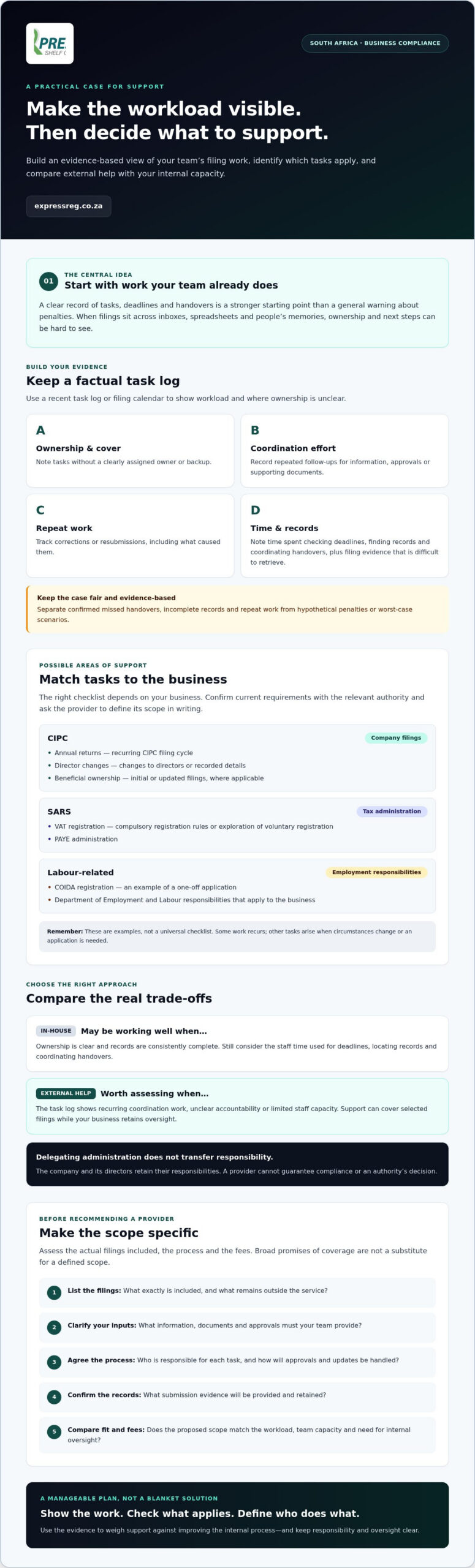
How to convince your boss that the business needs compliance support
A useful proposal answers five questions: what work is being done, why the current process needs attention, which tasks you want help with, how the business will retain control, and when you’ll review the arrangement. This gives your manager something concrete to assess, rather than a broad request to outsource statutory compliance services south africa.
What evidence should you take into the meeting?
Bring a recent filing calendar or task log. Keep it specific to your business, and separate confirmed work from tasks that may not apply. Include:
- Recurring CIPC, SARS or labour-related tasks, with their current internal owners.
- Known upcoming company changes or applications that need attention.
- Information or approvals still outstanding, and where a handover is incomplete.
- Time spent coordinating work, where staff have recorded it reliably.
- Corrections or repeat follow-ups, with a brief note about their cause.
Check that each task belongs on your list before presenting it as a business requirement. For example, VAT, PAYE, COIDA and CIPC filings don’t automatically apply in the same way to every company. Identify what needs verification rather than treating an unconfirmed obligation as established fact.
How should you present a manageable proposal?
Start with the business need shown by your records. Then request support for a limited set of relevant tasks, rather than proposing a broad arrangement before the scope is clear. Ask for a written description of included filings, exclusions, information the company must provide, fees and the provider’s communication process.
Explain the controls you’ll keep in place: name an internal contact, set out who approves information, and agree how management will access progress updates and submission evidence. Set a review date in the proposal so you can compare the agreed scope with the actual workload and decide whether to continue, adjust or manage the tasks internally. Don’t claim that the arrangement will save a particular amount of time or prevent penalties unless your own evidence supports that conclusion.
You could frame the discussion like this: “Our task log shows these filings and handovers are taking staff time. I’d like us to assess support for these specific tasks, confirm responsibilities and records access, then review whether the arrangement fits our needs.” This keeps the decision focused on workload and process control, not fear. External assistance can support administration, but responsibility remains with the business and its directors.
To compare a defined scope with your filing needs, review CIPC annual returns and company filing support as part of your assessment.
How to choose a statutory compliance service in South Africa and take the next step
A useful provider comparison starts with your task list, not a broad promise to “handle compliance”. Ask for a written scope that names each included filing, what’s excluded, what your business must supply and which decisions require your approval. The right scope for statutory compliance services south africa depends on your company’s circumstances, so confirm which CIPC, SARS or labour-related tasks apply before agreeing to delegate them.
What questions should you ask a prospective provider?
Use these questions to check whether the provider’s process matches your needs:
- Which specific filings are included, and which are outside scope?
- What information and supporting documents must our team provide?
- Who checks the details, obtains approval and submits the filing?
- How will you communicate queries, changes, delays and completed submissions?
- How are business records handled, stored and made available to us?
- What evidence will we receive after a submission, and how can we follow its status?
- What relevant experience do you have with the CIPC, SARS or Department of Employment and Labour process we need?
Ask the provider to explain its current process for the specific task, rather than relying on general claims of expertise. Clarify exclusions too. Administrative filing support is not the same as legal representation or independent auditing, and those services should not be assumed to form part of a filing engagement.
How can Express Shelf Company support the next step?
Express Shelf Company is a privately owned consultancy serving businesses nationally across South Africa. Its listed administrative services include CIPC annual returns, director changes, beneficial ownership filing, VAT registration, COIDA registration and Letters of Good Standing. It offers fixed-fee administrative processing, with the exact scope to be confirmed for the service you need. Not every filing applies to every business.
Before proceeding, match your task list to the provider’s written scope and confirm responsibilities, approvals, document handling and submission evidence. Keep an internal contact involved so your business can provide accurate information and retain oversight of outstanding work.
If you’re ready to clarify which filings fit your circumstances, discuss the compliance filings your business needs. A focused conversation can help establish the relevant administrative requirements and the scope of support to assess, without assuming every service is necessary.
Turn your filing workload into a clear next step
A strong case for statutory compliance services south africa begins with evidence: the tasks your business handles, the time spent coordinating them and any gaps in ownership or records. Use that picture to decide whether selected filings should stay in-house or whether administrative support could help. Then confirm the provider’s written scope, your team’s responsibilities and how approvals and submission records will be managed. The business and its directors retain their responsibilities.
Express Shelf Company provides administrative support for CIPC, SARS and Department of Labour-related services, serves clients nationally across South Africa, and offers fixed-fee administrative processing. The right filing depends on your business circumstances, so clarify which services are relevant before proceeding.
Ready to discuss a specific requirement? Discuss the compliance filings your business needs and take the next step with a clearer view of the work involved. A focused plan can make the process easier to manage while keeping your business in control.
Frequently Asked Questions
What are statutory compliance services in South Africa?
Statutory compliance services in South Africa are administrative services that help a business manage filings that apply to it. Depending on its legal structure, activities and circumstances, support may cover CIPC annual returns, director changes, beneficial ownership disclosures, or selected SARS and labour-related applications. The scope isn’t universal. Check current requirements with the relevant authority or a suitably qualified adviser, then confirm in writing which tasks a provider will handle.
Can a small business outsource statutory compliance in South Africa?
Yes, a small business can seek external administrative help for suitable filings while retaining oversight of its records, approvals and responsibilities. Start by identifying tasks that recur, require specialised administration or are difficult to manage with available staff. Ask the provider to specify what it handles and what remains with the company. Check which obligations apply to your business, rather than assuming every filing or service is necessary.
How do I convince my boss to use a compliance service?
Build your proposal from the company’s own filing calendar, task log and documented process gaps. If you’re researching “statutory compliance services south africa”, focus your case on who handles each task, where handovers occur and which specific support you’re requesting. Compare that scope with the current internal process, then explain how management will retain oversight. Avoid unsupported claims about savings, penalties avoided or guaranteed compliance.
What happens if a company misses a statutory filing in South Africa?
The outcome depends on the filing, the company’s circumstances and the rules in force. A missed submission may require follow-up or corrective action, but don’t assume a particular consequence or remedy. Identify the overdue item, check the company’s status and consult the relevant authority’s current guidance. If the next steps are unclear, seek appropriate administrative or professional advice. Verify applicable deadlines and remedies before acting.
Does a compliance service make a company fully compliant?
No. A service can assist with agreed administrative tasks, but it shouldn’t be treated as a guarantee of full compliance. The company remains responsible for supplying accurate information, reviewing requests and maintaining appropriate oversight. A provider’s engagement may exclude legal advice, auditing or obligations outside its written scope. Ask who is responsible for each step, keep records of approvals and submissions, and confirm uncertain requirements with the relevant authority.
What should I check before choosing a statutory compliance provider?
Request a written scope listing included filings, exclusions, required documents and your responsibilities. Check how the provider manages approvals, records, progress updates and submission evidence. Ask about its experience with the specific CIPC, SARS or labour-related processes you need, and how it communicates queries or delays. Compare the proposed scope with your actual requirements. Confirm which tasks apply to your business before agreeing to administrative support.