
A registration certificate proves your company exists, but it doesn’t confirm that every tax and compliance step is complete. If you’re asking, “what documents do I get after company registration”, it can be difficult to tell which papers confirm incorporation and which need separate follow-up.
That uncertainty is understandable: CIPC records and SARS tax information serve different purposes, and a missing document doesn’t automatically mean your company wasn’t registered. Check each document’s name, company number and details before deciding what may still be outstanding.
This guide explains the key CIPC records you may receive, including the Registration Certificate (CoR 14.3), Notice of Incorporation (CoR 14.1), initial director details (CoR 14.1A) and Memorandum of Incorporation (MOI). It also explains how the company income tax reference and SARS eFiling activation fit in, and which items, such as VAT or employer registrations, may need separate attention. You’ll finish with a clearer picture of what your paperwork proves and what to check next.
Key Takeaways
- Separate incorporation evidence from records linked to further tax or compliance steps to understand what documents you get after company registration.
- Use CIPC document names and form codes to see what each record confirms, rather than treating the paperwork as interchangeable.
- Check that the company name, registration number and director details are consistent across your records, then save the files securely.
- If a document is missing, check the contact details on the application, your inbox folders and any filing-provider correspondence before assuming registration failed.
What does company registration in South Africa officially confirm?
A CIPC registration record is evidence that the company’s incorporation has been processed. It confirms that the company has been recorded as a legal entity, separate from its owners. In practical terms, the company can hold rights and obligations in its own name rather than being the same legal person as its shareholders or directors.
Company registration documents are official records showing a company’s incorporation and the information recorded about it by CIPC. They help you verify the company’s identity and registration details, but they don’t prove that every tax, employer or industry-specific requirement has been completed.
What does CIPC do when it registers a company?
The Companies and Intellectual Property Commission (CIPC) is South Africa’s company-registration authority. When an incorporation application is processed, CIPC records the company and the incorporation information submitted. The resulting records provide evidence of the process and help identify the registered entity.
Document titles and delivery methods may depend on the application and the current CIPC process. Check the actual documents you receive against the company details rather than assuming every application produces an identical set. If you’re asking “what documents do I get after company registration”, remember that CIPC records relate to incorporation, not every registration or permission the business may need.
Does registration mean the business is ready to operate?
Not necessarily. Incorporation establishes the company as a legal entity, but it doesn’t automatically show that VAT or PAYE requirements have been addressed, or that employer registrations, licences or sector-specific obligations are complete. Requirements depend on the company’s activities, its circumstances and the rules that apply.
Keep these steps separate: confirm incorporation from the CIPC records, then check relevant tax and compliance matters with SARS and the appropriate authority. If the company will employ staff, sell regulated products or operate in a regulated sector, identify any additional requirements before proceeding. A missing tax or compliance document doesn’t, by itself, mean incorporation failed. It may relate to a separate process.
Check current requirements with CIPC, SARS or the relevant regulator. If the company’s circumstances are unclear, ask a qualified adviser to help identify which obligations apply. This puts the registration evidence in context and gives you a practical next step, without treating one certificate as proof that every part of the business setup is complete.
Which CIPC documents should you receive after registering a company?
CIPC incorporation records confirm different aspects of a company’s registration. The exact documents you receive can depend on the application, company circumstances and current CIPC process, so check the titles and form codes on your records. Use this checklist as a guide to what documents you may get after company registration, not as a guarantee that every application produces an identical bundle.
| Record | What it confirms |
|---|---|
| Registration Certificate (CoR 14.3) | Evidence that the company was incorporated, with its registered name and number. |
| Notice of Incorporation (CoR 14.1) | Information submitted to CIPC as part of the incorporation process. |
| Initial director details (CoR 14.1A) | Details recorded for the company’s initial directors. |
| Memorandum of Incorporation (MOI), commonly CoR 15.1A for a standard private company | The company’s founding rules and governance framework. |
What does the registration certificate confirm?
The Registration Certificate is the key record to check for evidence of incorporation. Confirm that the company name and registration number are correct, and note any dates shown. Compare these details with the Notice of Incorporation and other CIPC records. If you find a mismatch, contact CIPC or the filing provider promptly to establish the appropriate correction process. Don’t assume a discrepancy is harmless, particularly if you need to use the records for business administration.
What is the Memorandum of Incorporation?
The MOI sets out the company’s rules and governance arrangements, including how it is structured and managed. A standard private company may use a standard-form MOI, whilst a customised document may contain different provisions. Check the title and form code on the MOI you receive, and make sure it relates to your company. For more background on setting up this type of entity, see the Pty Ltd registration guide.
These records aren’t interchangeable: the certificate evidences incorporation, the notice reflects information filed, director details identify office-holders, and the MOI records the company’s governing rules. They’re also distinct from SARS tax records and later compliance filings. If you need help preparing or checking CIPC paperwork, administrative assistance with company registration is one option.
Which tax and compliance documents are separate from CIPC incorporation?
CIPC incorporation paperwork does not, by itself, prove that every tax registration or compliance step is complete. Records come from different authorities and serve different purposes. When working out what documents you get after company registration, separate the evidence of incorporation from tax and employer-related records that may need checking or follow-up.
| Record or item | What it relates to |
|---|---|
| CIPC incorporation records | Evidence that the company was incorporated and its details recorded by CIPC. |
| SARS Corporate Income Tax (CIT) reference | Identifies the company for income tax matters. SARS generates a CIT reference after successful CIPC registration; the company must be activated on SARS eFiling. |
| VAT registration evidence | Confirms VAT registration, if applicable. It is not the same as a CIT reference. |
| PAYE records | Relate to Pay As You Earn obligations where these apply to the company. |
| UIF registration | Relates to Unemployment Insurance Fund matters for employers where applicable. |
| COIDA records | Relate to Compensation for Occupational Injuries and Diseases requirements where applicable. |
| Tax Compliance Status (TCS) | Shows tax compliance status through SARS. A TCS PIN is different from a tax reference number or VAT registration evidence. |
Is a SARS tax number included with company registration?
After successful CIPC registration, SARS automatically generates a company’s Corporate Income Tax reference. That doesn’t mean every SARS step is finished: the company must be activated on SARS eFiling to manage its tax profile. Check the company’s details and tax information through SARS eFiling, or contact SARS through its official channels if you need confirmation. Don’t treat an incorporation certificate as proof of VAT registration or tax compliance.
When might VAT, PAYE, UIF, or COIDA paperwork be relevant?
These matters depend on the company’s activities and circumstances. VAT registration is separate from incorporation, whilst PAYE, UIF and COIDA may be relevant where the company has employer responsibilities. Requirements and registration routes can change, so confirm what applies with SARS, CIPC or the relevant body before relying on a document list. For VAT-specific guidance, see the SARS VAT registration guide.
Keep the records distinct: a tax reference identifies the company for tax, VAT evidence relates to VAT registration, and a TCS PIN allows tax compliance status to be shared with third parties. If you need help with VAT registration or a selected compliance filing, administrative assistance with business filings is an option. Express Shelf Company is a private consultancy, not a government authority.
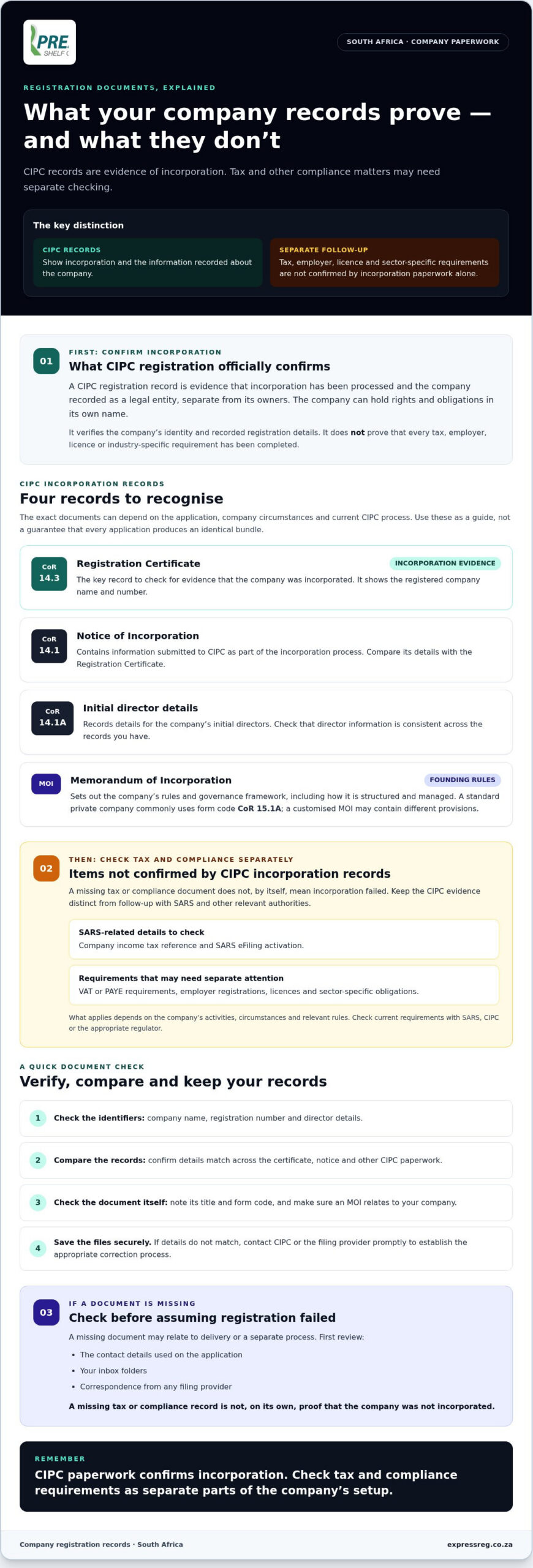
How should you check, save, and use your company registration documents?
A simple review after registration can catch incorrect details and show which follow-up items need attention. If you’re still asking “what documents do I get after company registration”, use this workflow to organise the records you have and identify anything that may still be outstanding.
- Compare the company details. Check that the registered name and company registration number match across your CIPC records. Review director details and incorporation information against the application submitted. Differences in spelling or numbers can cause delays when you use the paperwork elsewhere.
- Resolve inconsistencies. If records conflict, appear incomplete or show information you didn’t submit, contact CIPC or the filing provider that handled the application. Ask which record needs correction and follow the appropriate process. Keep copies of your query and any response with the company records.
- Save the issued files securely. Store the original digital files in an organised company folder, with a separate backup in a secure location. Use clear file names, such as “CIPC registration certificate” or “MOI”, so you can find each record quickly. Limit access to people who need it, as documents may contain personal or sensitive company information.
- List separate follow-up items. Check whether your company needs tax, VAT, employer or other compliance registrations based on its activities and circumstances. Keep related SARS or other authority records separate from CIPC incorporation documents, and confirm current requirements with the relevant body.
- Check requirements before sharing documents. A bank, customer or tender process may ask for different supporting records. One CIPC certificate may not be enough. Ask the organisation for its current document list and whether it needs certified copies, proof of address, tax information or another record before sending anything.
Good record-keeping continues after incorporation. Keep a note of later company updates and compliance filings alongside the original records, so you can distinguish current information from older versions. The CIPC annual returns guide covers one ongoing filing to track separately from your initial registration paperwork.
Need help preparing or checking CIPC registration paperwork? Get help with company registration documents from Express Shelf Company, a private consultancy, not a government authority.
What to do if a company registration document is missing
A missing email attachment doesn’t, by itself, mean your company registration failed. The document may not have reached the right inbox, or it may have been sent to the contact person or filing provider who submitted the application. Before assuming something has gone wrong, check what was filed and whether the company appears in CIPC records.
If you’re wondering “what documents do I get after company registration”, remember that records may be delivered through the contact details used for the application. Trace that route first, then confirm the company’s status and ask how to obtain any missing record.
Where can you confirm the company’s registration status?
Start with the application details. Check that the email address and other contact information were entered correctly, then search your inbox, spam and junk folders for messages from CIPC or the filing provider. Review correspondence or shared files from the person or service that handled the submission.
If the record is still missing, contact the filing provider for an update. You can also use CIPC’s current official channels to ask about the company’s registration status or document query. Have the proposed or registered company name, registration number if available, and application details ready. Check CIPC’s current guidance for the correct way to request records: retrieval methods, fees and processing times can change, so don’t rely on old instructions.
When can a registration consultant help?
A registration consultant may help you review the paperwork, trace an application handled through their service, or clarify what administrative follow-up may be needed. If a record contains incorrect details or the status is unclear, the issue still needs to be confirmed with CIPC or the appropriate authority. Ask what support is included before engaging anyone.
Express Shelf Company is a private consultancy, not a government body or CIPC representative. It assists with new company registration and CIPC documentation, but its involvement doesn’t replace confirmation from CIPC. Keep copies of your messages and any responses so you can track what has been checked and what remains unresolved.
In short: check the original contact details, search all relevant inbox folders, ask the filing provider, then confirm status or request guidance through CIPC’s current official channels. A missing attachment is a reason to investigate, not proof that incorporation failed. If you’d like to review what administrative support may be available, explore company registration assistance.
Keep your company records clear and ready for the next step
Knowing what documents do I get after company registration starts with separating CIPC incorporation records from SARS tax information and other compliance paperwork. Check that company and director details match, save the issued records securely, and confirm any separate registrations that apply to your business. If a document seems to be missing, check the application contact details and correspondence before confirming its status with CIPC or your filing provider.
Express Shelf Company assists with new Pty Ltd registration and CIPC documentation, as well as selected SARS and statutory compliance filings. It’s a private consultancy, not a government authority, and serves businesses across South Africa. If you’d like administrative support with your paperwork, explore company registration assistance.
With your records checked and organised, you can approach the next business or compliance step with greater confidence.
Frequently Asked Questions
What documents do you receive after registering a company in South Africa?
You commonly receive CIPC incorporation records, although the exact titles and delivery method can depend on the application. Check for the Registration Certificate, commonly identified as CoR 14.3, and the Memorandum of Incorporation (MOI), verifying the details against current CIPC guidance. Tax and employer registrations may have separate evidence. Compare the registered company name and registration number across every record, and follow up if details differ or an expected document is missing.
Do I automatically get a SARS tax number after company registration?
After successful CIPC registration, SARS automatically generates a Corporate Income Tax reference number, but the company must then be activated on SARS eFiling. Confirm the company’s tax profile through eFiling or ask SARS through its official channels if you need clarification. A Corporate Income Tax reference is not VAT registration evidence or proof of Tax Compliance Status, and a CIPC incorporation document alone doesn’t confirm that all tax steps are complete.
What is a CoR 14.3 document?
CoR 14.3 is the CIPC Registration Certificate for a company, according to the current document information available for this guide. It serves as evidence of incorporation and records key details such as the company’s registered name and registration number. Check those details, along with any dates shown, against your other CIPC records. Forms and document formats may vary by application, so consult current CIPC guidance if your certificate has a different title or appearance.
Is the Memorandum of Incorporation proof that my company is registered?
The MOI sets out the company’s rules and governance provisions; it isn’t interchangeable with the CIPC record that evidences incorporation. Keep both documents and check that the company details are consistent. The MOI helps explain how the company is governed, while the applicable CIPC registration record confirms incorporation. Neither document on its own proves that VAT, employer registrations or every other tax and compliance obligation has been completed.
What should I do if I have not received my company registration documents?
First check the email address supplied with the application, including spam and junk folders, then review messages or shared files from your filing provider. If the documents are still missing, ask the provider to confirm the application status and delivery details. You can also contact CIPC through its current official channels to check status or ask about obtaining records. Have the company name, registration number if available, and application details ready. A missing attachment alone doesn’t prove registration failed.
Does company registration include VAT, PAYE, UIF and COIDA registration?
No single CIPC incorporation record should be treated as proof that VAT, PAYE, UIF and COIDA matters are all complete. These are distinct tax or employer-related registrations and may not apply to every company. Processes and evidence can differ, so confirm current requirements with SARS and the relevant authority based on your company’s activities and circumstances. Check what applies before charging VAT or taking on employees, rather than assuming incorporation covered those steps.
Can I use my registration certificate to open a business bank account?
You can use the CIPC Registration Certificate as supporting evidence, but a bank may request other documents before considering an account application. Requirements vary by institution and account type; they may include directors’ identity documents, proof of business address, or tax and ownership information. Ask the bank for its current document list before applying and check whether copies must be certified. Providing the certificate doesn’t guarantee that the bank will approve the account.