
In the sole proprietorship vs pty ltd south africa decision, a Pty Ltd generally separates company debts from your personal obligations, while a sole proprietor and the business are not legally separate. That difference can affect which assets are exposed if the business cannot pay its debts.
A company does not guarantee that your personal assets are safe. Signing a personal surety or certain director conduct may expose you to personal liability. Incorporation also brings CIPC and tax compliance responsibilities to manage.
This guide compares how each structure affects personal liability and outlines practical ways to assess business debt exposure. You’ll learn when a company’s separate legal identity may not protect you, what to consider before signing an agreement, and how to weigh ongoing compliance. Use these points to prepare for a decision, and seek professional advice when your circumstances call for it.
Key Takeaways
- Compare how each structure affects your personal exposure, rather than choosing on simplicity alone.
- Weigh liability alongside administration, tax treatment and continuity to identify which structure fits your business plans.
- Before accepting business credit or signing an agreement, check whether you are taking on a personal obligation such as a surety or guarantee.
- Keep business and personal records organised, and review your financial position regularly.
- Use a practical decision checklist, then seek tailored legal or tax advice if your circumstances or potential exposure are complex.
Sole proprietorship vs Pty Ltd in South Africa: what changes for personal assets?
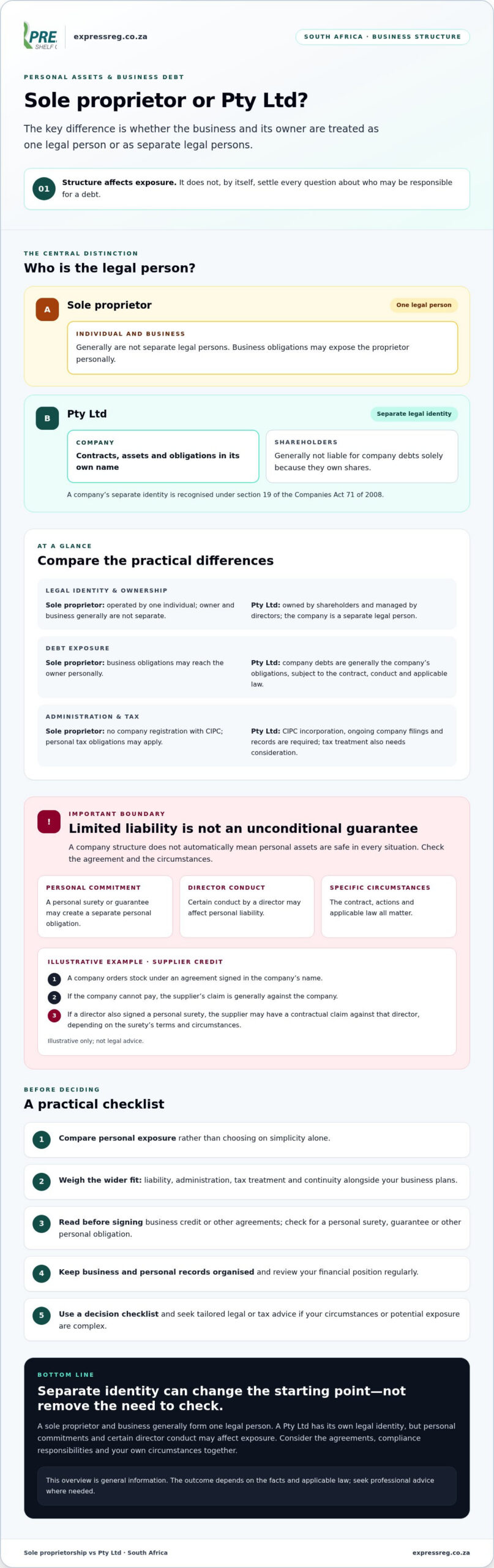
The same business debt can have different consequences depending on the business structure. A sole proprietorship and its owner generally are not separate legal persons. A Pty Ltd, by contrast, is a company with its own legal identity. This distinction is central to understanding sole proprietorship vs pty ltd south africa and what each structure may mean for your personal assets.
What does sole proprietorship mean in South Africa?
A sole proprietorship is a business operated by an individual, rather than a company registered as a separate entity with the Companies and Intellectual Property Commission (CIPC). The owner and business are generally treated as one legal person. Business obligations may therefore expose the proprietor personally, although the outcome depends on the facts and applicable law. A sole proprietor may still have tax obligations with SARS. Those obligations are separate from registering a company with CIPC.
What does Pty Ltd mean for ownership and liability?
A Pty Ltd is a private company that exists separately from its shareholders. Under the Companies Act 71 of 2008, a company has a legal identity distinct from the people who own its shares. The general principle is that shareholders are not personally liable for company debts simply because they are shareholders. However, limited liability is not an unconditional guarantee. Personal commitments, such as a surety, or circumstances involving a director’s conduct may change the position. For more background on the framework, see this overview of South African company law.
In short: a sole proprietor operates a business in their own legal capacity, while a Pty Ltd conducts business as a separate legal person. That difference can affect who is responsible for a debt, but it does not remove the need to assess each contract and circumstance.
| Consideration | Sole proprietor | Pty Ltd |
|---|---|---|
| Owner and legal identity | Individual and business generally are not separate legal persons. | Company has a legal identity separate from shareholders. |
| Liability exposure | Business obligations may reach the owner personally. | Shareholders generally are not liable for company debts solely because they own shares. Exceptions can apply. |
| Basic administration | No company registration with CIPC. Personal tax obligations may apply. | Requires CIPC incorporation and ongoing company filings and records. |
| Ownership | Operated by one individual. | Owned by shareholders and managed by directors. |
If you’re considering incorporation, read the Pty Ltd registration guide for an overview of the process. Registration and compliance assistance can help with administration, but it does not replace legal or tax advice about your personal exposure.
How does a Pty Ltd limit personal liability for business debt?
A Pty Ltd can separate company debts from a shareholder’s personal obligations, but it does not cancel debts or guarantee that personal assets are always beyond reach. Under section 19 of South Africa’s Companies Act 71 of 2008, a company is a juristic person separate from its shareholders. A person generally is not liable for company obligations solely because they are a shareholder or director. The Act and the facts of a particular situation still matter.
How does separate legal personality work in practice?
The company can enter contracts, own assets and incur obligations in its own name. Shareholders own shares, directors manage the company’s affairs, and the company itself is the contracting entity. These roles may overlap in a small business, but they are not legally interchangeable. If the company owes a supplier, the debt is generally the company’s obligation. Whether an individual also faces personal exposure depends on the contract, their actions and the applicable law.
Hypothetical example: A company orders stock from a supplier under an agreement signed in the company’s name. If the company later cannot pay, the supplier’s claim is generally against the company. If its director separately signed a personal surety, the supplier may also have a contractual claim against that director, depending on the surety’s terms and the circumstances. This example is illustrative, not legal advice.
Which situations can put personal assets at risk?
Check what you sign and how the company is run. A personal surety or guarantee may create an obligation in your own name, separate from your role as shareholder. Ask for the full agreement and get advice before accepting that responsibility. Do not assume a document relates only to the company because it concerns company borrowing, a lease or supplier credit.
There may also be personal consequences where a director’s conduct breaches legal duties. Section 22 of the Companies Act addresses carrying on business recklessly, with gross negligence, with intent to defraud a person, or for a fraudulent purpose. An allegation alone does not establish liability. The relevant facts and legal tests must be assessed, so the company’s separate identity is not a blanket shield from every claim.
For the sole proprietorship vs pty ltd south africa decision, look beyond the structure’s label. Check who is named in contracts, whether you are being asked to provide personal security, and whether company records and filings will be kept in order. If incorporation suits your circumstances, you can review Pty Ltd registration support as an administrative next step. For advice on personal exposure, consult a qualified legal professional.
Sole proprietorship vs Pty Ltd: which structure suits your business?
There is no automatic winner in the sole proprietorship vs pty ltd south africa choice. Consider the business risks you face, your plans for growth, the administration you can manage and the tax consequences for your circumstances. The comparison below is a starting point, not legal or tax advice.
| Consideration | Sole proprietor | Pty Ltd |
|---|---|---|
| Liability | The owner may be personally exposed to business obligations. | Separate legal identity generally distinguishes company debts from shareholders’ personal obligations, subject to exceptions. |
| Administration | No company incorporation with CIPC, but personal tax and other applicable obligations still need attention. | Incorporation brings company records and ongoing CIPC filing responsibilities to check and manage. |
| Tax | Business income is generally dealt with through the proprietor’s tax position. | The company has its own tax obligations. The right treatment depends on circumstances and current SARS rules. |
| Continuity and ownership | The business is closely tied to the individual, so consider succession and transfer plans. | A company provides a more formal ownership and record structure, but changes and continuity need proper planning. |
When might operating as a sole proprietor be suitable?
An individual starting a relatively straightforward activity may value a simpler operating arrangement, particularly if they’re working alone and do not need a separate company structure. Simplicity does not remove personal responsibility for business obligations. Before deciding, consider the contracts you’ll sign, the risks of your activity and whether you plan to employ staff.
When might a Pty Ltd be worth considering?
A Pty Ltd may be worth assessing if you plan to bring in co-owners, pursue larger contracts or build a business with formal records and a distinct legal identity. That separation is not a guaranteed shield, and incorporation adds ongoing administration. Check which records, tax filings and CIPC submissions apply, and whether you can keep them up to date.
For example, a solo consultant with limited contractual exposure may prioritise simplicity, while a business planning to take on partners or more complex contracts may want to examine the company structure. Neither scenario determines the right answer on its own. Ask a qualified tax professional to compare the tax treatment for your situation and confirm current SARS requirements.
If you incorporate, include continuing filings in your decision, not just the initial registration. Review the CIPC annual returns guide for an overview of this ongoing responsibility. Weigh your risks, plans and capacity to meet each structure’s obligations before choosing.
How to Reduce Personal Exposure to Business Debt
Your business structure is only one part of managing financial exposure. Clear records, careful contract checks and informed decisions can help you understand who is responsible for an obligation. These steps do not make assets unreachable or remove legitimate creditor claims. Use them to keep your arrangements clear, and seek advice when the implications are uncertain.
- Check who is borrowing. Before accepting credit, confirm whether the borrower named in the agreement is you personally or your company. If you’re asked to sign as a guarantor or surety, understand that this may create a separate personal obligation.
- Read the full agreement. Review liability, security and default clauses, not only the repayment terms. Ask an independent legal professional to explain any wording you do not understand before signing.
- Keep signed documents. Save the agreement and related correspondence so you can confirm who entered into it and in what capacity. Make sure the signature block shows whether you’re signing for yourself or, where authorised, on behalf of the company.
- Separate business and personal records. Where appropriate, use distinct accounts and bookkeeping records, and record transactions accurately. Clear records help show how the business operates, but do not guarantee protection from personal liability.
- Keep company administration current. Track relevant CIPC filing responsibilities, check deadlines through official CIPC sources, and update company information when circumstances change. Confirm the correct filing process for each change.
- Review insurance and professional advice. Ask an insurance professional what risks a policy covers and what exclusions apply. Insurance may help with covered risks, but it does not replace legal or financial advice or prevent every debt or claim.
These checks are useful whether you operate as a sole proprietor or a company. In the sole proprietorship vs pty ltd south africa decision, focus on practical exposure: the contracts you sign, how you keep records and which ongoing obligations you can manage. If a creditor’s terms are unclear, get advice before committing rather than assuming your chosen structure settles the question.
For a Pty Ltd, keeping filings organised is part of company administration. If you need help with CIPC annual returns and director changes, review the relevant filing support and confirm what applies to your company.
Choosing your structure and taking the next step in South Africa
Use this comparison to identify what needs closer attention, rather than looking for a structure that removes every risk. In the sole proprietorship vs pty ltd south africa decision, weigh your likely contractual exposure, ownership and growth plans, tax position, and ability to manage ongoing administration. A qualified legal or tax professional can assess how current South African law applies to your circumstances.
What information should you gather before deciding?
Prepare a clear outline of how the business will operate before seeking advice. Bring details of your planned activities, expected customer and supplier contracts, ownership plans and likely borrowing needs. Flag any agreement that asks you to provide a personal guarantee or surety. Also list questions about who may be liable and how business income should be treated for tax. An adviser can then consider your specific facts rather than relying on a general comparison.
- Business activity: What work will you do, and what contractual or operational risks could arise?
- Ownership and growth: Will you remain the only owner, bring in co-owners or plan to expand?
- Contracts and borrowing: Who will sign, who will borrow, and are personal commitments requested?
- Tax and administration: What tax treatment should you verify with SARS or a tax professional, and which filings can you keep up with?
How can you organise registration and ongoing filings?
If you choose a company, treat incorporation and ongoing compliance as separate steps. Registering a Pty Ltd establishes the company, but does not complete future filing responsibilities. Identify which CIPC filings and company records apply, note relevant deadlines, and check current requirements through official sources. Update company information when circumstances change, using the applicable CIPC process.
Express Shelf Company provides administrative support for new Pty Ltd registration and filings such as CIPC annual returns, director changes and beneficial ownership filings. This support is not legal advice or legal representation, and it does not determine whether a company is the right structure or guarantee protection from personal liability. Ask a qualified adviser about legal or tax questions, and use administrative support for the registration and filing steps that fit your decision.
Once you’ve considered your exposure, plans and capacity for compliance, you can arrange company registration support if you decide to incorporate. First confirm that the structure and its obligations suit your circumstances.
Make your next business decision with confidence
The sole proprietorship vs pty ltd south africa decision comes down to your personal exposure, business plans and ability to manage each structure’s obligations. A Pty Ltd creates a separate legal identity, but does not guarantee protection from every personal claim or commitment. Contracts, personal sureties and company conduct still matter.
Before choosing, review your expected contracts, ownership plans and borrowing needs. Ask a qualified legal or tax professional to assess how the law and tax rules apply to your circumstances. If you decide to incorporate, plan for ongoing CIPC filings as well as registration.
Express Shelf Company provides administrative support with new Pty Ltd registration and CIPC documentation, along with annual returns and selected compliance filings. This support is not legal advice or a guarantee of asset protection. If incorporation fits your plans, arrange company registration support and take the next step with a clearer view of your responsibilities.
With the right structure and sound administration, you can build your business on a more informed footing.
Frequently Asked Questions
Is a Pty Ltd better than a sole proprietorship for protecting personal assets?
A Pty Ltd generally provides more separation between business debts and shareholders’ personal obligations, but it does not guarantee complete protection. A company is a separate legal person, while a sole proprietor and the business generally are not legally distinct. Personal guarantees and certain conduct can affect exposure. In the sole proprietorship vs pty ltd south africa comparison, consider your contracts, business risks and ability to manage company compliance before deciding.
Can a sole proprietor be personally liable for business debt in South Africa?
Yes. A sole proprietor may be personally liable for business debts because the individual and business generally are not separate legal persons. For example, if you enter a supplier contract as a sole proprietor, the business obligation may be yours personally. The exact position depends on the contract, circumstances and applicable law. Review agreements carefully and seek legal advice if you’re unsure who is responsible for a particular debt.
Does a Pty Ltd protect directors from all business debts?
No. A Pty Ltd does not protect directors from every business debt or personal claim. The company is generally responsible for its own obligations, and a person is not liable solely because they are a shareholder or director. However, personal commitments such as a surety, or conduct that may breach legal duties, can create personal exposure. Get advice on the specific contract or conduct rather than assuming the company structure settles liability.
What happens if I sign a personal surety for my company?
Signing a personal surety may make you personally responsible for specified company obligations if the company fails to meet them, depending on the agreement and applicable law. The creditor may then have a claim against you under the surety, not only against the company. Before signing, check the amount and scope covered, duration, default terms and release conditions. Ask an independent legal professional to explain unclear wording before you commit.
Can I change from a sole proprietorship to a Pty Ltd?
You can establish a Pty Ltd and move business operations into it, but this is not necessarily an automatic conversion of the sole proprietorship. Consider how contracts, assets, registrations, records and tax matters will be handled, and check whether third-party agreements need updating or consent. The steps depend on your circumstances. Ask a qualified legal or tax professional to plan the transition, and confirm company registration and filing requirements with CIPC.
Do I need to file annual returns for a Pty Ltd in South Africa?
Yes. A Pty Ltd must file annual returns with the Companies and Intellectual Property Commission (CIPC). These are an ongoing company filing responsibility, separate from tax returns or initial registration. Check CIPC’s current requirements, applicable deadlines and the information needed for your company. Keep filing records organised, and seek administrative support if you need help preparing or submitting annual returns. Missing a filing can have consequences, so do not treat incorporation as a one-off task.
Should I speak to an accountant or lawyer before choosing a structure?
Speaking to both can help because the decision involves different questions. A qualified tax professional or accountant can assess tax treatment and reporting implications, while a lawyer can advise on liability, contracts, ownership and personal guarantees. Bring details of your business activity, expected agreements, borrowing plans and ownership intentions. Ask for advice based on your circumstances and current South African law, rather than relying on a general comparison alone.