
CIPC compliance in 2026 is not a single annual task. It involves recurring filings and updates that may be prompted by changes to your company. If you are unsure what your business must submit, start by identifying which obligations apply to your entity rather than assuming every filing is universal.
This practical checklist explains what to review, which company records and dates to verify against current CIPC guidance, and what to check next. It also separates CIPC responsibilities, such as annual returns and beneficial ownership information, from tax filings with SARS and labour-related requirements handled by other authorities.
Use the guide to review relevant deadlines alongside event-triggered updates, including changes to directors or ownership. Requirements can depend on your company’s circumstances, so treat this checklist as a starting point and confirm current forms, procedures and dates through official CIPC information before submitting.
Key Takeaways
- Identify your company type and check which CIPC tasks apply to that entity.
- Use CIPC 2026 as a prompt to review recurring filings and company records, then confirm relevant dates through official CIPC information.
- Review director and other company-information changes to determine whether CIPC records may need updating.
- Follow a simple self-audit: check records, verify dates, note follow-up actions and organise submission confirmations.
- Consider administrative filing assistance if you need help managing CIPC annual returns, director changes or beneficial ownership filings.
CIPC 2026: What South African companies should check first
The Companies and Intellectual Property Commission (CIPC) is the South African government agency responsible for company registration and company-related records. Its functions include registering companies and recording updates to key information. For a high-level overview, see the Companies and Intellectual Property Commission (CIPC). For filing requirements and procedures, rely on CIPC’s current official guidance.
Use this CIPC 2026 checklist as an orientation tool, not as confirmation that every item applies to every entity. A company’s legal form, current CIPC status and circumstances can affect the tasks it needs to review. Before acting, confirm current requirements, account access and filing dates through official CIPC channels. A checklist can help you identify what to verify, but your company’s records are the starting point.
What does CIPC manage for a registered company?
CIPC handles company registration and maintains information such as a company’s registered details and directors. Its processes also include annual returns and beneficial ownership disclosures. These are CIPC matters, separate from SARS tax registration and returns and from processes handled by the Department of Labour. Keep the obligations on distinct checklists so that completing a task with one authority is not mistaken for completing a task with another.
Which parts of this checklist may apply to your business?
Start by identifying the entity registered with CIPC, then check its status and recorded details. Separate routine monitoring, such as reviewing records and relevant filing dates, from event-triggered checks. A change to directors or other important company information may mean you need to check whether a CIPC update is required. Do not assume a dormant company or an unchanged business has no tasks. Verify its position using current CIPC information.
Company-specific circumstances affect which CIPC filing tasks apply, so verify each item against your entity’s records and current official guidance.
- Identify the entity: Confirm the company type and the details shown in CIPC records.
- Check routine items: Review annual return and beneficial ownership requirements, and confirm the relevant dates for your company.
- Review changes: Note any director or other material company-information changes, then check whether an update is needed.
- Confirm access: Make sure the appropriate person can access the relevant CIPC account and records before a filing is due.
Keep CIPC checks separate from SARS and labour administration, even if you organise them together in your company’s compliance file. For each item, record what you verified, which official source you consulted and any follow-up required. If a detail is unclear, check CIPC guidance before submitting information. Distinguishing routine reviews from event-triggered updates gives you a practical starting point for the rest of your compliance review.
Recurring CIPC 2026 checks: annual returns and company records
Treat recurring CIPC checks as a review list, not a filing calendar that applies identically to every business. Start with your company’s recorded details and filing status, then confirm through current CIPC channels which requirements and dates apply to your entity. This helps distinguish routine monitoring from updates prompted by a company change.
Annual returns: confirm the requirement and relevant date
An annual return is a filing used to keep a company’s information with CIPC up to date. It is not the same as an annual financial statement, which is a separate financial record. Check your entity’s CIPC status and relevant filing date through official channels rather than relying on a general calendar or an old reminder.
Before submitting, compare the details requested with your current company records. For detailed filing steps, consult CIPC’s current instructions or an CIPC annual returns service if you want administrative help managing the submission. Assistance with paperwork does not replace confirming your company’s requirements or checking that the information is accurate.
Beneficial ownership information and supporting records
Beneficial ownership information identifies the natural people who ultimately own or control a company. Check whether your company needs to review or submit this information, and verify current CIPC instructions on applicable thresholds, supporting documents and submission requirements. Ownership details can change, so compare the information held with your company’s records and note any discrepancies for follow-up.
Keep supporting records and submission confirmations together, with clear dates and copies of what was filed. CIPC requirements can be distinct from other obligations. For example, trust-related reporting may involve a separate process outside CIPC. Check the relevant official instructions for each authority rather than treating one filing as a substitute for another.
For a broader view of obligations beyond CIPC, SSLR Inc.’s comprehensive compliance checklist can help you organise a wider compliance review. Keep your CIPC review focused on recorded company details, filing status, relevant dates and beneficial ownership information.
- Check status: Confirm the entity’s CIPC filing position and next relevant date.
- Compare records: Check that recorded company information matches your current documents.
- Review ownership: Verify whether beneficial ownership information needs attention and what evidence CIPC currently requests.
- Save confirmations: File copies of submissions and responses so you can track completed tasks and follow up on outstanding items.
These recurring checks offer a practical starting point for CIPC 2026 without assuming that every company follows the same schedule. Verify each requirement through official CIPC information before preparing a filing.
When company changes trigger a CIPC update in 2026
Not every CIPC task follows a recurring schedule. A change within the company is a prompt to check whether the information held by CIPC remains accurate and whether an update or supporting submission is needed. Make this review part of your change-management process: note the event, identify the affected record and confirm the applicable steps through current official CIPC guidance.
Director changes and updates to company details
When a director joins, leaves or changes role, compare the company’s current records with the details shown at CIPC. Then check the current procedure, required documents and timing before submitting anything. Requirements may depend on the nature of the change, so do not rely on an old form or assume the same process applies to every company.
For other company details, such as a name or registered information, treat the change as a reason to review the CIPC record, not as proof that a particular filing is required. Confirm the process for your entity through official guidance. This overview is not a substitute for instructions tailored to the specific change.
Other changes that may need a record review
Changes in ownership or control may also call for a review of beneficial ownership information. Check the current CIPC rules and instructions to establish whether an update applies, what evidence is needed and when it must be submitted. Keep the company’s underlying records consistent with any information you provide, and resolve discrepancies before filing.
Recurring checks follow a schedule; event-triggered checks begin when something changes in the company. For a practical CIPC 2026 review, log relevant events and work through this checklist:
- Directors: Has someone joined, left or had their details changed? Compare current company records with the information held by CIPC.
- Company information: Has a recorded company detail changed? Confirm whether CIPC requires an update for that particular change.
- Ownership or control: Could the change affect beneficial ownership information? Check the applicable CIPC instructions and supporting records.
- Filing preparation: Before submitting, verify the correct procedure, documents and timing through official CIPC channels.
- Record-keeping: Save evidence of the change, copies of documents submitted and any CIPC confirmation with the company’s records.
A director change or another update can involve administrative steps that are easy to overlook alongside routine business work. If you need help managing the paperwork, a provider offering CIPC director changes may assist with the filing process. Filing assistance does not replace checking the requirements that apply to your company.
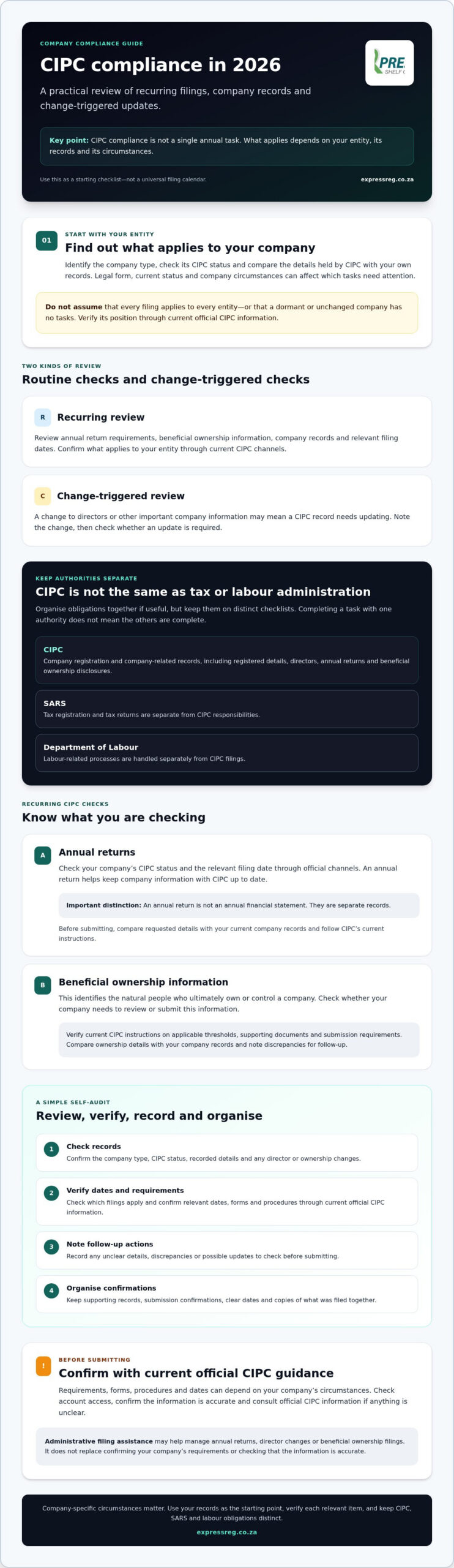
A practical CIPC 2026 self-audit checklist for your company
A short, documented review can turn CIPC compliance from a vague concern into a manageable list of checks and follow-up actions. Use this process to assess your company’s position. It is a practical review, not a substitute for confirming requirements with CIPC or obtaining advice suited to your circumstances.
How to review your company’s CIPC status
- Identify the entity. Note the company’s registered type and identifying details you will use to check its CIPC information.
- Review the available CIPC information. Check the account or status details available to you, including recorded company information and any filing history shown.
- Compare records. Set the CIPC information alongside your current company records. Flag discrepancies, such as a director detail that appears different, rather than assuming which version is correct.
- Verify relevant dates and requirements. Check current official CIPC guidance for the requirements and dates that apply to your entity. Do not rely solely on a previous year’s calendar or an old reminder.
- Record follow-up actions. List what needs clarification, who will check it and what action is planned. Verify unresolved questions with CIPC or a suitably qualified adviser before submitting information.
Keep the authorities distinct. Put CIPC company filings and records in one part of your review, SARS tax matters in another, and Department of Labour processes in a separate section. Completing a task with one authority does not confirm that a separate requirement has been addressed elsewhere.
What to keep in a compliance file
Organise a central file, digital or physical, so the person responsible can find the latest company records and evidence of completed tasks. Include relevant submission confirmations, correspondence with CIPC, copies of documents submitted and notes of questions still awaiting an answer. Label records clearly by task and date, and avoid deleting material based on an assumed retention period. Check applicable record-keeping guidance for each document type.
Assign someone to monitor upcoming review dates and record changes that may call for a CIPC check. Clear responsibility makes it less likely that a director change or new notice will disappear into general administration. Revisit the file when company information changes and after a submission, so it reflects what was filed and what still needs attention.
This CIPC 2026 self-audit gives you a clear next step: identify open items, confirm them through the right authority and organise the supporting paperwork. If you would like administrative help managing CIPC submissions, ask Express Shelf Company about filing support. Filing assistance can help with paperwork, while you remain responsible for checking which requirements apply to your company.
Getting help with CIPC filings and your next compliance steps
After reviewing your records, turn outstanding questions into clear next steps: identify the CIPC task, verify the current requirements and relevant date, then organise the information needed for the submission. If the task involves SARS or the Department of Labour, check that authority’s process separately. A CIPC filing does not replace tax or labour administration.
Administrative filing assistance may be useful if you need help managing paperwork or preparing a submission. Express Shelf Company is a private consultancy, not CIPC or a legal representative. Its CIPC-related services include annual returns, director changes and beneficial ownership filings. Assistance can help with the administrative process, but it does not replace checking which requirements apply or confirming details through official guidance.
When administrative filing support may be useful
Consider support if you are unsure how to organise a filing, have several company records to check or need help managing the submission process. Before proceeding, confirm the service scope, what information the provider needs and which company documents to prepare. Requirements can vary by filing and company circumstances, so use current CIPC instructions to check the correct procedure.
What to prepare before asking for assistance
A clear starting point keeps the discussion focused. Gather the company’s registration details and current records relevant to the filing. Then describe what you need help with, such as an annual return, a director change or a beneficial ownership filing. Avoid sending documents until you understand what is required and how they will be used.
- Identify the task: State the filing or company change you want to address.
- Collect relevant records: Prepare the company details and supporting information related to that task.
- List uncertainties: Note any discrepancy, missing information or question that needs checking.
- Verify the process: Confirm current requirements and submission instructions with CIPC before filing.
- Agree the scope: Ask what administrative assistance covers and what remains your responsibility.
Keep a copy of the information submitted and any confirmation or correspondence with your company records. If requirements are unclear or your circumstances need more than administrative filing support, seek guidance from the relevant authority or a suitably qualified adviser. This approach keeps your CIPC 2026 next steps organised without assuming that one checklist or service suits every company.
For help with CIPC annual returns, director changes or beneficial ownership filings, contact Express Shelf Company about CIPC filing assistance.
Make your next CIPC check a clear one
A manageable CIPC 2026 review starts with knowing which tasks apply to your company, checking current CIPC requirements and keeping records of what you have verified or submitted. Keep CIPC matters distinct from SARS and Department of Labour processes, and revisit your records when company details change.
Express Shelf Company supports businesses across South Africa with CIPC annual returns, director changes and beneficial ownership filings. Filing assistance can help organise paperwork and submissions, while you remain responsible for confirming your company’s requirements through official guidance.
If you have identified a filing to address, contact Express Shelf Company for help with CIPC filing administration. Verify the task, prepare the relevant records and follow up on any outstanding questions. A clear process can make company administration easier to manage.
Frequently Asked Questions
What does CIPC do for companies in South Africa?
CIPC registers companies and maintains official company information, including key details about registered entities and their directors. It also administers company filings such as annual returns and beneficial ownership disclosures. Businesses use CIPC’s services to register a company and check or update information on record. CIPC responsibilities are separate from tax matters handled by SARS and labour-related processes managed by the Department of Labour.
Which CIPC filings should a company check in 2026?
For CIPC 2026, start by checking your company’s registered type, current CIPC status and recorded information. Then verify whether an annual return or beneficial ownership filing needs attention, and review whether any company changes may require an update. These checks are not a universal calendar for every entity. Confirm applicable tasks, submission requirements and dates through current official CIPC information before preparing a filing.
When does a South African company need to submit a CIPC annual return?
A company’s annual return is due within 30 business days of its registration anniversary, according to the current guidance provided for this article. Check the anniversary date and filing status for your specific entity using official CIPC channels, and verify current procedures before submitting. An annual return is different from an annual financial statement and from a tax return filed with SARS.
Does every company need to file beneficial ownership information with CIPC?
Current guidance indicates that beneficial ownership information must be filed for all companies, but the information and supporting documents required can depend on the company’s circumstances. Check CIPC’s latest instructions for the relevant thresholds, documents and submission process. Review the company’s ownership or control records as well, and check whether a change means the information needs updating. Do not assume an earlier filing remains accurate if circumstances have changed.
What happens if company director details change and CIPC records are not updated?
If director details change, compare the company’s current records with the information held by CIPC and check the applicable update process. Out-of-date details may create inconsistencies between your company documents and its official record, so do not assume the change has been recorded automatically. Confirm the required procedure, documents and timing through current CIPC guidance. Keep copies of any submission and confirmation with your company records.
Can I check my company’s CIPC status online?
Yes. Use CIPC’s official online channels to access available company information and filing services. You may need the company’s identifying details and appropriate account access to check its record or manage a submission. Compare the information shown with your current company documents, and note any discrepancies or unclear status messages. If the online information does not resolve your question, confirm the next step with CIPC before filing.
Is CIPC the same as SARS?
No. CIPC and SARS are separate South African government authorities with different functions. CIPC manages company registration and company-related records and filings, whilst SARS handles tax matters such as tax registrations and returns. Completing a CIPC filing does not complete a separate SARS requirement, or vice versa. Keep a separate record of tasks for each authority and verify the relevant process directly with CIPC or SARS.