
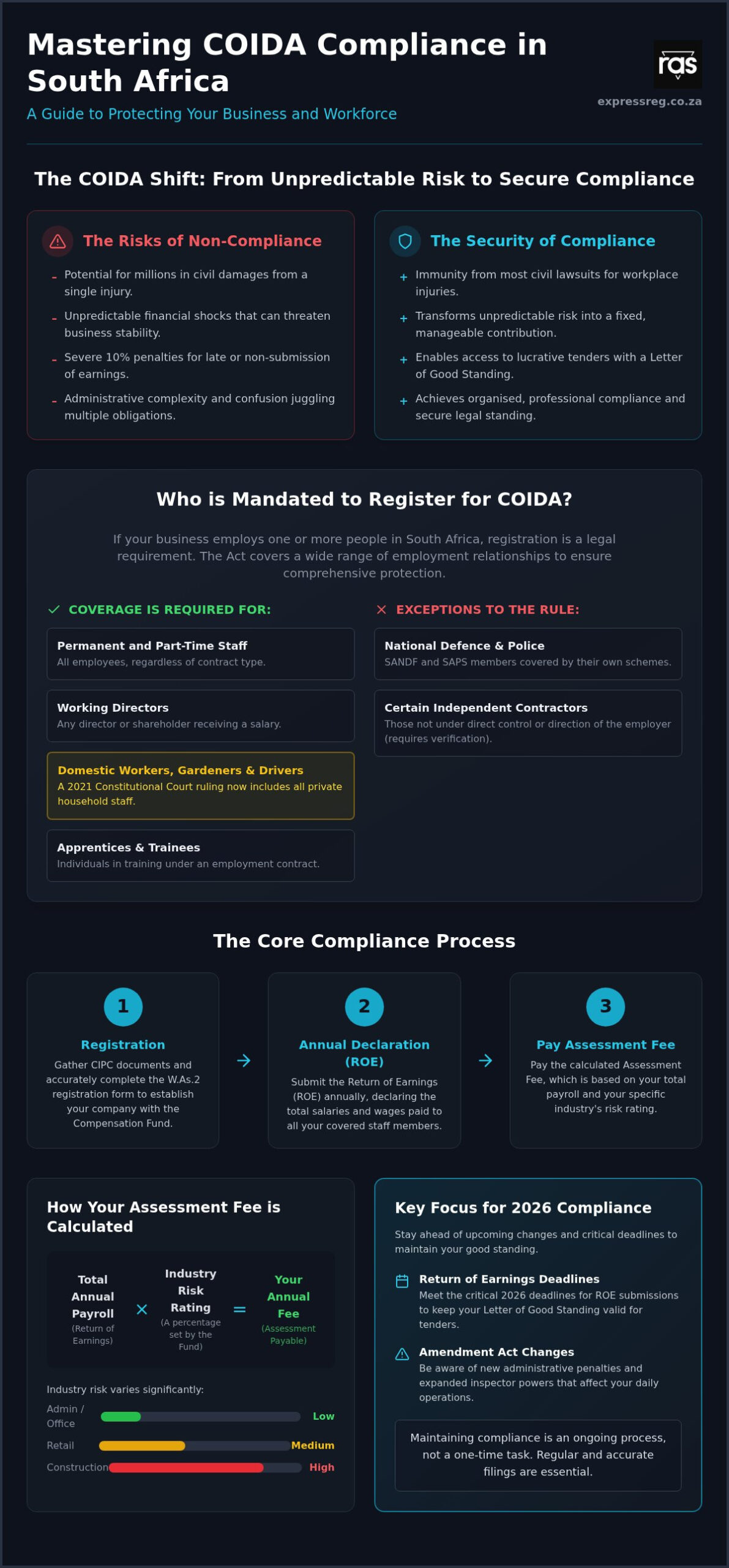
A single workplace injury could cost your company millions in civil damages, but COIDA registration turns that unpredictable risk into a fixed, manageable contribution. You likely view COIDA registration south africa as just another layer of government red tape that complicates your daily operations. It’s often frustrating to juggle UIF registration for employers south africa, PAYE, and private insurance whilst trying to navigate inconsistent government portals. We know that the stress of potential 10% late submission penalties often outweighs the clarity of how to actually stay compliant.
This guide simplifies the entire process, showing you how to master the 2026 COIDA requirements to protect your workforce and secure your company’s future. By the end of this article, you’ll understand exactly how to handle your statutory filings and maintain your legal standing. We’ll break down the latest COIDA Amendment Act changes, clarify your 2026 Return of Earnings obligations, and explain how to obtain the Letter of Good Standing required for lucrative tenders. We’ll help you move from administrative complexity to a state of organised, professional compliance.
Key Takeaways
- Identify which staff members, including working directors, must be covered under COIDA registration south africa to meet mandatory labour laws.
- Discover how to secure immunity from civil lawsuits by transferring the financial risk of workplace injuries to the Compensation Fund.
- Follow a clear, step-by-step guide to gathering CIPC documents and completing the W.As.2 registration form with professional accuracy.
- Learn the critical 2026 deadlines for Return of Earnings (ROE) submissions to maintain a valid Letter of Good Standing for tender applications.
- Understand the 2026 Amendment Act changes, focusing on new administrative penalties and expanded inspector powers that affect your daily operations.
Understanding COIDA Registration and the Compensation Fund
The Compensation for Occupational Injuries and Diseases Act (Act 130 of 1993), commonly known as COIDA, serves as the statutory backbone for workplace safety. It establishes a mandatory insurance fund that protects both the employer and the employee. Every business owner who employs one or more people must prioritise COIDA registration south africa to remain legally compliant. This system is overseen by the Compensation Commissioner, who operates under the authority of the Department of Employment and Labour. Securing your COIDA registration south africa is the first step toward building a resilient, compliant business.
Don’t confuse this with private medical aid or general business liability insurance. Whilst those services provide additional layers of security, they don’t replace your statutory obligations. COIDA is a dedicated fund specifically designed to handle workplace-related incidents. It ensures that the financial burden of medical care doesn’t bankrupt a business or leave a worker destitute. It’s a foundational requirement that moves your company from administrative complexity to full legal standing.
The Purpose of the COID Act in South Africa
The Act operates on a no-fault basis. This means an injured employee receives compensation regardless of whether their own mistake or the employer’s negligence caused the accident. It’s a trade-off that benefits everyone. Employees get guaranteed medical aid and compensation for lost income without the need for lengthy legal battles. For employers, the primary advantage is immunity. Once you’re registered and your assessments are up to date, employees generally cannot sue you for damages in a civil court for workplace injuries. This protection provides essential peace of mind, especially in high-risk industries.
Key Terminology for Employers
To manage your compliance effectively, you need to understand the specific language used by the Commissioner. This clarity helps you avoid errors during the filing process.
- The Compensation Fund: This is the actual pool of money, funded by employer contributions, used to pay out claims for medical expenses and permanent disablement.
- Return of Earnings (ROE): This is the annual declaration you submit detailing the total salaries and wages paid to your staff. It’s the factual basis for your contribution.
- Assessment Fee: This is the amount you actually pay. It isn’t a flat rate. Instead, it’s calculated using your total payroll and a specific risk rating assigned to your industry class.
Higher-risk sectors, such as rock drilling or construction, naturally pay a higher percentage than administrative services. Mastering these terms ensures you handle the heavy lifting of paperwork with confidence and accuracy.
Who Must Register for COIDA in South Africa?
Compliance isn’t optional for anyone who employs staff. If your business employs one or more people, regardless of their contract type, you’re legally required to complete COIDA registration south africa. This mandate covers a broad spectrum of workers, including permanent staff, apprentices, and even working directors who receive a salary. Many business owners mistakenly believe that shareholders or directors are exempt, but if you’re on the payroll, you’re an employee in the eyes of the Department of Employment and Labour.
There are very few exceptions to this rule. The Act specifically excludes members of the South African National Defence Force (SANDF) and the South African Police Service (SAPS) who are covered under their own specific compensation schemes. Additionally, certain independent contractors who aren’t under the control or direction of the employer may fall outside the Act’s scope, though this is a complex legal area that requires careful verification.
Domestic Workers and COIDA Compliance
A landmark 2021 Constitutional Court ruling significantly expanded the reach of the Act. Private households are now officially classified as employers. This means if you employ a domestic worker, gardener, or driver, even on a part-time basis, you must ensure they’re covered. This change corrected a long-standing exclusion and ensures that domestic staff have access to the same medical aid and compensation benefits as corporate employees. Organising registration for domestic staff is a straightforward administrative task that protects you from personal liability if an accident occurs on your property.
Registration for Small Businesses and Startups
Timing is critical for new ventures. You should initiate the process immediately upon hiring your first employee. If you’ve recently finished registering a Pty Ltd, labour compliance should be your next priority. Don’t fall into the trap of thinking casual or seasonal workers don’t count. The law doesn’t distinguish between a full-time manager and a weekend casual worker; both require coverage under the fund. Failure to register can lead to heavy administrative penalties, which can be particularly damaging for a growing startup. You can simplify your statutory filings by partnering with an expert facilitator who handles the heavy lifting of Department of Labour paperwork for you.
The Strategic Benefits of COIDA Compliance
Viewing COIDA registration south africa as a mere administrative hurdle overlooks its role as a powerful financial shield. This statutory insurance provides your business with absolute immunity from civil lawsuits related to workplace injuries or occupational diseases. Without this protection, a single serious accident could lead to a devastating legal claim that threatens your company’s solvency. By maintaining your registration, you transfer the liability for medical expenses and permanent disability payments to the Compensation Fund, ensuring that your business capital remains untouched during a crisis.
Beyond legal protection, compliance safeguards your corporate reputation. Clients and partners prefer working with businesses that demonstrate a commitment to worker welfare and statutory obligations. Conversely, the cost of non-compliance is steep. The Department of Employment and Labour imposes a 10% penalty on late Return of Earnings submissions, along with accumulating interest on unpaid assessments. These avoidable costs can quickly erode your profit margins and signal a lack of internal discipline to external stakeholders. Ensuring your broader labour compliance, including UIF registration for employers in South Africa, is equally important to maintaining a complete and legally sound compliance profile.
Protecting Business Capital from Unforeseen Claims
The financial logic of the fund is clear when you contrast the annual cost against potential liabilities. For most commercial employers, the minimum annual assessment is R1,621, which is a negligible expense compared to the multi-million Rand costs of a long-term disability or rehabilitation claim. This system converts an unpredictable and potentially ruinous liability into a predictable, fixed budget item that you can account for in your annual financial planning. The Assessment is a risk-based premium calculated on your company’s annual payroll. It allows you to operate with the confidence that an industrial accident won’t result in a sudden, unmanageable drain on your cash flow.
Tender Eligibility and Supply Chain Compliance
In the South African business environment, your compliance status directly impacts your ability to secure new contracts. Most government tender requirements mandate proof of active registration and up-to-date payments. The primary document used to verify this is the Letter of Good Standing. Without it, your bid will likely be disqualified before the technical evaluation even begins.
This requirement extends deep into the private sector as well. Large corporations and main contractors are increasingly vigilant about supply chain compliance. They use COIDA status to vet their sub-contractors because the law holds main contractors liable for the compliance of those they hire. By keeping your COIDA registration south africa current, you position your business as a low-risk, professional partner ready to compete for high-value projects. It’s a strategic asset that opens doors to growth whilst ensuring your current operations remain legally sound.
Step-by-Step: How to Organise Your COIDA Registration
Organising your COIDA registration south africa doesn’t have to be a bureaucratic nightmare. By following a structured approach, you ensure your business moves from administrative uncertainty to full legal standing without unnecessary delays. The process begins with meticulous document preparation and ends with the activation of your account through your first assessment payment. Taking these steps early protects your business from the risk of civil claims and ensures you’re ready for any commercial opportunity that requires a Letter of Good Standing.
Follow this logical progression to secure your registration:
- Gather all statutory company documents and personal identification for directors.
- Complete the W.As.2 Registration of Employer form, ensuring every field matches your CIPC records.
- Submit your application through the official Department of Labour online portal or via a private facilitator.
- Monitor your application status until the Commissioner issues your unique COIDA Registration Number.
- Submit your initial Return of Earnings (ROE) to generate your first Notice of Assessment.
Required Documentation Checklist
To avoid rejection, ensure your digital copies are clear and valid. The Department of Labour requires specific evidence to verify your business entity and its leadership. You’ll need to have the following documents ready for upload:
- CIPC Registration Documents (specifically the COR 14.3 form).
- Certified copies of ID documents for all registered directors.
- SARS Tax Clearance Certificate or proof of tax registration.
- Proof of the physical business address, such as a recent utility bill or lease agreement.
- A recent bank statement or a stamped letter from your bank confirming account details.
Common Pitfalls in the Registration Process
Accuracy is your best defence against future audits. One frequent error is choosing the wrong industry classification. Since your assessment rate is risk-based, an incorrect code can lead to overpayment or, worse, significant under-coverage. Similarly, don’t provide unrealistic payroll estimates. If your actual figures vary wildly from your initial estimates, the Compensation Fund may trigger a manual audit of your financial records.
Navigating these technical requirements often feels overwhelming for new entrepreneurs. Many business owners choose to work with a professional registration consultant to ensure their filings are correct the first time. This approach eliminates the guesswork and frees you to focus on your core business operations. If you’re ready to secure your workforce, you can start your COIDA registration south africa today through our streamlined administrative service.
Maintaining Compliance: Assessments and Letters of Good Standing
Completing your initial COIDA registration south africa is a significant milestone, but it’s only the start of your journey toward total statutory compliance. To keep your business protected, you must engage with the annual Return of Earnings (ROE) cycle. This window typically opens on 1 April and closes at the end of June each year. During this period, you’re required to declare the actual earnings of your employees for the past year and provide an estimate for the coming year. This data allows the Compensation Commissioner to calculate your specific contribution accurately.
Once you’ve submitted your ROE, the Fund issues a Notice of Assessment. This document specifies the amount due based on your industry risk rating and total payroll. You must pay this assessment promptly to remain in the Fund’s good books. Falling into arrears triggers immediate penalties, including a 10% late submission fine and accumulating interest charges. More importantly, it voids your protection against civil claims, leaving your business capital exposed if an accident occurs whilst your account is overdue.
How to Obtain a Letter of Good Standing
A Letter of Good Standing (LOGS) is the most sought-after document in the procurement world. It’s a certificate that confirms your business is fully compliant with the Act. However, simply having a COIDA registration south africa doesn’t guarantee you a letter. To qualify, your business must meet three strict criteria: you must be registered, your annual returns must be up to date, and all assessed fees must be paid in full. For a comprehensive walkthrough of the process, our guide on letter of good standing registration online covers every step you need to secure your certificate without delays.
The LOGS is only valid for one year, usually expiring on 30 April. This means you must repeat the ROE and payment process annually to maintain your eligibility for tenders and contracts. Managing this cycle requires precision and timing. Express Shelf Company can manage this entire administrative cycle for you, ensuring you never miss a deadline or lose your compliant status.
Dealing with Assessments and Audits
The Compensation Fund reserves the right to audit your payroll records at any time. Audits typically occur if there’s a significant discrepancy between your estimated and actual earnings or if a large claim is lodged. To prepare for this, keep meticulous records of all workplace incidents, even minor ones that don’t result in a claim. This grounded, matter-of-fact approach to record-keeping builds a foundation of transparency that simplifies the audit process.
If you’ve missed previous years, don’t ignore the problem. You can rectify past non-compliance by submitting back-dated returns and paying the associated assessments plus interest. This “back-pay” process is essential for restoring your legal standing and regaining eligibility for government contracts. Clear documentation and organised filing turn a potentially stressful audit into a routine administrative check. By staying disciplined with your records, you ensure your transition to full legal standing remains permanent.
Securing Your Company’s Future Through Compliance
Maintaining your legal standing under the COID Act is more than a statutory requirement; it’s a strategic move to protect your business capital and secure lucrative tenders. You’ve learned that COIDA registration south africa provides absolute immunity from civil lawsuits whilst ensuring your employees have access to essential medical care. Remember that compliance is an ongoing cycle. You must submit your Return of Earnings every April and pay your assessments promptly to keep your Letter of Good Standing active.
Navigating the Department of Labour’s technical portals often presents a significant administrative hurdle for busy entrepreneurs. We act as your reliable intermediary, providing expert administrative processing for all statutory filings across South Africa. Let Express Shelf Company handle your COIDA registration and compliance today to ensure your paperwork is handled with professional accuracy. By shifting the heavy lifting of government administration to our specialists, you gain the peace of mind needed to focus on your core business growth. Take the first step toward a fully compliant, protected, and tender-ready enterprise.
Frequently Asked Questions
Is COIDA registration compulsory for small businesses in South Africa?
Yes, COIDA registration south africa is compulsory for every business that employs one or more people, including part-time, casual, or domestic staff. The law makes no distinction based on company size. Failing to register leaves your business exposed to massive civil claims and heavy administrative fines. Ensure you initiate the process immediately. This protects your business capital from unpredictable liabilities and ensures you remain compliant with national labour laws.
How much does COIDA registration cost for a new company?
The Department of Labour doesn’t charge a registration fee, but you must pay an annual assessment. For the 2025/2026 period, the minimum assessment for commercial employers is R1,621, whilst domestic employers pay a minimum of R560. Your actual cost depends on your total payroll and industry risk rating. Remember that late submissions incur a 10% penalty. Accurate budgeting for these statutory contributions is essential for your financial planning and compliance.
Can I register for COIDA online without a consultant?
You can certainly register directly through the Department of Labour’s online portal without professional assistance. However, many entrepreneurs find the government systems difficult to navigate due to technical errors and complex industry classifications. Using a facilitator ensures your application is correct the first time, avoiding the delays common with manual submissions. If you choose the DIY route, ensure you have all CIPC and SARS documents ready to ensure a smooth transition to compliance.
What is the difference between COIDA and a Letter of Good Standing?
Registration is the act of opening your account with the Compensation Fund, whereas a Letter of Good Standing is the certificate proving your account is active and paid. You cannot obtain the letter without first completing your COIDA registration south africa and paying your latest assessment. Most tenders require the letter specifically. It confirms you aren’t in arrears and that your workforce is currently covered under the national insurance scheme. If you’re unsure how to navigate the digital application process, our detailed resource on letter of good standing registration online provides a step-by-step breakdown to help you avoid common errors.
How long does it take to get a COIDA registration number in 2026?
Processing times in 2026 typically range from 10 to 21 working days, depending on the Department of Labour’s current backlog and the accuracy of your digital submission. Providing clear, certified copies of director IDs and CIPC documents helps prevent administrative delays. Once the Commissioner issues your unique registration number, you must submit your first Return of Earnings. This activates the account fully and generates your initial Notice of Assessment for payment.
What happens if an employee is injured and I am not registered for COIDA?
If an unregistered employer faces a workplace injury claim, they become personally liable for all medical expenses and compensation payments. The Compensation Commissioner may also impose a significant fine for non-compliance. In such cases, the business loses its statutory immunity, meaning the injured employee could potentially sue for civil damages in court. This financial risk far outweighs the cost of the annual assessment. Early registration is a vital business priority for every entrepreneur.
Do I need to register for COIDA if I only have independent contractors?
You generally don’t need to register if you only use genuine independent contractors who operate their own businesses and provide their own equipment. However, the Department of Labour applies strict criteria to determine if someone is truly independent or actually an employee. If you control their working hours or provide their primary tools, they might be classified as employees. Always verify the status of your contractors to ensure you aren’t inadvertently bypassing your mandatory obligations.
How often must I submit a Return of Earnings (ROE)?
You must submit your Return of Earnings (ROE) once every year. The submission window for 2026 opened on 1 April and the final deadline is 30 June. During this window, you declare the total wages paid to your staff for the previous year. You also provide an estimate for the upcoming period. Missing this deadline triggers an automatic 10% late submission penalty. This can significantly increase your annual compliance costs and jeopardise your legal standing.