
With South Africa’s unemployment rate sitting at 32.9%, the Department of Employment and Labour has intensified its focus on employer compliance to ensure the national safety net remains robust. For many business owners, the requirement for UIF registration for employers south africa feels like an administrative hurdle that distracts from core operations. You’ve likely felt the pressure of trying to distinguish between UIF, COIDA, and PAYE while worrying that a missing document might disqualify you from a lucrative government tender or result in avoidable penalties.
Navigating these statutory obligations shouldn’t be a source of stress for focused entrepreneurs. This 2026 guide provides the clarity you need to master labour compliance, protecting both your workforce and your commercial reputation. We’ll walk you through the essential registration steps, explain contribution limits, and show you how to secure a Letter of Good Standing. By following this structured approach, you ensure your business remains fully compliant and ready for any contract opportunity that comes your way.
Key Takeaways
- Master the mandatory process of UIF registration for employers south africa to ensure accurate 2% contributions for all staff working more than 24 hours per month.
- Transition your organisation from a basic legal entity to a fully compliant employer by aligning with national social security and employment standards.
- Protect your directors from civil liability and secure your commercial standing by completing mandatory COIDA registration and obtaining a Letter of Good Standing.
- Utilise a structured 2026 checklist to navigate the administrative prerequisites of labour certification and avoid the common pitfalls of DIY filing.
- Minimise the risk of costly errors and industry misclassifications by leveraging professional facilitation to handle complex Department of Labour paperwork.
The Foundation of Labour Compliance in South Africa
Labour compliance represents the strategic alignment of your business with South Africa’s national employment standards and social security laws. It marks the transition where your company evolves from being a simple legal entity into a recognised employer in the eyes of the state. This shift requires formal acknowledgement from the Department of Employment and Labour, which serves as the primary regulatory body for national workplace standards. Securing your UIF registration for employers south africa is a critical first step in this professional journey.
Establishing this foundation is vital for your commercial standing. Without it, your organisation remains vulnerable to administrative friction that can halt growth. Total compliance ensures you’re “tender-ready,” allowing you to compete for government and corporate contracts that demand proof of consistent statutory standing. It transforms your administrative duties into a competitive advantage that demonstrates your reliability to the market.
Why Statutory Standing Matters for Your Business
Maintaining a clean record with the Department of Labour protects your organisation from the disruption of unexpected audits and inspections. When your paperwork is in order, these regulatory checks become routine rather than a source of legal risk. Beyond avoiding fines, statutory registrations build essential trust with corporate partners who need to know their supply chain is ethically and legally sound. Labour compliance is the prerequisite for sustainable commercial expansion.
The Interplay Between UIF, COIDA, and SARS
Total labour compliance south africa relies on three distinct pillars that must be managed in unison. The Unemployment Insurance Fund (UIF) provides a safety net for workers, forming a core part of South Africa’s social welfare system. Whilst UIF handles unemployment and maternity benefits, the Compensation for Occupational Injuries and Diseases Act (COIDA) acts as mandatory workplace insurance against accidents.
Finally, Pay As You Earn (PAYE) is the tax component managed through SARS. Neglecting any one of these areas creates a gap in your compliance shield. For instance, completing your UIF registration for employers south africa but failing to register for COIDA will prevent you from obtaining a Letter of Good Standing. This missing link can disqualify your business from high-value opportunities, regardless of how well you manage your payroll or tax returns. You must treat these obligations as a single, integrated framework to secure your commercial future.
UIF Registration for Employers South Africa: Key Obligations
Every business owner in South Africa must understand that UIF registration for employers south africa isn’t optional for those with a workforce. If you employ staff for more than 24 hours per month, the law requires you to register with the fund immediately. This obligation applies whether you have one domestic worker or a full team of corporate professionals. Failing to register at the start of employment creates a compliance gap that grows more expensive over time. The Department of Labour enforces back-dated payments and interest penalties on all outstanding contributions from the date the first staff member was hired.
The financial structure of the fund relies on a total contribution of 2% of an employee’s gross salary. You’re responsible for paying 1% as the employer, whilst the remaining 1% is deducted from the employee’s monthly earnings. It’s vital to remember that contributions are capped at a monthly salary ceiling of R17,712. This means the maximum monthly contribution is R177.12 from each party. You can find detailed guidance on these UIF contributions and employer responsibilities through the official SARS portal to ensure your payroll calculations remain accurate.
Monthly Declarations and Contribution Payments
Once registered, your administrative duties shift to monthly maintenance. You must submit declarations via the uFiling portal to update the fund on your current staff list and their earnings. The 7th of every month serves as the critical deadline for these payments. If you miss this window, you risk a 10% penalty on the outstanding amount plus interest. Many entrepreneurs find that facilitating these statutory filings through a professional consultant reduces the risk of human error and ensures the business remains in good standing without constant internal monitoring.
Managing Employee Data and Terminations
Your responsibility extends beyond mere payment. You must notify the fund whenever you hire new staff or when an employee leaves the organisation. Accurate record-keeping is the only way to prevent administrative bottlenecks during the termination process. When declarations are incorrect or missing, former employees often find themselves unable to claim benefits. This frequently leads to avoidable legal disputes and friction at the CCMA. Maintain a disciplined approach to your digital records to ensure your compliance history remains spotless and your workforce remains protected.
COIDA and the Letter of Good Standing: The Commercial Asset
While your UIF registration for employers south africa provides a safety net for workers facing unemployment, the Compensation for Occupational Injuries and Diseases Act (COIDA) serves as your organisation’s primary insurance against workplace accidents. This mandatory workplace insurance is a legal requirement for any business that employs one or more staff members. You must Register with the Compensation Fund to ensure your team is covered for medical expenses and lost wages resulting from on-the-job injuries or diseases.
Completing your COIDA registration south africa does more than satisfy a legal checkbox; it protects directors from personal civil liability. Without this registration, an injured employee could sue the business owners directly for damages. By maintaining active compliance, the Compensation Fund assumes this financial risk, effectively shielding your personal and business assets from potentially ruinous litigation. This protection is a foundational element of a secure corporate structure in 2026.
The physical proof of this compliance is the Letter of Good Standing. This document confirms that your assessments are fully paid and your account is in good standing with the fund. For procurement officers in both the public and private sectors, this letter is the “holy grail” of documentation. It proves that your business is stable, responsible, and won’t expose the hiring client to secondary liability risks. Without it, your UIF registration for employers south africa alone won’t be enough to secure high-value contracts.
The Annual Return of Earnings (ROE) Process
Maintaining your standing requires participation in the annual Return of Earnings (ROE) cycle. Every year, the Compensation Fund opens a window for employers to declare their total payroll and staff numbers. For the 2026 cycle, you must meet the specific deadline of 30 June 2026 for online submissions. The fund uses these figures to calculate your assessment fee, which varies based on your specific industry risk category and total payroll. Proactive filing is essential to ensure your Letter of Good Standing doesn’t lapse during a critical tender season.
Securing Your Certificate for National Tenders
To obtain a valid certificate for national tenders, you must satisfy three strict prerequisites:
- An active and verified registration with the Compensation Fund.
- Submission of all historical Return of Earnings documents.
- A zero balance on your account, confirming all assessment fees are paid in full.
Administrative bottlenecks often occur during the payment reconciliation phase. Using a professional intermediary to handle these filings can provide a significant speed advantage, as they understand how to navigate the Department of Labour’s internal systems. Remember that a single missed COIDA payment or a late ROE filing can disqualify your firm from a multi-million rand contract in an instant. If you’re unsure where to begin, our detailed resource on letter of good standing registration online walks you through every step of the COIDA process to ensure your certificate is secured without delay.
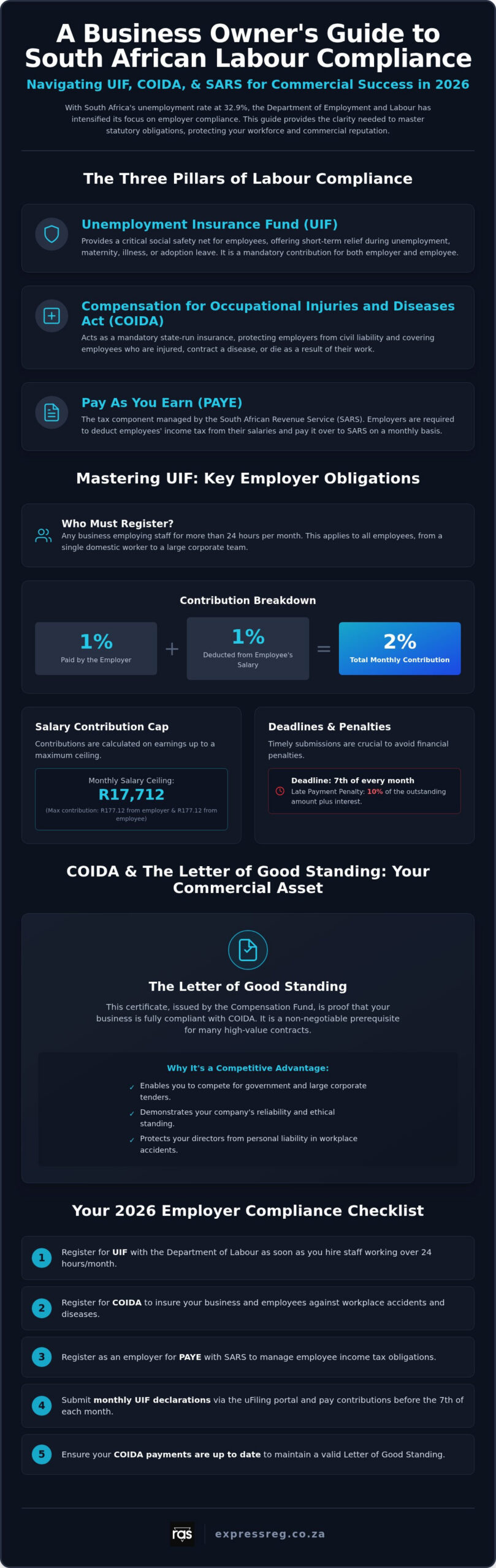
Step-by-Step Employer Registration Checklist for 2026
Securing your UIF registration for employers south africa requires a methodical approach that begins long before you submit your first declaration. Many entrepreneurs stumble because they treat labour compliance as an afterthought rather than a sequential process. To avoid administrative delays or rejected applications, you must follow a logical path from company incorporation to final certification. This ensures that every government database, from CIPC to the Department of Employment and Labour, contains matching and verified information about your organisation.
Before you begin the digital filing process, gather your administrative prerequisites. You’ll need clear copies of all directors’ ID documents, your latest CIPC registration certificates, and a recent bank statement in the company’s name. The Department of Employment and Labour uses these documents to confirm your business’s legitimacy during the verification phase. Any discrepancy in the company name or registration number between these records will result in an immediate rejection of your application, forcing you to restart the process from the beginning.
Phase 1: Initial Statutory Enrolment
Step 1: Ensure your Pty Ltd is correctly registered with CIPC and SARS. You cannot apply for employer status without a valid income tax number. Step 2: Compile the necessary employer registration forms, ensuring that all director signatures are present and legible. Step 3: Submit simultaneous applications for UIF and COIDA. Handling these together prevents gaps in your compliance profile and streamlines your interaction with the bureaucracy, ensuring you don’t have to navigate two separate registration cycles months apart.
Phase 2: Validation and Certification
Step 4: Await the issuance of your unique UIF and COIDA reference numbers. These digits are your primary identifiers for all future correspondence and payments. Step 5: Register on the mandatory online portals, uFiling and CompEasy, for ongoing management. These platforms are where you’ll manage your staff data and monthly submissions for your UIF registration for employers south africa. Step 6: Pay your initial COIDA assessments immediately. This final step triggers the release of your first Letter of Good Standing, making you officially eligible for national tenders for the 2026 financial year. Alongside these obligations, ensure your company’s CIPC annual return fees south africa are settled on time, as understanding the CIPC annual return fees south africa is equally critical to keeping your legal entity active and your compliance profile intact.
Secure your standing and skip the administrative queues by letting our team facilitate your statutory registrations and compliance filings today.
Streamlining Compliance with Professional Support
The administrative machinery of the Department of Labour is notoriously complex, often leaving entrepreneurs overwhelmed by technical requirements. Attempting a UIF registration for employers south africa without expert guidance frequently leads to avoidable errors that stall business operations. A specialised consultant acts as a vital buffer between your business and this bureaucracy, ensuring that every form is accurate and every submission is timely. This support isn’t merely an administrative cost; it’s a strategic investment in risk mitigation that protects your commercial standing.
One common pitfall in the DIY approach is the incorrect industry classification during COIDA registration. If you select a category that doesn’t align with your actual business activities, you may face inflated assessment fees or, worse, have claims rejected when an accident occurs. Professional facilitators possess the industry knowledge to categorise your firm correctly from the start. They track statutory deadlines on your behalf, providing the peace of mind that comes from knowing your compliance is handled by experts while you focus on growth.
The Hidden Costs of Non-Compliance
Failing to maintain your statutory obligations carries heavy financial and reputational consequences. Late payments attract a 10% penalty plus interest; persistent non-compliance can lead to your business being blacklisted from national tenders. If your COIDA registration lapses, directors face significant personal liability risks in the event of workplace accidents, as the fund won’t cover the medical or legal costs. Professional assistance ensures your firm remains a “going concern” in the eyes of the law by maintaining an uninterrupted chain of compliance.
How Express Shelf Company Simplifies the Process
We provide a structured, fixed-fee approach to Department of Labour applications and CIPC filings to eliminate the uncertainty of administrative costs. Our team manages the “heavy lifting” of paperwork, leveraging specialised expertise to secure your certificates and registrations with speed and precision. By organising your UIF registration for employers south africa and COIDA filings through our expert management, you avoid the administrative friction of government portals. This allows you to dedicate your energy to your core business operations whilst we secure your statutory foundations and ensure you’re ready for every commercial opportunity.
Securing Your Commercial Future Through Total Compliance
Mastering your statutory obligations ensures your business remains protected and competitive throughout 2026. You’ve seen that UIF registration for employers south africa is far more than a legal checkbox; it’s the first step in a broader framework that includes COIDA and the essential Letter of Good Standing. By maintaining these pillars, you shield your directors from personal liability and position your organisation as a reliable partner for high-value government and private sector tenders. Consistency in your filings is the only way to transform administrative duties into a genuine commercial asset.
Don’t let the complexity of government bureaucracy hinder your expansion. Our statutory compliance specialists provide expert administrative filing for the Department of Labour, offering national service coverage for all compliance certificates. We manage the technical requirements and tracking of deadlines so you can focus on your core operations with total peace of mind. Secure your UIF registration and Labour Compliance today and build your business on a foundation of organised efficiency. We’re here to help you navigate every procedural step with speed and precision.
Frequently Asked Questions
What is the most important labour compliance document for tenders in South Africa?
The Letter of Good Standing is the most critical document for any business bidding on contracts. It serves as physical proof that your firm is registered with the Compensation Fund and that all assessment fees are fully paid. Procurement officers require this certificate to ensure that the hiring organisation isn’t held liable for workplace accidents. Without this document, your business will likely be disqualified from both government and private sector tender opportunities.
Is UIF registration mandatory for a company with only one director?
Yes, registration is mandatory if the director is paid a salary and works more than 24 hours per month. In the South African labour framework, a director who receives remuneration is legally classified as an employee. You must complete the UIF registration for employers south africa and contribute 2% of the gross salary to the fund. This ensures the director is covered for benefits like illness or maternity leave under national social security laws.
How long does it take to get a Letter of Good Standing in 2026?
The timeframe generally varies from a few business days to several weeks depending on your account status. If your Return of Earnings submissions are up to date and your balance is zero, the system can often generate the letter almost immediately. However, if there are historical gaps or unallocated payments, the process takes longer because the Department of Labour must manually reconcile your records. Professional facilitation often speeds up this essential verification phase.
What happens if I fail a Department of Labour inspection?
Failing an inspection typically results in a compliance order or an immediate spot fine. The inspector will outline specific issues, such as missing declarations or unpaid assessments, and provide a strict timeframe for rectification. If you don’t resolve these problems within the deadline, you risk legal prosecution and significant financial penalties. Maintaining consistent UIF registration for employers south africa and accurate employee records is your best defence against these disruptive regulatory interventions.
Can I apply for a Letter of Good Standing if I have outstanding COIDA debt?
No, you cannot obtain a Letter of Good Standing while your account reflects an outstanding balance. The Compensation Fund only issues this certificate to employers who are fully paid up. You must first settle all assessment fees and any accrued interest or penalties. Once your account shows a zero balance and all Return of Earnings are submitted, the system will allow for the generation of your certificate, restoring your commercial eligibility for contracts.
Do I need to register for labour compliance if I only use independent contractors?
You don’t need to register for UIF or COIDA for genuine independent contractors, but you must be careful with workforce classification. If an individual works primarily for you, uses your equipment, or is under your direct control, the state may reclassify them as an employee. If this happens, you’ll be held liable for all back-dated contributions and interest. It’s often safer to verify the legal status of your contractors to avoid future liability.
What is the difference between a compliance certificate and a Letter of Good Standing?
A compliance certificate is a broad term for various statutory documents, whereas a Letter of Good Standing refers specifically to your status with the Compensation Fund. The Letter of Good Standing proves you’re insured against workplace injuries and is a prerequisite for most tenders. Other certificates might relate to your BEE status or tax standing. For total labour compliance, ensure you have both your UIF registration number and a valid COIDA letter.
How often must I renew my UIF and COIDA registrations?
You don’t need to renew the registrations themselves, but you must maintain your compliance status through recurring actions. For COIDA, this involves submitting your Return of Earnings by the 30 June 2026 deadline and paying the annual assessment fee to renew your Letter of Good Standing registration online. For UIF, you must submit declarations every month via the uFiling portal. Your registrations remain active as long as you continue to employ staff and meet these administrative duties.