
What if your company’s legal status vanished overnight simply because of a missed digital deadline? It’s a genuine concern for many South African entrepreneurs who find the government’s shifting online requirements difficult to manage. You likely already feel the weight of balancing business growth with strict regulatory demands, especially when trying to determine how to file annual returns CIPC while distinguishing these filings from your SARS tax obligations.
We understand that administrative hurdles often feel like an unnecessary distraction from your daily operations. This guide is designed to remove that friction, offering a clear and action-oriented path to ensure your company remains “In Business” and fully compliant throughout 2026. You’ll learn exactly which documents are required, how to settle the mandatory Beneficial Ownership filings, and the most efficient way to navigate the updated CIPC systems for a successful submission confirmation.
Key Takeaways
- Grasp the legal necessity of annual returns as mandated by the Companies Act to distinguish this process from your SARS tax obligations.
- Master exactly how to file annual returns CIPC by preparing your Beneficial Ownership register and financial data before accessing the digital portal.
- Discover the sequential steps for submitting your return through eServices or BizPortal to secure a successful “In Business” status.
- Weight the advantages of professional filing agent services against DIY methods to ensure your statutory documents are processed with speed and correctness.
- Implement a proactive compliance calendar to track your registration anniversary and protect your company from the risk of final deregistration.
Understanding CIPC Annual Returns and Your Legal Obligations
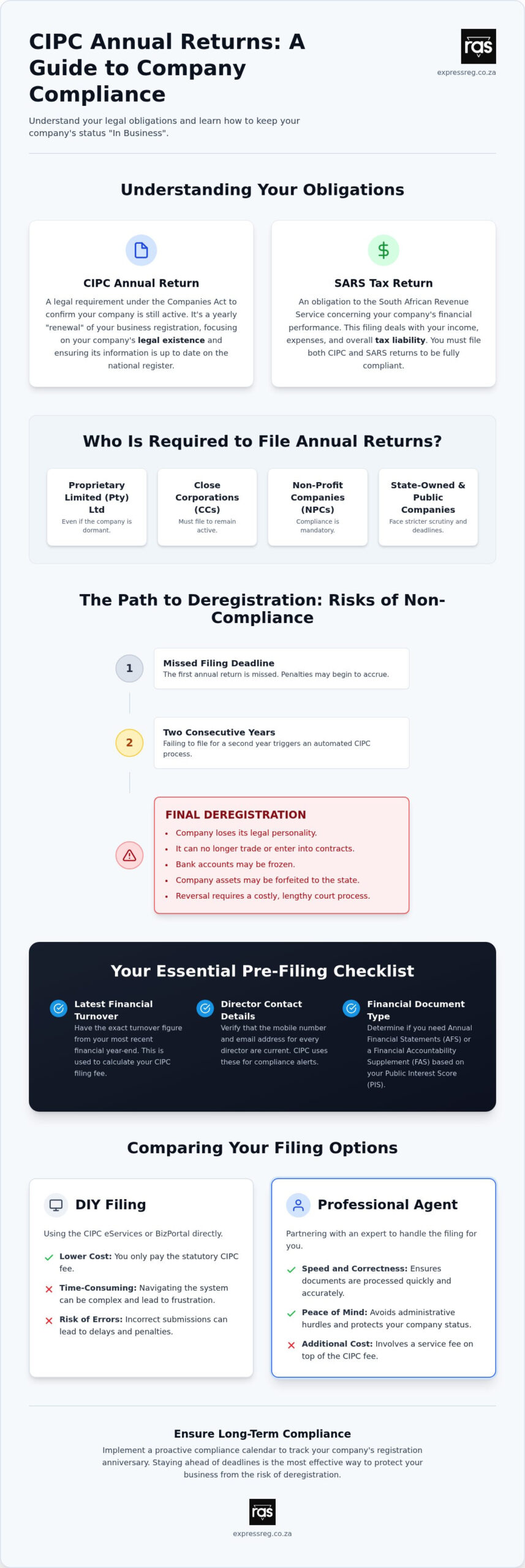
An annual return is essentially a yearly “renewal” of your company’s registration. It’s a statutory requirement that confirms your entity is still active and that its information is up to date. This process is mandated by Section 33 of the Companies Act 71 of 2008, which requires every registered business to lodge a return once a year. Understanding how to file annual returns CIPC is vital for every director, as it serves as the primary mechanism the Companies and Intellectual Property Commission (CIPC) uses to maintain an accurate database of South African businesses. Without this data, the commission cannot verify the ongoing existence of your enterprise.
Many business owners confuse this with their SARS tax returns. It’s a critical distinction to make; while SARS deals with your financial income and tax liability, the CIPC focuses on your legal existence. You must complete both to remain fully compliant. Filing your CIPC return ensures your company retains its “In Business” status, signalling to banks, creditors, and the public that the entity is legally recognised. Maintaining this status is the foundation of your company’s credibility and operational safety.
Who Must File Annual Returns?
The obligation to file applies to a wide range of entities. Every Proprietary Limited (Pty) Ltd company must submit a return, even if the business is dormant and hasn’t traded for the entire year. Close Corporations (CCs) and Non-Profit Companies (NPCs) are also required to comply. State-owned and public companies face even stricter scrutiny with specific deadlines tailored to their registration dates. If your name is on the register, the law expects a return.
The Consequences of Non-Compliance
Ignoring this administrative task carries heavy risks. If you fail to file for two consecutive years, the CIPC will automatically move your entity into the “Deregistration Process.” This isn’t just a change in status on a website; it has severe real-world implications. A deregistered company loses its legal personality. This means it can no longer enter into contracts, it cannot trade, and its assets may technically be frozen or forfeited to the state.
Directors should take proactive steps to avoid company deregistration CIPC by keeping their filings current. Reversing a final deregistration often requires a costly and lengthy legal process, sometimes involving a court order. Learning how to file annual returns CIPC correctly from the start is the most efficient way to protect your business’s foundational legal standing. It provides the peace of mind that your company remains a valid legal entity, ready for any commercial opportunity that arises.
The Essential Pre-Filing Checklist: Financials and Beneficial Ownership
Success in administrative compliance begins long before you access the digital systems. Attempting to log into the CIPC Annual Return Filing Portal without your data ready often leads to session timeouts and frustration. You’ll need to have your company’s latest financial turnover figures and updated contact details for all directors immediately available. This preparation ensures that once you start the process of how to file annual returns CIPC, you can complete it in a single sitting without errors.
Your annual turnover is the primary metric the commission uses to calculate your filing fee. It’s vital to use the figures from your most recent financial year-end to ensure the fee is accurate. Beyond financials, verify that every director’s mobile number and email address are current. The CIPC uses this information for automated compliance alerts; outdated details can result in missed notifications and subsequent penalties. If the technical requirements seem daunting, you can always seek assistance with CIPC Annual Returns through a professional agent to ensure your records are perfect.
AFS vs FAS: Which Financial Document Do You Need?
The type of financial information you must provide depends on your company’s Public Interest Score (PIS). This score is a calculation based on your number of employees, turnover, and third-party liabilities. If your PIS is high enough, you’re legally required to submit full audited or independently reviewed Annual Financial Statements (AFS). Most smaller (Pty) Ltd companies fall below this threshold. In these cases, you’ll instead complete a Financial Accountability Supplement (FAS), which is a simplified summary of your financial records. Correctly identifying your category prevents the commission from rejecting your filing due to insufficient documentation.
Organising Your Beneficial Ownership Records
As of 2026, you cannot complete your annual return without first ensuring your Beneficial Ownership (BO) register is up to date. This is a mandatory prerequisite designed to increase corporate transparency. Beneficial Ownership is the natural person who ultimately owns or controls the company. This typically applies to any individual holding 5% or more of the company’s shares or voting rights.
Gather these documents before you begin the process of how to file annual returns CIPC:
- Certified ID copies of all beneficial owners.
- Current share certificates and the share register.
- A formalised Beneficial Ownership register document.
Having these records organised avoids the common pitfall of having your return blocked by the system due to missing BO disclosures. It’s a foundational step that secures your company’s legal transparency and ensures a smooth transition to “In Business” status.
Comparing Your Filing Options: DIY eServices vs Professional Filing Agents
Deciding how to file annual returns CIPC requires a pragmatic look at your business’s administrative capacity. For many directors, the primary question is whether the time spent navigating a government portal is worth more than the fee charged by a professional facilitator. While the DIY approach saves on service fees, it requires you to manage every technical detail and assume all risk for inaccuracies in your turnover or Beneficial Ownership declarations. You’re not just paying for a submission; you’re paying for the assurance that your company’s legal standing remains intact.
Professional agents provide a layer of insurance against the “Final Deregistration” status that haunts non-compliant companies. They don’t just push buttons; they audit your data to ensure it matches the commission’s expectations before the final click. This level of scrutiny is particularly helpful given the legal complexities described in this Legal Guide to CIPC Annual Returns, where the consequences of a single oversight can lead to the loss of your company’s legal personality. Using an intermediary moves the burden of technical correctness from your desk to theirs.
The Benefits of Using a Professional Agent
The 2026 CIPC portal relies heavily on multi-factor authentication (MFA) and specific digital certificates that can occasionally fail or lock out users. A professional agent is equipped to navigate these technical bottlenecks without the frustration a business owner might face. They also handle the precise calculation of late filing penalties, ensuring you don’t overpay or leave a balance that could trigger a compliance alert. If you’re looking for expert support, choosing a professional CIPC filing agent allows you to delegate the entire process to experts who understand the nuances of the South African regulatory landscape.
When to Choose the DIY Route
The DIY route is best suited for entrepreneurs with straightforward (Pty) Ltd structures who are comfortable managing digital accounts. You must maintain an active CIPC customer code and ensure your password hasn’t expired, which happens regularly for security reasons. Your CIPC account must also be linked to a payment method with enough credit to cover the tiered fees based on your turnover. Success on the portal often depends on your technical setup; you’ll need to configure your browser to allow pop-ups and ensure that your security software isn’t blocking the CIPC’s scripts. It’s a methodical process that rewards patience, but it leaves the burden of how to file annual returns CIPC entirely on your shoulders.
Step-by-Step Guide: How to Successfully Submit Your Return
Executing the submission requires strict adherence to the CIPC’s digital sequence. Begin by logging into the CIPC eServices or BizPortal using your verified credentials. Ensure you have your multi-factor authentication device ready, as the 2026 security protocols require immediate verification for every login session. Once inside, navigate to the “Annual Returns” tab and enter your Enterprise Number. This unique identifier ensures you are updating the correct entity and prevents the common mistake of filing against the wrong registration.
The portal will then prompt you to provide your turnover for the most recent financial year. This data allows the portal to calculate your specific filing fee automatically. For example, companies with an annual turnover under R1 million will see a fee of R100 if filed on time. Mastering how to file annual returns CIPC also requires you to address the mandatory Beneficial Ownership disclosure. Since July 1, 2024, the commission has blocked annual return filings for any company that has not yet updated its Beneficial Ownership records. You must complete this disclosure to unlock the final payment and confirmation stages. If you’ve already missed your filing window, understanding the full implications of a CIPC annual return late submission — including the updated 2026 penalty structure and recovery steps — is essential before you proceed.
If you prefer to avoid these technical hurdles and the risk of system errors, you can file your CIPC Annual Returns through our professional service for guaranteed accuracy and speed.
Navigating the Payment Process
The CIPC primarily operates using a “Virtual Account” system. This requires you to deposit funds into your specific customer code before you attempt to lodge the return. Direct card payments are often available on the BizPortal, but the Virtual Account remains the most reliable method for statutory filings. Always use your customer code as the payment reference to ensure the funds are allocated to your profile without delay. Filing is only considered complete once the payment is cleared and the certificate is issued.
Uploading Supporting Documents
Your financial documents must be correctly formatted before they are uploaded to the portal. Convert your AFS or FAS into a PDF format and ensure the file size does not exceed the 5MB limit. Use a logical naming convention, such as your Enterprise Number followed by the year, to help the system categorise the file correctly. Double-check that the upload status shows as “Successful” in your dashboard before you terminate your session. This final verification prevents the common error of a “pending” status that could lead to administrative deregistration. Understanding how to file annual returns CIPC is only half the battle; the payment and upload phases require equal attention to detail.
Ensuring Long-Term Compliance and Avoiding Deregistration
Confirming your company’s status shouldn’t be a once-a-year event. Use the CIPC “Enterprise Search” tool regularly to verify that your entity remains “In Business.” By entering your company name or registration number, you can see the exact date your last return was processed. This simple check provides immediate peace of mind that your efforts in learning how to file annual returns CIPC have been successful and that the commission’s records accurately reflect your current standing.
To avoid the stress of last-minute filings, set up an internal compliance calendar based on your company’s incorporation anniversary. Companies have a 30-business-day window starting from this date to lodge their returns. If you’ve recently undergone director changes or updated your registered office address, ensure these are filed separately before you start the annual return process. Discrepancies between your current company records and the CIPC database can lead to “Validation Errors” that block your submission. Keeping these details synchronised is a vital part of how to file annual returns CIPC effectively.
Common Filing Hurdles and How to Resolve Them
Technical glitches can stall even the most prepared director. If your customer code is locked or your password reset fails, don’t keep attempting to log in, as this can lead to a permanent lockout. Instead, use the CIPC’s official enquiry system to request a manual reset. Validation errors during the turnover entry phase often occur if the system’s expected financial year-end doesn’t match your entry. If you encounter a discrepancy between the commission’s records and your share register, you’ll need to file a formal correction or a director change to align the two systems before the annual return can proceed. Directors who have already missed their deadline should review the penalties and recovery options for a late CIPC annual return submission to understand the most efficient path back to full compliance.
The Logical Next Steps for Your Business
Maintaining your “In Business” status is about more than just avoiding penalties; it’s a prerequisite for commercial growth. If you intend to apply for government tenders or private contracts, you’ll likely need a “Letter of Good Standing.” This document proves that your company is compliant with all statutory requirements, including annual returns and COIDA. Integrating your returns into a broader statutory maintenance programme ensures you’re always ready for new opportunities. For a more detailed look at the entire landscape of corporate governance, refer to our CIPC annual returns submission pillar page to secure your business’s future.
Securing Your Company’s Legal Future
Maintaining your company’s “In Business” status is a foundational duty for every South African director. By mastering how to file annual returns CIPC, you protect your enterprise from the severe risks of administrative deregistration and ensure your business remains eligible for tenders and commercial contracts. Success depends on preparing your financial data and Beneficial Ownership register well in advance of your incorporation anniversary.
While the digital process is accessible, the technical hurdles of multi-factor authentication and portal validation errors can be time-consuming. You don’t have to navigate these bureaucratic complexities alone. Let our experts handle your CIPC Annual Returns for you with our fast, fixed-fee compliance management. Our professional CIPC filing agents provide nationwide service for South African entrepreneurs, ensuring your statutory records are accurate and up to date.
Take the weight of paperwork off your shoulders today. With the right support, keeping your company compliant becomes a simple, stress-free part of your annual business cycle.
Frequently Asked Questions
How much does it cost to file CIPC annual returns in 2026?
Filing fees are tiered based on your company’s annual turnover. For a standard (Pty) Ltd company with a turnover under R1 million, the on-time fee is R100, increasing to R150 for late submissions. If your turnover is between R1 million and R10 million, you’ll pay R450 on time or R600 if late. These fees must be paid into your CIPC virtual account before you begin the submission process.
What is the deadline for filing my company annual returns?
Companies must file their annual returns within 30 business days following the anniversary of their registration date. Close Corporations (CCs) have a slightly different window, requiring submission within their anniversary month. Missing these deadlines results in immediate late penalties and places your company at risk of administrative deregistration. Setting a digital reminder for your incorporation date is the most effective way to ensure you remain compliant.
Can I file my annual returns if my company is dormant?
Yes, every registered entity is legally required to file an annual return, regardless of its trading status. Even if your company is dormant or has never traded, you must still lodge a return and pay the minimum fee of R100 to maintain its “In Business” status. Failure to do so signals to the commission that the company is no longer required; this eventually leads to final deregistration and the loss of the legal entity.
What is the difference between a CIPC annual return and a tax return?
A CIPC annual return is a statutory requirement to confirm your company’s legal existence, whereas a SARS tax return calculates your financial liability based on income. These are separate obligations to different government bodies. Filing your CIPC return doesn’t satisfy your tax requirements, and paying your taxes doesn’t keep your company registration active. You must complete both processes annually to ensure full regulatory compliance in South Africa.
What happens if I miss the CIPC filing deadline?
Missing the deadline results in an immediate late filing penalty, which can range from R50 to R1,000 depending on your turnover. If you fail to file for two consecutive years, the commission will initiate the deregistration process. This status prevents you from trading or owning property legally. Reversing a final deregistration is a complex process that often requires a R200 reinstatement fee and potentially a costly court order to resolve.
Do I need an auditor to file my CIPC annual returns?
Most small Proprietary Limited companies don’t require an auditor to file. You can typically submit a Financial Accountability Supplement (FAS) if your Public Interest Score is low. However, larger firms or those that manage third-party assets may be legally required to submit audited or independently reviewed Annual Financial Statements (AFS). You should check your company’s specific score to determine which financial document is necessary for your submission.
How do I check if my company is in good standing with CIPC?
You can verify your company’s current status by using the “Enterprise Search” tool on the official CIPC website. By entering your enterprise number or company name, you can see if your status is listed as “In Business,” “Deregistration Process,” or “Final Deregistration.” This tool is also helpful for identifying exactly how to file annual returns CIPC for previous years if you’ve fallen behind on your statutory obligations.
Is Beneficial Ownership filing mandatory for my annual return?
Yes, Beneficial Ownership (BO) filing is now a mandatory prerequisite for submitting your annual return. As of 2026, the CIPC system will block your annual return submission if your BO information isn’t current. You must update this information within 30 business days of your company’s anniversary. This requirement ensures transparency regarding who ultimately owns or controls the entity, helping the commission combat illicit financial activities and maintain corporate integrity.