
Last Tuesday, an entrepreneur discovered a perfect government tender, only to realise the submission deadline was forty-eight hours away. If you’re currently waiting for the CIPC to approve a name reservation, that opportunity is already slipping through your fingers. When you buy shelf company south africa registered entities, you bypass these administrative hurdles and secure a registration number instantly. You likely feel the frustration of waiting on bureaucratic processes when your business is ready to move; you’re right to want a faster solution.
This comprehensive 2026 guide promises to show you how to fast-track your market entry with a legally compliant, clean entity that’s ready for immediate trade. We’ll examine the impact of the May 2026 Companies Act amendments on director responsibilities and outline the exact steps to handle name changes and SARS tax registrations professionally. From understanding the new R2.3 million VAT threshold to managing statutory filings, you’ll learn how to transform a shelf company into a foundation for your commercial success.
Key Takeaways
- Discover why a shelf company is the most efficient route for immediate trading, providing an instant registration number for urgent tender or contract requirements.
- Identify the critical compliance documents required for a valid transfer, including the COR14.3 registration certificate and a pre-linked SARS Income Tax number.
- Compare the 24-hour turnaround of a shelf entity against the typical 10-day wait for new registrations to determine the best fit for your business timeline.
- Follow a secure, step-by-step framework to buy shelf company south africa entities and manage the transition of directors and beneficial ownership correctly.
- Learn how professional administrative handling ensures your new business foundation is clean, compliant, and fully aligned with the 2026 Companies Act amendments.
What is a Shelf Company and Why Buy One in South Africa?
A shelf company is a Private Company (Pty Ltd) that has already completed the formal registration process with the Companies and Intellectual Property Commission (CIPC). These entities are often referred to as “ready-made” because they’re fully incorporated but have never conducted any business activities. When you ask What is a Shelf Company?, you’re essentially looking at a shell that possesses a valid registration number and a standard Memorandum of Incorporation (MOI). These entities remain entirely free of assets, debts, or historical liabilities until they’re transferred to a new owner.
In the South African market, these companies are governed by the Companies Act and provide a legally sound foundation for entrepreneurs. Because the entity has no trading history, it’s considered “clean,” ensuring that new directors start with a blank slate. If you choose to buy shelf company south africa registered stock, you’re securing an entity that is already in good standing with the national authorities, allowing you to focus on operations rather than paperwork.
The Strategic Advantage of Speed
The most compelling reason to buy shelf company south africa entities is the elimination of the name reservation queue. The CIPC often experiences backlogs that can delay the approval of a new business name by several days or even weeks. By choosing a pre-registered entity, you bypass this entire phase. You receive an immediate registration number, which is the primary requirement for most formal business interactions and regulatory filings.
This speed is vital for opening a business bank account. Most South African banks require a full set of registration documents before they’ll begin the KYC (Know Your Customer) process. Having these documents in hand on day one allows you to move from a concept to a functional, transacting business within twenty-four to forty-eight hours. It’s the most logical choice when an opportunity won’t wait for administrative cycles. Entrepreneurs who need to act fast often explore a pre-registered company south africa solution to gain immediate trading capability without navigating CIPC backlogs.
Common Use Cases for Ready-Made Entities
Entrepreneurs typically turn to shelf companies when time is their most scarce resource. If you’ve identified a lucrative contract or a government tender with a closing date in the next forty-eight hours, you don’t have time to wait for a standard registration. A shelf company provides the instant credentials needed to submit your bid and demonstrate your business’s legal existence.
Other common scenarios include:
- Organising a professional corporate structure for an immediate investment or property purchase.
- Meeting the specific requirements for a letter of good standing for tender applications.
- Facilitating a quick transition for international companies looking to establish a local subsidiary without bureaucratic friction.
- Securing a registration number for immediate payroll or tax registration purposes.
Key Features and Inclusions of a 2026 Shelf Company
A shelf company is more than just a registration number; it’s a bundle of essential statutory assets. To ensure you’re ready to trade immediately, every entity should arrive with a complete set of founding documents. This foundation protects your new business from the potential pitfalls of a shelf company transfer, such as incomplete records or hidden liabilities. When you buy shelf company south africa entities, verifying the contents of this package is the first step toward operational security.
Statutory Compliance Documents
The most critical document is the COR14.3, also known as the Registration Certificate. This document serves as official proof of the company’s existence to banks, creditors, and government departments. It displays the unique registration number that remains constant even after you change the company name. Alongside this, you’ll receive the Memorandum of Incorporation (MOI), which dictates the internal governance of the business. The MOI defines the relationship between shareholders and directors, which is vital for resolving future disputes and ensuring the company is in “Good Standing” with the CIPC from day one.
Ownership and Governance
Ownership is legally formalised through the share register and share certificates. Whilst the CIPC tracks directors, the share register is the private internal record of who actually owns the business. You’ll also receive a CIPC-compliant minutes book to record the initial meeting where the original directors resign and the new owners are appointed. These certificates must be signed and issued correctly to be legally binding. You can view compliant shelf company packages to see how these governance documents are structured for a clean transfer.
Tax and Labour Registrations
Every shelf company should arrive with an active SARS Income Tax reference number. This allows you to register for other tax types immediately as your business grows. For instance, if your turnover is expected to exceed the R2.3 million threshold, you can move straight to compulsory VAT registration without waiting for a new tax number to be generated. If you plan to employ staff, you should also consider optional COIDA and UIF registrations to ensure you meet national labour law requirements from your first day of operation. When you buy shelf company south africa options, verifying these tax links is a vital part of your due diligence process.
Shelf Company vs New Registration: A Buying Framework
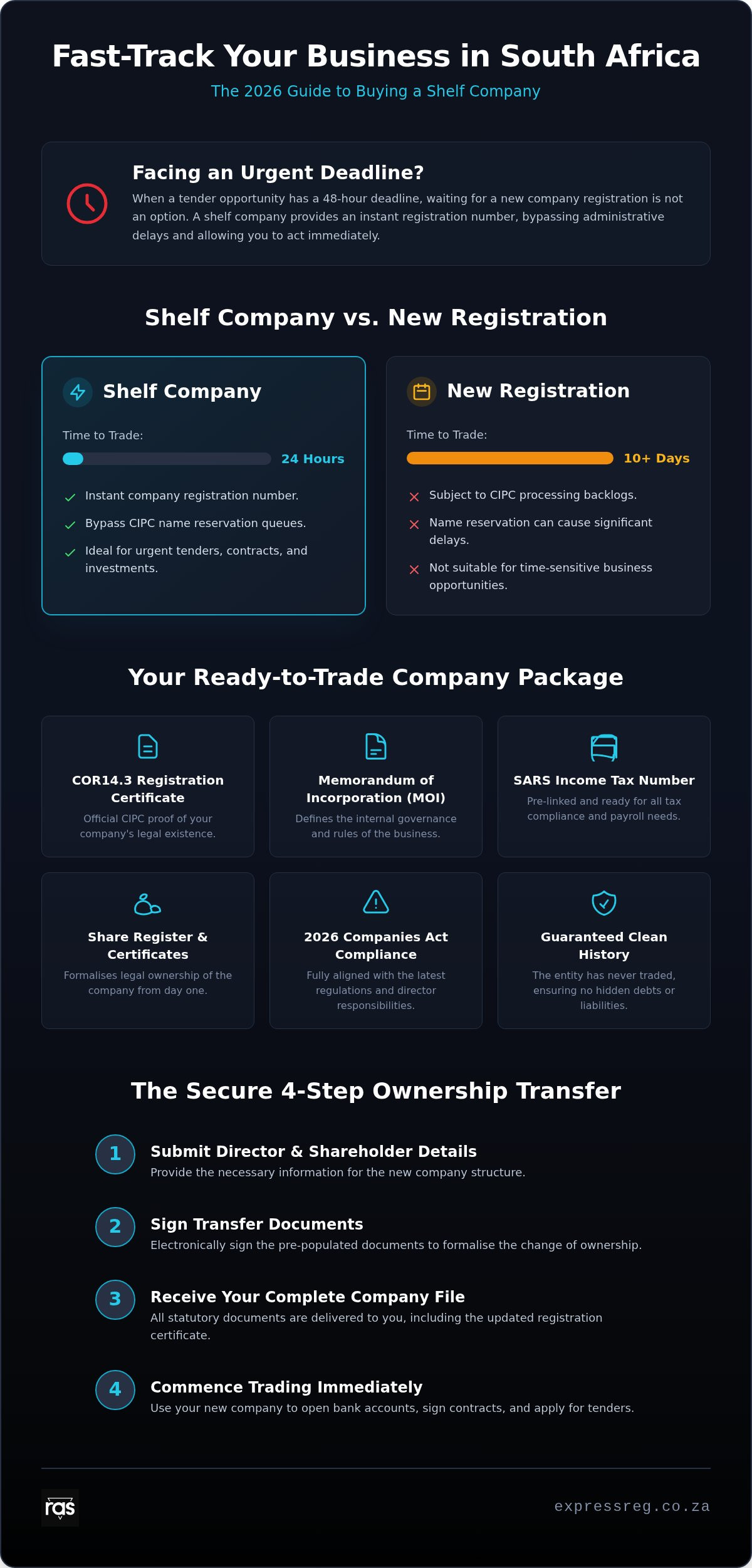
Choosing between a ready-made entity and a fresh registration involves weighing your immediate needs against your long-term branding goals. When you buy shelf company south africa options, you’re primarily paying for the luxury of time. A shelf company is usually ready for transfer within twenty-four hours; in contrast, a new registration through the CIPC typically takes ten or more business days, depending on the current backlog for name approvals. This difference is often the deciding factor for entrepreneurs facing strict, non-negotiable deadlines.
The cost structure also differs significantly. A new registration carries lower official fees, starting at R125 for a standard MOI plus R50 for name reservation. Shelf companies reflect the provider’s costs for pre-registration, maintenance, and immediate availability. While the initial outlay is higher, many find the expense justified when a potential contract or tender is worth significantly more than the administrative premium. If you’re ready to buy shelf company south africa stock, ensure the provider guarantees the entity has never traded to avoid the risks of shelf companies associated with hidden liabilities.
When to Choose a Shelf Company
A shelf company is the superior choice if you need to sign a contract or open a bank account by tomorrow. These entities often come with generic names like “Trading and Projects,” which are perfectly acceptable for immediate commercial use. You can always change the name later while keeping the same registration number. If you’re weighing these factors, read our analysis of the shelf company vs new registration debate for 2026 to see which path aligns with your current growth strategy.
The “age” of a company can also play a role in your decision. Some older shelf companies from 2015 or 2020 are available at a premium, sometimes costing up to R38,000. These are often sought by businesses that believe an older registration date adds a layer of perceived stability or meets specific tender requirements for “years in existence.” It’s vital to ensure these entities have remained compliant with annual CIPC filings throughout their dormant years.
When a New Pty Ltd Registration is Better
If you have a specific, unique name in mind and no urgent deadline, a new registration is the more cost-effective route. This allows you to build your brand from the ground up without the need for subsequent name changes or director transfers. Budget-conscious startups often prefer this path to keep initial overheads low. For a step-by-step walkthrough on this process, consult our register pty ltd south africa guide to ensure your application is processed correctly from the start.
The Buying Process: How to Transfer Ownership Safely
Securing a ready-made entity involves a structured administrative handover. When you buy shelf company south africa registered stock, the transition from the provider to your control requires five distinct steps to ensure full legal compliance. This process begins with selecting your preferred entity and completing the payment. Once the transaction is confirmed, the focus shifts to the statutory filings that formalise your ownership.
- Submit Director Details: Provide certified ID copies and residential addresses for all incoming directors to initiate the CIPC transfer.
- Beneficial Ownership Filing: Disclose the ultimate natural persons who own or control the company, a mandatory step in 2026.
- Update Registered Office: Change the company’s physical and postal address to your own business location for official correspondence.
- Name Reservation: If you prefer a custom name over the generic shelf name, initiate this reservation to link it to your registration number.
- Final Disclosure: Receive the updated CIPC certificate and disclosure documents reflecting the new directors and active status.
CIPC Director Changes and Beneficial Ownership
Updating director records is a legal mandate that must be completed promptly after the purchase. In 2026, the CIPC has intensified its focus on transparency to align with international anti-money laundering standards. This means you must file a Beneficial Ownership register alongside the standard director changes. This register identifies who truly benefits from the company’s profits, even if they aren’t listed as formal directors. Express Shelf Company manages these complex filings as part of our service, ensuring your entity remains in good standing without you having to navigate the CIPC’s digital portals yourself. You can buy a compliant shelf company today and let our consultants handle these mandatory disclosures on your behalf. For a detailed breakdown of the 2026 beneficial ownership requirements and the full transfer process, our pre-registered company south africa explainer guide covers every statutory step in plain language.
Changing the Company Name
One of the greatest benefits of this route is that you can trade under the existing shelf name immediately. You don’t need to wait for a name change approval to sign contracts or open bank accounts. If you do choose to rename the entity, the process involves reserving a new name and linking it to your registration number. Whilst the CIPC typically processes these changes within five to seven business days, your registration number remains the same throughout. This continuity ensures that your banking and tax links aren’t disrupted during the rebranding. We recommend keeping the generic name for urgent tenders and initiating the name change once your immediate deadlines are met.
Securing Your Business Foundation with Express Shelf Company
Choosing a reliable provider is the final step in securing your business’s future. Whilst many platforms offer ready-made entities, buying from an unverified source carries significant risks. You might inherit undisclosed liabilities or find the entity has already been used for fraudulent activities. When you buy shelf company south africa options through a professional consultancy, you receive a guarantee that the entity is clean and has never traded. This transparency is the foundation of our service at Express Shelf Company.
Our operations serve as a national hub, assisting entrepreneurs across South Africa. We operate on a fixed-fee pricing model, which eliminates the administrative surprises often found in professional services. You know exactly what you’re paying for from the start: a fully compliant entity, a professional director transfer, and all necessary SARS links. This grounded approach builds the trust necessary for a long-term commercial partnership.
Why Our Methodology Works
We prioritise rapid document turnaround without compromising on procedural accuracy. Every entity we manage is 100% compliant and prepared for a shelf company south africa transition. This methodology ensures that when you receive your documents, they’re ready for immediate use in tender applications or banking KYC processes. Our consultants provide personalised assistance for businesses with complex director structures or specific shareholding requirements, ensuring that every statutory filing is correct from the first submission. When you buy shelf company south africa registered stock from us, you’re buying a foundation that’s been verified by experts.
Beyond the Purchase: Long-term Compliance
Securing your registration number is only the beginning of your corporate journey. To avoid company deregistration, you must file CIPC annual returns every year. We provide ongoing support to manage these filings, keeping your business in good standing with the authorities. As your turnover grows, we also facilitate VAT and PAYE registrations to ensure your tax affairs remain in order. This long-term partnership allows you to focus on your commercial operations whilst we handle the heavy lifting of statutory paperwork and SARS compliance.
View our available shelf companies and start trading today and experience the peace of mind that comes with professional administrative management.
Accelerate Your Market Entry Today
Securing a ready-made entity is the most efficient way to overcome the administrative delays that often hinder South African entrepreneurs. By choosing this route, you obtain an immediate registration number and bypass the CIPC name reservation queue, allowing you to meet urgent tender deadlines with total confidence. It’s essential to ensure your new business is backed by full statutory compliance, including the mandatory 2026 Beneficial Ownership filings and active SARS tax links discussed throughout this guide.
When you choose to buy shelf company south africa entities through our team, you benefit from the expertise of CIPC-registered agents who manage every step of the transfer. We provide comprehensive statutory compliance and operate on a fixed-fee model to ensure transparency and peace of mind. Our consultants handle the heavy lifting of bureaucratic paperwork so you can focus on growth and operations. Buy your shelf company and start trading today and build your business on a secure, professional foundation. Your next big opportunity is just twenty-four hours away.
Frequently Asked Questions
Is it legal to buy a shelf company in South Africa?
It’s entirely legal to purchase a shelf company in South Africa under the Companies Act. These entities are registered by professional services specifically for the purpose of being sold to entrepreneurs who need an immediate registration number. The legality is maintained through the formal transfer of directors and beneficial ownership via the CIPC. This ensures the transition is fully documented and the new owners take complete control of the entity’s statutory records.
How long does it take to transfer a shelf company to my name?
You receive the company registration number and founding documents instantly. However, the formal CIPC director change and beneficial ownership filing typically take between five and seven business days in 2026. During this period, you’re able to trade and sign contracts using the existing shelf name. We manage the entire administrative process to ensure the transfer is completed correctly without any technical delays or CIPC rejections.
Does a shelf company come with a bank account?
A shelf company doesn’t include a pre-opened business bank account. Financial institutions require the new directors to undergo a FICA verification process in person once the company has been transferred. Because you already have the COR14.3 and MOI, you can start this application immediately. Most South African banks will allow you to begin the process using the existing shelf name whilst the name change is being processed by the authorities.
What is the difference between a shelf company and a shell company?
A shelf company is a clean, pre-registered entity created specifically for sale to a new owner with no trading history. A shell company is a broader term for an entity that may have existed for years without active business operations or significant assets. When you buy shelf company south africa registered entities, you’re specifically looking for a “clean” shell that has never traded and carries no historical liabilities or tax debts.
Can I change the name of the shelf company after I buy it?
You’re able to change the company name at any point after the purchase. This process involves reserving a new name with the CIPC and linking it to your registration number. Whilst the name change takes approximately five to seven working days to approve, your business can trade under the original shelf name in the interim. This ensures that your operations aren’t delayed by the branding process or name reservation queues.
Are there any hidden debts in a shelf company?
Reputable providers guarantee that their shelf companies have never traded and therefore carry no debts or liabilities. We provide a professional indemnity that the entity is clean from its date of incorporation. To maintain this safety, it’s vital to buy shelf company south africa options through a verified consultancy rather than an unverified third party. This protection ensures that your business foundation is free from any historical SARS or creditor claims.
What documents will I receive after the purchase?
You’ll receive a comprehensive statutory pack including the COR14.3 Registration Certificate and the Memorandum of Incorporation (MOI). We also provide the share certificates, a share register, and the initial minutes book required for corporate governance. Additionally, the company is delivered with an active SARS Income Tax reference number. These documents provide everything you need to open a bank account and apply for a letter of good standing or VAT registration.
Do I need to file annual returns for a shelf company?
Every South African company must file annual returns with the CIPC to remain in “Good Standing.” This requirement applies even if the company hasn’t started trading or is currently dormant. Filing these returns prevents the CIPC from deregistering the entity. We assist our clients with these ongoing submissions to ensure your business foundation remains secure and compliant with the latest 2026 regulatory standards and Companies Act amendments.