
The lowest-cost route to registering a company is not always the simplest to manage. You can submit an application through the CIPC’s online BizPortal yourself, but choosing the right details, preparing the information and responding to correction requests can take time. The benefits of a professionally registered company are usually practical: help organising these administrative steps, not an automatic advantage with clients, tenders or tax.
If you are unsure which forms to complete or what happens after incorporation, that is understandable. Registration is only the starting point, and support varies between providers. Professional assistance may include preparing CIPC documents and handling initial tax registration. Follow-on filings, such as annual returns, beneficial ownership information or VAT registration, may need to be arranged separately.
This article explains what a registration service can take off your plate, when a do-it-yourself approach may suit you, and what to clarify before appointing a provider. It also covers what professional support cannot do: take over your responsibilities as a director or guarantee business success. Use these distinctions to decide whether assistance suits your needs and compare services on a clear, informed basis.
Key Takeaways
- The benefits of a professionally registered company centre on organised administrative support, not a transfer of director responsibilities.
- Check who prepares and submits the CIPC information, what document checks are included, and how you will receive confirmation and records.
- Compare assisted registration with DIY by weighing your available time, confidence with the process and need for guidance.
- Clarify which CIPC filings, SARS tax registrations and applicable Department of Labour processes are included or handled separately.
- Use a provider checklist to compare service scope, communication, fees and document handling before you appoint anyone.
What does professionally registered company mean in South Africa?
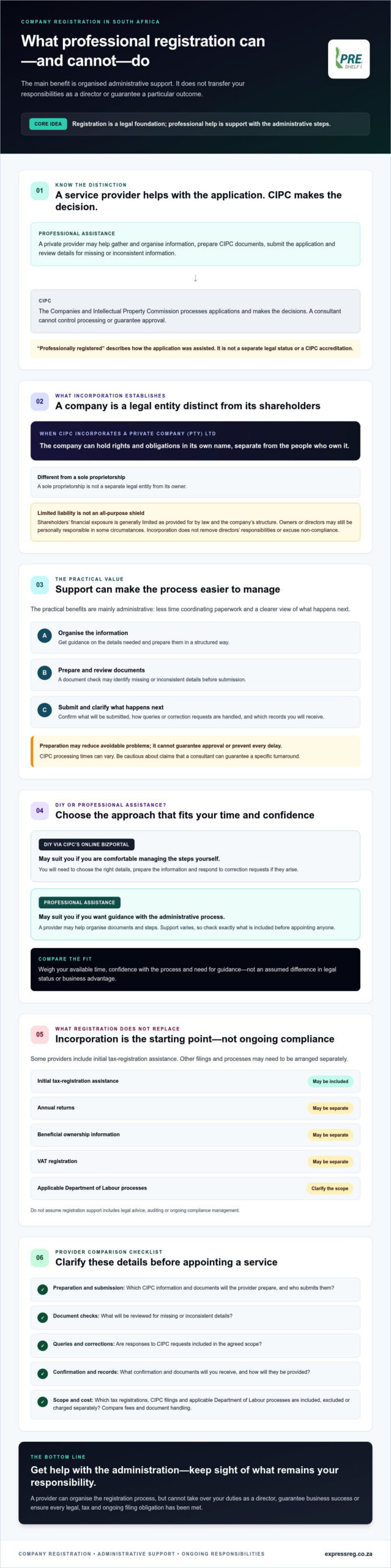
A professionally registered company is one whose incorporation information has been prepared and submitted to the Companies and Intellectual Property Commission (CIPC) with help from a private service provider. “Professionally registered” describes how the application was assisted. It is not a separate legal status or a CIPC accreditation. CIPC is the company-registration authority. A consultancy can help with the process, but it does not make the government’s decisions.
This distinction matters when weighing the benefits of a professionally registered company. A business can be properly registered whether its owner submits the application or appoints a provider. Professional support may organise the administrative steps, but it does not ensure that every legal, tax or ongoing filing obligation has been met. For background on the framework, see this overview of South African company law.
What does CIPC registration establish for a company?
When CIPC incorporates a private company (Pty) Ltd, it establishes the company as a legal entity distinct from its shareholders. The company can hold rights and obligations in its own name, separate from the people who own it. This differs from a sole proprietorship, which is not a separate legal entity from its owner.
Limited liability generally means shareholders’ financial exposure is limited in the way provided for by law and the company’s structure. It does not mean owners or directors can never be held personally responsible. Circumstances matter, and incorporation does not remove directors’ responsibilities or excuse non-compliance. Treat registration as a legal foundation, not an all-purpose shield.
What does a registration professional actually do?
A registration professional can help gather and organise the required information, prepare CIPC documentation and submit it for processing. A document review may identify missing or inconsistent details before submission, although it cannot guarantee approval or prevent every delay. The provider’s role is administrative support, not CIPC decision-making.
Scope varies. Some services include initial tax-registration assistance, while other tasks require a separate arrangement. Before appointing a provider, ask which documents they will prepare, who will submit them, what confirmation and records you will receive, and which steps are excluded. Do not assume registration support includes legal advice, auditing or ongoing compliance management. Clear boundaries help you compare the practical benefits of a professionally registered company with the work you will still need to manage.
The practical benefits of professional company registration
Professional assistance can make incorporation easier to manage by bringing the required information, documents and submission steps into one organised process. Rather than working out each step alone, you can get guidance on the information needed, prepare it in a structured way and confirm what will be submitted. The practical benefits of a professionally registered company are mainly administrative: less time coordinating paperwork and a clearer view of what happens next.
Can professional help reduce registration delays?
It may help prevent avoidable problems, but it cannot control CIPC processing or guarantee approval. Before submission, a provider may check whether information is missing or inconsistent, such as details that do not match across the application documents. Identifying these issues early can reduce the risk of needing to clarify or resubmit information. The Companies and Intellectual Property Commission (CIPC) remains responsible for processing applications and making decisions, so check its current guidance for requirements and expectations.
Think of this support as improving preparation, not securing a particular outcome. Ask how the provider handles queries or requests for corrections, and whether responses are included in the agreed scope. Processing times can vary, so be cautious about any claim that a consultant can guarantee a specific CIPC turnaround.
How can registration support help new business owners?
For a first-time founder, the paperwork can feel unfamiliar before the business has even started trading. Guided preparation can turn a broad task into manageable steps: gather the requested details, review the documents, confirm what will be submitted, then keep the resulting records. Knowing what is needed before you begin can help you spot missing information early and avoid last-minute scrambling.
Document checks offer another opportunity to catch omissions or mismatched details, but they are not a legal audit and do not transfer responsibility for the information supplied. Administrative convenience is not the same as legal compliance. CIPC incorporation confirms registration, but it does not automatically fulfil every statutory, tax or ongoing filing obligation, or guarantee that the company’s choices meet its needs.
Ask whether the registration service includes initial tax-registration assistance, which registrations it covers and whether anything is handled separately. The right scope depends on your circumstances. To compare the administrative support available, review New (Pty) Ltd registration support and check which steps are included before proceeding.
DIY registration or professional assistance: which approach fits?
Neither route is automatically better. Self-service may suit an owner who has time to review current guidance, understands the information requested and is comfortable managing the submission. Professional assistance may be useful if the paperwork feels unfamiliar, time is limited or you want help coordinating registration with related filings. The benefits of a professionally registered company depend on the support you need and the service provided.
| Consideration | DIY registration | Professional assistance |
|---|---|---|
| Owner effort | You manage the steps, information and submission yourself. | A provider can help organise the process, but you still need to supply and check your information. |
| Administrative guidance | You use official guidance and decide how to proceed. | You can ask for help understanding the steps included in the service. |
| Document preparation | You prepare and review the documents before submitting them. | The provider may assist with preparation and checks. Confirm exactly what is covered. |
| Responsibility | You remain accountable for the information submitted. | Assistance does not transfer your responsibility or guarantee an outcome. |
When might self-managed registration be suitable?
DIY may be a sensible choice if the requirements appear straightforward, you have time to manage each step and you are comfortable checking the Companies and Intellectual Property Commission (CIPC) guidance. Use current official information rather than relying on an older third-party summary. Before submitting, check that details are complete and consistent, and keep copies of the information and confirmation you receive.
When might a registration service be worth considering?
Guided administration may suit you if you are unsure what paperwork is needed, have limited time or prefer help organising related tasks. It can make the process easier to follow, but it does not make professional registration mandatory or promise faster processing, approval or a stronger business outcome.
Before appointing a provider, compare its stated scope, fees, communication and exclusions. Ask who prepares and submits the application, what happens if CIPC requests a correction, and which follow-on filings are separate. Review company registration support from Express Shelf Company to see what assistance may be relevant to your needs.
What professional registration does not replace: compliance after incorporation
Incorporation is a starting point, not a complete compliance package. A company may still need to meet separate requirements involving the Companies and Intellectual Property Commission (CIPC), the South African Revenue Service (SARS) and, where relevant, the Department of Employment and Labour. Applicable obligations depend on the company’s activities and circumstances, so confirm current requirements with the relevant authority or a suitably qualified adviser.
Which responsibilities continue after CIPC registration?
Annual returns and beneficial ownership disclosures are separate CIPC-related filing topics. They are not the same as a company’s tax submissions to SARS, and completing one does not automatically complete the others. Directors should keep track of the company’s records and filing responsibilities, and check current deadlines and procedures directly with CIPC rather than relying on an old reminder or third-party summary.
For a closer look at one recurring filing, consult the article titled CIPC Annual Returns Submission: The Complete 2026 Compliance Guide. Check that its details remain current before acting, as filing requirements and procedures can change. A registration service may offer relevant follow-on filings, but confirm whether these are included or need to be arranged separately.
When might tax or labour registrations be relevant?
Tax obligations depend on the business’s circumstances. VAT registration may be relevant depending on turnover and applicable rules, while PAYE may apply where a business employs staff and meets the relevant requirements. Do not assume every new company needs the same tax registrations, or that initial tax-registration assistance covers all future SARS responsibilities. Review current SARS guidance and clarify which registrations apply to your business.
COIDA and a Letter of Good Standing relate to labour processes, not CIPC incorporation. Their relevance depends on the company’s activities and circumstances, so check current Department of Employment and Labour requirements before assuming an application is necessary. A SARS VAT registration guide or Letter of Good Standing guide can help you understand the respective processes, but verify details against official guidance before relying on them.
Professional support can help organise selected administrative filings, but it does not remove the company’s responsibility to understand and meet its obligations. Ask which CIPC filings, tax registrations or labour applications a provider handles, what information it needs from you, and what remains your responsibility. To discuss relevant CIPC filings, VAT registration or labour-related applications, review compliance support from Express Shelf Company.
How to choose a professional company registration service
Compare the work a provider will actually do, not just the phrase “company registration”. The benefits of a professionally registered company depend on clear scope, careful communication and reliable handling of your information. Ask for the service details in writing before you appoint anyone.
Questions to ask before appointing a registration provider
- Scope: Which CIPC documents and administrative steps are included? Does the service cover preparation and submission, or only guidance?
- Your role: What information and supporting documents must you supply, and when will the provider need them?
- Submission and confirmation: Who submits the application? How will you receive CIPC confirmation and copies of the company records?
- Document handling: How will your information be shared, stored and returned to you? Ask how corrections or CIPC queries are handled.
- Fees and exclusions: Request a written breakdown of the quoted fee, any additional charges and services not included.
- Communication: Confirm your contact person, how updates are provided and what you can expect if information is missing.
Be specific about tax and follow-on compliance. Ask whether initial SARS tax-registration assistance is included, which registrations it covers and whether later filings, such as CIPC annual returns or beneficial ownership filings, are separate services. Do not assume a registration fee covers every task your company may need.
What should happen after the company is registered?
Keep the CIPC confirmation and company records together, and check that the details match the information you supplied. Then consider which SARS tax registrations or Department of Employment and Labour processes may apply to your company’s activities. Requirements can differ, so confirm current procedures with the relevant authority rather than treating incorporation as completion of every compliance step.
A clear provider should explain what it handles and what remains your responsibility, without suggesting administrative support guarantees approval or business success. If you want to clarify which registration or follow-on filings may suit your circumstances, discuss company registration and compliance support.
Choose the registration support that fits your business
The benefits of a professionally registered company come from practical help with preparation and administration, not guaranteed approval or freedom from ongoing responsibilities. If you have the time and confidence, managing the application yourself may suit you. If you would prefer guidance, compare providers carefully and confirm what their service includes, what it excludes and what you will still need to manage.
Express Shelf Company assists with new Pty Ltd registrations and CIPC documentation, including initial tax registration. Its listed services also include CIPC annual returns, director changes and beneficial ownership filings. Ask which support may be relevant beyond incorporation and whether each filing is included or arranged separately.
Discuss your company registration requirements with Express Shelf Company and clarify the administrative steps that may apply to your business.
Frequently Asked Questions
What are the benefits of using a professional company registration service?
A professional service can help organise the registration process, prepare CIPC documentation and check for missing or inconsistent information before submission. These are the practical benefits of a professionally registered company: less administration for the owner and guided steps through an unfamiliar process. The service cannot guarantee approval, ensure every compliance obligation is met or take over directors’ responsibilities. Check exactly what preparation, submission and follow-on support the provider includes.
Is it better to register a company yourself or use a professional?
Neither option is always better. DIY may suit you if the requirements are straightforward, you have time and you are comfortable following current CIPC guidance and managing the paperwork. Professional assistance may be useful if you are unsure what information is needed or prefer help organising the process. In either case, you remain responsible for the accuracy of the information submitted. Compare your available time and confidence with the provider’s scope and fees.
Does a professional company registration service guarantee CIPC approval?
No. A private service provider can help prepare and submit company-registration information, but CIPC is responsible for processing the application and making decisions. Careful document preparation may help identify omissions or inconsistencies, but it cannot guarantee acceptance or a particular processing time. Ask the provider how it handles a CIPC request for clarification or correction, and confirm whether that follow-up work is included in the agreed service.
Does registering a company automatically register it for tax in South Africa?
Company incorporation and tax obligations are not the same thing, and incorporation does not automatically complete every tax registration a business may need. Ask whether the registration process includes initial SARS tax-registration assistance, and confirm what has actually been completed. VAT and PAYE requirements depend on the business’s circumstances and applicable rules. Check current SARS guidance to establish which registrations apply, rather than assuming every company needs the same tax set-up.
What happens if a company is registered but does not keep up with compliance?
Registration does not remove ongoing filing responsibilities. A company that fails to submit required CIPC filings, such as annual returns, may face further compliance consequences, including possible deregistration proceedings. Tax responsibilities are separate and should also be checked with SARS. Keep company records organised, track filing dates and confirm current requirements with the relevant authority. If a filing has been missed, seek guidance promptly on the appropriate steps for that company.
Can a professional registration service also help with annual returns and VAT registration?
Yes, some providers offer follow-on services, but do not assume they are included in the initial registration. Express Shelf Company lists CIPC annual returns and VAT registration among its services, alongside other selected filings. Confirm the scope, information needed and fees for each task before proceeding. CIPC annual returns and SARS VAT registration are separate processes, so ask who handles each filing and how you will receive confirmation and records.
Does a professionally registered company automatically qualify for tenders or funding?
No. Company registration does not automatically qualify a business for tenders or funding, and it does not guarantee contracts, tax approval or business success. Registration establishes the company with CIPC, but tender and funding requirements depend on the specific opportunity and the organisation offering it. Check each application’s criteria directly, and make sure relevant company records and compliance filings are current before applying.