
POPIA compliance starts with understanding what personal information your business collects, why it uses it, where it is stored and who can access it. Managing statutory obligations for a small business means keeping these responsibilities in view alongside tax, employment and company filings, rather than treating compliance as a once-off task.
CIPC deadlines deserve particular attention: companies must file an annual return within 30 business days of their incorporation anniversary, and beneficial ownership information should cover anyone holding 5% or more of the company. Missing these filings can leave important company records out of date.
It’s understandable to find the mix of rules difficult to manage, especially as a business grows or hires staff. This guide explains how POPIA, employment equity, record-keeping, VAT and CIPC requirements apply to South African small businesses, including the five-year period for keeping tax records and the VAT rate of 15% on taxable supplies, according to the South African Revenue Service. You’ll also see how to organise these obligations into a practical compliance routine, so you can identify what applies and when action is due.
Key Takeaways
- Keep tax records and supporting documents for five years from the date you submit the return, and organise them so you can retrieve them when needed.
- Track your company’s incorporation anniversary: the CIPC annual return is due within 30 business days, and beneficial ownership information is another filing to manage.
- Understand which employment and Compensation Fund duties apply to your business, then include their filings and deadlines in your compliance calendar.
- Apply the 15% VAT rate to taxable supplies of goods and services, according to the South African Revenue Service, and keep VAT submissions and payments on schedule.
- Use a clear compliance framework to monitor registrations, records and filing dates, and seek professional guidance when requirements change or your business circumstances shift.
Record-keeping and documentation
Keep business records organised by transaction, tax period and business activity. In South Africa, accurate records help explain figures reported to SARS and support sound day-to-day decisions.
Maintaining business records
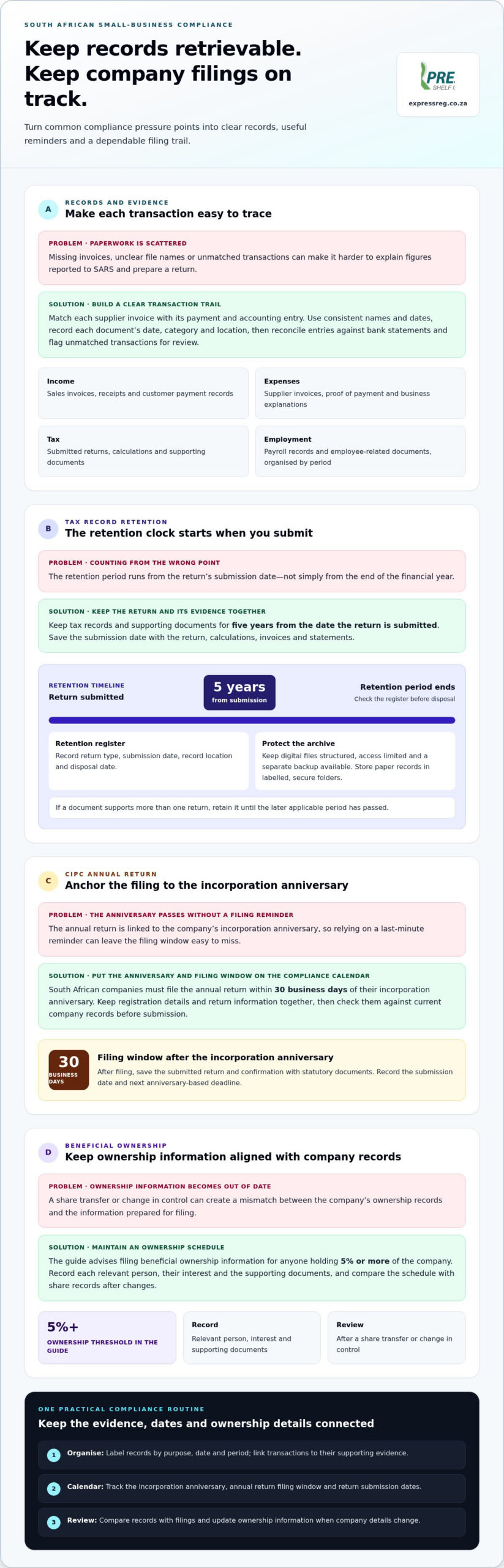
Business record-keeping means documenting transactions and storing the evidence behind them. For example, match each supplier invoice with its payment and accounting entry. This creates a clear trail when preparing figures for a tax return and helps you spot missing paperwork before filing.
Separate records by purpose, using consistent names and dates. Keep sales invoices, supplier bills, bank statements, payroll documents and tax submissions in clearly labelled folders. For each sale, file the invoice, payment record and any credit note together. This makes it easier to trace the amount from the original transaction to your accounts.
- Income: Keep sales invoices, receipts and records of customer payments.
- Expenses: File supplier invoices, proof of payment and related business explanations.
- Tax: Store submitted returns with calculations and supporting documents.
- Employment: Organise payroll records and employee-related documents by period.
Use a spreadsheet or accounting system to record each document’s date, category and location. Reconcile entries against bank statements and flag unmatched transactions for review. If a purchase serves both business and personal purposes, record the business reason clearly. A dated explanation can help distinguish it from unrelated spending.
Retaining records
Record retention means keeping documents for the required period after a relevant filing. South African businesses must keep tax records and supporting documents for five years from the date a return is submitted. Keep the submission date with the return’s records so you can retrieve evidence connected to that filing.
For example, create a folder for each submitted return and include its invoices, statements and calculations. Label the folder with the tax period and submission date. The retention period runs from submission, not simply from the end of the financial year. Keep records accessible throughout the full five-year period.
Maintain a retention register showing the return type, submission date, record location and disposal date. Review it during routine administration instead of relying on memory. If a document supports more than one return, retain it until the later applicable period has passed. This helps prevent a shared invoice or bank statement from being discarded too early.
Store digital files in a structured system and limit access to people handling business administration. Keep a separate backup and test that files open correctly. Store paper documents in labelled, secure folders. For either format, ensure authorised staff can locate a specific invoice or return without searching through unrelated records.
Before disposing of records, compare the retention register with submitted returns and supporting documents. Record what was removed and when. This keeps the archive orderly while preserving evidence associated with each filing period.
CIPC annual returns and beneficial ownership
Keep CIPC company filings on a calendar alongside ownership records. South African companies have two related administrative tasks: filing an annual return and keeping beneficial ownership information organised.
Filing the CIPC annual return
A CIPC annual return is a recurring company filing linked to the incorporation anniversary. South African companies must file it within 30 business days of that anniversary. Record the anniversary date and calculate the filing window in your compliance calendar, rather than relying on a reminder near the deadline.
For example, use the company’s incorporation anniversary to set its annual filing reminder. Keep the registration details and information used for the return together. Before submission, compare those details with current company records and note any changes that need attention.
After filing, save the submitted return and its confirmation with the company’s statutory documents. Record the submission date and next anniversary-based deadline. This provides a clear trail if a director needs to establish when the return was filed or which filing period it covered.
Recording beneficial ownership
Beneficial ownership information identifies the people who ultimately hold or control interests in a company. The guide advises South African companies to file information for anyone holding 5% or more of the company. A share register can help reveal direct interests, while ownership arrangements may require further review to identify the individuals behind them.
Keep an up-to-date ownership schedule recording each relevant person, their interest and the documents supporting that information. For example, compare the schedule with share records after a transfer or ownership change. This helps identify discrepancies before preparing a filing and keeps internal records aligned.
Review ownership information whenever company records change, including after a share transfer or change in control. Assign responsibility for updating the schedule and store supporting documents alongside it. Clear dates and version labels distinguish current information from earlier records.
Co-ordinating both filings
Annual returns and beneficial ownership filings concern different company information, so track them as separate tasks. A single CIPC calendar can show each due date, responsible person, preparation status and submission confirmation. Use a checklist to avoid mistaking a completed annual return for a completed ownership filing.
- Calendar: Record the incorporation anniversary and the 30-business-day filing window.
- Ownership: Compare the ownership schedule with company records, including interests of 5% or more.
- Evidence: Save each filing confirmation and supporting record in the company archive.
- Review: Revisit the schedule after a documented ownership change.
If preparing or tracking submissions is taking time away from company administration, Express Shelf Company’s CIPC Services include Annual Returns support. Keep responsibility clear internally and retain the filing confirmation with the company’s records.
How must small businesses register with the Compensation Fund and submit COIDA returns?
South African employers must register with the Compensation Fund under COIDA. Registration and the annual Return of Earnings are separate compliance tasks. Put both on the business calendar and assign responsibility for preparing records and tracking submissions.
Registering with the Compensation Fund
Registration places an employer on record with the Compensation Fund for workplace injury compensation purposes. Treat it as an employer administration task, not a substitute for CIPC company filings or tax registrations. Keep the business details used for registration with the confirmation and related correspondence.
Identify who manages employment administration and who maintains remuneration records. They should work from consistent business and payroll information. If the business structure or employment details change, update the internal records used to manage the Compensation Fund relationship.
For a small employer, a simple register can track registration status, the responsible person, correspondence and the next Return of Earnings task. Note each submission and any response received. This gives the business a clear record to draw on when preparing later declarations.
Preparing the Return of Earnings
The Return of Earnings, often called the ROE, reports employee earnings for assessment purposes. Employers should prepare the figures from payroll records for the relevant reporting period. Reconcile the figures before submission and retain a copy of the return with its supporting calculations.
For the submission described for the 2025 to 2026 period, employers must declare actual earnings from 1 March 2025 to 28 February 2026. The stated deadline for South African employers’ COIDA Return of Earnings submission was 30 June 2026. Keep the completed return and evidence of submission together, so the period and figures are clear.
Check that the declared earnings match the underlying payroll information. For example, compare the return figures with payroll summaries for the same dates. Resolve differences before submitting and record how adjustments were calculated. This review helps prevent transcription errors between payroll records and the declaration.
Tracking deadlines and consequences
Build the ROE task into the annual compliance calendar, and assign a named person to oversee preparation. A missed COIDA Return of Earnings submission attracts a 10% penalty on the assessment. That makes deadline tracking and submission evidence practical controls, not simply filing habits.
Use a short checklist for each return: confirm the reporting period, compile actual earnings, reconcile payroll figures, submit the declaration and save its confirmation. Keep the checklist with the relevant records. If a return is outstanding, record its status and the action taken instead of leaving the task undocumented.
Keep the Compensation Fund registration record separate from each annual ROE file. This helps staff find the original registration details, a specific reporting period and its submission evidence without mixing them together. Review the calendar and assigned responsibilities as employment arrangements change.
What statutory returns, payments, and filing deadlines should South African small businesses track?
Build one calendar for tax returns, payments and employer reconciliations. For each obligation, record its period, due date, responsible person and proof of submission. This distinguishes recurring monthly tasks from annual company filings and tax-year deadlines.
VAT and company income tax
The VAT rate on taxable supplies of goods and services is 15%, according to the South African Revenue Service. South African VAT returns are generally submitted every two months before the 25th, although some businesses may have monthly submissions. Match each return to its sales and purchase records, then track payment separately.
Late VAT payment attracts a 10% penalty plus interest. Put the return and payment dates in the same calendar entry, but mark each task as complete separately. A business may apply for voluntary VAT registration if sales have exceeded R50 000 or are likely to exceed R50 000 in a 12-month period.
Companies must submit an ITR14 within 12 months after their financial year-end. They must also make two compulsory IRP6 provisional tax payments each year of assessment. The first company provisional tax submission is due six months from the start of its financial year. Use the company’s own financial year dates to plan these submissions.
Payroll declarations and reconciliations
Employers must submit the EMP201 monthly declaration by the 7th of the following month. PAYE and UIF deductions must be paid to SARS within seven days after the month ends. Reconcile payroll deductions against the EMP201 before submission, then retain the declaration and payment evidence together.
Employer reconciliations have separate annual and interim deadlines. The interim EMP501, covering 1 March to 31 August, is due by the end of October. The annual EMP501 reconciliation is due by 31 May. For the 2026 Employer Interim Reconciliation, the submission period runs from 21 September 2026 to 31 October 2026, according to the South African Revenue Service.
Make the calendar usable
Assign each return to a named person and set reminders ahead of its deadline. Include monthly EMP201 tasks, VAT periods, IRP6 dates and the ITR14 deadline. Add the EMP501 periods as distinct calendar entries, so an interim reconciliation isn’t confused with the annual filing.
- Before submission: Match figures to sales, purchase or payroll records.
- After submission: Save the return, confirmation and payment evidence.
- At review: Update dates when the financial year or filing frequency changes.
Keep the business owner involved in the review. A tax practitioner or another person may handle filings, but the owner remains responsible for accurate, timely returns and payments. Naming both the preparer and reviewer on the calendar makes that responsibility visible.
Compliance software and professional guidance
A compliance framework turns obligations into assigned tasks, records and review dates. Include POPIA, tax, CIPC filings and employment requirements, then revisit the framework when business activities or staffing change.
Build a practical checklist
List each registration, licence and filing that applies to your business. For every item, record the responsible person, due date, evidence required and completion status. For example, assign one person to prepare a filing and another to review its supporting information.
A spreadsheet may suit a small operation with few recurring tasks. Compliance software can organise deadlines, assign responsibilities and store document references in one place. Choose a format your team can keep up to date, rather than a complex system nobody maintains.
- Obligations: Group tasks under tax, company, privacy and employment headings.
- Ownership: Name the person preparing and reviewing each task.
- Evidence: Record where confirmations and supporting documents are stored.
- Review: Update the list after a change in staff or business activity.
Review tasks monthly to identify overdue items and upcoming submissions. A quarterly review can check whether the compliance list still reflects the business. Keep dated notes of changes, such as a new activity affecting registrations or records.
Check employment and labour requirements
Employment duties depend on the business’s workforce and working arrangements. Under Employment Equity Act amendments effective 1 January 2025, a designated employer is one with 50 or more employees. Track headcount and review the threshold when staffing changes.
The Basic Conditions of Employment Act sets ordinary working hours at a maximum of 45 hours per week. Include working hours, overtime and minimum-wage requirements in the employment section of your checklist. For example, compare recorded hours with rosters and payroll records before processing wages.
Keep employment records consistent across contracts, schedules and payroll. If a new work arrangement changes hours or responsibilities, record the change and review its effect on existing processes. This gives managers clear information for routine decisions and professional advice.
Use professional guidance at the right point
Software can organise deadlines, but it cannot determine how every rule applies to a particular business. Seek professional guidance when a new activity, employee group or ownership change affects your compliance duties. Bring the relevant records and a list of open questions to keep the discussion focused.
For POPIA, identify how your business handles personal information and include those processes in the compliance framework. If you handle EU customer data, the GDPR may also apply. Document who manages the relevant records and how staff follow the business’s procedures.
Keep the framework practical: review it after changes, record decisions and assign follow-up actions. For help organising statutory company filings, get support with company compliance administration.
Express Shelf Company: Shelf Company
Express Shelf Company can help with company structures and selected statutory filings. Choose a Shelf Company for an existing company structure, or use New (Pty) Ltd Registration to establish a new company. For ongoing company administration, CIPC Services include Annual Returns support. VAT Registration is available when your business needs to register for VAT.
These services address specific company and registration tasks. They do not replace your internal responsibility to maintain records, monitor deadlines and keep business information accurate. Identify the task holding up your next step, then gather the relevant company details and paperwork before proceeding.
Contact Express Shelf Company to discuss the registration or filing support you need.
Make compliance part of your next business decision
As your business changes, its administrative needs may change too. Treat each new direction, ownership update or hiring decision as a prompt to review who handles the related paperwork. Assigning a clear owner to each task connects compliance with everyday business decisions, instead of leaving it until a deadline is close.
Managing statutory obligations for a small business is more workable when you address the next administrative need in a clear order. If you’re establishing a company, Express Shelf Company offers a Shelf Company and New (Pty) Ltd Registration. For an existing company, its CIPC Services include Annual Returns support.
Choose the support that matches the task in front of you, and keep responsibility for your records and decisions clear within the business. Contact Express Shelf Company today to discuss company registration or CIPC annual return support. A steady, organised approach can help you move forward with greater confidence.
Frequently Asked Questions
How do you register for PAYE, UIF and SDL?
Register as an employer with SARS when your business becomes an employer, then manage payroll declarations and payments through the relevant tax processes. A South African employer must register with SARS within 21 business days after becoming an employer. Keep employee details, payroll calculations and payment records aligned. UIF contributions include 1% from the employer and 1% from employees, subject to a monthly earnings ceiling. Include SDL in your payroll registration review.
What are the EMP201 and EMP501 submission deadlines?
Submit the EMP201 monthly declaration by the 7th of the following month. EMP501 reconciliations have separate interim and annual cycles: the interim reconciliation covers 1 March to 31 August and is due by the end of October, whilst the annual reconciliation is due by 31 May. For 2026, the Employer Interim Reconciliation period runs from 21 September 2026 to 31 October 2026, according to the South African Revenue Service.
What are the SARS corporate tax compliance requirements?
South African companies must submit an ITR14 within 12 months after their financial year-end and make two compulsory IRP6 provisional tax payments each year of assessment. The first company provisional tax submission is due six months from the start of its financial year. The stated annual corporate income tax rate for companies and close corporations is 28%. Keep tax calculations consistent with the company’s accounting records and review them before submission.
What is statutory compliance in South Africa?
Statutory compliance means meeting the legal and administrative duties that apply to your business. These may include company filings, tax returns, employment obligations, privacy practices and record retention. The specific duties depend on factors such as business structure, activities and whether you employ staff. For example, a company with employees needs to manage employer tax processes, while a business handling personal information must consider POPIA responsibilities.
Which statutory registrations must a small business complete in South Africa?
Registration requirements depend on the business structure, activities and employment arrangements. A company needs CIPC company registration and relevant SARS tax registrations. A business making taxable supplies may need VAT registration, while an employer must register with SARS for employer obligations and with the Compensation Fund under COIDA. Map each registration to the activity that triggers it, then keep its confirmation and related filing responsibilities together.
When must a South African small business register for income tax, VAT and PAYE with SARS?
Register for each tax type when the business’s activities create that obligation. A company’s income tax compliance includes filing an ITR14 after its financial year-end. A business may apply for voluntary VAT registration if sales have exceeded R50 000 or are likely to exceed R50 000 in a 12-month period. Register with SARS as an employer within 21 business days after becoming an employer.
What are the current VAT registration thresholds and rates in South Africa?
The VAT rate is 15% on taxable supplies of goods and services, according to the South African Revenue Service. A business may be able to apply for voluntary VAT registration depending on its sales and circumstances. Consider the nature of supplies and sales when assessing registration. Keep VAT invoices and transaction records organised for return preparation.
What are the PAYE, UIF and Skills Development Levy obligations for employers in South Africa?
Employers must deduct and submit payroll taxes for employees, including PAYE and UIF deductions. Pay PAYE and UIF deductions to SARS within seven days after the end of the month, and submit the EMP201 declaration by the 7th of the following month. UIF contributions are split equally between employer and employee at 1% each, subject to a monthly earnings ceiling. Include SDL in your employer tax compliance review.