
Handling compliance in-house can reduce spending on administrative support, but it does not remove the work of keeping filings on track. The ongoing compliance costs for a Pty Ltd depend on the filings the company needs and whether you manage the administration yourself or use professional support. Failing to file two consecutive annual returns leads to automatic deregistration by CIPC.
It makes sense to compare the cost of handling compliance yourself with the cost of professional help, especially when you’re balancing administration with day-to-day business. The practical difference is who tracks deadlines, prepares information and submits required filings. This article compares those approaches, explains what shapes the ongoing workload and outlines what can happen if annual returns are missed, helping you decide what suits your company’s needs.
Key Takeaways
- Compare DIY compliance with professional support by weighing the administration you can manage against the filings your company needs to keep on top of.
- Understand how annual returns, financial statements and a financial accountability supplement relate to CIPC requirements.
- Learn which factors affect whether an audit is required and what shapes its cost, without assuming every company has the same obligations.
- Map your company’s SARS filing and payment responsibilities to its tax registrations and business activities.
- Express Shelf Company can assist with CIPC Annual Returns when you want support managing that filing.
Consequences of missing annual returns
Missing an annual return leaves a South African company with an overdue CIPC filing and, if the failure continues, a serious risk to its registration. To keep compliance costs under control, separate the filing charge from the time and support needed to complete the return.
For a registered office and company records, consider whether the business already has a suitable address and who is responsible for organising its records. Keep the address and company information accessible and up to date, so the details needed for filings are ready.
Late annual return penalties
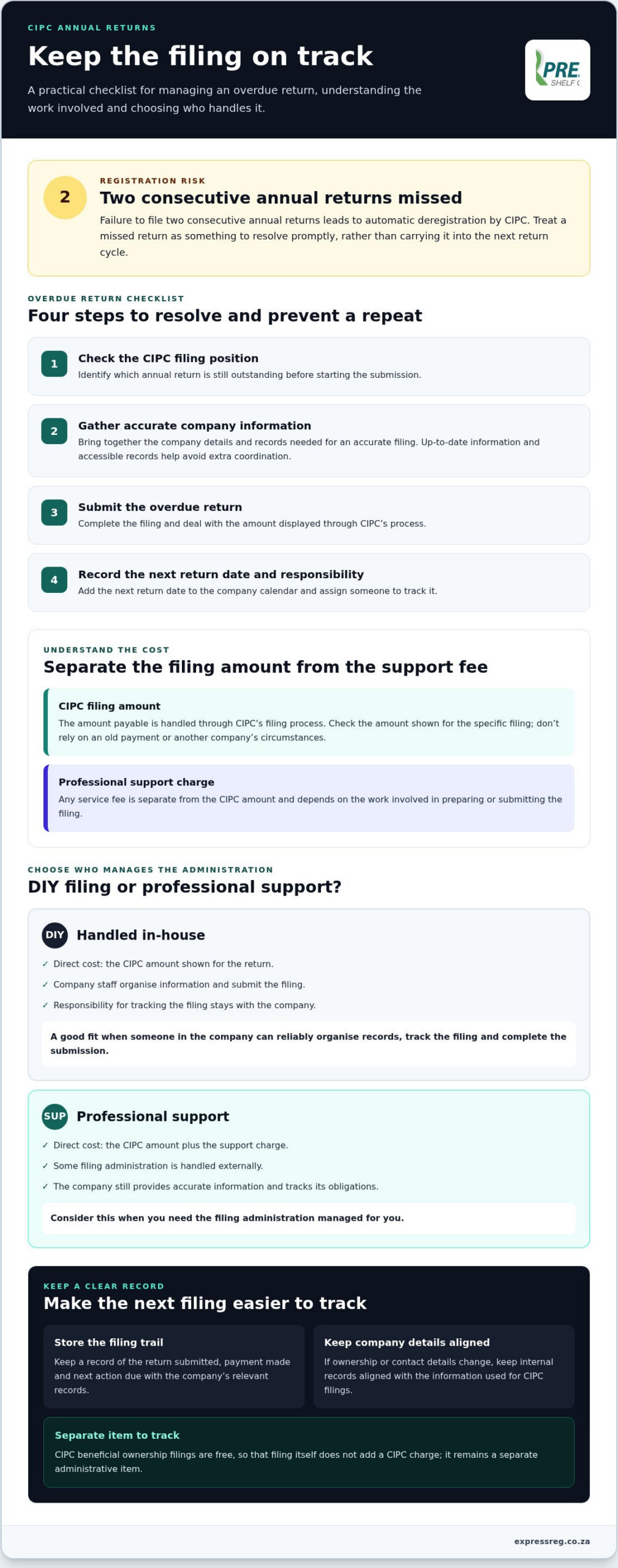
The key consequence is more than a late payment: failing to file two consecutive annual returns leads to automatic deregistration by CIPC. Repeated non-filing is therefore more serious than one overdue return, because the company’s registered status is at risk. Treat a missed filing as an item to resolve promptly, rather than letting it carry over into the next return cycle.
CIPC annual return fees
Separate the CIPC annual-return amount from any professional service fee for preparing or submitting the filing. The amount payable is handled through CIPC’s filing process, while support costs depend on the work involved. Don’t budget using an old payment or another company’s circumstances. Check the amount shown for the specific filing when planning payment.
A missed return also creates practical work. Someone must identify the outstanding return, gather accurate company information, complete the submission and handle any payment shown in the process. If records are scattered or the responsible director is unavailable, resolving the filing can require more coordination than completing it on time.
Use a simple sequence to manage an overdue return:
- Review the company’s CIPC filing position and identify the annual return that remains outstanding.
- Gather the company details and records needed to prepare an accurate submission.
- Complete the overdue filing and deal with the amount displayed through CIPC’s process.
- Record the next return date in the company’s calendar and assign responsibility for it.
This distinction helps separate the filing task from the broader cost of maintaining company records. DIY handling uses a director’s or employee’s time; professional support adds a service fee and can take on filing administration. Neither approach removes the need for accurate company information and timely action.
| Option | Direct cost | Time and administration | Late-filing exposure |
|---|---|---|---|
| DIY filing | CIPC amount shown for the return | Company staff organise information and submit the filing | Responsibility stays with the company |
| Professional support | CIPC amount plus the support charge | Some filing administration is handled externally | The company still needs to provide accurate information and track its obligations |
Choose DIY handling if someone in the company can reliably organise records, track the filing and complete the submission. Choose professional support if you need the filing administration managed for you.
Keep a filing record showing the return submitted, payment made and next action due. Store it with the company’s relevant records, rather than relying on one director’s inbox or memory. If ownership or contact details change, make sure internal records remain aligned with the information used for CIPC filings. CIPC beneficial ownership filings are free, so that filing itself does not add a CIPC charge; it remains a separate administrative item to track.
Does a Pty Ltd need to file annual financial statements or a financial accountability supplement with CIPC?
A Pty Ltd should distinguish its annual return from its financial reporting documents. For a CIPC filing, establish whether the company needs annual financial statements or a financial accountability supplement, then prepare the relevant document alongside the return. The appropriate route depends on the company’s reporting position, so don’t treat the documents as interchangeable.
Start by reviewing the company’s latest financial records and the information requested for its filing. Annual financial statements present financial information in a structured set of accounts. A financial accountability supplement is a separate document that provides accountability information. Each serves a different role in the company’s compliance records, and preparing one does not mean the other is complete.
Use these steps to organise the filing:
- Gather the company’s current financial records and its most recent reporting documents.
- Identify whether the filing calls for annual financial statements or a financial accountability supplement.
- Check that the chosen document relates to the correct company and reporting period.
- Prepare the annual return separately, using consistent company details.
- Keep copies of the submitted documents and filing records together.
For example, if the company has annual financial statements, don’t assume they automatically answer every accountability question in the filing. Compare the information requested with the document prepared, and resolve any mismatch before submission. If a supplement is required, gather the relevant company information for it instead of attaching unrelated accounts.
This distinction also explains why compliance work can involve more than a filing fee. Someone must organise source records, confirm that the document matches the reporting route and complete the submission accurately. With DIY handling, a director or staff member takes on these steps. Professional support can manage filing administration, while the company still needs to provide complete and accurate information.
Keep records accessible after filing. Store the financial statements or supplement with supporting company information, and retain a record of the annual return submission. If a later filing raises a question about the reporting period or company details, organised records make it easier to trace what was prepared and submitted. A folder labelled with the company name and reporting period can help prevent documents from being mixed with another entity’s records.
Review the reporting document before submitting it. Match its company details against the records used for the annual return, check that the relevant period is clear, and save the final copy. If the company’s circumstances or records have changed, include that information when preparing the appropriate document. This review helps keep financial reporting distinct from the annual return task.
For the related filing task, CIPC annual return filing support can help manage the annual-return submission separately from preparing financial reporting documents.
Treat any director-detail update as a separate administrative task from the financial reporting choice. CIPC director-detail changes can be submitted online at no charge. That does not make a director-detail change a substitute for annual financial statements or a financial accountability supplement, and it does not remove the need to identify which financial document applies to the company’s filing. Keep director information and financial reporting material clearly distinguished in the company’s records, so material prepared for one purpose is not mistaken for material required for another. Before completing the annual return, review the company details used across the records and check that the chosen financial document remains aligned with the filing. If director details have changed, handle that update through the online process, while retaining a record of the submission with the company’s other compliance documents. Keep this record separate from the financial statements or supplement, but accessible alongside them. That separation makes it easier to see which administrative action was taken, which financial document was prepared, and what information was used for the filing.
When must a South African Pty Ltd have an audit, and what does an audit typically cost?
A South African Pty Ltd’s audit requirement depends on its applicable reporting obligations, not simply its company name. Establish the company’s reporting position before budgeting, then distinguish audit costs from other financial reporting and filing work.
Start by identifying the company’s legal and reporting circumstances. The assessment may involve its ownership arrangements, financial activities, governance documents and obligations to stakeholders. These factors help determine whether an audit is required or another form of financial reporting applies. Don’t assume every Pty Ltd follows the same route, or that preparing annual financial statements automatically requires an audit.
Work through these practical checks before arranging an audit:
- Gather the company’s current financial records and governance documents.
- Identify its reporting obligations and any audit conditions that apply to its circumstances.
- Separate statutory requirements from conditions agreed with lenders, investors or other stakeholders.
- Organise supporting documents, including transaction records and explanations for unusual entries.
- Confirm the audit scope and required outputs before setting the budget.
For example, a company with clear transaction records presents a different preparation task from one with incomplete accounts and unresolved entries. Audit work addresses the records and risks within its scope. The company’s activity, transaction complexity and quality of documentation can therefore affect the time and professional work involved.
There is no single audit price that applies to every South African Pty Ltd. The fee depends on the scope of work, volume and complexity of transactions, quality of records and time needed to resolve queries. A business with multiple revenue streams or complicated supporting records may require more examination than one with straightforward, well-organised documentation. These are cost factors, not a fixed tariff.
To build a useful budget, list the records already prepared, note any gaps and describe the company’s activities clearly. Request the proposed audit scope and deliverables in writing, so the budget reflects the work required. Keep the audit fee separate from bookkeeping, financial statement preparation and CIPC filing administration. Each task addresses a different part of the company’s reporting process.
Preparation can help avoid unnecessary work. Assign someone to collect bank records, invoices, contracts and explanations for unusual transactions. Arrange files by reporting period and use consistent descriptions. If a query arises, provide the supporting document and a clear response together. This reduces repeated searches through email and makes the audit trail easier to follow.
Once the reporting position is established, record the next steps and who is responsible for each task. A director might oversee document collection, while the finance team prepares reconciliations and responds to audit queries. If the company’s reporting circumstances change, review the audit assessment before the next reporting period. This keeps the decision based on current company records rather than last year’s assumptions.
What are the ongoing SARS tax filing and payment requirements for a South African Pty Ltd?
A Pty Ltd’s SARS filing and payment workload depends on its tax registrations and business activities. Start by listing the taxes linked to the company, then organise the returns, supporting records and payments for each relevant tax type.
Company income tax is one area to include in that review. Keep records of income, expenses and supporting transactions so the company’s tax position can be prepared from its accounts. Filing a return and making any payment are separate tasks: preparing information does not settle an amount due. Reconcile the figures before submission and retain the supporting records.
Other tax responsibilities depend on the company’s circumstances. For example, a VAT-registered company needs to manage its VAT administration, while an employer may have payroll-related obligations. Not every Pty Ltd has the same filing requirements. Confirm which registrations apply to the company and use its SARS account and notices to track relevant submissions and payment instructions.
Use a practical workflow to manage the tasks:
- List the company’s SARS registrations and identify the return or payment associated with each.
- Assign someone to collect invoices, expense records and other supporting documents.
- Reconcile the source records against the figures prepared for each submission.
- Submit the relevant information through the company’s SARS process and record the outcome.
- Track payment instructions separately, then retain proof of payment with the related return.
A VAT-registered company, for example, should organise sales and purchase records for its VAT administration. A company with employees should also maintain payroll information relevant to its tax responsibilities. These records serve different purposes, so don’t combine them into one unexplained total. Label documents by tax type and reporting period to make preparation and review clearer.
Plan payments based on the company’s own position, not another business’s experience. The amount depends on the company’s taxable activity, records and applicable tax treatment. Keep funds available for amounts identified through the company’s SARS process, and record payments made. If figures change after reconciliation, update the relevant working papers before finalising the filing.
DIY management can work when someone consistently maintains records, follows SARS notices and records each completed task. Professional tax support may help when the company’s transactions or registrations make administration difficult to coordinate. In either case, the director remains responsible for ensuring company information is accurate and relevant tasks are not overlooked.
Separate SARS tax tasks from CIPC company filings in the compliance calendar. CIPC beneficial ownership filings are free, but they are not a substitute for tax returns or payments to SARS. Keep ownership information and tax records in distinct folders, with a clear owner for each action. This structure helps directors see which obligation belongs to which authority.
If company ownership details need attention alongside tax administration, submit a beneficial ownership filing as a separate CIPC compliance task.
An employer should maintain payroll information relevant to its tax responsibilities and organise applicable filings and payments according to its registrations and SARS instructions. The cost depends on the company’s circumstances and applicable obligations.
Express Shelf Company: Shelf Company
Express Shelf Company can help with company setup and filing administration. If you need an existing company structure, consider a Shelf Company; if you’re starting from the beginning, New (Pty) Ltd Registration may suit your plans. For an operating company, CIPC Annual Returns support can help manage the filing. VAT Registration is available when you need to register for VAT.
Turn to Express Shelf Company for assistance with company setup or filing administration. The right option depends on whether you’re forming a company, using a shelf company or managing an existing filing. Contact Express Shelf Company or visit expressreg.co.za to discuss the relevant service for your situation.
Make compliance easier to plan
Build your compliance budget around the work your company actually needs, rather than treating every filing as one fixed expense. The ongoing compliance costs for a Pty Ltd depend on its registrations, reporting needs and whether staff manage the administration or you use professional support. Set a clear process: assign responsibility, organise company records and review upcoming tasks as the business changes.
Choose support for the specific administrative task you need to move forward. Express Shelf Company offers Shelf Company and New (Pty) Ltd Registration options for businesses setting up, as well as CIPC Annual Returns support for companies managing their filings. Focus the next step on your company’s current need, keeping administrative support distinct from accounting or audit work.
To discuss the relevant company service, contact Express Shelf Company. Put a straightforward compliance process in place, then give your attention to running and developing your business.
Frequently Asked Questions
What are the annual CIPC compliance fees for a South African Pty Ltd?
There is no single annual CIPC compliance fee that covers every obligation. Separate the official charge for a specific CIPC filing from any professional service fee for preparing or submitting it. The ongoing compliance costs for a Pty Ltd therefore depend on the filings it needs and whether it handles them internally. Check the amount displayed for the company’s filing before payment, and keep the proof with relevant records.
What are the annual return filing deadlines and penalties for a South African private company?
A private company must manage its annual return according to its CIPC filing cycle, so record the due date shown for that company rather than relying on another business’s calendar. Set an internal reminder ahead of the deadline and assign someone to prepare the information and payment. Missing two consecutive annual returns leads to automatic deregistration by CIPC. Keep submission confirmations with company records to track completed filings.
What penalties and risks apply for late CIPC, SARS, VAT, or payroll compliance in South Africa?
The consequences depend on the authority and obligation involved, so assess each late item separately. For CIPC, failing to file two consecutive annual returns leads to automatic deregistration. For SARS VAT and payroll tasks, identify the outstanding return or payment, review the company’s account or notice, and resolve the specific item. Keep separate records of submissions, balances and payment confirmations. A single compliance calendar can help prevent missed tasks.