A late Compensation Fund assessment can attract interest of 15% of the outstanding balance every month after its due date. The cost of non-compliance with the Compensation Fund can also include unpaid assessments and the consequences of failing to register or meet reporting duties, so the amount depends on the issue and the employer’s circumstances.
It’s understandable to want a clear figure, especially when an assessment notice or audit raises questions about what is owed. The practical starting point is to identify the missed requirement, how the assessment was calculated and whether interest applies to an overdue balance.
Read on to learn how assessments are calculated, how employer audits can affect compliance costs and what may happen when obligations are missed. You’ll also find out which records and processes can help you manage Compensation Fund responsibilities and address gaps before they become harder to resolve.
Key Takeaways
- Separate overdue assessment amounts from interest and other possible consequences to understand what is driving your total liability.
- Keep employee earnings records organised, as accurate payroll information helps support correct assessments and employer audits.
- Understand how work-related risks and accident costs can affect an employer’s assessment and potential rebate eligibility.
- Act promptly on missed registration, reporting or payment obligations, as non-compliance can lead to more than an outstanding balance.
- Review your Compensation Fund account, assessment notices and payment history to identify discrepancies and plan the steps to settle arrears.
What are the fines for late submission of Compensation Fund returns?
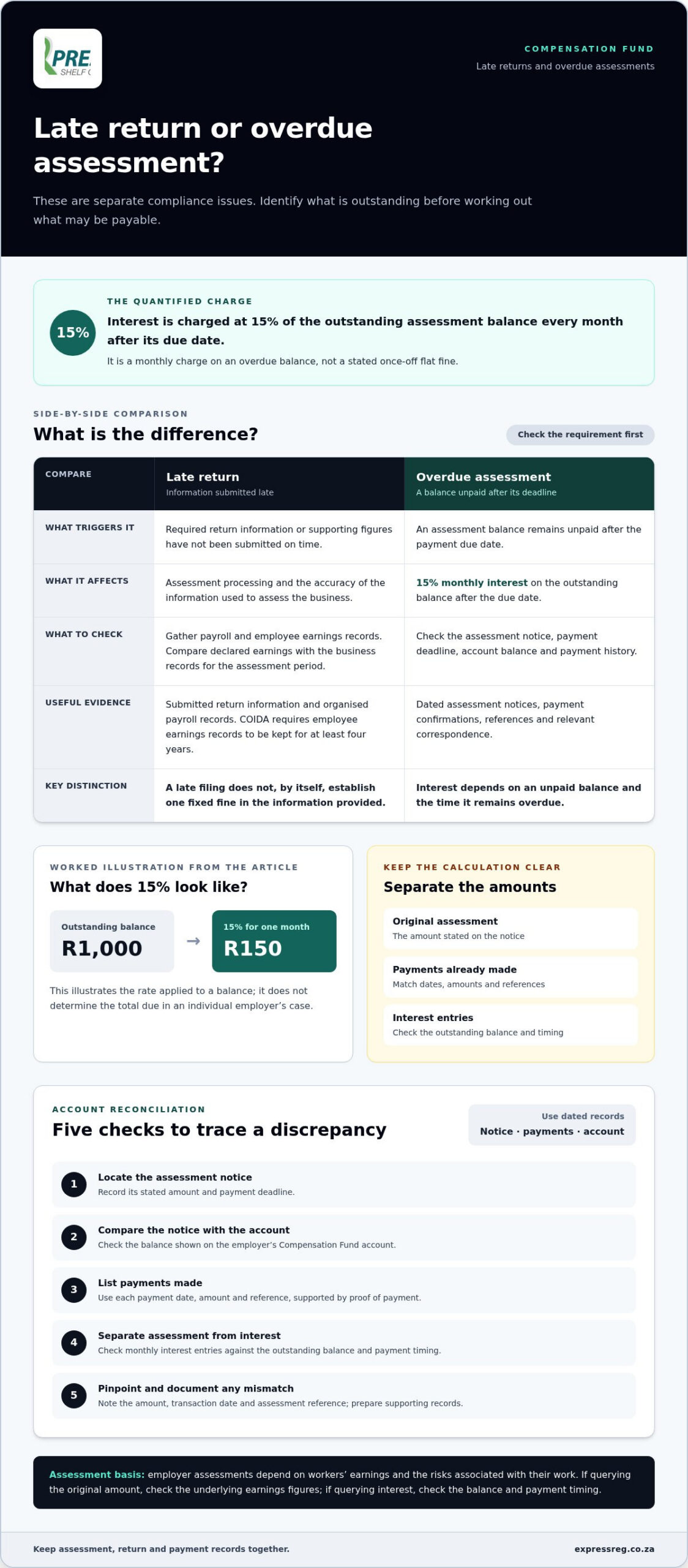
The clearest quantified consequence is interest on an assessment that remains unpaid after its due date. The Compensation Fund service booklet states that interest of 15% of the outstanding balance is charged every month after the due date. A late return and an overdue assessment are separate issues: submitting information late can affect assessment processing, while the stated interest applies to an outstanding balance after its payment deadline.
South Africa’s Compensation for Occupational Injuries and Diseases Act is Act No 130 of 1993, amended in 1997, according to the South African Government. For employers, the key practical task is to submit accurate earnings information so the Compensation Fund can assess the business. Assessments depend on workers’ earnings and the risks associated with their work. Certain employers are exempt from paying the annual assessment fee.
The assessment year runs from 01 March to 28 February of the following year. The Compensation Fund sends employers an assessment notice every year in April, stating the amount payable for the assessment fee. Use the notice to identify the assessment period, the amount due and its payment deadline. If a return or supporting figures are outstanding, organise the relevant payroll records before reconciling the assessment.
Under COIDA, keep employee earnings records for at least four years. These records help explain the figures used for an assessment and support a correction if reported earnings differ from payroll information. Compare the earnings declared for the assessment period with your employee records, then identify any differences before responding to an assessment notice.
To manage a late return and reduce uncertainty, take these steps:
- Gather payroll and employee earnings records for the relevant assessment period.
- Compare declared earnings with the figures recorded by the business.
- Review the Compensation Fund assessment notice and note its due date.
- Submit the required return information and address any difference in the assessment.
- Pay an outstanding assessment by its due date, because the stated 15% monthly interest applies after that date.
The cost of non-compliance with the Compensation Fund depends on the assessment and whether a balance remains unpaid. A late filing should prompt a review of the return and any assessment notice, rather than an assumption that one fixed fine applies. Keep submitted information, payroll records and payment evidence together. This gives you a clear record for resolving questions about the assessment, its earnings basis or the payment date.
How are penalties and interest calculated on overdue Compensation Fund assessments?
The Compensation Fund service booklet states that interest of 15% of the outstanding balance is charged every month after the due date. This makes the unpaid assessment balance and the period overdue central to the calculation. The rule describes a monthly charge, not a once-off flat amount.
For a straightforward illustration, if R1,000 remains outstanding after the due date, 15% of that balance is R150 for one month. This example shows the rate applied to a balance; it does not establish the total due in any particular employer’s case. Use the amount and dates on the assessment notice and payment record to reconcile the actual account.
Separate the figures before deciding what needs attention. Identify the original assessment, payments already made and interest charged after the due date. Differences between your records and the Compensation Fund account may result from an omitted payment, an incorrect reference or a disputed assessment amount. Match each transaction to its proof of payment to pinpoint the issue.
Follow a consistent reconciliation process:
- Locate the assessment notice and record its stated amount and payment deadline.
- Compare the notice with the balance shown on the employer’s Compensation Fund account.
- List payments made, using each payment date, amount and reference.
- Separate the original assessment from monthly interest in the account calculation.
- Identify any mismatch and prepare the supporting records before taking the next step.
Timing matters. An assessment paid by its due date does not meet the stated condition for post-due-date interest. If you pay after that date, compare your payment evidence with the account’s interest entries. Keep dated copies of the notice, payment confirmation and correspondence to make the sequence of events clear.
Do not treat a late return and interest on an overdue assessment as interchangeable charges. Interest applies to an outstanding balance after the payment deadline. The assessment itself is based on employer information, including earnings and work-related risk, so check the underlying figures if you are querying the original amount. If you are querying interest, check the balance and payment timing.
Where an account appears inconsistent, set out the specific amount, transaction date and assessment reference in your records. Keep the explanation factual and attach relevant evidence when raising the issue with the Compensation Fund. For related statutory administration, company compliance support can sit alongside your separate assessment reconciliation.
The Compensation Fund’s minimum assessment is intended to ensure that the assessment is not less than the administration costs incurred. Separately, under South African COIDA, monthly payments for permanent disablement apply when the disablement is assessed at over 30% and is related to the employee’s wage; these are distinct from interest on an overdue assessment.
Can the Compensation Fund recover claim costs from a non-compliant employer?
Non-compliance and an employee’s compensation claim are related, but they are not the same liability. South Africa’s COIDA no-fault system allows an employee to claim compensation without suing the employer. A claim payment alone does not establish that its cost is automatically recoverable from the employer. Keep the employee’s compensation entitlement separate from the employer’s registration, assessment and reporting obligations.
Employers must register for compensation with the Compensation Commissioner or a designated mutual association. Failure to register constitutes an offence. This does not mean that every claim involving an unregistered employer automatically becomes a debt equal to the claim’s value. Assess the specific compliance failure and the circumstances of the claim separately.
Reporting duties also matter. An employer must notify the Commissioner or designated carrier of an employee’s accident within 7 days after becoming aware of it. For an occupational disease, the notification period is 14 days after awareness. These deadlines concern reporting, not a calculation of claim costs owed by the employer. Record when the employer learned of the incident and when the report was sent.
Keep the claim file and compliance records together. Include details of the employee’s incident or disease, the date you became aware of it, the report submitted and proof of delivery. Add registration information and relevant earnings records. These documents create a factual timeline if the Compensation Fund or designated carrier raises questions about the claim or compliance history.
Employer negligence is a separate issue from ordinary claim handling. An employee who believes compensation is inadequate may seek increased compensation if they can prove employer negligence. The employee must lodge an application with the Commissioner within 24 months of the accident or diagnosis. This route concerns increased compensation, not an automatic recovery of every claim cost from a non-compliant employer.
For a practical review, sort the records into these categories:
- Registration: identify the compensation carrier and retain registration details.
- Assessment: keep assessment notices and earnings information distinct from claim documents.
- Incident reporting: record awareness dates, notification dates and supporting evidence.
- Claim correspondence: preserve requests, decisions and any stated reason for an amount claimed.
If a demand seeks repayment, identify its stated basis and the specific amount before treating it as a claim-cost debt. Compare the demand with your registration, assessment and incident records. This helps distinguish a confirmed assessment balance or reporting issue from the employee’s compensation claim, so you can respond to the matter actually raised.
What legal action can the Department of Employment and Labour take against non-compliant employers
Failure by an employer to register for compensation under COIDA constitutes an offence. This is the clearest legal consequence to consider if a business has not registered with the Compensation Fund or a designated carrier. On its own, it does not establish a specific fine or mean every claim becomes a debt payable by the employer.
The Department of Employment and Labour’s response depends on the specific compliance failure. If your business faces a registration concern, establish whether registration was completed, which carrier holds the record and what documents support your position. If you have no registration evidence, gather your company details, employee information and any correspondence about the compensation account.
Keep this issue separate from an unpaid assessment. A registration offence concerns the employer’s failure to register for compensation. An overdue assessment concerns money payable to the Compensation Fund. Each matter requires its own records and response, rather than a single assumption about what the Department may do.
Build a clear file before responding to an official communication. Include the notice or request, the date it arrived, registration documents, assessment records and relevant correspondence. Match each document to the issue raised. For example, if the concern is registration, lead with registration evidence, not unrelated payroll material. If the issue is an assessment, organise the notice and payment records separately.
Use these steps to manage a compliance enquiry:
- Identify whether the notice concerns registration, an assessment, reporting or another matter.
- Record the date received and any response deadline stated in the communication.
- Collect documents that directly address the stated issue.
- Prepare a factual response and retain a copy with proof of submission.
- Track any follow-up request and add the response to the same file.
Do not treat an alleged offence, an assessment balance and a compensation claim as interchangeable. Each involves different facts. Registration evidence shows whether the employer registered. Assessment records explain an amount payable. Claim documents relate to an employee’s compensation matter. Keeping these categories separate makes it easier to address the Department’s actual concern.
If you receive a formal notice, read it carefully and respond to the issue it identifies. Evidence that an application was started may not answer a question about completed registration. Similarly, proof of payment does not establish registration. Keep dated evidence of each step, including submissions, acknowledgements and correspondence, to show what action you took and when.
How can an employer check and settle outstanding Compensation Fund assessments and penalties
Start with the latest Compensation Fund assessment notice and compare it with your payment records. The notice identifies the assessment and amount payable; your bank records show payments made. Match each payment to its date, amount and reference. This helps distinguish an unpaid balance from a payment that may not have been allocated correctly.
Then reconcile the account period by period. The Compensation Fund assessment year runs from 01 March to 28 February of the following year, and annual assessment notices are sent in April. Organise each notice alongside the return information and earnings figures used for that period. Employers must keep employee earnings records for at least four years under COIDA, which can help explain differences in declared earnings.
Use this sequence to identify and settle the amount shown as outstanding:
- Collect assessment notices, submitted return details and payment confirmations.
- Match every payment to the relevant assessment period and reference.
- Compare the assessed earnings with employee earnings records.
- Separate the original assessment balance from interest entries.
- Follow the payment instructions on the current notice or account information.
- Retain the proof of payment and check that the account reflects the transaction.
Check interest separately. Compare the due date, the balance on which interest was applied and the dates of any payments. If the figures differ from your records, prepare a concise reconciliation listing the amount, date and reference for each transaction.
Do not rely on an old notice as the sole guide to the current amount. Later payments, assessments or interest entries may have changed the account balance. For example, a payment made after an earlier notice could reduce the principal balance, while later monthly interest entries may still appear. Record each item separately before making another payment.
Contact the Compensation Fund through the relevant official account or correspondence channel to resolve an unexplained mismatch. Include your employer details, assessment period, notice reference, payment evidence and a clear description of the discrepancy. Keep your query and any response with the account records. This creates a traceable record of the amount in question and the steps taken.
Once the balance is reconciled, retain the updated account information with the assessment and payroll records. Employers who also need help with a Letter of Good Standing can arrange that separately; the letter is not a substitute for settling an outstanding assessment.
Check whether an applicable exemption or rebate affects the amount being reviewed. In South Africa, employers must register with the Compensation Fund and pay an annual assessment fee based on workers’ earnings and the risks associated with their work, although certain employers are exempt from paying the fee. The fee may increase or decrease according to the employer’s accident costs, and employers with low costs may qualify for rebates.
The Compensation Fund simplified employer assessments by limiting the number of classes used to assess employers through a new regulation published by the Minister. The Compensation Fund had about 11 000 employers flagged for audit, with the number fluctuating as employers were flagged, assessed and cleared.
Express Shelf Company: Shelf Company
Express Shelf Company can help with setting up a business and managing its company administration. Choose a Shelf Company or New (Pty) Ltd Registration for a new business structure, or use CIPC Annual Returns support to manage company filing obligations. COIDA Registration is relevant when your business needs to register for compensation coverage.
These services cover company and registration processes; they do not settle an existing Compensation Fund assessment or determine a disputed balance. Keep the Fund’s assessment notices, payment records and earnings information organised separately, and follow up with the Fund about any outstanding amount.
For company setup or a related filing, contact Express Shelf Company to discuss the next step that suits your needs.
Put your next compliance steps in order
Managing the cost of non-compliance with the Compensation Fund starts with separating Fund obligations from wider company administration. Keep assessment matters on their own track, then identify any company filings that also need attention. This practical order helps you focus on the issue that needs action first, without confusing a CIPC filing with a Compensation Fund payment.
For business setup and company administration, Express Shelf Company offers Shelf Company options, New (Pty) Ltd Registration and CIPC Annual Returns. These services support company-related tasks; they do not settle an outstanding Compensation Fund assessment or replace a response to the Fund. Choose the next step that matches your business need, and keep the relevant records together as you work through it.
If you need help with company setup or CIPC filings, contact Express Shelf Company for help. Take one clear administrative step at a time, and keep building a more organised compliance process.
Frequently Asked Questions
What are the penalties for failing to register with South Africa’s Compensation Fund?
Failure to register for compensation under COIDA constitutes an offence. This is distinct from an unpaid assessment: registration concerns whether the employer is registered with a compensation carrier. Establish your registration status and gather any application records or correspondence. If registration was not completed, address the requirement and keep evidence of the steps taken. Do not treat an assessment payment as proof of registration.
Can employers be held liable for employees’ medical costs if they are not registered with the Compensation Fund?
Non-registration alone does not establish that an employer must personally pay every employee medical bill. COIDA provides a no-fault compensation system, allowing an employee to claim without suing the employer. Keep the medical invoice, incident details and claim correspondence separate, then establish whether the amount relates to a compensation claim or another matter. The employer’s registration obligation remains a separate compliance issue.
What are the consequences of failing to report a workplace injury to the Compensation Fund?
An employer must notify the Commissioner or designated carrier of an accident within 7 days after becoming aware of it. For an occupational disease, notification is due within 14 days after awareness. A late report can leave the claim file without a timely employer account of the incident. Record when the employer learned of the injury, prepare the report and retain its submission evidence with the employee’s claim documents.