
What if the address you need to change isn’t the one you first had in mind? Changing your company’s registered address with CIPC can feel straightforward, but South African companies need to distinguish the registered office from directors’ residential or business addresses. Identifying the correct record is the first step towards an orderly filing.
If you’re unsure which details CIPC needs, which form applies or what supporting documents to prepare, you’re not alone. Incomplete or inconsistent information can lead to follow-up and delay. This guide explains how to identify the right address record, gather company details and supporting documents, and manage the filing through to confirmation.
You’ll also learn how a registered-office change differs from an update to director particulars, and why related records, such as SARS details, may need separate attention. Express Shelf Company provides independent administrative support through its Company Amendments service, including preparation, submission and follow-up. It is not a government agency. This guide will help you approach the process with clear expectations.
Key Takeaways
- Identify whether the change concerns your company’s CIPC registered office or another address record before preparing an amendment.
- For changing your company’s registered address with CIPC, gather consistent company details and the proposed address information before starting the filing.
- Follow a clear sequence: confirm the change, prepare the required details, submit the amendment and keep the filing outcome for your records.
- A change to your trading location does not automatically update the registered office recorded with CIPC, so check that the correct company record is amended.
- Express Shelf Company’s Company Amendments service includes preparation, submission and follow-up of filings. The service is independent of CIPC.
What changing your company’s registered address with CIPC actually updates
When a company’s registered office changes, updating the CIPC record helps ensure official company correspondence is directed to the correct place. Changing your company’s registered address with CIPC means amending the relevant company record. It does not mean simply telling customers where you now trade or asking every organisation to use a new mailing address.
The Companies Act requires a company to maintain a registered office in South Africa. In practical terms, this is the address recorded for official company administration, where formal notices and documents may be directed. CIPC, the Companies and Intellectual Property Commission (CIPC), is the official registrar of South African companies. A registered-office amendment changes the company information held by CIPC. It does not, by itself, change the information held by SARS, a bank or another organisation.
Registered office, trading address and postal address: what is different?
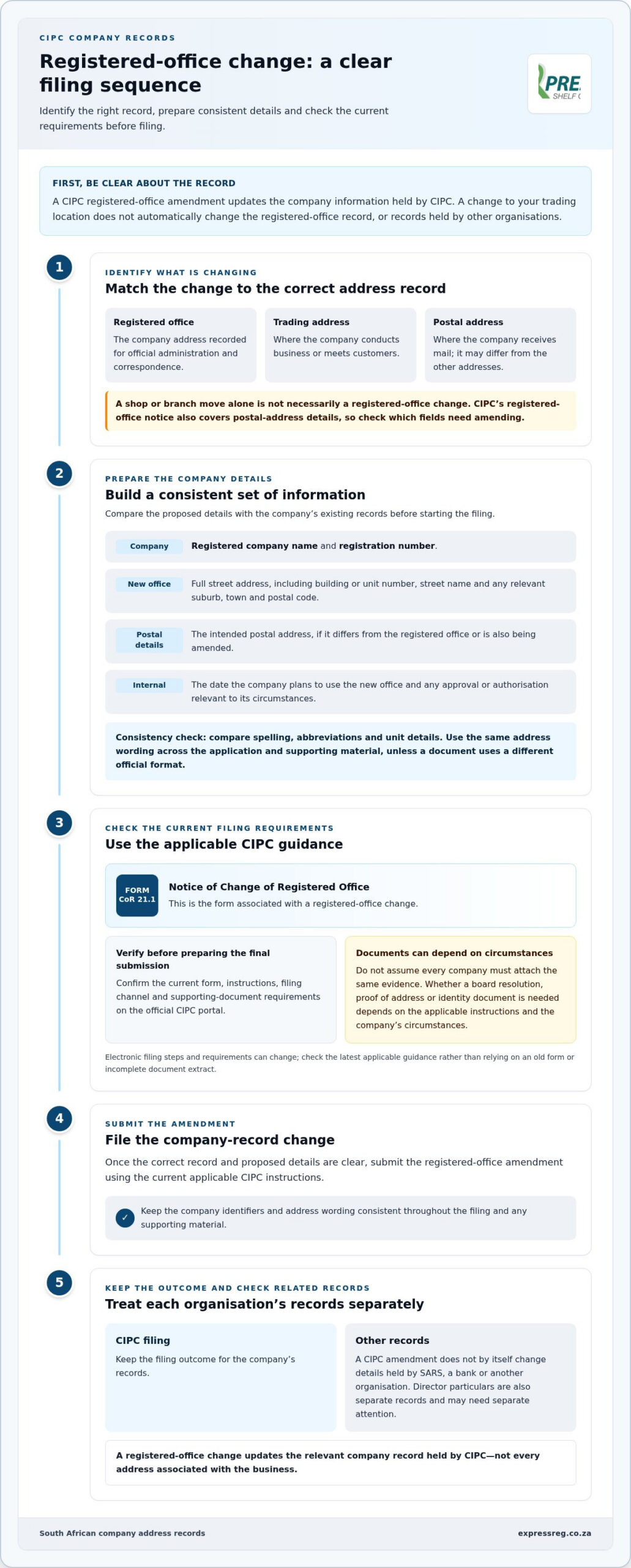
These address types serve different purposes. The registered office is the company’s address recorded for official administration. The trading address is where it conducts business or meets customers. The postal address is where it receives mail, and may differ from both.
A company can use the same address for all three, but that is not automatic. For example, a retailer might move its shop while keeping its registered office at its existing administrative premises. The shop’s move alone does not mean the registered-office record has changed. CIPC’s registered-office notice also covers postal-address details, so identify which company fields need amending and prepare the information for each. Do not assume that changing one address updates records held by other organisations.
Which South African companies may need an address amendment?
Private companies, including (Pty) Ltd companies, may need to amend their registered-office details when that office moves. The same practical distinction applies to other South African company types, such as public companies, non-profit companies and personal liability companies. Focus on the registered office recorded for the company rather than assuming every operational move calls for a CIPC amendment.
For example, if a company relocates its administrative office from one South African address to another and that location is its registered office, the CIPC record should reflect the new office. If it only opens a branch or changes its trading premises while retaining the registered office, those changes are not necessarily the same amendment. First identify the exact record that has changed. Then make sure the proposed address is complete and consistent wherever it is required.
This section concerns company records held with CIPC. Other addresses, including director particulars or details held by SARS, are separate records and may need separate attention. Treat each update as its own administrative task, rather than expecting one CIPC filing to change every address associated with the business.
Preparing for a CIPC registered address change
Good preparation starts with accurate company identifiers and a complete version of the address you intend to record. Before changing your company’s registered address with CIPC, collect the information below and compare it with the company’s existing records. This gives you a clear working file and helps identify inconsistencies before submission.
Company information and new address details to check
Have the company’s registered name and registration number to hand. Check the current registered-office details against the proposed new address, and decide whether postal details are changing as well. These are practical preparation steps; not every item is necessarily a prescribed attachment.
- Company identifiers: the registered company name and registration number.
- Address information: the full new street address, including building or unit number, street name and any relevant suburb, town and postal code.
- Postal details: the intended postal address, if it differs from the registered office or is also being amended.
- Internal records: the date the company plans to use the new office and any approval or authorisation relevant to its circumstances.
Check spelling, abbreviations and unit details carefully. Use the same address wording across the application and any supporting material, unless a document uses a different official format. A missing unit number or mismatched street name can create avoidable questions about which location the filing refers to.
Supporting documents and approval: verify the current CIPC rules
The form associated with a registered-office change is Form CoR 21.1, Notice of Change of Registered Office. Before preparing a final submission, confirm the current form, instructions, channel and supporting-document requirements on the official CIPC portal. Electronic filing steps and requirements can change, so use the latest applicable guidance rather than relying on an old copy or an incomplete document extract.
Do not assume that every company must attach the same evidence. Whether a board resolution, proof of address or identity document is needed can depend on the applicable CIPC instructions and the company’s circumstances. Check the current requirements, prepare any requested records in the specified format, and make sure approval is properly recorded where the company’s governance arrangements call for it.
In short, prepare the company’s name and registration number, the complete proposed address, and the form, approvals and supporting documents required by current CIPC guidance. This keeps preparation focused without treating an unverified checklist as a mandatory document list.
Express Shelf Company’s Company Amendments service helps organise the amendment paperwork, including preparation, submission and follow-up. Express Shelf Company is an independent service provider, not a government authority or CIPC representative.
How the CIPC address-change filing works and what can affect progress
Once you’ve identified the company record to amend and prepared the details, keep the filing process orderly from the initial decision through to confirmation. Current CIPC instructions should guide the submission channel, form version and supporting information required. Check that any saved application or instructions you plan to use are still current.
A practical sequence from decision to submission
- Confirm the change. Check that the registered-office record is the one that needs updating, and agree the complete address the company intends to record.
- Prepare the filing. Use current CIPC guidance to confirm the applicable form, submission method and supporting requirements. Compare the information in the form with the company’s records and any documents being submitted.
- Lodge the amendment. Follow the relevant CIPC process and complete each required step. If the process requests director verification or further information, respond through the stated channel.
- Save the evidence. Keep a copy of the submitted information, any acknowledgement or reference, and related correspondence. This creates a clear record if you need to follow up.
Careful preparation can reduce avoidable questions, but it cannot determine how quickly CIPC will handle a filing. Inconsistent details, missing information, a request for clarification or incomplete verification may affect progress. Processing and the outcome depend on CIPC’s handling of the application, so do not assume that submission guarantees acceptance or an immediate update.
After submission: follow up and retain the record
After lodging the amendment, monitor the email address and other contact channels used for the filing. Look out for an acknowledgement, request for correction or additional information, and a final outcome. If CIPC asks for clarification, use the reference details and respond in line with its instructions. Keep track of what was sent and when, so the company can follow the application’s history.
Submitting an address-change filing is not the same as confirmation that CIPC has updated the company record. Once you receive an outcome, use the current official CIPC channel to check the company’s registered details. If the record still shows the previous address, review the outcome and correspondence before deciding on the next step.
Retain the confirmation, submitted form, supporting records and relevant messages with the company’s compliance documents. An organised file helps directors and staff refer to the correct registered address later, and provides useful context if the company makes another amendment. It also helps distinguish the CIPC filing record from separate address updates the business may need to make with other organisations.
For changing your company’s registered address with CIPC, treat follow-up as part of the filing, not an optional extra. Record who is monitoring the application, where the correspondence is stored and how the company will verify the updated details. This handover helps prevent an acknowledgement from being mistaken for a completed amendment.
Common address-change mistakes and how to avoid them
A filing can be delayed or need correction if it describes the wrong change or contains details that do not match across the application and supporting information. Before lodging an amendment, check that it concerns the company’s registered-office record, that the address is complete, and that someone will monitor the filing afterwards. These checks help keep the process clear without assuming every business move requires a CIPC update.
Mistaking an operational move for a CIPC record update
Moving a shop, workshop or customer-facing office does not automatically amend the registered-office details held by CIPC. A company might change where staff work while keeping its registered office elsewhere. The key question is whether the registered-office record itself is changing, not simply whether daily operations have moved.
Before preparing the application, identify the precise address field or company record that needs attention. A CIPC filing should not be treated as an instruction to update SARS, a bank or another organisation. Those records have their own processes, so list any separate updates the business needs to make rather than assuming they will follow automatically.
Preventing incomplete details and missed follow-up
Small inconsistencies can make an address harder to verify. Compare the application with the company’s source information and any documents required under current CIPC guidance. Check spelling, building and unit numbers, street details and postal code. Do not switch between shortened and full versions of a street name without a clear reason, or leave out a unit or floor that identifies the company’s premises.
Keep the submitted form, acknowledgement, reference details and CIPC correspondence in one place. Assign someone to monitor the contact channel used for the filing. If CIPC requests a correction or more information, follow the instructions in its correspondence and use the current process. Guessing at a replacement document or resubmitting without understanding the request can create further confusion.
Also avoid treating proof of submission as proof of completion. Check the company record through the current official CIPC channel once an outcome is available. If the previous address still appears, review the correspondence and filing status before assuming the amendment has been processed.
Final check before lodging:
- Confirm that the change concerns the registered-office record, not only the trading location.
- Compare the company identifiers and every part of the proposed address across the filing information.
- Verify against current CIPC guidance: the applicable form, submission channel, supporting-document requirements and any approval documents relevant to the company.
- Save the submission record and make a plan to monitor correspondence and check the company record after processing.
Express Shelf Company’s Company Amendments service supports filing preparation and follow-up. Arrange help with a CIPC company amendment through the service. Express Shelf Company is an independent service provider, not a government authority or CIPC representative.
How Express Shelf Company supports a CIPC Company Amendment
Preparing and following up a company amendment can take time, particularly when you’re balancing filing tasks with day-to-day operations. Express Shelf Company provides independent administrative support to South African businesses through its Company Amendments service. It is a private service provider, not CIPC or a government representative. CIPC remains responsible for handling the filing and updating its company records.
What administrative support covers
The service helps organise the amendment from preparation through follow-up. Express Shelf Company works with the company information and proposed change, prepares and submits the filing, and monitors for correspondence or an outcome. Client updates help keep the process visible, so you know what has been submitted and whether a response or further information is needed.
This organised approach helps keep filing details and related communication together, rather than leaving them scattered across emails, forms and reminders. Requirements are managed in line with the filing process and the information available for the company’s circumstances. CIPC’s current instructions and its handling of the application still apply.
Express Shelf Company brings 10 + years of experience to its business administration work. Its role is to support the preparation and handling of the amendment, not to guarantee a particular processing time or outcome. The listed professional service fee for Company Amendments is R850. Our prices are for our professional services. Official government fees may apply in addition to our service fee.
Start an enquiry for a CIPC Company Amendment
To begin an enquiry, provide the company’s registered name and registration number, describe the address record you intend to change, and share the proposed new details. Include any information you already have about the move or filing. This gives the administrative process a clear starting point and helps organise the next steps.
The filing information and applicable requirements are addressed before submission, with follow-up handled as the application progresses. If CIPC requests clarification or further information, the response can be managed in line with its instructions. Timing and the final decision remain subject to CIPC’s processing.
If changing your company’s registered address with CIPC feels like one more task to manage, Company Amendments support can help organise the filing process. Share the company and amendment details to get started. Express Shelf Company provides administrative support independently and does not represent itself as a government authority.
Make the address change your next organised business task
An office move can involve several practical decisions, so give the company’s CIPC amendment a clear place in the handover. Decide who will oversee the filing and keep track of any correspondence. Assigning responsibility helps prevent the task from getting lost among premises, supplier and staff arrangements.
Changing your company’s registered address with CIPC can be treated as a defined administrative step rather than an ongoing distraction. Before proceeding, make sure the person responsible has the company details and proposed address information ready, and knows where to record updates as the filing progresses. This gives the business a straightforward way to maintain continuity while its arrangements change.
For administrative support with the amendment, enquire about support with your CIPC Company Amendment. Share the company’s details and the change you’re planning to begin the filing process with Express Shelf Company.
Frequently Asked Questions
Can I change my company’s registered address with CIPC online?
Express Shelf Company prepares and submits Company Amendments filings, including registered-office changes. If you are lodging a filing directly, follow the latest CIPC instructions for the applicable channel and required steps. Have the company’s registered name, registration number and proposed address ready. Keep the submission acknowledgement and any later CIPC correspondence for your records.
What documents do I need to change a registered office address with CIPC?
The documents required depend on current CIPC instructions and the company’s circumstances. Form CoR 21.1 is the notice used for a registered-office change, but check the latest official guidance for supporting-document requirements before lodging it. Gather the company’s identifying details and the complete proposed address, then save copies of the form and anything submitted. Use guidance for this specific amendment, rather than relying on instructions for a different filing.
How long does a CIPC registered-address change take?
There isn’t a processing time you should treat as guaranteed. CIPC’s handling of the filing and whether it needs further information can affect progress. Keep the acknowledgement or reference details so you can check the filing status through the relevant channel. Monitor the contact details used in the application for requests or updates, respond according to CIPC’s instructions, and verify the company record after processing before treating the change as complete.
Does changing my registered address with CIPC automatically update SARS?
No. Do not assume that a CIPC amendment changes the address held by SARS or another organisation. The company’s registered representative should follow the current SARS process for updating the tax record, including the relevant eFiling steps and any information SARS requests. Keep separate notes of each update and retain its confirmation or correspondence. This makes it easier to see which records have changed and which still need attention.
Is a registered office the same as a company’s trading address?
Not necessarily. A company’s trading address is where it carries out business activity, whilst its registered office is the address recorded for official company administration. For example, a business could move its customer-facing premises but keep its registered office at another location. Before preparing a filing, decide which address record is changing and use the terminology shown in current CIPC guidance to avoid submitting an amendment for the wrong details.
Are official CIPC fees included in an address-change service fee?
Our prices are for our professional services. Official government fees may apply in addition to our service fee. The listed R850 Company Amendments service fee is for professional services and should not be assumed to include charges payable to CIPC. Consider any official charges separately so you understand which amount relates to administration and which may be payable to a government authority.
Can Express Shelf Company submit a registered-address change for my business?
Yes. Express Shelf Company provides Company Amendments support, including preparation, submission and follow-up of filings. It is an independent South African business services provider, not CIPC or a government representative. To start an enquiry, provide your company’s registered name and number, explain that you’re changing the registered-office details, and share the proposed address. This gives the service process a clear basis for preparing the filing.